What Does FYTB Mean? Meaning, Slang, Examples & How to Use It
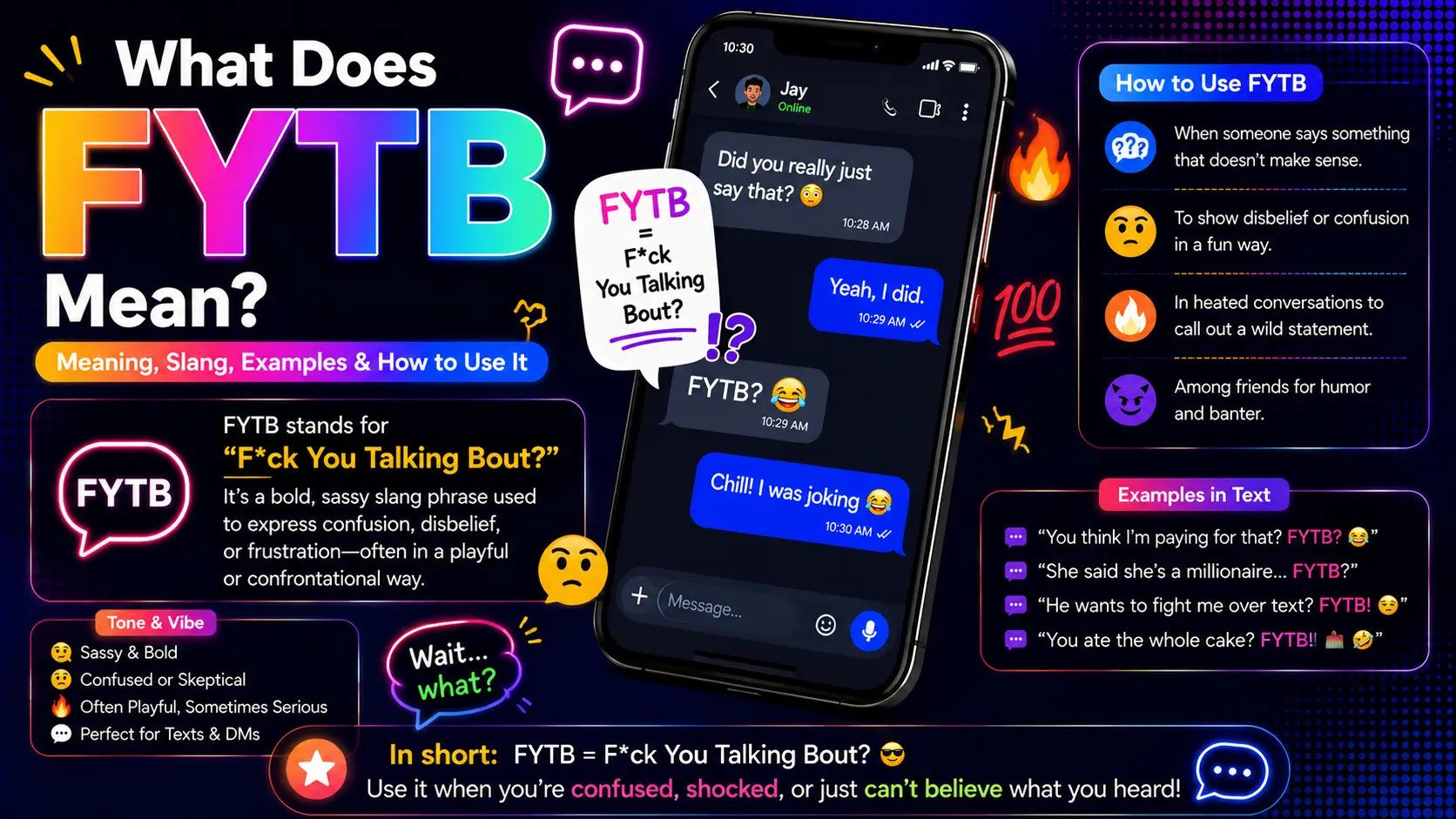
If you have seen FYTB in a text, Instagram DM, TikTok comment, or group chat, you may have wondered, “What does FYTB mean?” In most informal online conversations, FYTB is a shortened form of “What the fuck you talking ’bout?” or “Fuck you talking ’bout?” It is usually used to express confusion, disbelief, disagreement, or a challenge.
The important part is the tone. FYTB can be playful between close friends, but it can also sound rude, aggressive, or confrontational when used with someone you do not know well. Understanding the surrounding conversation is the easiest way to tell what the sender actually means.
FYTB: Quick Meaning
FYTB is internet and texting slang that generally means “What are you talking about?” with strong or profane emphasis.
In simple terms, someone may use FYTB when they think what you said is:
- Confusing
- Incorrect
- Unexpected
- Exaggerated
- Hard to believe
- Worth challenging
The phrase is commonly written as FYTB, fytb, or occasionally with punctuation such as “FYTB?” The lowercase and uppercase versions normally have the same meaning. Wiktionary identifies fytb as an internet and text-messaging initialism used to indicate confusion.
For example:
“FYTB? I never said that.”
“Bro, FYTB 😂 That cannot be serious.”
“FYTB, you know I was joking.”
In all three examples, the exact emotional meaning comes from the conversation.
Origin & Background
There is no single, universally documented origin for FYTB. It developed as part of informal spoken slang and later became easier to type as an abbreviation in online conversations.
The longer phrase behind it has been used as a forceful way of questioning someone’s statement. Internet users then shortened the expression, following the same pattern seen with many other texting abbreviations.
Social media helped make expressions like FYTB more visible. Short, emotionally charged phrases work particularly well in comment sections, group chats, memes, gaming conversations, and quick reactions.
Older slang often existed primarily in speech, while today’s internet culture turns those expressions into compact written forms. FYTB is a good example of that transition.
There are also multiple informal interpretations of the same four letters in user-generated slang dictionaries. However, the most consistently documented texting meaning is the “what are you talking about?” sense.
That distinction matters because slang does not always behave like formal vocabulary. People can create their own meanings inside friend groups, fandoms, gaming communities, or private chats.
SA Meaning: What Does SA Mean in Text, Slang, and Social Media
Real-Life Conversations
Seeing FYTB in an actual conversation makes its meaning much easier to understand.
WhatsApp Conversation
Person A:
I think you secretly like that song.
Person B:
FYTB 😂 You know I can’t stand it.
Here, FYTB is playful. Person B is not necessarily angry. The laughing emoji makes the reaction feel more like teasing disbelief.
Instagram DM
Person A:
You told everyone I was leaving the group.
Person B:
FYTB? I literally said I needed a break.
In this situation, FYTB sounds more defensive. Person B is challenging the accusation and asking why Person A believes it.
TikTok Comment
Person A:
Nobody listens to this artist anymore.
Person B:
FYTB 😭 The whole comment section is singing along.
Here, FYTB expresses disagreement and disbelief. It is closer to saying, “What are you talking about? Look around.”
Text Message
Person A:
I’m waking up at 5 every morning from now on.
Person B:
FYTB 😂 You barely wake up before 10.
This is a humorous use between people who know each other well. The phrase adds attitude to the joke.
Emotional & Psychological Meaning
FYTB is more than four letters. It often carries an emotional reaction that a simple “What?” does not.
Depending on the situation, it can communicate:
Disbelief:
The person thinks your statement sounds impossible.
Confusion:
They genuinely do not understand what you mean.
Defensiveness:
They believe you have accused or misunderstood them.
Disagreement:
They strongly reject your opinion.
Amusement:
Close friends may use it jokingly when something sounds ridiculous.
Challenge:
The sender may be pushing you to explain or defend your statement.
One interesting feature of modern texting is that people often need very few words to communicate attitude. FYTB can compress an entire reaction into four letters.
For example, imagine telling a friend, “I just bought another pair of sneakers.”
If they respond, “FYTB 😂”, you might immediately understand that they are joking about your shopping habit. If the same message appears during a serious argument, however, it can feel much harsher.
In everyday conversations, I have found that the relationship between the people matters almost as much as the abbreviation itself. Friends who regularly tease each other may see FYTB as funny. Someone unfamiliar may read it as an insult.
That is why interpreting slang requires more than knowing the dictionary definition.
Usage in Different Contexts
Social Media
FYTB is most natural in informal digital spaces such as TikTok comments, Instagram DMs, Snapchat conversations, gaming chats, and private group messages.
It can be used as a quick reaction to an opinion, joke, accusation, or surprising statement.
Example:
“FYTB 😂 That is definitely not the best movie ever.”
Friends & Relationships
Close friends may use FYTB without intending serious hostility.
Example:
“FYTB, you said you were staying home tonight!”
The emotional tone depends on the relationship.
Work & Professional Settings
FYTB is generally not appropriate for professional communication.
Even if you intend it as a joke, the profanity and confrontational tone can make you sound disrespectful.
Instead of:
“FYTB, that report is not late.”
A professional response would be:
“I think there may be some confusion about the deadline.”
Casual vs. Serious Tone
The same abbreviation can have completely different emotional effects.
Casual:
“FYTB 😂 You’re actually going to wear that?”
Serious:
“FYTB. I never told you that.”
The first sounds teasing. The second can sound defensive or angry.
When NOT to Use It
FYTB is best avoided when you are unsure how the other person will interpret it.
Do not normally use it in:
- Job applications
- Professional emails
- Workplace discussions
- Customer service conversations
- Academic communication
- Conversations with strangers
- Serious conflicts where clarity matters
It is also worth considering cultural sensitivity. Slang can travel quickly online, but that does not mean every audience interprets it in the same way.
Someone who is familiar with American internet slang may recognize FYTB immediately. Another person may see only an unfamiliar abbreviation and assume it is an insult.
If the conversation is already tense, using FYTB may escalate the situation rather than clarify it.
Common Misunderstandings
1. Thinking FYTB Is Always Friendly
It is not.
Although friends may use it jokingly, FYTB can sound aggressive because the underlying phrase contains profanity.
2. Assuming It Has Only One Meaning
The “what are you talking about?” interpretation is the main texting meaning, but user-generated slang sources show that the same letters can occasionally be assigned other meanings.
Context should therefore come first.
3. Confusing It With Other Acronyms
FYTB can look similar to abbreviations such as FYT, FYM, or FYP, but these are not automatically interchangeable.
4. Ignoring Tone
A message saying “FYTB 😂” may be playful.
A message saying “FYTB.” during an argument can feel much more hostile.
5. Taking It Literally
The person may not literally be asking for a detailed explanation. Sometimes FYTB simply means:
“That makes no sense to me.”
The emotional reaction can be more important than the literal wording.
Comparison Table
| Expression | Meaning | Typical Tone | Common Use |
|---|---|---|---|
| FYTB | What are you talking about? | Strong, confused, challenging | Casual chats |
| WYM | What you mean? | Neutral | Texting |
| WTF | What the fuck? | Shocked, confused | Informal reactions |
| WTH | What the heck? | Milder surprise | Casual conversations |
| FR? | For real? | Surprised, doubtful | Social media |
| SMH | Shaking my head | Disapproval | Comments and texts |
| You serious? | Are you serious? | Doubtful | Everyday conversation |
| Say what? | What did you say? | Confused | Informal speech |
| No way | I cannot believe it | Surprised | Casual reactions |
| Explain that | Give me clarification | Direct | Serious or casual |
Key Insight
FYTB is stronger than simple clarification slang. It does not merely ask what someone means. Depending on the situation, it can challenge the statement, reject it, or react to it with disbelief.
Variations and Related Types
1. FYTB
Meaning: The standard abbreviation for the strong phrase behind “What are you talking about?”
Use: Common in informal texts, comments, and private chats.
2. fytb
Meaning: The lowercase version of FYTB.
Use: Often appears naturally in fast-paced texting where capitalization is ignored.
3. “What You Talking ’Bout?”
Meaning: The fuller informal expression behind the abbreviation.
Use: More conversational and easier for people unfamiliar with texting slang to understand.
4. WYM
Meaning: “What you mean?”
Use: A much softer way to ask for clarification.
5. WTF
Meaning: “What the fuck?”
Use: Expresses strong surprise, confusion, or disbelief, although it does not specifically mean “what are you talking about?”
6. WTH
Meaning: “What the heck?”
Use: A milder alternative when someone wants to express surprise without profanity.
7. FR?
Meaning: “For real?”
Use: Often signals doubt, surprise, or a request for confirmation.
8. SMH
Meaning: “Shaking my head.”
Use: Usually expresses disappointment, disbelief, or annoyance.
9. “You Serious?”
Meaning: “Are you actually serious?”
Use: Helpful when someone says something difficult to believe.
10. “Say What?”
Meaning: “What did you say?” or “What do you mean?”
Use: An informal reaction to confusion or surprise.
How to Respond When Someone Uses FYTB
Your response should match the tone rather than automatically becoming defensive.
Casual Replies
- “I’m serious 😂”
- “Hear me out.”
- “I said what I said.”
- “You heard me!”
- “Let me explain.”
Funny Replies
- “Exactly what you read 😂”
- “Don’t make me repeat myself.”
- “Google it, bestie.”
- “You know exactly what I mean.”
- “Stay with me here 😭”
Mature Replies
- “Let me explain what I meant.”
- “I think you misunderstood me.”
- “That is not what I was trying to say.”
- “Let me give you some context.”
Respectful Replies
- “I understand why that sounded confusing.”
- “Let me clarify.”
- “I may not have explained that clearly.”
- “Here is what I meant.”
A calm response can completely change the direction of a conversation, especially if FYTB was sent during an argument.
Regional & Cultural Usage
Western Culture
FYTB is most recognizable in informal American internet and texting culture. It can appear in social media conversations, memes, music-related discussions, gaming, and friend groups.
The phrase is particularly dependent on familiarity with informal American slang.
Asian Culture
In Asian countries where English is widely used online, FYTB may appear among younger users who regularly consume American social media, entertainment, gaming content, and internet culture.
However, familiarity with the abbreviation can vary significantly from one community to another.
Middle Eastern Culture
FYTB may appear in English-language social media, gaming communities, and international group chats. It is generally more likely to be understood by users who regularly interact with English-language online culture.
Global Internet Usage
Social media has made slang increasingly international. A phrase that began in one linguistic community can quickly appear in conversations thousands of miles away.
Still, global visibility does not guarantee universal understanding. The safest approach is to consider the audience before using strongly informal slang.
Gen Z vs. Millennials
Younger internet users may recognize FYTB quickly because of constant exposure to short-form content and evolving online slang.
Millennials who spend significant time on social media may understand it equally well, while people who use mostly formal communication may be unfamiliar with it.
Generational differences are therefore less about age alone and more about online habits and cultural exposure.
Is It Safe for Kids?
FYTB is not usually considered child-friendly because the expression it represents contains profanity and can sound confrontational.
A child may encounter it in a TikTok comment, game chat, group message, or social media post without understanding its tone.
The useful lesson is not simply to memorize the abbreviation. Children should learn that context, audience, and respectful communication matter.
For younger users, safer alternatives include “What do you mean?”, “Really?”, or “I don’t understand.”
FAQs
What does FYTB mean in text?
FYTB usually means “What are you talking about?” in a strong, slang-heavy form. It can express confusion, disbelief, disagreement, or challenge.
Is FYTB a bad word?
FYTB itself is an abbreviation, but the phrase it represents contains profanity. As a result, it can be considered rude or inappropriate in formal situations.
Is FYTB rude?
It can be. Among close friends, it may be playful, but during an argument or with someone unfamiliar, it can sound aggressive or disrespectful.
What does FYTB mean on TikTok?
On TikTok, FYTB is generally used as a quick reaction meaning “What are you talking about?” It may express disbelief, disagreement, sarcasm, or confusion.
Can FYTB be used jokingly?
Yes. Friends sometimes use FYTB humorously, especially when the surrounding message contains laughing emojis or obvious teasing.
Should I use FYTB at work?
Generally, no. The slang and profanity make it unsuitable for most professional conversations. A clearer phrase such as “Could you clarify what you mean?” is safer.
What is a polite alternative to FYTB?
Try “What do you mean?”, “Could you explain that?”, “I’m not sure I understand,” or “Are you serious?” depending on the situation.
Conclusion
So, what does FYTB mean? In most texting and social media contexts, it is a slang abbreviation for a strong version of “What are you talking about?” It can communicate confusion, disbelief, disagreement, defensiveness, or playful disbelief.
The most important thing to remember is that FYTB does not have one emotional tone. A laughing emoji and a close friendship can make it playful, while the same four letters during an argument can feel openly confrontational.
That is the bigger lesson behind internet slang. Understanding the letters is only the first step. Understanding the person, situation, relationship, and tone is what helps you communicate confidently.