Extol vs Extoll: Understanding the Difference and Correct Spelling
If you have ever paused while writing the word “extol,” you may have wondered whether the correct spelling is extol or extoll. The difference is only one letter, but choosing the right form matters when you want your English to look polished and professional.
The confusion becomes even stronger because English uses extolled and extolling, both of which contain two Ls. As a result, many writers naturally assume that “extoll” must also be the correct base form.
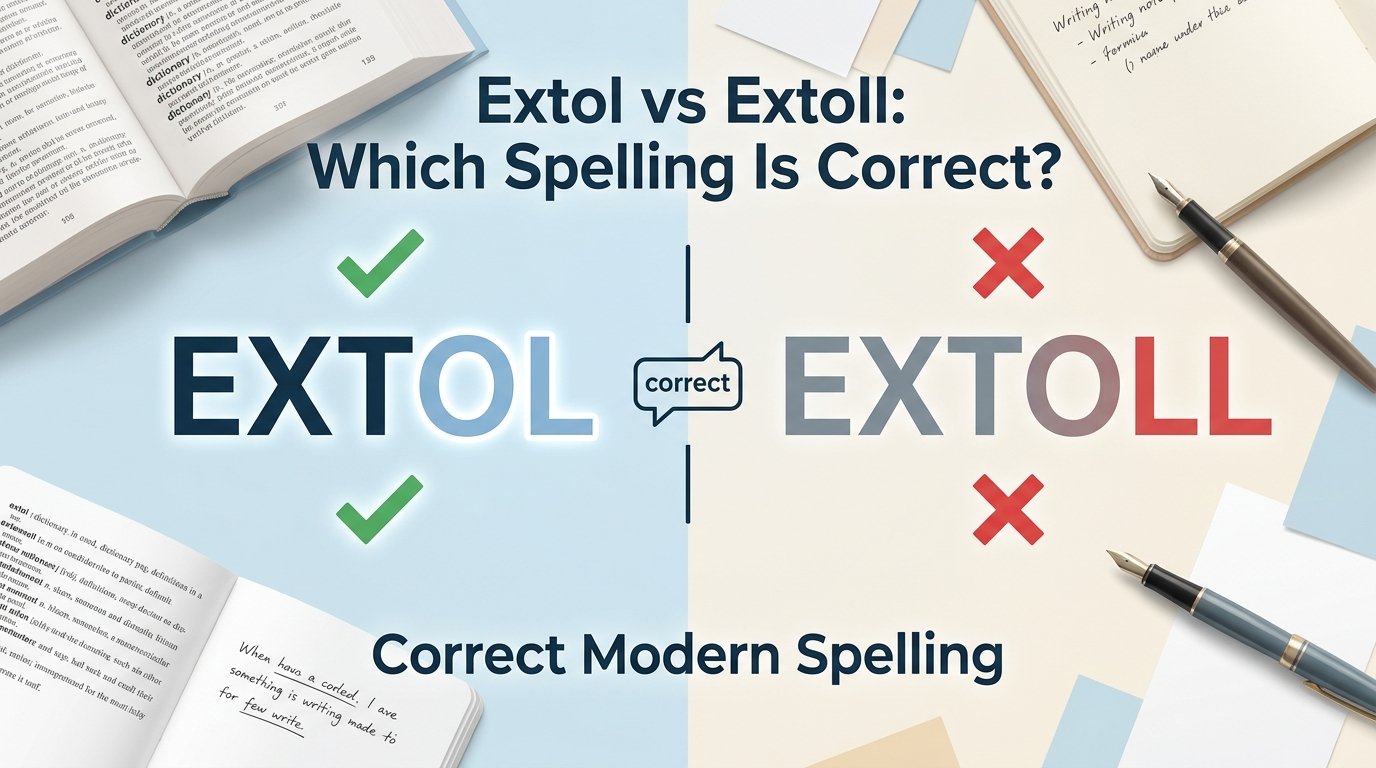
In modern English, however, extol is the standard spelling. It is a verb that means to praise someone or something enthusiastically. The spelling “extoll” is generally considered an incorrect or obsolete variant in contemporary standard English.
Understanding Extol vs Extoll can help you improve your spelling, vocabulary, grammar, and overall writing accuracy. Let’s explore the difference, meaning, origins, examples, and common mistakes in detail.
Extol vs Extoll: Why Does the Confusion Exist?
The main reason for the confusion is the way English verbs change when certain endings are added.
The standard base verb is extol. When you add “-ed,” it becomes extolled.” When you add “-ing,” it becomes extolling.”
Seeing these forms can make writers believe that the extra L should also appear in the base word.
For example:
- Base form: extol
- Past tense: extolled
- Present participle: extolling
- Third-person singular: extols
This spelling pattern is not unique to extol. English sometimes doubles a final consonant when adding particular endings.
For instance, “control” becomes “controlled,” while “patrol” becomes “patrolled.” Therefore, the double L in “extolled” does not mean that the base word is “extoll.”
Why It Matters in Professional Settings
Correct spelling becomes especially important in professional writing. Emails, reports, academic papers, articles, presentations, and business documents all require clear language.
Using extoll instead of extol may distract readers or make your writing appear less polished. Although the intended meaning can usually be understood from context, correct spelling supports clarity and credibility.
Professional communication does not always require sophisticated vocabulary. In fact, choosing a precise word and spelling it correctly is often more valuable than using complicated language.
Extol vs Extoll: Which One Is Correct?
Extol is the standard modern spelling.
The verb means to praise someone or something enthusiastically, often by highlighting impressive qualities, achievements, benefits, or contributions.
For example:
Critics extol the director’s creative storytelling.
Here, “extol” means that the critics praise the director’s storytelling strongly.
By comparison, “extoll” is not the standard spelling you should normally use in modern English. It may appear in historical or older texts, but contemporary writers should generally choose extol.
| Word | Status | Meaning | Recommended Today |
|---|---|---|---|
| Extol | Standard | Praise enthusiastically | Yes |
| Extoll | Rare/obsolete variant | Same basic meaning | Generally no |
| Extolled | Correct past form | Praised enthusiastically | Yes |
| Extolling | Correct -ing form | Praising enthusiastically | Yes |
| Extols | Correct third-person form | Praises enthusiastically | Yes |
So, if you’re asking about the difference between extol and extoll, the practical answer is simple: use “extol” as the modern base form.
What Does “Extol” Mean? Origins, Definition, and Usage
Definition of Extol
Extol is a verb meaning to praise someone or something highly or enthusiastically.
The word usually expresses stronger admiration than ordinary words such as “like” or “approve.”
For example:
- The critics extol the actor’s performance.
- Experts extol the benefits of renewable energy.
- The professor extolled her student’s dedication.
- Fans extol the singer’s powerful voice.
The word can describe admiration for achievements, qualities, ideas, products, people, values, or accomplishments.
Its tone is usually formal, expressive, or literary. Therefore, it often appears in journalism, academic writing, speeches, book reviews, and professional commentary.
Origins of the Word “Extol”
The history of extol helps explain its modern meaning.
The word comes from the Latin verb extollere, which carried the idea of raising or lifting something up. Over time, the physical idea of lifting developed into a figurative meaning: raising someone’s reputation or status through praise.
This connection still makes sense today.
When you extol someone, you metaphorically “lift them up” by emphasizing their positive qualities or achievements.
The word entered English centuries ago and became established in literary, religious, and formal language. Historical texts often used it when describing praise directed toward people, virtues, or divine figures.
Why Extol Is a Common Misspelling
One major reason writers misspell the word is its verb forms.
When you see:
- extolled
- extolling
the two Ls are clearly visible. A writer may then assume the base form must be “extoll.”
That assumption is understandable but incorrect in modern standard English.
Another reason involves comparison with other English words that genuinely end in double consonants. Since English spelling has many exceptions and patterns, learners may rely on visual memory rather than checking the base form.
The easiest solution is to remember that the standard base verb has one L: extol.
Exploring the Significance of “Extol” in Professional Language
Although “extol” is not a technical term, it has an important role in formal communication because it expresses strong approval in a concise way.
A journalist might write that analysts extol a company’s innovative strategy. An academic writer might say scholars extol a researcher’s contribution. A reviewer could extol a novel’s storytelling.
The word works particularly well when ordinary “praise” feels too general.
Role of “Extol” in Formal Writing
In professional and academic settings, word choice can influence tone.
“Praise” is simple and widely understood. “Extol” sounds more formal and suggests enthusiastic admiration.
Consider these examples:
Simple:
The researchers praised the scientist’s contribution.
More formal:
The researchers extolled the scientist’s contribution.
Neither sentence is grammatically wrong. The second simply creates a stronger and more formal tone.
Still, writers should avoid using sophisticated vocabulary merely to sound intelligent. If “praise” communicates the idea more naturally, it may be the better choice.
Common Reasons for the “Extol” Misspelling
Several factors can cause confusion between extol or extoll.
The first is the spelling of its inflected forms. “Extolled” and “extolling” contain double Ls, which can create a misleading visual association.
The second involves pronunciation. The words sound essentially the same, so pronunciation cannot help you distinguish the spelling.
A third reason is unfamiliarity. “Extol” is less common in everyday conversation than “praise,” meaning writers may encounter it mainly in formal or literary contexts.
Finally, writers sometimes remember words by appearance rather than by their grammatical forms. Learning the complete verb pattern makes the distinction much easier.
Side-by-Side Comparison: Extol vs Extoll
| Feature | Extol | Extoll |
|---|---|---|
| Standard modern spelling | Yes | No |
| Word type | Verb | Variant/obsolete form |
| Meaning | Praise enthusiastically | Same historical meaning |
| Common today | Yes | Rare |
| Used in formal writing | Yes | Generally avoided |
| Past form | Extolled | — |
| -ing form | Extolling | — |
The important point is that the spelling changes when the verb receives certain endings. The extra L belongs to forms such as “extolled” and “extolling,” not to the standard base form.
Therefore, if you’re trying to how to spell extol or extoll, remember this simple pattern:
Extol → Extolled → Extolling → Extols
That sequence makes the spelling easier to remember.
Everyday Examples of “Extol” in Language
Seeing the word in context is one of the best ways to understand its usage.
Here are several natural examples:
- The critics extol the film’s powerful storytelling.
- Experts extol the benefits of regular exercise.
- Fans extol the athlete’s determination.
- The article extols the advantages of clean energy.
- Economists extol the company’s sustainable business model.
- The professor extolled her student’s academic achievement.
- Reviewers extol the author’s ability to create memorable characters.
Notice that “extol” usually has a direct object. Someone extols a person, quality, achievement, idea, benefit, or thing.
A useful sentence structure is:
Subject + extol + object
For example:
Analysts extol the company’s innovative approach.
This structure makes the meaning clear and natural.
“How to Spell Extol” and Remember the Correct Spelling
If you want to know how to spell “extol or extoll”, the answer is extol for the standard modern base verb.
A simple memory trick is to separate the base form from its changed forms:
Extol = base form
Extolled = past tense
Extolling = present participle
Extols = third-person singular
The extra L appears when “-ed” or “-ing” is added.
You can also connect the meaning to the spelling. Think:
Extol = praise highly.
Whenever you’re unsure, ask yourself whether you’re writing the base verb or a changed form.
Practice Sentences
Try reading these sentences aloud and notice the different forms:
The critics extol the director’s creativity.
The critics extolled the director’s creativity.
The critics are extolling the director’s creativity.
The critics often extol the director’s creativity.
These examples show why extol and extolled should not be treated as separate base spellings.
Literature and Media Mentions: Correct Usage of “Extol”
The word “extol” has a long history in literary and formal language.
It has appeared in religious texts, poetry, classic literature, newspapers, essays, speeches, and modern journalism.
Literary writers often choose it because it communicates admiration with more intensity than a basic verb such as “like.”
Modern media also uses the word when journalists want to describe strong approval. For example, an article may report that analysts extol a company’s new technology or that critics extol an actor’s performance.
The word remains useful because it combines brevity with a formal tone.
However, context still matters. In a casual conversation with a friend, “praise” or “admire” may sound more natural. In an editorial or academic discussion, “extol” can fit comfortably.
Related guides: Attornies vs Attorneys: Meaning, Spelling and Usage · Flys vs Flies: Meaning, Spelling, and Correct Usage · Nominator vs Nominee: Meaning, Roles and Examples
Frequently Asked Questions About Extol vs Extoll
What’s the correct way to spell “Extol”?
The correct modern spelling is extol with one L. Its past and participle forms are extolled and extolling, which contain two Ls.
Is “Extoll” a French word?
No. Extol comes from Latin extollere. “Extoll” may appear historically, but modern standard English generally uses extol as the base form.
Why is spelling “Extol” correctly important?
Correct spelling improves clarity, credibility, and professionalism. Using extol correctly also helps readers understand your writing without being distracted by an unusual or incorrect spelling.
What does “Extol” mean in English?
Extol means to praise someone or something enthusiastically. It usually suggests strong admiration and commonly appears in formal, literary, academic, and professional contexts.
What is the past tense of “Extol”?
The past tense is extolled. The double L appears because the verb takes the “-ed” ending, while the standard base form remains extol.
Conclusion: Why It’s Important to Spell “Extol” Correctly
Choosing between extol vs extoll becomes easy once you understand the grammar behind the spelling. Extol is the standard modern base form and means to praise enthusiastically or express strong admiration. The spelling extoll is generally not used as the standard modern form. Confusion often happens because the correct forms extolled and extolling contain two Ls. Remembering this pattern can prevent mistakes and improve your writing. Whether you’re writing an academic paper, professional report, article, review, or formal email, using extol correctly helps your language remain clear, accurate, and polished.