HBU Meaning in Text: What Does HBU Mean?
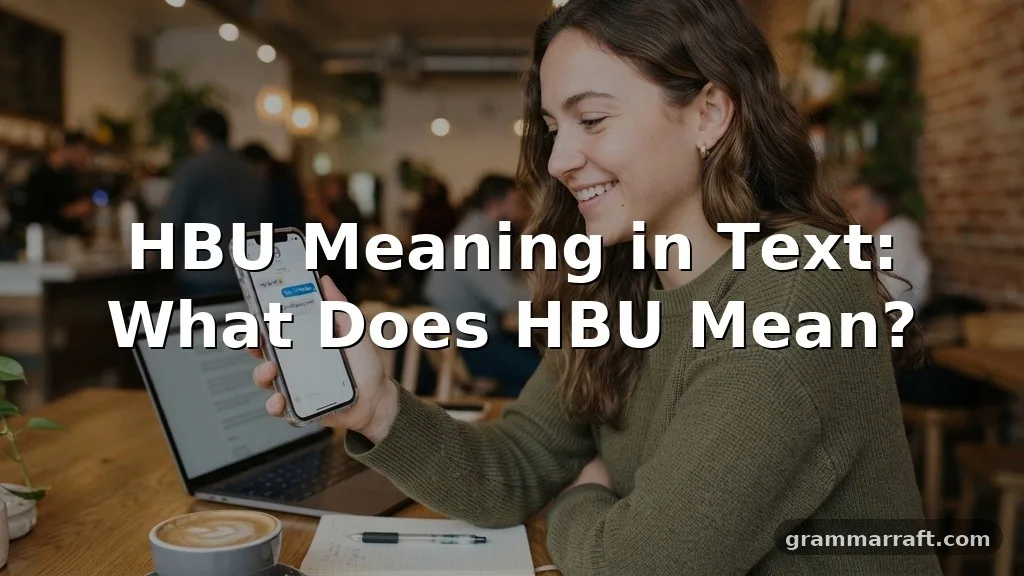
HBU meaning in text is simple: “How about you?” It’s a common chat abbreviation used after someone shares an answer, opinion, feeling, or update and wants the other person to respond in kind.
For instance, “I’m doing well, hbu?” means “I’m doing well; how about you?” The wording is casual, but the tone can shift with context, relationship, and punctuation. Knowing those small differences makes it easier to understand HBU in a reply, recognize what someone intends, and answer naturally.
What Does HBU Mean in Text?
HBU is an abbreviation for “How about you?” People use it in text messages, instant messaging, online dating, social media comments, and casual workplace chats. It usually returns a question to the other person rather than introducing a completely new subject.
Someone might write, “I’m from Chicago. HBU?” They’re asking where you’re from. If they say, “I’m tired after class, hbu?” they want to know how you’re feeling.
The abbreviation can follow almost any personal response. It often appears after a statement about someone’s mood, location, plans, preferences, or background.
- “I’m watching a movie, hbu?” asks what you’re doing.
- “I’m a junior in college. HBU?” asks about your school status.
- “I love Thai food. HBU?” asks about your preference.
- “My day was hectic. How about you?” expresses the same idea without an abbreviation.
HBU is not normally a hidden code or a special romantic signal. It is usually a quick way to keep a conversation balanced and moving.
| Phrase | Meaning | Typical setting |
|---|---|---|
| HBU? | How about you? | Texting, chat, social media |
| And you? | A direct return question | Casual or neutral conversation |
| What about you? | A slightly fuller version | Conversation and writing |
| How about yourself? | A more polished return question | Professional or polite exchanges |
Is HBU Correct English?
HBU is understandable and widely used texting slang. It isn’t a standard formal-English phrase, but that doesn’t make it meaningless or incorrect within its intended setting. Like “LOL,” “BRB,” and “IDK,” it belongs to a system of informal text message abbreviations.
The full expression, “How about you?” is grammatically correct. HBU is simply a shortened written form used for speed, convenience, and conversational tone. In a text or private chat, using it is generally natural.
That distinction matters. A word or abbreviation can work perfectly in casual online communication and still be unsuitable for a formal letter, academic paper, legal document, or client-facing message.
Capitalization and punctuation

People write HBU in several ways: HBU, hbu, or occasionally “Hbu.” All three are recognizable, although lowercase “hbu” is especially common in fast texting.
Use a question mark when the abbreviation is a direct question: “I’m free tonight, hbu?” In a quick exchange, some people omit punctuation, but “HBU?” is clearer and easier to read.
It can also appear in a longer sentence: “I’m not sure about the new schedule—hbu?” In formal writing, replace it with “How about you?” rather than trying to make the abbreviation look more official.
HBU versus “How about you?”
These expressions mean the same thing, but they create different impressions. “How about you?” sounds complete and natural in speech, while HBU feels faster, lighter, and more associated with texting slang.
Compare “I’m available after three. How about you?” with “I’m free after 3, hbu?” The first could fit a polite professional conversation. The second sounds like a casual text message.
For a useful overview of common text abbreviations and their standard meanings, consult this reference on texting abbreviations.
How People Use HBU in Chat
HBU usually works as a conversational handoff. One person gives information, then uses the abbreviation to invite the same kind of information from the other person.
That makes it a practical tool for keeping a chat from becoming one-sided. If someone asks, “What are you studying?” you might answer, “I’m majoring in biology, hbu?” Here, HBU means “What are you studying?” because the surrounding context supplies the specific question.
HBU in a reply
When HBU appears in a reply, read the message immediately before it. The abbreviation normally refers back to the same topic, but not always word for word.
Suppose the exchange is:
“Do you like living here?”
“Yeah, I do. HBU?”
The second person is returning the question. But if the exchange is “I’m heading home after work. HBU?” then the implied question is probably “What are you doing?”
Context prevents most confusion. If the topic has changed several times, answer the most recent clear subject or ask, “Do you mean how I’m feeling or what I’m doing?”
HBU meaning from a girl or guy
Searches for HBU meaning from a girl or HBU meaning from a guy often reflect uncertainty about romantic intent. In most cases, HBU has the same basic meaning regardless of who sends it: “How about you?”
The abbreviation alone doesn’t prove flirting, attraction, boredom, or disinterest. A person may use it because they’re being polite, trying to continue a conversation, or genuinely curious about your answer.
Romantic meaning comes from the broader exchange. Frequent follow-up questions, personal details, playful language, and attempts to make plans provide more information than HBU itself.
HBU in college and business
HBU meaning in college depends on what was discussed. In a student group chat, “I’m taking two classes this summer, hbu?” could ask about someone’s course load. In a conversation about housing, it might ask where the person lives.
HBU meaning in business is more limited because professional communication often calls for clearer wording. A coworker might write “I’m available at 2 p.m., hbu?” in an informal team chat, but a new client should usually receive “How about you?” or a direct scheduling question.
Is HBU Professional?
HBU can be acceptable in a relaxed workplace chat, but it isn’t a universally professional choice. Its suitability depends on the organization, the communication channel, your relationship with the recipient, and the seriousness of the subject.
A close coworker may appreciate “I’m logging off soon, hbu?” A customer or senior executive may expect a complete sentence instead. The issue is not grammar alone; it is audience appropriateness.
Professional writing usually benefits from precision. “How about you?” takes only a moment longer than HBU and avoids any uncertainty about tone.
| Recipient | HBU suitability | Safer wording |
|---|---|---|
| Close coworker | Usually fine in chat | “How about you?” |
| Entire workplace team | Depends on team culture | “How is everyone doing?” |
| Manager or boss | Fine in an informal relationship | “And how about you?” |
| New professional contact | Best avoided | “How about yourself?” |
| Client or customer | Usually too casual | “How has your week been?” |
HBU to a boss or manager
You can say HBU to a boss or manager if the relationship is relaxed and the channel is informal. For example, after your manager says, “I’m hoping to get outside this weekend,” a friendly reply could be, “Same here—hbu?”
In a formal email, performance discussion, or sensitive work conversation, write the full phrase. “I’m available Thursday afternoon; how about you?” sounds polished without being stiff.
HBU to a client or customer
HBU is generally not the best choice for a client or customer, especially during a sales, support, finance, or legal exchange. It may sound overly familiar or suggest that the message was written too quickly.
Professional Friday greetings for clients can still be warm: “I hope your week is going well,” “I hope you have a pleasant weekend,” or “Thank you for your time this week.” These phrases build goodwill without assuming a casual relationship.
How to Respond to HBU
To respond to HBU, answer the implied question directly and add a return question if you want the conversation to continue. There’s no special formula.
If someone writes, “I’m grabbing coffee, hbu?” you could say, “I’m making tea at home. What kind of coffee did you get?” A short answer is fine when the conversation is brief, but a detail gives the other person something to respond to.
Simple HBU reply examples
- “I’m doing pretty well too.” Use this when the topic is mood or general well-being.
- “I’m at work until six. What are you up to afterward?” Use this for plans.
- “I’m studying marketing. Are you still in engineering?” Use this for school or career topics.
- “I prefer coffee, especially cold brew.” Use this when someone asks about a preference.
- “I haven’t decided yet. Any suggestions?” Use this when the question involves plans or choices.
When deciding how to respond to HBU from someone you like, focus on the conversation rather than decoding the abbreviation. A warm answer with one genuine follow-up question usually communicates more interest than a carefully engineered phrase.
HBU reply to a girl or guy
An HBU reply to a girl or an HBU reply to a guy can be playful, direct, or neutral. Match the tone already established instead of assuming romantic interest.
For a friendly exchange, try “I’m having a quiet night—what about you?” For a flirtier conversation, “I was going to ask you the same thing. Want to compare plans over coffee?” makes the intention clearer than HBU alone.
If you don’t want to continue, a polite answer can close the exchange: “I’m good, thanks.” You don’t owe a second question every time someone uses HBU.
Alternatives to HBU
Other ways to say HBU range from very casual to distinctly professional. Choose the wording based on what you’re actually asking, because “How about you?” can be broader than “What are you doing this weekend?”
| Alternative | Tone | Best use | What it asks |
|---|---|---|---|
| And you? | Neutral and concise | Everyday conversation | The same question just discussed |
| What about you? | Friendly and natural | Texting or speech | A broad return question |
| How are things with you? | Warm and personal | Friends, family, colleagues | General well-being |
| How about yourself? | Polished and courteous | Professional conversations | The recipient’s corresponding answer |
| What are your plans? | Specific and direct | Scheduling and social chat | Upcoming activities |
“And you?” is often the safest short substitute. “What about you?” feels slightly more conversational, while “How about yourself?” can sound more deliberate and respectful.
Professional alternatives
Professional alternatives to HBU include “How has your week been?”, “How are things on your end?”, and “Do you have similar availability?” The best option depends on whether you’re making small talk or gathering work information.
For a new contact, “I’m based in Denver—how about yourself?” is natural and courteous. For a client, “I hope the week has been going smoothly on your end” is warmer than a bare return question.
Casual alternatives
Casual Friday greetings and everyday alternatives can be shorter: “And you?”, “What about you?”, “You?”, or “What are you up to?” Close friends may also use “How’s your Friday going?” and “Any plans for the weekend?”
These alternatives aren’t interchangeable in every situation. “You?” is efficient but can seem abrupt in writing, while “How’s your Friday going?” specifically asks about the present day.
HBU in Friday Messages and Work Communication
Friday communication often mixes practical information with a lighter tone. HBU may fit a team chat, but a complete phrase is usually better in an email, especially if the message concerns deadlines, deliverables, or clients.
Friday email greetings
A Friday email greeting should match the purpose of the message. If you’re opening a formal business email, use the recipient’s name and move quickly to the subject rather than forcing a cheerful phrase into the first line.
For a client, write: “Hello Maya, I hope your week has gone well. I’m sending the revised proposal for your review.” This is friendly without sounding as though the email is only making small talk.
For an internal colleague, “Happy Friday, Jordan—thank you for sending those figures over” can work if your workplace commonly uses end-of-week greetings. A more neutral version is “Hi Jordan, thanks for sending the figures. I’ve reviewed the first section.”
Messages for teams
Friday messages for teams should recognize the group without implying that everyone feels the same way about the weekend. “Thanks for the strong finish this week. Please review the final notes before logging off” combines appreciation with a useful reminder.
Motivational Friday messages can also be specific: “We closed the remaining support tickets and delivered the client draft ahead of schedule. Let’s finish the last review carefully.” Concrete recognition sounds more sincere than exaggerated enthusiasm.
Chat, WhatsApp, and text examples
Friday WhatsApp and chat messages can be more relaxed. “Happy Friday, everyone! Is anyone joining the team lunch?” is suitable for an informal group, while “Hope everyone has a good weekend—please post urgent updates before 4” keeps a workplace group organized.
For a friend, “Happy Friday! I’m ready to shut my laptop and disappear into weekend mode.
What are you doing tonight?” sounds personal and natural. For family, “Hope you’re having a peaceful Friday—are you coming by Sunday?” adds warmth and a clear practical question.
Friday Greetings by Tone and Audience
There is no single best Friday greeting. The right phrase reflects the relationship and the amount of emotional energy appropriate to the setting.
Formal and professional
Formal Friday greetings include “I hope you have a pleasant Friday,” “Wishing you a productive end to the week,” and “I hope you enjoy a restful weekend.” These work in business correspondence, though they shouldn’t replace the actual purpose of the message.
“Wishing you a productive Friday” is useful before a deadline but may sound odd after the workday is essentially over. “Have a pleasant weekend” is better for a Friday afternoon sign-off.
Friendly and warm
Friendly Friday messages include “Hope your Friday is going well,” “Enjoy your Friday,” and “Have a wonderful Friday.” They show goodwill while remaining less familiar than a joke or an emoji-heavy message.
With coworkers, “Happy Friday! You made it through a busy week” can be supportive. With a friend, “Weekend vibes are starting early over here” is more personal and playful.
Funny and creative
Funny Friday greetings work best when the audience already shares your sense of humor. “Happy Friday—the inbox can wait five more minutes” may get a laugh from a close coworker, but it’s not suitable for a customer.
Other playful options include “May your coffee be strong and your meetings be short,” “Friday has entered the chat,” and “We’re one calendar page away from freedom.” Avoid humor that mocks a person’s workload, implies poor productivity, or sounds like you want to abandon responsibilities.
TGIF
TGIF means “Thank God It’s Friday.” It expresses relief or excitement that the workweek is ending. The phrase is familiar and often playful, but it can sound more informal and more openly anti-work than “Happy Friday.”
Use TGIF with friends, close coworkers, or an informal social media audience. In a client email or a message to a new professional contact, “I hope you have a great weekend” communicates the same positive feeling with less risk.
Friday Greetings for Social Media
Friday social media captions can be brief because the image or video supplies much of the context. “Weekend vibes,” “Happy Friday,” and “Friday feeling” are broad captions that work for many personal posts.
A professional platform such as LinkedIn calls for more substance. “Happy Friday—grateful for the team that helped us complete this launch ahead of schedule” connects the greeting to a real accomplishment.
Informal social media allows more personality: “Friday arrived just in time,” “Clocked out and entering weekend mode,” or “A little sunshine for the end of the week.” These phrases are present-focused, while “Have a great weekend” looks ahead.
- Professional LinkedIn: “Wishing everyone a productive close to the week and a restful weekend.”
- Personal Instagram: “Weekend vibes are officially here.”
- Community group: “Happy Friday! What’s everyone getting into this weekend?”
- Work announcement: “Happy Friday—thank you to everyone who helped meet today’s deadline.”
Don’t add a cheerful Friday caption to a post about a serious event unless the connection is clear. Tone depends on the surrounding message, not just the words “Happy Friday.”
Happy Friday Versus Have a Great Weekend
“Happy Friday” and “Have a great weekend” overlap, but they don’t mean exactly the same thing. The first acknowledges the current day; the second offers a good wish for the time that follows.
| Expression | Focus | Typical timing | Emotional effect |
|---|---|---|---|
| Happy Friday | The present day | Morning through Friday afternoon | Cheerful acknowledgment |
| Enjoy your Friday | The rest of Friday | Any point during the day | Warm and personal |
| Have a great weekend | The coming weekend | Usually Friday afternoon or evening | Polite farewell or sign-off |
| Finish the week strong | Remaining work | Before a deadline or close of business | Motivational |
You can combine them naturally: “Happy Friday! Have a great weekend when you wrap up.” That message recognizes the day and offers a forward-looking farewell.
For a client email, “I hope you have a great weekend” may be more useful than “Happy Friday” because it fits the closing. For a morning team chat, “Happy Friday, everyone” is a natural opening.
Common Mistakes With HBU and Friday Greetings
The most common mistake is using an abbreviation with an audience that expects formal communication. HBU may be clear, but clarity is only one part of professional tone.
A second problem is forcing enthusiasm. Repeated exclamation marks, exaggerated claims about the “best Friday ever,” or jokes about avoiding work can feel artificial in a business setting.
Watch the context
Don’t answer HBU with unrelated information unless you’re deliberately changing the subject. If someone asks how your day is going, “I’m good—just finishing a report. How’s yours?” makes the connection obvious.
Be careful with sensitive topics, too. A cheerful Friday greeting may be inappropriate if the recipient has just shared bad news, a deadline problem, or a serious personal concern.
Choose the right level of detail
“HBU?” can feel like a conversation shortcut. If someone has written a thoughtful message, reply with more than one word. A specific response shows that you read what they said.
Likewise, don’t turn a simple workplace greeting into a long personal update. “I’m doing well, thanks. I hope your week is going smoothly” is enough for a professional exchange.
Remember regional and generational differences
HBU is common in American texting slang and widely understood in many English-speaking online spaces. Still, not every reader uses the same chat abbreviation, particularly in international, multilingual, or formal settings.
If your audience may not recognize HBU, write “How about you?” There’s no benefit in making a recipient decode a phrase that takes only three additional words to spell out.
Copy-Ready HBU and Friday Examples
The examples below are designed for specific situations rather than as interchangeable phrase lists. Adjust the names, details, and level of warmth to fit the relationship.
For a close coworker
“I’m heading out after this last call—hbu? Any plans tonight?” This sounds relaxed and keeps the question focused on plans.
For an entire workplace team
“Happy Friday, team. Thank you for getting the client materials out on time; please add any urgent updates to the board before signing off.” The greeting is upbeat, but the reminder remains clear.
For a manager or boss
“I’ve completed the report and sent it to the shared folder. I’m planning a quiet weekend—how about you?” This is appropriate when the relationship supports light personal conversation.
For a new professional contact
“I’m based in Seattle and work with the partnerships group. How about yourself?” The full phrase feels polished and invites a reciprocal introduction.
For an existing client
“Thank you for your feedback on the draft. I’ll incorporate the revisions Monday, and I hope you have a relaxing weekend.” This offers a professional Friday farewell without sounding overly familiar.
For a close friend
“Happy Friday! I’m officially done with errands and ready for something fun. What are you up to?” The language is casual, warm, and specific.
For family
“Hope your Friday’s been good. I’m making dinner Saturday if you’d like to come over.” A personal invitation works better than a generic greeting by itself.
For WhatsApp or group chat
“Friday check-in: who’s free for lunch, and who’s already in weekend mode?” This gives a group an easy way to participate.
For a business email
“Hello Daniel, I hope your week has gone well. Attached is the updated agreement for your review. Please let me know if you have any questions, and have a great weekend.”
For LinkedIn
“Wishing our project team a strong finish to the week. The latest release reflects careful work across design, engineering, and support.” This is more credible than a generic motivational slogan.
For an informal social post
“Happy Friday—sunshine, a finished to-do list, and nowhere urgent to be.” It is concise, visual, and clearly personal.
FAQ About HBU Meaning in Text
Is HBU correct?
HBU is a widely understood informal abbreviation for “How about you?” It is appropriate in texting and casual chat, but the full phrase is better for formal or client-facing writing.
What is another way to say HBU?
You can write “How about you?”, “What about you?”, or “And you?” Choose the version that matches the conversation. “How about yourself?” is a more polished option.
Can I say HBU to my boss?
Yes, if your workplace relationship is informal and you’re using a casual chat channel. In a formal email, performance conversation, or sensitive matter, write “How about you?” instead.
Can I say HBU to a client?
It’s usually better to avoid HBU with a client or customer. Use “How has your week been?” for small talk or “Do you have similar availability?” when discussing a schedule.
What does TGIF mean?
TGIF means “Thank God It’s Friday.” It conveys relief that the workweek is ending and is generally more casual than “Happy Friday.” It fits friends, close coworkers, and informal social posts better than formal business messages.
Related guides: IMA Meaning in Text: What Does IMA Mean? · What Does OHB Mean in Text? Meaning & Examples · HMU Meaning in Text: Definition, Tone and Replies
Conclusion
HBU meaning in text is straightforward: it means “How about you?” The abbreviation is natural in casual conversation, but the full phrase is safer for clients, new contacts, formal email, and audiences that may not use texting slang.
Use the same principle for Friday greetings: match the words to the relationship, channel, and purpose. “Happy Friday” works as a cheerful acknowledgment, while “Have a great weekend” works as a farewell. Choose a phrase that sounds like you, then add one specific detail when you want the conversation to continue.