What Does CSTM Mean in Text? Meaning, Uses, Examples & More
If someone sent you “CSTM” in a text, comment, or direct message, it can be confusing at first. Unlike common texting abbreviations such as “LOL” or “BTW,” CSTM is not universally understood, and its meaning can depend heavily on context.
In many online conversations, CSTM can be used as a shortened form of “custom,” especially when people are talking about personalized items, settings, designs, or choices. However, abbreviations can also be personal or community-specific, so the surrounding words matter.
Understanding what CSTM means in text helps you avoid reading the wrong emotion or intention into a short message. A two-second abbreviation can carry a surprisingly different meaning depending on whether it appears in a casual chat, social media comment, gaming conversation, or professional message.
CSTM Meaning in Text: Quick Answer
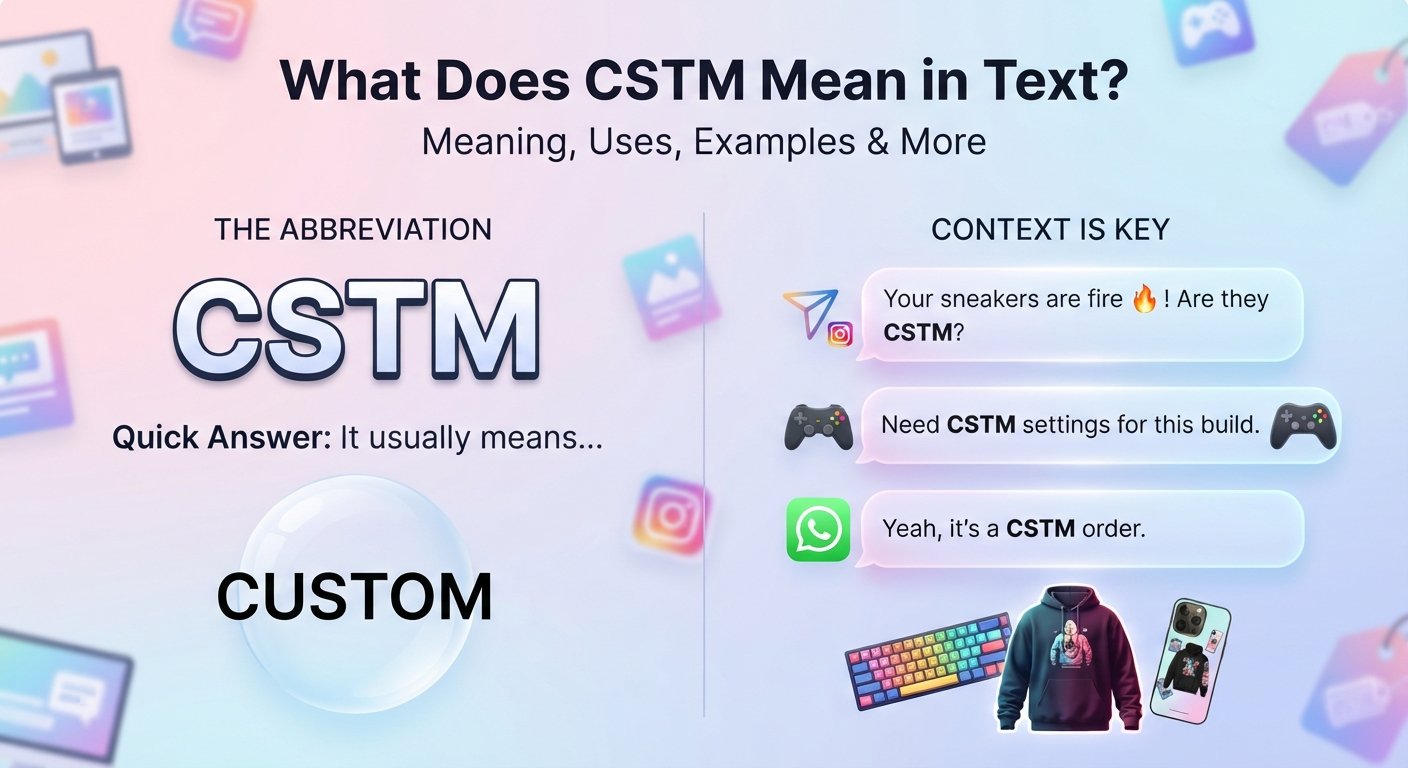
The most common interpretation of CSTM in text is “custom.”
It is often used when someone wants to describe something that has been personally made, modified, selected, or tailored.
For example:
- “I ordered a CSTM hoodie.”
Meaning: “I ordered a custom hoodie.” - “Can you make a CSTM version?”
Meaning: “Can you make a custom version?” - “Need CSTM settings for this.”
Meaning: “I need custom settings for this.”
The important point is that CSTM is usually an abbreviation rather than a slang word with a strong emotional meaning. The sentence around it tells you what the person actually means.
See Also: What Does WSGG Mean in Text? Full Meaning & Examples
Origin and Background of CSTM
CSTM comes from shortening the word “custom.” Online communication often removes vowels and unnecessary letters to make words quicker to type or fit within limited spaces.
This type of abbreviation is especially common in usernames, product descriptions, gaming communities, social media posts, and casual digital conversations.
The shortened form can also appear because “custom” is frequently used in digital and commercial language. People may talk about custom clothing, custom artwork, custom keyboards, custom settings, custom cars, or custom designs.
Over time, abbreviations like CSTM have become easier to recognize within specific communities.
Social media has accelerated this process. A creator, seller, gamer, designer, or online community may repeatedly use CSTM, and followers gradually understand it without needing the full word.
That does not mean everyone interprets it immediately. Unlike highly established texting abbreviations, CSTM remains context-dependent.
CSTM in Real-Life Conversations
The easiest way to understand the abbreviation is to see how it behaves in ordinary conversations.
WhatsApp Conversation
Person A:
“Did you get the shirt you ordered?”
Person B:
“Yeah, it’s a CSTM design. Turned out better than I expected.”
Here, CSTM clearly means custom because the conversation is about a personalized shirt.
Instagram DM
Person A:
“Your necklace is so pretty 😍”
Person B:
“Thank you! It’s CSTM. I picked the initials myself.”
In this context, CSTM refers to something custom-made or personalized.
TikTok Comment
Person A:
“Where did you get that keyboard?”
Person B:
“It’s CSTM. Built it myself.”
The abbreviation means custom, suggesting that the keyboard was personally assembled or modified.
Text Message
Person A:
“Are you buying the regular version?”
Person B:
“Nah, getting the CSTM one.”
The surrounding conversation makes the intended meaning straightforward: the person wants a custom version.
Emotional and Psychological Meaning of CSTM
Unlike abbreviations such as “ILY,” “OMG,” or “IDC,” CSTM generally does not communicate a specific emotion by itself.
Its emotional effect comes from what is being customized.
For example, saying “CSTM gift” can suggest thoughtfulness because a personalized gift often feels more meaningful than a generic one.
Likewise, “CSTM design” can communicate creativity, individuality, or personal preference.
This reflects something interesting about modern communication. People increasingly value personalization and self-expression, and language naturally adapts around those habits.
I have seen this kind of abbreviation cause confusion when someone reads too much emotion into it. A short message such as “I want the CSTM version” can sound cold if you are expecting a more conversational response, but the person may simply be typing quickly.
The safest approach is to interpret CSTM from the topic rather than from the abbreviation alone.
See Also: What Does HMPT Mean in Text? Meaning, Uses, and Examples
How CSTM Is Used in Different Contexts
CSTM on Social Media
On Instagram, TikTok, Facebook, and other platforms, CSTM may describe a personalized product, artwork, outfit, design, or digital creation.
For example:
“CSTM sneakers finally arrived 🔥”
Here, the abbreviation points toward custom sneakers.
CSTM Among Friends and Relationships
Friends may use CSTM casually when discussing personalized gifts, clothing, decorations, or creative projects.
For example:
“I got a CSTM mug for her birthday.”
The meaning is simply custom mug.
It does not automatically suggest romance or intimacy.
CSTM at Work
Professional use requires more caution.
A colleague might write:
“Client requested CSTM packaging.”
In a business environment, this can reasonably mean custom packaging, particularly when the company commonly uses abbreviations.
However, if the audience is unfamiliar with the abbreviation, writing “custom packaging” is clearer.
Casual vs. Serious Tone
CSTM itself is generally neutral.
It can appear in a relaxed message:
“Got a CSTM controller 😎”
It can also appear in a work-related discussion:
“We need CSTM dimensions for the new order.”
The tone comes from the rest of the message, not from CSTM alone.
When You Should Not Use CSTM
Although abbreviations save time, they are not always the best choice.
Avoid CSTM when communicating with someone who may not understand the abbreviation.
For example, in a formal proposal, customer contract, academic paper, or important business email, “custom” is usually clearer than “CSTM.”
Cultural and professional context also matters.
A person who frequently uses internet abbreviations may understand CSTM immediately. Someone unfamiliar with digital shorthand might wonder whether it is a company name, technical term, or typo.
When clarity matters more than speed, use the complete word.
Common Misunderstandings About CSTM
One common mistake is assuming that every appearance of CSTM means exactly the same thing.
Context matters.
Someone might use CSTM to mean custom, while another person could use the same letters as an internal abbreviation for a product, project, organization, or technical term.
Another misunderstanding comes from treating abbreviations as emotional signals.
CSTM does not normally mean that someone is angry, excited, romantic, dismissive, or sarcastic.
For example:
“Can you send the CSTM file?”
There is no obvious emotional message here. The sender is simply referring to something identified as custom.
If the meaning is unclear, look at the words immediately before and after CSTM.
CSTM vs. Similar Expressions
| Expression | Meaning | Typical Use |
|---|---|---|
| CSTM | Custom | Short digital abbreviation |
| Custom | Made or modified for a specific person or purpose | General communication |
| Personalized | Adapted specifically for someone | Gifts, products, experiences |
| Tailored | Designed to suit particular needs | Professional or polished language |
| DIY | Do it yourself | Personally made or modified projects |
| Standard | Regular, non-custom version | Opposite of customized |
| Default | Original or preset option | Software, devices, settings |
| Modified | Changed from its original form | Products, designs, settings |
| Bespoke | Made specifically for an individual | Fashion, services, premium products |
| Personalized version | A version adapted to someone | Social and commercial contexts |
Key Insight
CSTM usually points to “custom,” but context determines whether it means a custom product, design, setting, version, or something else. When clarity matters, spelling out “custom” is the safer choice.
Variations and Related Forms of CSTM
Here are several forms and related expressions you may encounter online.
1. CSTM
Meaning: Custom.
A shortened version commonly used in quick digital communication.
2. CSTM Design
Meaning: Custom design.
Refers to something created specifically according to someone’s preferences.
3. CSTM Version
Meaning: Custom version.
Indicates that something has been modified or personalized.
4. CSTM Settings
Meaning: Custom settings.
Common when discussing software, games, devices, or applications.
5. CSTM Build
Meaning: Custom build.
Often used for computers, keyboards, vehicles, gaming equipment, and other projects.
6. CSTM Order
Meaning: Custom order.
Usually refers to a product made or changed according to a buyer’s requirements.
7. CSTM Made
Meaning: Custom-made.
Describes something specifically produced for a particular customer or purpose.
8. Custom
Meaning: Personalized or made to particular specifications.
This is the complete word and is generally clearer than CSTM.
9. Personalized
Meaning: Adapted for a specific individual.
It often emphasizes the personal aspect rather than the manufacturing process.
10. Bespoke
Meaning: Individually designed or made.
This word is more formal and is especially common in fashion, luxury products, and specialized services.
How to Respond When Someone Uses CSTM
You do not need a special response just because someone says CSTM. Reply according to the conversation.
Casual Replies
- “Oh nice, custom?”
- “That sounds cool!”
- “You made it custom?”
- “Nice, what did you change?”
Funny Replies
- “CSTM? Okay, fancy 😂”
- “So basically, custom but in disguise? 😂”
- “You saved two letters. Respect.”
Mature Replies
- “Got it. You mean a custom version.”
- “That makes sense. What specifications did you choose?”
- “Understood. What did you customize?”
Respectful Replies
- “Thanks for clarifying.”
- “Got it, I understand what you mean.”
- “That sounds interesting. Can you tell me more about the customization?”
If you are unsure what CSTM means in a particular conversation, asking is perfectly normal.
A simple “Do you mean custom?” can prevent an unnecessary misunderstanding.
Regional and Cultural Usage of CSTM
CSTM does not have one fixed cultural meaning worldwide, but its recognition varies.
Western Culture
In the United States, Canada, the United Kingdom, and other English-speaking environments, people familiar with digital shorthand may understand CSTM as custom, particularly in shopping, design, gaming, and creative communities.
However, it is not as universally recognized as abbreviations such as “LOL” or “BRB.”
Asian Culture
In many Asian online communities, English abbreviations are frequently mixed with local languages.
CSTM may therefore appear in English-language gaming, shopping, fashion, technology, or social media conversations.
Its meaning still depends on the community and context.
Middle Eastern Culture
English abbreviations are also common in many online conversations across the Middle East, particularly among bilingual users.
CSTM may be understood when the conversation involves products, customization, technology, or online services.
However, users communicating mainly in another language may not recognize it immediately.
Global Internet Usage
The internet has created a shared vocabulary where abbreviations travel quickly between countries.
A gamer in one country may understand an abbreviation used by another gamer thousands of miles away.
Still, community familiarity matters more than geography.
Gen Z vs. Millennials
Gen Z users often encounter compressed language through short-form video, gaming, messaging, and social platforms.
Millennials may recognize CSTM easily when they work in digital, retail, design, or technology-related spaces, but recognition is not universal.
The real difference is often online community exposure rather than age alone.
Is CSTM Safe for Kids?
CSTM itself is generally harmless when it is being used to mean “custom.”
It does not normally contain sexual, violent, or offensive meaning.
The important consideration is context. Internet abbreviations can have different meanings in different communities, so parents and educators should look at the surrounding conversation rather than assuming every abbreviation has one universal definition.
For ordinary conversations about customized clothing, games, artwork, products, or settings, CSTM is generally benign.
FAQs About CSTM
What does CSTM mean in text?
CSTM usually means “custom.” It is a shortened form often used in online messages, product discussions, gaming, and social media.
Is CSTM a slang word?
CSTM is better described as an abbreviation or shorthand than traditional slang. Its meaning usually comes from the word “custom.”
What does CSTM mean on Instagram?
On Instagram, CSTM commonly refers to something custom or personalized, such as clothing, artwork, jewelry, designs, or products.
Does CSTM mean custom-made?
It can. Depending on the sentence, CSTM may refer to something custom-made, customized, or simply a custom version.
Is CSTM professional?
CSTM can be acceptable in informal or industry-specific communication, but “custom” is safer in formal writing because it is immediately understandable.
Can CSTM have another meaning?
Yes. Abbreviations can be community-specific. If CSTM does not fit the surrounding conversation, it may represent a different term, name, or internal abbreviation.
How should I respond to CSTM?
If the context is clear, respond normally. If you are unsure, ask “Do you mean custom?” rather than guessing.
Conclusion
So, what does CSTM mean in text? In most everyday digital contexts, it is a shortened form of “custom.” You may see it when someone talks about personalized products, custom designs, modified settings, or something created specifically for a particular purpose.
The key is not to treat CSTM as an emotional slang expression. It usually describes something rather than expressing a feeling.
If you encounter it in a message and the context makes sense, you can confidently read it as “custom.” If the conversation is unclear, a quick question is better than an incorrect assumption.
Digital language keeps changing, but the basic rule remains simple: context gives abbreviations their meaning.