WYS Meaning in Text: Definition and Replies
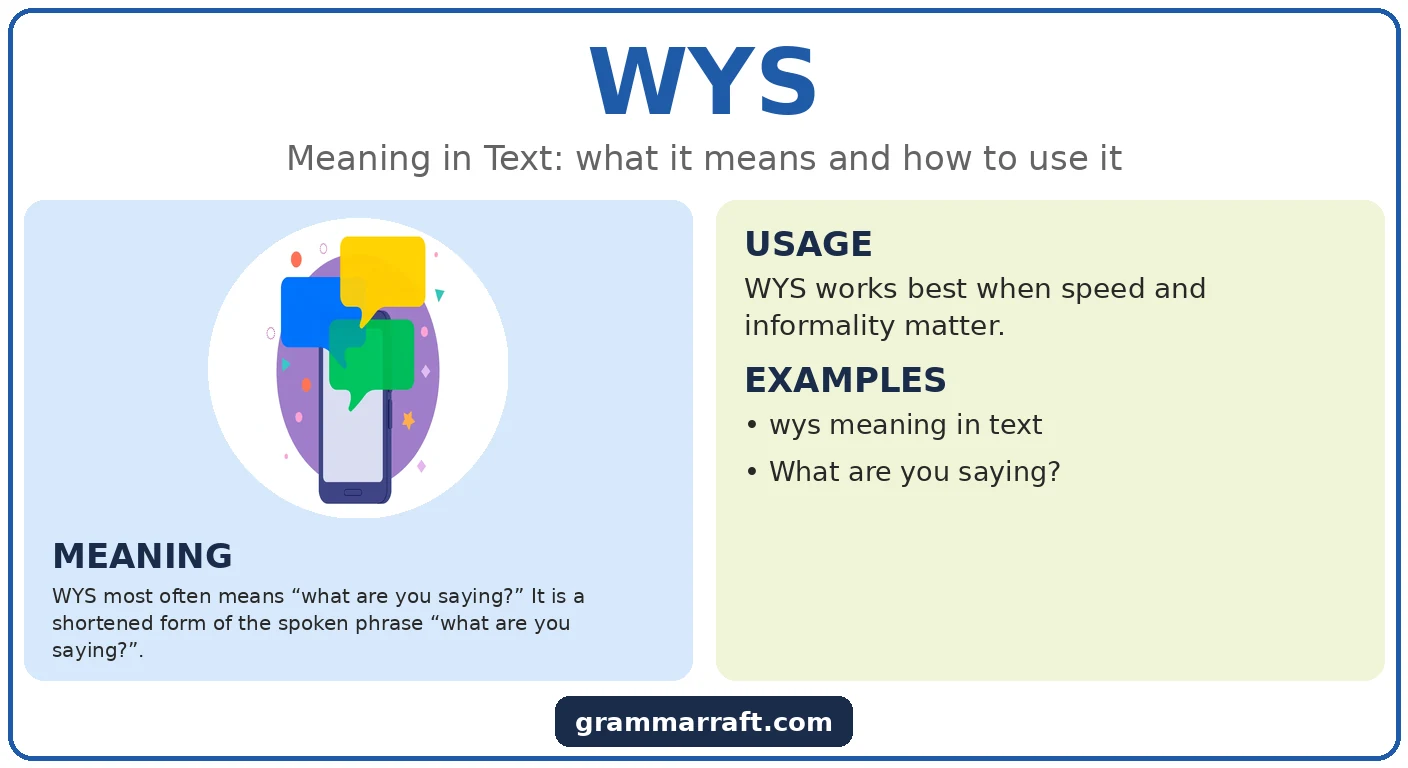
The phrase “wys meaning in text” usually points to a casual question: “What are you saying?” In everyday messaging, WYS commonly means “what are you saying?” and can be used to ask what someone is doing, thinking, planning, or trying to explain.
The exact meaning depends on the conversation, the relationship, and the platform. A friend may use it like “What’s up?”, while someone reacting to a confusing message may mean “What do you mean?” or “What are you talking about?”
That small difference matters because a reply that fits a relaxed Snapchat exchange may sound evasive in a serious conversation. The examples below explain the abbreviation, show how people use it, and give natural replies for messages from friends, dates, classmates, and online contacts.
What Does WYS Mean in Text?
WYS most often means “what are you saying?” It is a shortened form of the spoken phrase “what are you saying?” or “what you saying?” The spelling leaves out the vowels and grammar, which is common in texting slang.
In many conversations, WYS is close to “What’s up?” or “What are you doing?” For example, a friend might text “WYS later?” to ask about your plans, or simply send “wys” as a casual way to start a conversation.
The abbreviation can also ask for clarification. If someone sends a surprising statement, the reply “wys?” may mean “What are you saying?” in the more literal sense. The sender may be asking you to explain something rather than asking about your schedule.
| WYS in context | Likely meaning | Natural example |
|---|---|---|
| Opening a chat | What are you saying? / What’s up? | “Wys?” |
| Asking about plans | What are you doing? | “Wys tonight?” |
| Reacting to news | What are you talking about? | “WYS, that can’t be true.” |
| Requesting an explanation | What do you mean? | “Wys by that?” |
There is no single official definition that works in every message. Tone, punctuation, and the words around WYS provide the clues.
Why WYS Can Have More Than One Meaning
Text abbreviations remove the vocal cues people normally use in conversation. When someone says “What are you saying?” aloud, their tone can show whether they are curious, amused, confused, or annoyed. A three-letter message cannot carry all of that information on its own.
The phrase also comes from informal spoken language, where “what you saying?” may function as a greeting. In that setting, the speaker is not demanding a detailed answer. They may simply be checking in, just as someone might say “What’s happening?” or “How’s it going?”
Context usually resolves the ambiguity. A message such as “wys this weekend?” clearly asks about plans, while “wys, you actually believe that?” is more likely a challenge or request for clarification.
- The message before WYS: a previous question or joke may reveal whether the sender wants information.
- Extra words: phrases such as “tonight,” “about that,” or “right now” narrow the meaning.
- Punctuation: “wys?” can sound curious, while “WYS!” may show disbelief or excitement.
- The relationship: friends often use it casually, while unfamiliar contacts may intend a more literal question.
- The sender’s dialect: regional speech patterns influence whether WYS sounds like a greeting or a challenge.
That is why a dictionary-style answer is useful but incomplete. The abbreviation means something specific enough to recognize, yet flexible enough to shift with the conversation.
WYS as “What Are You Saying?”
The most direct expansion of WYS is “what are you saying?” This reading applies when someone wants to know what another person is communicating. It can follow a statement that seems unclear, unexpected, exaggerated, or difficult to believe.
Imagine a friend texts, “I might quit my job tomorrow and move across the country.” A response such as “WYS?” may mean “What are you saying?” or “Are you serious?” The sender is reacting to the content, not asking what the friend is doing at that exact moment.
WYS can also challenge a claim without becoming openly hostile. For example, “WYS, you said the event was cancelled” points to a contradiction. The writer may be asking the other person to reconcile two different things they have said.
Examples of the literal meaning

Here are several situations in which WYS is close to “what do you mean?” or “what are you talking about?”
- “Wys? You told me the meeting was at six.”
- “WYS by ‘soon’?”
- “Wys, that’s not what happened.”
- “Sorry, wys? I didn’t understand the last part.”
In these examples, the abbreviation is not simply a greeting. It asks the other person to clarify something they said. The surrounding words, especially “by,” “that,” or a reference to an earlier statement, make that clear.
If the tone seems sharp, a calmer version may be better. Instead of replying with another abbreviation, you could write, “What do you mean?” or “Can you explain that?” Direct language reduces the chance that the exchange becomes an argument over tone.
WYS as a Greeting or Check-In
In casual messaging, WYS often works as a short check-in. Here, it may mean “What are you saying?” in a conversational or regional style, but the practical meaning is closer to “What’s up?” or “How are things?”
A friend might send “wys” after seeing you online. They may not be asking for a carefully worded explanation. A simple answer such as “Not much, just watching a film” usually fits the situation.
The greeting use is especially common when the message appears by itself. A standalone “wys?” at the beginning of a chat normally invites conversation, while “wys about the homework?” is more focused. The same three letters can therefore open a chat or question a specific point.
How the greeting sounds
WYS is informal and familiar. It suits friends, siblings, classmates, gaming contacts, and people who already communicate with relaxed slang. It may feel too casual in a job application, a complaint to a company, or a formal academic message.
There is also a difference between “WYS?” and “Wys.” The question mark makes the message look like a direct question, while the version without punctuation may be a quick opener. Neither form guarantees a particular mood, though; some people omit punctuation in nearly every text.
Possible replies include:
- “Not much—what about you?”
- “I’m heading home. WYS?”
- “Just finished work.”
- “All good here. What’s up?”
- “I’m free later if you want to hang out.”
Notice that these answers do not overanalyze the abbreviation. They respond to the likely purpose of the message: starting a relaxed conversation.
WYS on Snapchat, Instagram, and Other Apps
WYS does not have a special built-in meaning on Snapchat or Instagram. The abbreviation means what the sender intends it to mean, whether it appears in a direct message, a comment, a group chat, or a reply to a story.
Platform context can still affect how the message feels. On Snapchat, a friend replying “wys?” to a photo may be asking what you are doing or where you are. On Instagram, a person responding to a post may instead be asking what you mean by a caption, opinion, or joke.
The message format offers useful clues. A reply to a travel story may mean “What are you saying?” about the destination or “What are you doing there?” A response to a bold opinion may express disbelief. A message sent after a long silence may simply be an attempt to restart contact.
| Platform or setting | Common interpretation | Example reply |
|---|---|---|
| Snapchat chat | What are you doing? | “Just walking home.” |
| Instagram story reply | What do you mean by that? | “I was joking about the caption.” |
| Group chat | What’s happening? | “We’re meeting at eight.” |
| Comment thread | What are you saying? | “I mean the first point, not the second.” |
If you do not know which interpretation applies, answer broadly. “What do you mean—about my plans or the message?” is clear without sounding defensive.
For a quick reference on how informal shortened forms work in English, the Cambridge Dictionary’s explanation of abbreviations and acronyms provides useful general language context.
What WYS Means From a Girl or a Guy
Searches often ask whether WYS has a different meaning when it comes from a girl or a guy. Usually, the sender’s gender does not change the definition. WYS still generally means “what are you saying?” or functions as a casual “what’s up?”
What can change is the personal context. A close friend may use WYS in a playful way, while someone you are dating may use it to start a conversation or ask what you are doing. Those possibilities come from the relationship and the surrounding messages, not from a fixed male or female version of the abbreviation.
It is also risky to treat WYS as automatic evidence of romantic interest. A person may send it because they want to chat, need information, or saw an unusual post. One short message cannot establish intent by itself.
Reading the broader conversation
Look at the messages before and after it. If the sender follows WYS with “you free later?”, they may be asking about your availability. If they respond to a joke with “wys 😂”, they may be expressing amusement or disbelief.
Timing can add context, but it is not proof. A late-night message might suggest the sender wants company, yet it could also be a practical question or an ordinary check-in. Avoid assigning a romantic meaning before the rest of the conversation supports it.
A neutral response keeps things comfortable:
- “Not much. How about you?”
- “I’m just finishing some work—what’s up?”
- “Do you mean what I’m doing or what I meant?”
- “I’m not sure what you’re asking. Can you clarify?”
These replies give the sender room to explain. They also prevent a small abbreviation from turning into an unnecessary guessing exercise.
How to Reply to “WYS” Naturally
The best response depends on whether WYS is a greeting, a question about your plans, or a reaction to something you said. You do not need to mirror the abbreviation. A normal sentence is often clearer and more useful.
If it means “What are you doing?”
Answer with your current activity or immediate plan. “I’m cooking dinner,” “Just got home,” and “I’m studying for tomorrow’s test” all work. If you want to continue the conversation, add “What about you?”
If it means “What’s up?”
A brief social answer is enough. “Nothing much,” “All good,” or “Not much—how have you been?” acknowledges the check-in without making the exchange formal.
If it means “What do you mean?”
Explain the point that caused confusion. You might write, “I meant the second appointment, not today’s one,” or “I was saying the plan needs more time.” Specific wording is more effective than replying with another vague abbreviation.
If the tone seems confrontational
Slow the conversation down. “I’m not trying to argue; I meant that…” can soften the exchange, while “Can you tell me which part you’re asking about?” identifies the problem directly.
| Incoming message | Likely intent | Good reply |
|---|---|---|
| “wys?” | Casual check-in | “Not much, you?” |
| “wys tonight?” | Asking about plans | “I’m free after seven.” |
| “WYS by that?” | Requesting clarification | “I mean the plan is delayed.” |
| “WYS 😂” | Surprise or amusement | “I know it sounds wild, but it happened.” |
If the message is too vague to answer, ask a short follow-up. “About what?” or “Do you mean my post?” can resolve the issue quickly.
WYS, Similar Abbreviations, and Common Confusion
Text slang can look interchangeable even when the abbreviations have different meanings. WYS is sometimes confused with “wyd,” which usually means “what are you doing?” The two may overlap in casual conversation, but they are not the same abbreviation.
“Wassup,” “sup,” and “how are you?” are also possible translations when WYS is used as a greeting. Meanwhile, “what do you mean?” is a better expansion when the message responds to something confusing or contradictory.
| Abbreviation | Usual expansion | Typical use |
|---|---|---|
| WYS | What are you saying? | Checking in or asking for clarification |
| WYD | What are you doing? | Asking about someone’s current activity |
| WBU | What about you? | Returning a personal question |
| HBU | How about you? | Returning a question about feelings or status |
| WYM | What do you mean? | Requesting an explanation |
| SUP | What’s up? | Very short casual greeting |
Regional usage creates another source of confusion. “What you saying?” is more natural in some varieties of informal British and international English than in others, so readers may interpret it through their own speech patterns.
Capitalization rarely changes the meaning. “wys,” “WYS,” and “Wys” generally refer to the same expression. The surrounding wording carries more information than the letter case.
When to Use WYS and When to Avoid It
WYS works best when speed and informality matter. It belongs in a relaxed text to someone who already understands your style. A short abbreviation can make a message feel friendly and conversational, especially in an ongoing chat.
Clarity matters more in professional or sensitive situations. If you are discussing a deadline, correcting an error, or asking a serious question, write the full sentence instead. “What do you mean by the revised date?” is easier to interpret than “WYS?”
Use the surrounding message to decide whether WYS will help or hinder communication. A recipient who rarely uses slang may not recognize it, and someone reading quickly may interpret it as rude or dismissive.
- Good fit: messages to close friends, casual group chats, gaming conversations, and informal social replies.
- Use caution: conversations with new contacts, older relatives, customers, teachers, or people from different language backgrounds.
- Avoid it: formal work messages, applications, complaints, contracts, medical discussions, and high-stakes instructions.
- Clarify it: whenever the message could reasonably mean both “what are you doing?” and “what do you mean?”
There is no problem with slang itself. The practical question is whether the recipient can understand the intended meaning without extra effort.
If you are writing to someone unfamiliar with the abbreviation, spell it out once. After that, you can use the shorter form if the other person adopts the same style.
FAQ About WYS Meaning in Text
What is the main WYS meaning in text?
The main WYS meaning in text is “what are you saying?” In casual chats, it can also function like “what’s up?” or “what are you doing?” The message’s surrounding words and tone determine which interpretation fits.
What does WYS mean on Snapchat?
On Snapchat, WYS usually means “what are you saying?” or acts as a casual check-in. If it follows a photo or video, the sender may be asking what you are doing, where you are, or what you meant by the post.
How should I reply to “WYS”?
If it is a casual greeting, reply with something like “Not much, what about you?” If the sender seems confused, explain your point or ask, “Do you mean what I’m doing or what I meant?”
Does WYS mean something different from a girl or a guy?
No fixed gender-specific meaning exists. A girl or a guy may use WYS as a greeting, a question about plans, or a request for clarification. The relationship and conversation provide better clues than the sender’s gender.
Is WYS the same as WYD?
Not exactly. WYD normally means “what are you doing?”, while WYS usually means “what are you saying?” In quick informal chats, their practical meanings can overlap, but they are separate abbreviations.
Final Takeaway on WYS Meaning in Text
WYS usually expands to “what are you saying?” and may serve as a greeting, a question about plans, or a request for clarification. Read the words around it before deciding what the sender means, especially on Snapchat, Instagram, or in a fast-moving group chat.
If the meaning still feels unclear, answer broadly or ask a short follow-up. Knowing the WYS meaning in text helps, but the safest interpretation comes from context, tone, and the relationship between the people messaging.
Related Articles
- GMFU Meaning in Text: What Does GMFU Mean?
- NWS Meaning in Text: What Does NWS Mean?
- DHZ Meaning in Text: What Does DHZ Mean?
Explore more helpful guides on GrammarRaft.