
IC Meaning in Text: What “IC” Really Means
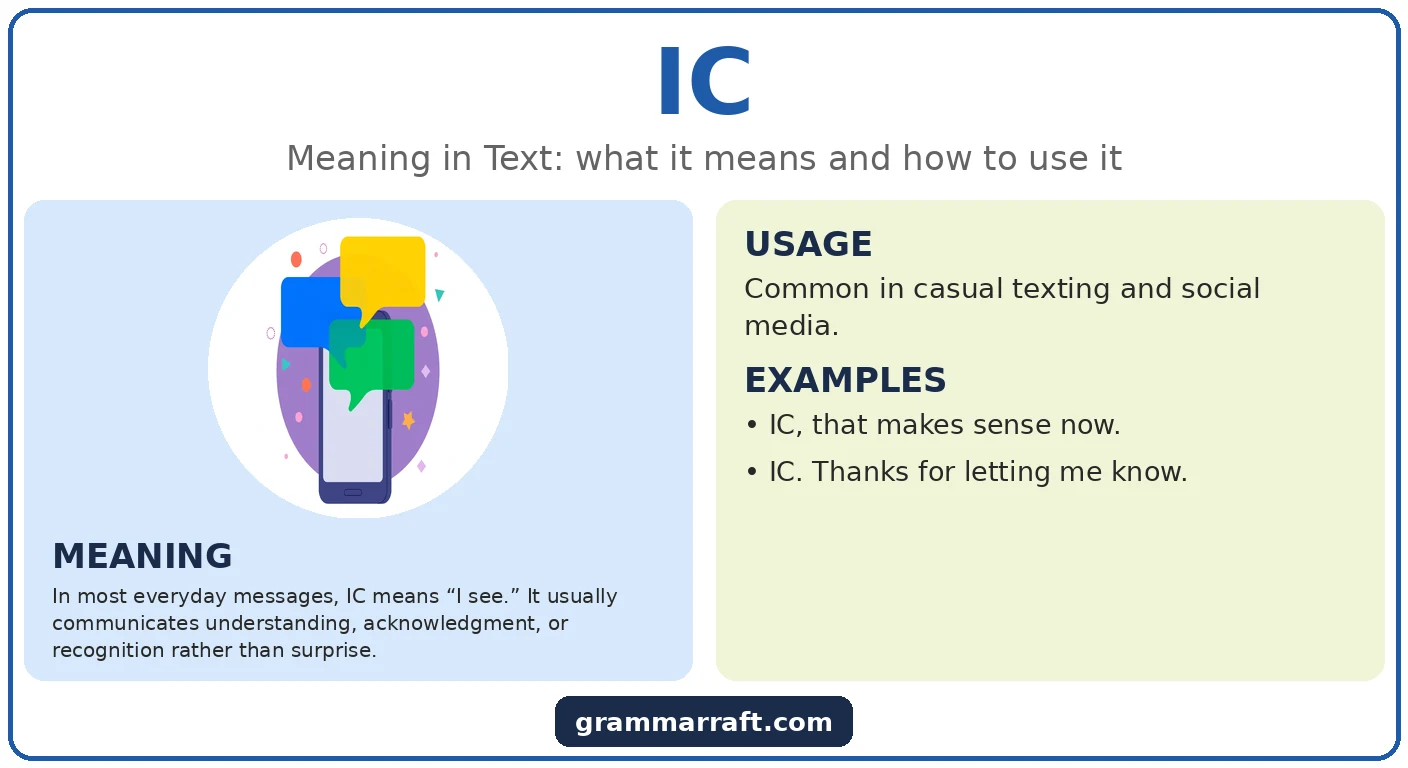
The most common IC meaning in text is “I see,” a quick way to show that you understand or acknowledge what someone has said. You’ll often find it in text messages, online chats, comments, and casual conversation.
IC can also mean “in character,” especially in role-playing chat, gaming communities, and fan spaces. The correct interpretation depends on the text message context, the people talking, and whether the conversation is ordinary or built around a fictional role.
This guide explains IC meaning in texting, shows how the abbreviation works in real messages, and separates the common slang use from less obvious meanings. It also covers IC vs OOC, related text message acronyms, and the clues that help you avoid misreading a short reply.
What Does IC Mean in Text?
In most everyday messages, IC means “I see.” It usually communicates understanding, acknowledgment, or recognition rather than surprise. If someone explains why they missed an appointment and you reply “IC,” you’re saying that you understand the explanation.
The phrase is a shortened form of spoken language. People began typing “I see” as “IC” because the letter names sound similar in English, making the abbreviation fast and easy to recognize in informal chat.
Here are several common uses of IC in a text message:
- Understanding: “IC, that makes sense now.”
- Acknowledgment: “IC. Thanks for letting me know.”
- Recognition: “IC what you mean.”
- Transition: “IC. So what should we do next?”
IC is generally casual and concise. It belongs with internet slang, chat shorthand, and texting abbreviations rather than formal business writing, academic work, or a carefully written letter.
The tone can vary. A friendly conversation may use “IC” as a neutral acknowledgment, while a one-word response may sound distant if the surrounding messages are emotional or detailed. The abbreviation itself is not automatically rude, but its brevity can make the sender seem uninterested.
IC Meaning in Texting: The Main Use
The most useful way to interpret IC meaning in texting is to replace it with “I understand” or “I see.” Try that substitution mentally. If the sentence still makes sense, the sender probably uses IC in its ordinary texting sense.
For example, imagine this exchange:
| Message | Likely meaning | Natural reply |
|---|---|---|
| “The train was delayed, so I’ll be late.” | “IC” means “I see” or “I understand.” | “No problem. Get here safely.” |
| “I didn’t call because my phone died.” | “IC” acknowledges the explanation. | “That’s okay.” |
| “IC, you’re talking about the second file.” | “IC” signals recognition. | “Yes, the one marked final.” |
| “The wizard enters the room.” | “IC” may mean “in character.” | Continue the fictional scene. |
IC does not usually mean that the sender agrees with everything you said. It may only mean that they understand your point or now recognize the situation. That distinction matters in disagreements, because “I see” is not always the same as “you’re right.”
Context also affects punctuation. “IC” can feel neutral, while “IC!” may show sudden recognition. “Oh, IC” often sounds more conversational, and “IC…” can suggest hesitation, doubt, or a desire to move on.
Is IC the Same as “I See”?
Usually, yes. IC is a phonetic text abbreviation based on the sound of the words “I see,” not the first letters of those words. Similar sound-based shortcuts include “CU” for “see you” and “U” for “you,” although these forms are less common in some modern conversations than they were in earlier text messaging.
Some people prefer writing “I see” because it is clearer and warmer. Others use IC because it is quick, familiar, or fits the relaxed style of a group chat.
IC Meaning in Text by Conversation Context
No abbreviation has one guaranteed meaning in every online community. The safest way to understand IC is to examine the messages around it, the platform being used, and the relationship between the participants.
Everyday Text Messages
In a normal conversation between friends, relatives, or coworkers, IC usually means “I see.” A person may use it after receiving an explanation, an update, or a correction.
Example:
“The meeting moved to Thursday.”
“IC, I’ll update my calendar.”
Here, IC is simply an acknowledgment. It doesn’t suggest a hidden code or a special technical meaning.
Online Games and Group Chats
Gaming communities sometimes use IC differently. In a role-playing server, IC often means “in character.” It tells participants that a message is being written or spoken as a fictional character rather than as the real person controlling that character.
For example, a player might write, “IC: The captain refuses to open the gate.” That message is part of the story. Another player could respond as a guard, a rival, or a member of the same fictional world.
Work and Professional Messages
IC can appear in workplace communication, but its meaning may change. In some organizations, IC means “individual contributor,” describing an employee who contributes as a specialist rather than managing a team.
That professional meaning is different from the IC slang used in casual texting. A message such as “This role is an IC position” is discussing job structure, not saying “I see.”
Social Media Comments
In social media slang, IC can be used as a short reaction to a post or reply. A commenter may write “IC” after someone clarifies a controversial point, explains a joke, or adds background information.
Because social media often strips away tone, a brief “IC” may be interpreted as dismissive. If the topic is sensitive, “I understand what you mean” is usually clearer and more considerate.
IC vs OOC in Role-Playing Chat
Role-playing communities commonly distinguish between IC and OOC. IC means “in character,” while OOC means “out of character.” These labels help separate fictional dialogue from real-world communication between the people participating in the scene.
Consider a fantasy role-playing chat. A player may write, “IC: The healer draws her sword,” followed by dialogue spoken by the healer. If the same player needs to ask another participant about scheduling, they might write, “OOC: Can we continue this scene tomorrow?”
| Term | Meaning | Typical purpose |
|---|---|---|
| IC | In character | Advances the fictional scene or reflects a character’s thoughts and actions |
| OOC | Out of character | Communicates as the real participant outside the fictional scene |
| IC dialogue | Speech from the fictional character | Creates story, conflict, atmosphere, or character development |
| OOC note | Real-world message from the participant | Discusses rules, timing, consent, or plot coordination |
Understanding IC vs OOC is important because fictional conflict is not necessarily personal conflict. A character may insult another character during a scene, while the players behind those characters remain perfectly friendly.
How Role-Playing Communities Mark IC Messages
Different groups use different conventions. Some put “IC” at the start of a message, while others reserve a channel for in-character writing and use a separate channel for OOC discussion.
Common signals include:
- IC: Marks a fictional action, thought, or line of dialogue.
- OOC: Marks communication from the real participant.
- Parentheses: Sometimes used for quick out-of-character notes.
- Separate channels: Keep story content and practical planning apart.
- Character formatting: Names, tags, or dialogue styles identify the fictional speaker.
There is no universal formatting rule. Before joining a role-playing chat, check its community guidelines or observe how existing members label their messages.
Other Meanings of the IC Abbreviation
Although “I see” is the most likely answer in casual text, IC is used for several unrelated concepts. A reader should not assume that every appearance of the abbreviation is internet slang.
In employment discussions, IC can mean individual contributor. A software engineer, designer, researcher, or sales specialist may be described as an IC when their main responsibility is individual expertise rather than direct people management.
In electronics and computing, IC commonly means integrated circuit. An integrated circuit is a small electronic component containing connected circuitry, such as transistors and other elements, on a semiconductor material. A technical message about a circuit board is unlikely to mean “I see.”
In healthcare, education, finance, or public administration, IC may be an organization-specific abbreviation. Its meaning could be defined by a local document, department, form, or professional system.
| IC meaning | Where it appears | Clue that helps identify it |
|---|---|---|
| I see | Texting, chat, social media | It responds to an explanation or update |
| In character | Role-playing chat, gaming, fan communities | The conversation involves fictional characters |
| Individual contributor | Workplace, hiring, management | The message discusses career levels or reporting lines |
| Integrated circuit | Electronics, engineering, computing | The surrounding terms include hardware or circuit design |
Capitalization may offer a small clue, but it is not decisive. People often type IC in uppercase because it is an abbreviation, while casual users may write “ic” without thinking about standard capitalization.
If the meaning remains unclear, ask a short follow-up question. “Do you mean ‘I see’ or ‘in character’?” is more efficient than guessing and continuing the conversation in the wrong direction.
How to Use IC Naturally in a Text
IC works best when the conversation is informal and the meaning is obvious. It is especially suitable for quick acknowledgments where a full sentence would feel unnecessarily formal.
Examples include:
- “IC, that explains the delay.”
- “Oh, IC now.”
- “IC. I thought you meant the other project.”
- “IC, so the event is online instead.”
- “IC what happened.”
The abbreviation can also introduce a follow-up question. “IC. Does that mean we should cancel?” shows that the sender understands the explanation but still needs a decision.
When “I See” Is Better
Write “I see” instead of IC when the situation calls for warmth, clarity, or professionalism. A customer, manager, teacher, or unfamiliar contact may not know the abbreviation, and even people who know it may read it as abrupt.
Compare these responses:
“IC.”
“I see what happened. Thanks for explaining.”
The second response communicates more emotional information. It shows attention and gives the other person confidence that their message was received.
IC is also a poor choice for serious conversations. If someone is sharing grief, a personal crisis, or a complaint, a fuller response is more respectful than a two-letter acknowledgment.
How to Avoid Sounding Dismissive
Adding a few words can soften the message without making it long. “IC, thanks for clarifying” sounds more engaged than “IC” on its own.
Other useful alternatives include “Got it,” “That makes sense,” “I understand,” and “Thanks, I didn’t know that.” Each option gives the recipient more information about your reaction than the abbreviation alone.
There is no need to avoid IC completely. Use it with people who already understand your texting style, and choose a complete phrase when the relationship or subject requires extra care.
How to Tell Which IC Meaning Applies
Start with the topic. If the message concerns a late bus, a changed plan, or an explanation between friends, “I see” is the obvious interpretation. If the message concerns a character, fictional action, or a server rule, “in character” becomes more likely.
Next, examine the grammar. IC meaning “I see” often appears as a standalone reply or before a reaction: “IC, that makes sense.” IC meaning “in character” often appears as a label before a scene: “IC: The knight leaves the room.”
The platform can help, too. A messaging app, social network, or ordinary group chat usually favors the “I see” meaning. A role-playing forum, multiplayer game, or character-based server may use the term in its technical community sense.
| Question to ask | If the answer is yes | Most likely interpretation |
|---|---|---|
| Is someone replying to an explanation? | Yes | I see |
| Does the message describe a fictional character? | Yes | In character |
| Is the topic hiring, management, or career progression? | Yes | Individual contributor |
| Is the topic hardware or circuit design? | Yes | Integrated circuit |
Reading one message before and after the abbreviation often resolves the ambiguity. A single “IC” is difficult to interpret in isolation, but a short exchange usually supplies enough evidence.
When context still fails, clarification is appropriate. Short abbreviations are efficient only when both people attach the same meaning to them.
IC and Other Text Message Acronyms
IC belongs to a broad group of text message acronyms and chat abbreviations designed to save typing. Some are formed from initial letters, while others rely on sound, shortened spelling, or a phrase that online communities have adopted.
Common examples include “IDK” for “I don’t know,” “BRB” for “be right back,” “FYI” for “for your information,” and “LOL” for “laughing out loud.” Their familiarity varies by age, platform, country, and group.
IC is slightly different from acronyms such as IDK because it represents the sound of “I see.” That makes it closer to a phonetic abbreviation than a strict initialism.
- IDK: I don’t know.
- IMO: In my opinion.
- BRB: Be right back.
- FYI: For your information.
- OOC: Out of character.
- IC: I see or in character, depending on context.
Texting language changes over time. A phrase that feels familiar to one group may seem old-fashioned, confusing, or overly casual to another. That is why knowing the audience matters more than memorizing a fixed list of abbreviations.
For a broader reference on the ordinary meaning of “see,” the Merriam-Webster dictionary entry for “see” provides useful definitions beyond its use as a texting shortcut.
Common Mistakes About IC Meaning
The first mistake is assuming that IC always means “I see.” That interpretation is common, but role-playing communities use IC as “in character,” and professional or technical settings may use entirely different definitions.
The second mistake is treating IC as a sign of agreement. Someone who writes “IC” may understand your explanation without accepting your opinion, approving your decision, or admitting that you are correct.
A third mistake is judging tone from the abbreviation alone. “IC” can be friendly, neutral, hurried, or dismissive depending on punctuation, timing, and the relationship between the people involved.
New users in a role-playing community may also confuse IC with OOC. If a person gives practical instructions inside a fictional scene, other players may not know whether those instructions are part of the story or a real request from the player.
| Common mistake | Why it causes confusion | Better approach |
|---|---|---|
| Assuming one fixed definition | IC has different meanings across communities | Check the subject and platform |
| Reading “IC” as agreement | Understanding is not the same as approval | Look for a separate statement of opinion |
| Calling the sender rude immediately | Short messages can lack visible tone | Consider the wider conversation |
| Mixing IC and OOC | Fictional and real-world messages become blurred | Use the community’s labeling conventions |
Clear communication does not require avoiding all shorthand. It requires choosing shorthand that the recipient can reasonably understand.
FAQ About IC Meaning in Text
What does IC mean in a text message?
In an ordinary text message, IC usually means “I see.” It tells the other person that you understand or acknowledge what they have explained. The exact tone depends on the surrounding conversation.
What does IC mean in texting slang?
IC is texting slang for “I see,” based on the similar sound of the letters. It is a quick acknowledgment used in casual conversations, online chats, and social media messages.
What does IC mean in role-playing chat?
In role-playing chat, IC usually means “in character.” It identifies writing, dialogue, or actions performed as part of a fictional role rather than by the real participant.
What is the difference between IC and OOC?
IC means “in character,” while OOC means “out of character.” IC messages belong to the fictional scene, whereas OOC messages come from the real person and may discuss rules, scheduling, or story planning.
Is IC rude in a text?
IC is not automatically rude, but a one-word reply can feel abrupt in a serious or emotional conversation. “I see, thanks for explaining” is a clearer and warmer alternative when tone matters.
Conclusion
The most common IC meaning in text is “I see,” an informal way to acknowledge information or show understanding. In role-playing chat, however, IC usually means “in character,” while workplace and technical settings may use the abbreviation for individual contributor or integrated circuit.
Use the surrounding words, platform, and conversation style to decide which meaning fits. If the context remains unclear, ask rather than guess; that small step keeps short online communication from creating unnecessary confusion.
Related Articles
- WYGG Meaning in Text: Definition, Uses and Examples
- IMU Meaning in Text: Definition, Examples and Usage
- NT Meaning in Text: Nice Try or No Thanks?
Explore more helpful guides on GrammarRaft.
One Comment