TMO Meaning in Text: Definition, Uses and Examples
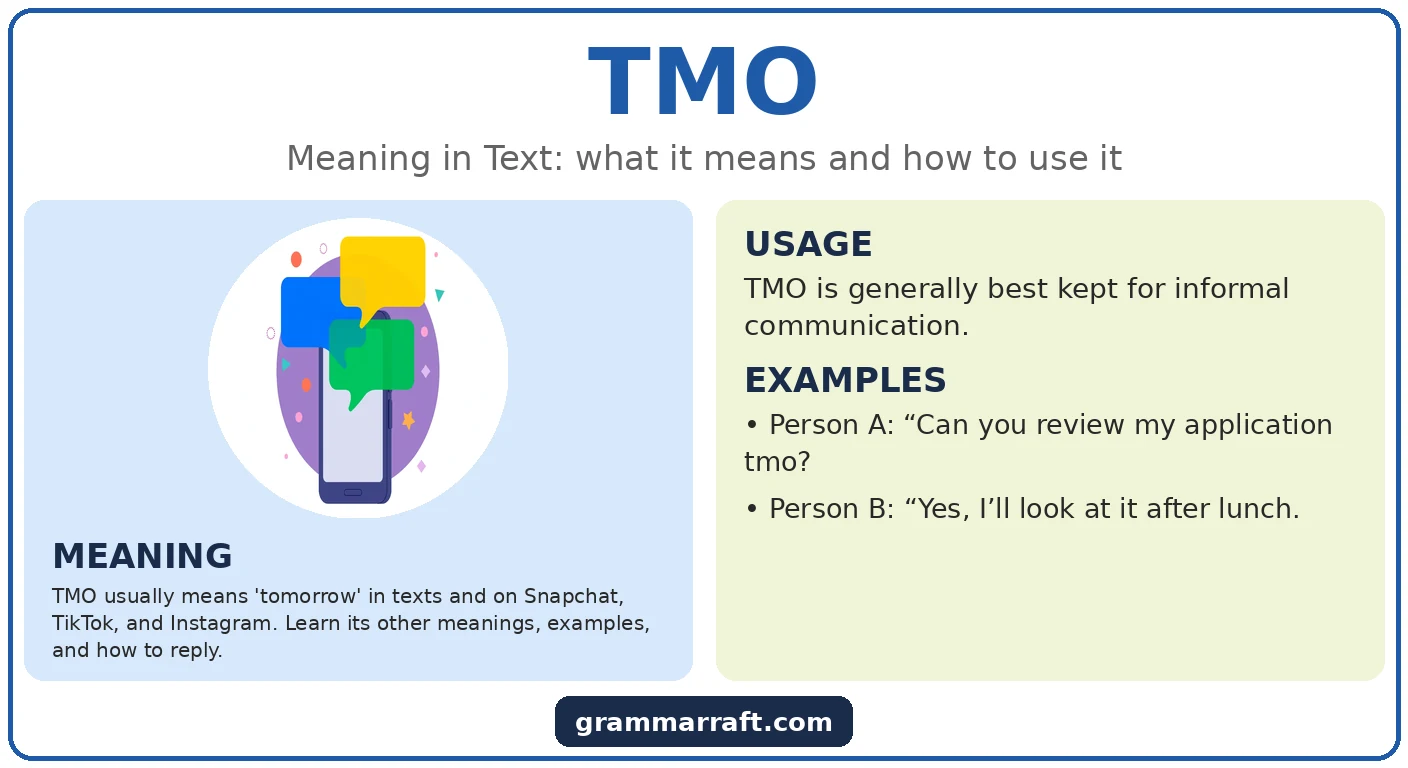
The tmo meaning in text is usually “tomorrow”, especially in quick messages, social posts, and casual chats. It is a shortened form rather than a formal dictionary word, so the surrounding sentence still matters.
You may also see TMO used for a different phrase, including “tell me more” or a group-specific expression. That variation explains why the same three letters can seem obvious in one conversation and confusing in another.
This guide explains the most likely definition, shows how people use tmo on Snapchat, TikTok, Instagram, and messaging apps, and covers the relationship and slang questions that often come with it. You’ll also see practical examples for deciding what the sender meant.
The Most Common TMO Meaning in Text
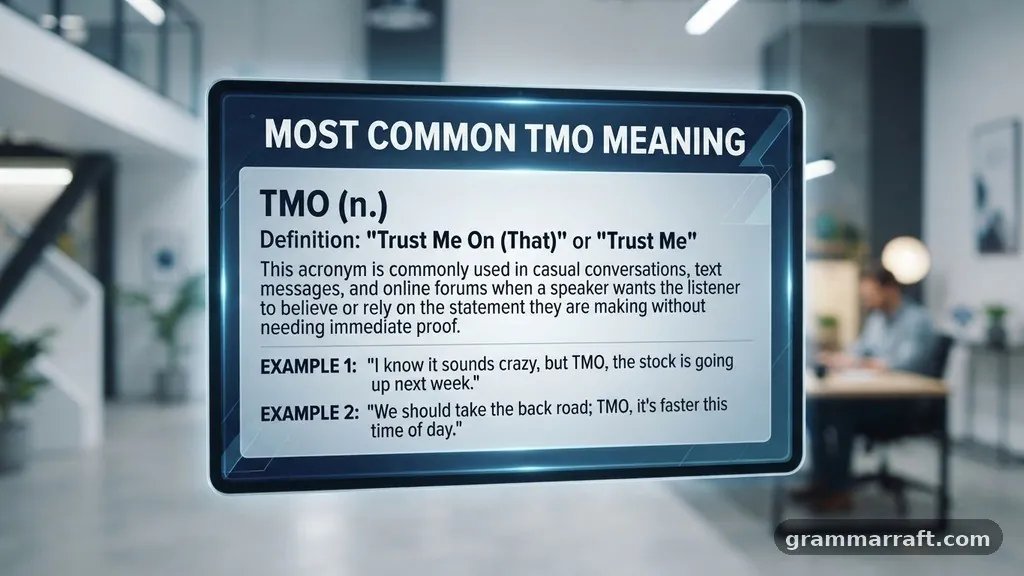
In ordinary texting, tmo most often means “tomorrow.” Someone might write, “Can we talk tmo?” or “I’ll send it tmo,” using the abbreviation to save time. The meaning is normally clear because the sentence refers to a future event.
It works much like other shortened time expressions, such as “tmr,” “tmrw,” “2moro,” or “tomo.” None is guaranteed to be the sender’s preferred form, and people often create their own versions while typing quickly on a phone.
Here are common examples:
- “See you tmo” means “See you tomorrow.”
- “Are you free tmo?” means “Are you free tomorrow?”
- “I’ll finish it tmo” means “I’ll finish it tomorrow.”
- “Tmo works for me” means “Tomorrow works for me.”
- “Let’s decide tmo” means “Let’s decide tomorrow.”
The abbreviation can appear in lowercase as tmo or in capitals as TMO. Capitalization usually doesn’t change the meaning in a casual message; it may simply reflect the sender’s keyboard settings or writing style.
A useful clue is the verb around it. Words such as “see,” “call,” “meet,” “finish,” “send,” and “go” often point to a future date, making “tomorrow” the natural interpretation.
Why TMO Can Have More Than One Definition
Text slang has no single governing rulebook. Unlike a standard word with a stable dictionary definition, a short acronym can be invented by a friend group, adopted from a social platform, or borrowed from gaming, work, school, or another online community.
That is why it’s safer to treat TMO as a context-dependent abbreviation. The sentence, the platform, the sender’s usual language, and the earlier messages all help determine what the letters mean.
| Context | Possible meaning | Clue to look for |
|---|---|---|
| Plans or scheduling | Tomorrow | Future actions such as meet, call, see, or finish |
| Conversation or advice | Tell me more | The sender wants additional information |
| Private friend-group slang | A local phrase or inside joke | No obvious standard meaning fits |
| Work or an organization | A formal initialism | Capital letters, job-specific language, or a named company |
| Gaming or online communities | Community-specific terminology | Game, server, username, or fandom references |
For example, “I’m busy tmo” strongly suggests “tomorrow,” while “TMO, that story is wild” may mean something else if the sender uses TMO as a conversational shortcut. A message such as “TMO?” is especially ambiguous because it contains no surrounding information.
Capital letters can provide a small clue, but they are not proof. People capitalize text slang for emphasis, while some users type every abbreviation in uppercase.
If the meaning affects plans, money, safety, or an important relationship conversation, asking is better than guessing. A simple “Do you mean tomorrow?” resolves the uncertainty without making the exchange awkward.
TMO Examples in Real Text Conversations
Short examples make the main definition easier to recognise. In a planning conversation, one person might write, “Movie tmo?” The likely meaning is “Movie tomorrow?” because the abbreviation follows an activity and asks about a future time.
Another exchange could look like this:
- Person A: “Can you review my application tmo?”
- Person B: “Yes, I’ll look at it after lunch.”
Here, “tmo” clearly refers to tomorrow because “after lunch” describes when the review will happen. The same abbreviation can also appear at the beginning or end of a sentence without changing its meaning.
Consider these variations:
| Message | Likely reading |
|---|---|
| “I’ll call tmo.” | I’ll call tomorrow. |
| “Tmo morning?” | Tomorrow morning? |
| “Not today, tmo.” | Not today; tomorrow. |
| “Can you explain tmo?” | Possibly “tell me more,” depending on the earlier message |
| “TMO, I need details.” | Possibly a request for more information, but context is essential |
Notice that “tmo morning” is slightly redundant because tomorrow already identifies the day, but casual texting often contains this kind of repetition. It sounds natural because people use abbreviations to type quickly rather than to create perfect formal sentences.
Context can also come from punctuation. “See you tmo!” is a confident statement, while “Tmo?” may be asking whether tomorrow is available. The exclamation mark, question mark, and surrounding words change the tone more than the abbreviation itself.
Typos are another possibility. A sender may intend to write “tmr,” “tomo,” or another short form and produce “tmo” instead. If the message seems inconsistent with the conversation, a typo may be more likely than a hidden slang definition.
TMO Meaning on Snapchat, TikTok and Instagram
The tmo meaning in text generally stays the same across Snapchat, TikTok, Instagram Direct Messages, and ordinary SMS. In all of these spaces, users often shorten common words because posts, comments, and messages are informal and fast-moving.
On Snapchat, “streak tmo?” would usually mean “streak tomorrow?” or ask whether the sender will continue the exchange tomorrow. On Instagram, a direct message such as “I’ll reply tmo” normally means “I’ll reply tomorrow.” The visual platform does not automatically give TMO a new definition.
TikTok can create more uncertainty because trending slang spreads quickly and meanings may differ between communities. A comment may use TMO as part of a joke, an in-group phrase, a caption style, or an acronym that has nothing to do with tomorrow.
These signals can help you interpret it:
- Look at the words immediately before and after TMO.
- Check whether the message discusses plans, deadlines, or a future event.
- Review the sender’s earlier use of abbreviations.
- Consider whether the post belongs to a fandom, game, school, workplace, or friend group.
- Ask for clarification if more than one definition fits.
A viral comment does not automatically establish a permanent meaning. Social-media language changes quickly, and a phrase that is trending in one group may be unfamiliar to another.
It also helps to distinguish a hashtag or username from ordinary text slang. TMO may appear as a brand, organization, event, or account name in capital letters. In that setting, it should not be expanded as “tomorrow” without checking the surrounding content.
For a broader explanation of how shortened forms and initialisms differ, consult this Merriam-Webster reference on acronyms. The distinction matters because not every group of initials functions like a spoken acronym.
TMO Meaning in a Relationship
When TMO appears in a romantic or personal conversation, the most likely definition still depends on the actual sentence. “Can we talk tmo?” normally means “Can we talk tomorrow?” It does not, by itself, reveal whether the sender is affectionate, upset, distant, or ending the relationship.
People sometimes search for “TMO meaning in a relationship” because they want to decode emotional intent rather than just define the letters. The abbreviation cannot reliably provide that answer. Tone comes from the complete message, the timing, the topic, and the pattern of communication.
For instance, compare these messages:
| Message | What it may communicate |
|---|---|
| “Good night, talk tmo ❤️” | A casual plan to continue talking tomorrow |
| “We need to discuss this tmo.” | A future conversation, possibly serious |
| “Can I tell you more tmo?” | Likely a time reference, though the full sentence matters |
| “TMO?” | Too short to interpret confidently without context |
The same “talk tmo” can feel warm in one exchange and worrying in another. A person who normally sends long messages may sound abrupt when using only a few words, while a person who always writes briefly may mean nothing unusual.
Don’t infer a hidden relationship message from capitalization alone. “TMO” is not a recognised universal code for love, rejection, cheating, commitment, or a breakup.
If you need clarity, reply directly: “Sure—do you mean tomorrow?” If the emotional issue matters, you can add, “And are we okay?” That asks about the real concern instead of placing too much weight on three letters.
TMO From a Boy or Girl: Does Gender Change the Meaning?
No standard text-slang rule makes TMO mean one thing when it comes from a boy and something different when it comes from a girl. The sender’s gender does not change the ordinary interpretation of “tomorrow.” Claims that TMO has a fixed male or female meaning are usually based on personal experience, social-media speculation, or a private code.
The same caution applies to questions such as “What does TMO mean from a boy?” or “What does TMO mean from a girl?” Those questions often reflect uncertainty about tone, not a separate dictionary definition.
Suppose someone writes, “I’ll see you tmo.” The message gives a likely time reference, but it does not prove romantic interest. Likewise, “I’m busy tmo” does not automatically mean disinterest or avoidance.
Use the broader exchange to interpret intent:
- Has the person suggested a specific plan?
- Do they answer consistently or leave messages unclear?
- Does their wording match how they usually communicate?
- Have they explained why they are unavailable?
- Are you interpreting one abbreviation in isolation?
Actions carry more information than a short acronym. A person who confirms a time, follows through, and communicates clearly is giving stronger evidence of intent than someone who sends vague messages filled with abbreviations.
Age, region, first language, and online community can matter more than gender. Some people use text slang heavily, while others prefer complete words. A sender may also use “tmo” simply because it is shorter than “tomorrow,” with no emotional subtext at all.
If the conversation is flirtatious, the surrounding language may suggest that tone, but TMO itself remains a time abbreviation in the most common reading. Ask a clear follow-up rather than relying on assumptions about what the sender “must” mean.
Other Possible Meanings of TMO
Although “tomorrow” is the leading text interpretation, TMO can represent other phrases. One possibility in casual conversation is “tell me more.” This reading is most plausible when someone has shared a story or claim and TMO appears as a request for additional details.
For example, “I met someone famous today.” “TMO!” could be intended as “Tell me more!” However, many people would write “TMI,” “tell me more,” or “details?” instead, so this is not as universal as the time-related meaning.
TMO may also be a formal initialism inside a company, school, agency, publication, game, or online group. Formal uses should be interpreted from the subject rather than from general text slang. If a message discusses a department, event, or named organisation, the letters may be an abbreviation for that proper name.
| Possible expansion | How likely in casual texting | Typical evidence |
|---|---|---|
| Tomorrow | Common | Plans, appointments, deadlines, or future actions |
| Tell me more | Possible but less universal | A story, confession, claim, or request for details |
| Group-specific phrase | Depends on the community | Repeated use by the same friends or creators |
| Formal organisation or term | Context-specific | Capital letters and professional or institutional language |
There is no reliable universal expansion for every TMO appearance. Acronym lists found online may include technical or regional meanings that do not apply to a personal message.
Words such as “freak,” “relationship,” or “Snap” can also change the interpretation searchers expect. A phrase like “TMO freak” may be a typo, an inside joke, a username, or a fragment without enough context. It should not be assigned a confident definition from the letters alone.
The best approach is to rank possible meanings by fit. Start with “tomorrow” if the sentence involves time, consider “tell me more” if it requests information, and ask the sender when neither reading works.
How to Work Out What TMO Means
Decoding text slang is less about memorising every acronym and more about testing the definition against the message. Begin with the simplest reading: does “tomorrow” make the sentence grammatical and sensible? If it does, that is usually the strongest candidate.
Next, inspect the message’s timing. If someone sends TMO late at night while discussing a meeting, appointment, school assignment, or phone call, the future-date meaning is highly plausible. If the conversation is about gossip or a personal story, “tell me more” becomes more conceivable.
Use this practical process:
- Read the entire conversation rather than only the three letters.
- Replace TMO with “tomorrow” and see whether the sentence makes sense.
- Try “tell me more” if the message invites explanation or details.
- Check whether the sender belongs to a group with its own slang.
- Ask a short clarification question when the result still feels uncertain.
The replacement test is useful because it checks grammar and meaning at the same time. “I’ll send the photo tomorrow” works naturally, while “I’ll send the photo tell me more” does not. That difference makes the intended definition easier to identify.
Don’t overanalyse spelling. A person who writes “tmo,” “tmr,” and “tom” in different messages may simply type inconsistently. Informal language is flexible, and an abbreviation can be a one-off shortcut rather than a deliberate acronym.
A good clarification message is short and neutral. Try “Do you mean tomorrow?” or “What does TMO mean here?” If the sender meant something else, they can correct you without feeling challenged.
Is TMO Appropriate in Formal Writing?
TMO is generally best kept for informal communication. Text messages, direct messages, gaming chats, comments, and personal notes can tolerate abbreviations because the audience already understands the relaxed style.
Formal writing usually calls for the complete word “tomorrow.” Use it in business emails, school assignments, applications, reports, contracts, customer-service messages, and professional instructions unless the organisation has defined TMO as an official initialism.
Compare the tone of these examples:
- Casual: “Can you send the file tmo?”
- Professional: “Could you send the file tomorrow?”
- Formal deadline: “Please submit the file by tomorrow at noon.”
- Unclear: “Send it TMO.”
The formal versions are clearer because they reduce the chance that the reader will mistake TMO for a company, department, technical term, or typing error. Clarity matters most when a deadline or responsibility is involved.
Even in casual chat, avoid abbreviations if the recipient may not know your style. A new contact, older relative, customer, teacher, or international colleague may read TMO differently. Complete words are often faster than repairing a misunderstanding later.
If you are defining TMO in a document, write the phrase first and place the abbreviation after it only if you will use the abbreviation repeatedly. For example, “The Tomorrow Meeting Organisation (TMO)…” would be appropriate only if that is the organisation’s verified name, not as an invented expansion.
Good writing is not about banning slang. It is about matching the language to the audience, purpose, and consequences of confusion.
Related guides: Nth Meaning in Text: What It Means in Messages · NVM Meaning in Text: Definition, Tone, and Examples · TB Meaning in Text: Text Back, Throwback, or More?
FAQ: TMO Meaning in Text
What does TMO mean in a chat?
In most casual chats, TMO means “tomorrow.” A message such as “Can we talk tmo?” is usually asking about a conversation the next day. If the sentence does not involve time or future plans, ask the sender whether they intended a different phrase.
What does TMO mean on Snapchat?
On Snapchat, TMO usually has the same meaning as in an SMS: “tomorrow.” The platform does not create a universal Snapchat-specific definition, although a particular friend group may use the letters as private slang.
What does TMO mean on TikTok?
TMO on TikTok can mean “tomorrow” in captions, comments, or messages, but trending communities may give it another meaning. Check the full comment, video theme, and creator’s usual language before deciding that one definition applies everywhere.
What does TMO mean in a relationship?
In relationship messages, TMO most commonly still means “tomorrow,” as in “talk tmo.” It does not independently signal affection, anger, rejection, or a breakup. The surrounding conversation and the person’s actions provide more useful information than the abbreviation.
Can TMO mean “tell me more”?
Yes, some people may use TMO to mean “tell me more,” particularly after someone shares a story or surprising detail. That use is less universal than “tomorrow,” so the sentence and conversation should support it before you assume that definition.
Conclusion
The tmo meaning in text is usually “tomorrow,” especially when the message discusses plans, calls, deadlines, or another future event. Other meanings, including “tell me more,” can occur in private groups or specific conversations, but they are not universal.
Use the surrounding words, platform, and sender’s habits to interpret TMO, then ask a quick follow-up if the message matters. Once you separate common text slang from group-specific acronyms, the intended meaning is usually easy to identify.
Explore more helpful guides on GrammarRaft.