What Is It Called Meaning: Definition, Grammar and Usage?
The phrase “what is it called?” asks for the name of a person, object, action, symbol, place, or idea. If you’re searching for the meaning behind “what is it called,” you’re usually trying to understand both the words themselves and the way English speakers use them in real conversation.
The wording is simple, but similar expressions can create confusion. “What is it called?” is a request for a name, while “what is called” belongs to a different grammatical structure, and “I called it” can mean either making a phone call or predicting an event correctly.
Once you separate those uses, the phrase becomes much easier to recognize. The examples below explain the verb call, the role of it, common slang, formal alternatives, and the difference between asking what something is called and asking what something means.
What Does “What Is It Called?” Mean?
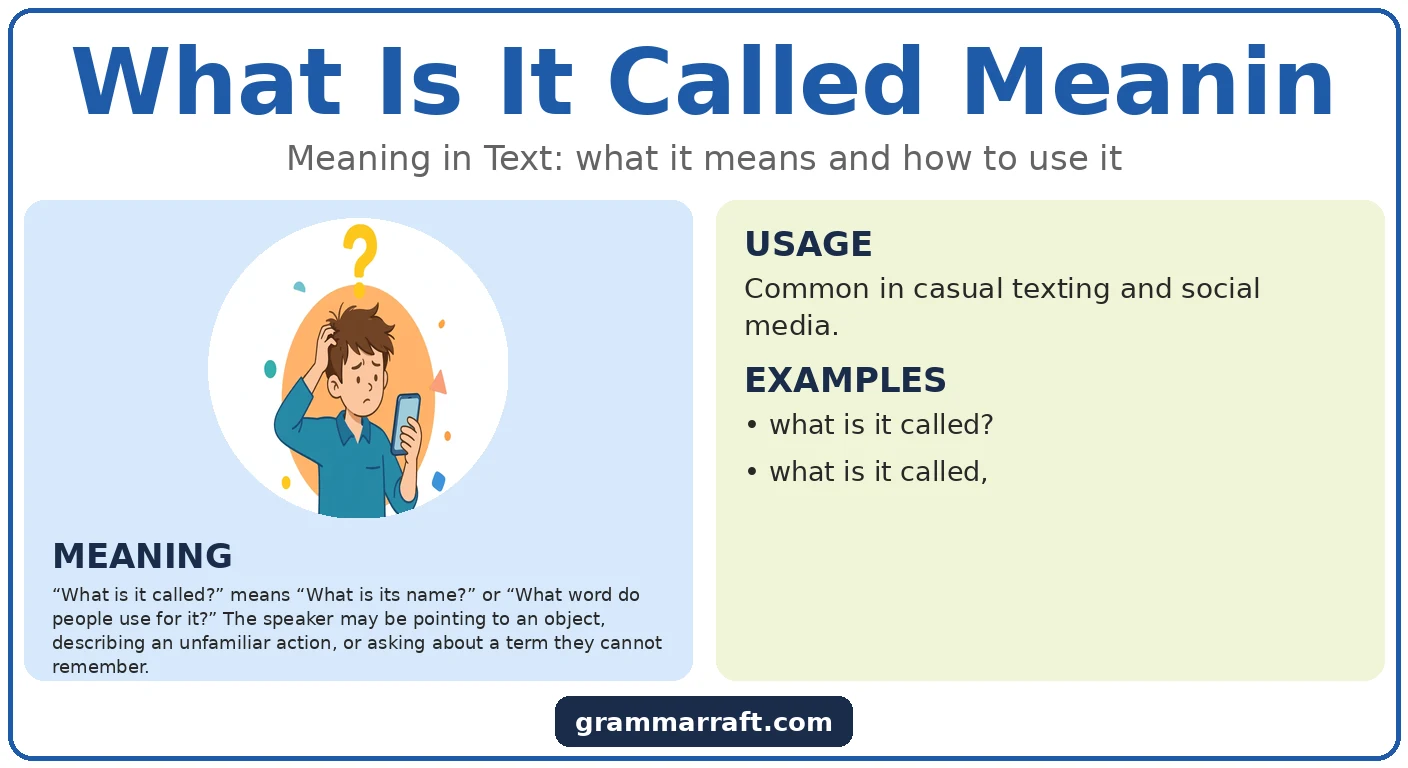
“What is it called?” means “What is its name?” or “What word do people use for it?” The speaker may be pointing to an object, describing an unfamiliar action, or asking about a term they cannot remember.
For example, someone might ask, “What is it called when water turns directly into vapor?” The expected answer is a name for the process: sublimation. In another conversation, a person might point to a kitchen tool and ask, “What is it called?” They want the tool’s name, not an explanation of how it works.
The pronoun it refers to the thing being discussed. The thing could be visible, previously mentioned, or understood from the situation. English speakers often use this short question because repeating the entire description would sound unnecessary.
Here are the most common meanings:
- Requesting a name: “What is it called?” means “What is its name?”
- Requesting a technical term: “What is it called when a word imitates a sound?” asks for the term onomatopoeia.
- Recalling a forgotten word: “What is that called again?” signals that the speaker almost remembers the name.
- Identifying a symbol: “What is this symbol called?” asks for the symbol’s accepted name.
- Identifying a condition or experience: “What is it called when someone fears crowded places?” asks for a label or description.
The question does not always demand one universally correct answer. An object may have a common name, a regional name, and a formal name. For instance, people may use one word in everyday speech while professionals use another term in medicine, law, science, or technology.
How the Grammar of “What Is It Called?” Works
Grammatically, “what is it called?” is a question formed with the verb be and the past participle called. The basic pattern is what + is + it + called. Here, called means “named,” not “contacted by telephone.”
The sentence uses a passive structure. Something or someone gives the object a name, but that person does not need to be mentioned. “What is it called?” is therefore similar to “What name is given to it?” The shorter version sounds much more natural in ordinary English.
Compare these sentences:
| Expression | Meaning | Example |
|---|---|---|
| What is it called? | What is its name? | What is this tool called? |
| What do you call it? | What name do people use? | What do you call this dish? |
| What is it? | What kind of thing is it? | What is it, exactly? |
| What does it mean? | What idea or message does it express? | What does this phrase mean? |
| What is called X? | Which thing has the name X? | What is called a comet? |
“What do you call it?” has nearly the same meaning as “What is it called?” The first version focuses slightly more on the name used by people, while the second focuses on the object’s name. In everyday conversation, native speakers commonly use both.
The word order matters. “What it is called?” is not normally a complete direct question in standard English. It can appear inside a larger sentence, however: “I don’t know what it is called.” In that example, the words form an embedded question, so the subject comes before the verb.
“Called” Has More Than One Meaning

The word called is the past form and past participle of the verb call. Its meaning changes according to context. In “What is it called?” it means “given a name,” but in “She called her friend” it means “contacted by phone” or “spoke to by telephone.”
English uses call for several different actions. A person can call someone on the phone, call someone by a particular name, call for assistance, call someone into a room, or call an event a success. The surrounding words usually make the intended meaning clear.
Consider these examples:
- Giving a name: “They called the puppy Milo.”
- Using a label: “People call this style minimalist.”
- Making contact: “I called my sister last night.”
- Summoning someone: “The manager called the team together.”
- Requesting action: “The situation calls for patience.”
- Predicting correctly: “She called it before anyone else saw the problem.”
- Describing or judging: “He called the decision unfair.”
Context is especially important when the object is a person. “What is she called?” may ask for her name, job title, role, or nickname. “What did he call her?” may ask about an insult, a description, or a name he used.
A related expression, “called for,” also has several uses. A meeting may be “called for Monday,” meaning scheduled for that day, while a loud noise may “call for attention,” meaning it demands notice. These meanings are connected to the older idea of calling someone or something toward a particular action.
The safest way to interpret called is to examine what follows it. “Called it” often differs from “called it by name,” and “called someone” differs from “called someone something.” The grammar provides clues.
What Does “I Called It” Mean?
“I called it” commonly means “I predicted that would happen, and my prediction was correct.” The phrase is informal and often appears after an expected event occurs. Someone might say, “I called it—the team changed its coach,” after previously predicting the change.
This use of called comes from the idea of announcing a judgment or prediction in advance. The speaker is claiming that they identified the likely result before it became obvious. They are not necessarily saying that they caused the event.
For example:
- “I called it. The meeting was canceled.”
- “She called it when she guessed the ending of the film.”
- “You called it—the package arrived today.”
The phrase can also mean claiming something first. In a group of friends, someone might say, “I called the window seat,” meaning they claimed it before another person did. In sports or games, “I call heads” means the speaker chooses or announces heads before a coin is tossed.
There is also a different expression, “I called it quits.” That means “I decided to stop,” often after frustration, exhaustion, or repeated difficulty. A worker might say, “After three hours of repairs, I called it quits.” Here, called does not mean predicted.
| Phrase | Meaning | Typical context |
|---|---|---|
| I called it | I predicted it correctly | News, sports, plans, events |
| I called it first | I claimed it before others | Seats, turns, choices |
| I called it quits | I stopped or gave up | Work, arguments, activities |
| I called you | I telephoned you | Phone conversations |
| I called you that | I used that name or description for you | Labels, insults, descriptions |
These expressions show why the full sentence matters. The same verb can refer to prediction, possession, stopping, communication, or naming.
“What Is Called” Versus “What Is It Called”
“What is called” and “what is it called?” look similar, but they do different grammatical jobs. “What is it called?” is a direct question asking for a name. “What is called” usually introduces a description, a definition, or a passive construction.
In the sentence “This is what is called a compromise,” the phrase means “this is commonly described as a compromise.” It does not ask a question. The word what refers to the thing or situation that receives the description.
Compare the following examples:
- Direct question: “What is it called?”
- Embedded question: “Do you know what it is called?”
- General description: “This is what is called a compromise.”
- Formal definition: “A device that measures temperature is called a thermometer.”
- Literary or formal phrasing: “That is what is called good judgment.”
The expression “what is called” can sound formal, especially when it introduces a concept that the writer wants to define. In ordinary conversation, people may say “what people call” or “what we call” instead. For example, “This is what we call a lucky break” sounds more personal and conversational than “This is what is called a lucky break.”
Another common pattern is “so-called.” This word can be neutral, as in “the so-called control group,” but it can also suggest doubt or criticism. “His so-called solution made the problem worse” implies that the speaker does not believe the solution deserves that name.
Do not confuse “what is called” with “what it is called.” The first often forms part of a statement, while the second contains the normal word order for an indirect question. “Tell me what it is called” is correct; “Tell me what is it called” is not standard English.
How to Ask for a Name Clearly
The best wording depends on what kind of name you need. “What is it called?” is broad and useful, but a more precise question can prevent confusion. If you need a technical term, say so. If you want a spelling, pronunciation, or formal name, ask directly.
Useful alternatives include:
| What you want | Natural question | Example answer |
|---|---|---|
| An everyday name | What is this called? | It’s called a ladle. |
| A technical term | What is the technical term for this? | The technical term is erosion. |
| A person’s name | What is his name? | His name is Daniel. |
| A job or role | What is that role called? | It’s called a mediator. |
| A spelling | How do you spell it? | It’s spelled with two letters of “l.” |
| A pronunciation | How do you pronounce it? | The stress is on the second syllable. |
When speaking to someone you do not know, “What should I call you?” is often more polite than “What are you called?” The first asks what name or title the person prefers. It can also cover nicknames, professional titles, and forms of address.
“What do you call this in English?” is useful in a language-learning situation. It makes clear that the speaker may know the object but not the English word. A learner might point to a household item and ask, “What do you call this in English?”
For a symbol, the wording can be specific: “What is this punctuation mark called?” For an action, ask, “What is it called when someone does that?” For a phrase, ask, “What does this expression mean?” The last question is different because it seeks an explanation rather than a name.
Politeness also changes the tone. “What’s this called?” is casual, while “Could you tell me the name of this?” is more formal. Neither is automatically more correct; the setting determines which sounds appropriate.
“It Is What It Is” and Other Related Expressions
One common search connected with this topic asks about the phrase “it is what it is.” The expression means that a situation exists as it does and cannot easily be changed. It can communicate acceptance, resignation, realism, or sometimes frustration.
Imagine that a flight is delayed because of severe weather. A passenger might say, “It is what it is,” meaning that complaining will not make the weather improve. The phrase does not identify a name, so it has a different function from “what is it called?”
Its tone depends heavily on context and voice. Said calmly, it can sound practical.
Said sharply, it may suggest that the speaker wants to end the discussion rather than examine the problem. In workplace conversations, it can be viewed as reasonable acceptance or as an excuse for not taking action.
Other phrases involving call also have specialized meanings:
- Call it a day: stop working for the day.
- Call someone out: publicly challenge or criticize someone’s behavior.
- Call for something: require or demand something.
- Call upon someone: formally ask someone to act or speak.
- Call something off: cancel it.
- Call something by its name: identify it directly and honestly.
“What is it called?” can also appear in discussions about labels and identity. Someone may ask what a belief, relationship, medical experience, or social behavior is called because a name helps them describe it. Still, a label may not capture every detail, and a formal term should not be treated as a diagnosis without qualified advice.
The central distinction remains simple: “what is it called?” asks for a name, while related expressions such as “it is what it is” express an attitude toward a situation. Similar words do not guarantee similar meanings.
Common Mistakes in Writing and Conversation
One frequent mistake is using question word order inside an indirect question. Write “I wonder what it is called,” not “I wonder what is it called.” Direct questions invert the subject and verb, but embedded questions normally keep statement word order.
Another mistake is confusing called with call. “What is it called?” is correct because the object receives a name. “What does it call?” would mean that the object itself is making a call or giving a name, which is unusual unless the context specifically supports it.
Writers also sometimes use “name” and “meaning” as if they were interchangeable. They are not. “What is this word called?” is unusual if the word is already visible; “What does this word mean?” asks for its definition. “What is this symbol called?” asks for its label, while “What does this symbol represent?” asks about its purpose or message.
Check these corrections:
| Less suitable wording | Better wording | Reason |
|---|---|---|
| What it is called? | What is it called? | Direct questions use inverted word order. |
| Do you know what is it called? | Do you know what it is called? | Embedded questions use statement order. |
| What is this word called mean? | What does this word mean? | Ask for meaning, not the word’s name. |
| What do you call to it? | What do you call it? | The verb does not need “to” here. |
| What is he called? | What is his name? | The second option is clearer for a person’s name. |
Regional English can add another layer. A word may be common in American English but less familiar in British English, or the reverse. If a name seems unfamiliar, ask, “Is that the formal term?” or “Is there another word for it?”
Finally, avoid treating every unusual word as a mistake. Technical vocabulary, slang, dialect, and historical language can all be correct in the right setting. The question “What is it called?” is often the best first step toward finding the appropriate term.
How to Understand the Phrase in Context
The fastest way to interpret “what is it called?” is to identify what the speaker is pointing toward. If the speaker gestures at an object, they want its name.
If they describe a behavior, they may want a technical term. If they repeat a sentence from a conversation, they may actually be asking for the phrase’s meaning.
Listen for the words around called. “What is it called?” usually requests a label. “What was he called?” may ask about a name or title. “What did she call you?” asks what words she used for you. “What do they call this practice?” asks about a customary term used by a group.
The setting provides evidence too. In a classroom, the answer may be a subject-specific vocabulary word. In a restaurant, it may be the name of a dish.
In a church, it could refer to a religious role, ceremony, or building feature. In a phone conversation, “I called” is more likely to concern communication than naming.
When the question is unclear, a short follow-up can solve the problem:
- “Do you mean the name of the object?”
- “Are you asking what the word means?”
- “Do you want the formal term or the everyday one?”
- “Are you asking how to pronounce it?”
- “Do you mean what happened, or what that situation is called?”
Good communication does not always require the most advanced word. The correct term is the one that fits the audience and purpose. A doctor, engineer, teacher, or lawyer may need a precise formal term, while friends may prefer a familiar phrase.
For learners of English, examples are especially useful because one translation rarely covers every use of call. Study the entire sentence rather than memorizing one definition. That approach makes it easier to recognize naming, telephoning, summoning, prediction, and criticism in real speech and writing.
Related guides: Quote Shows: Famous TV Lines, Meaning and Uses · Greatly Appreciated: Meaning, Usage and Better Alternatives · Parents vs Parents Apostrophe: Meaning and Usage
Frequently Asked Questions
What is the meaning of “what is it called”?
“What is it called?” means “What is its name?” It is used when someone wants to identify an object, person, action, symbol, process, phrase, or concept.
Is “what is it called?” grammatically correct?
Yes. It is a standard direct question in English. The usual structure is what + is + it + called, where called means “given a name.”
What is the difference between “what is it called?” and “what does it mean?”
“What is it called?” asks for a name or label. “What does it mean?” asks for an explanation of an idea, word, sign, phrase, or message.
What does “I called it” mean in slang?
“I called it” often means “I predicted it correctly.” It can also mean that someone claimed something first, depending on the context. The phrase is informal.
Is “what it is called” correct English?
Yes, but it usually belongs inside a longer sentence, such as “I don’t know what it is called.” As a direct question, use “What is it called?” instead.
Conclusion
The meaning behind “what is it called” is usually straightforward: the speaker wants the name of something. The verb call, however, has several uses, so context determines whether called refers to naming, telephoning, summoning, predicting, or describing.
Use “what is it called?” for a direct request for a name, “what does it mean?” for an explanation, and “what it is called” inside an indirect question. Once that distinction is clear, you can choose the right phrase in conversation, writing, language study, and formal communication.
Explore more helpful guides on GrammarRaft.