ONG Meaning in Text: Definition, Uses and Examples
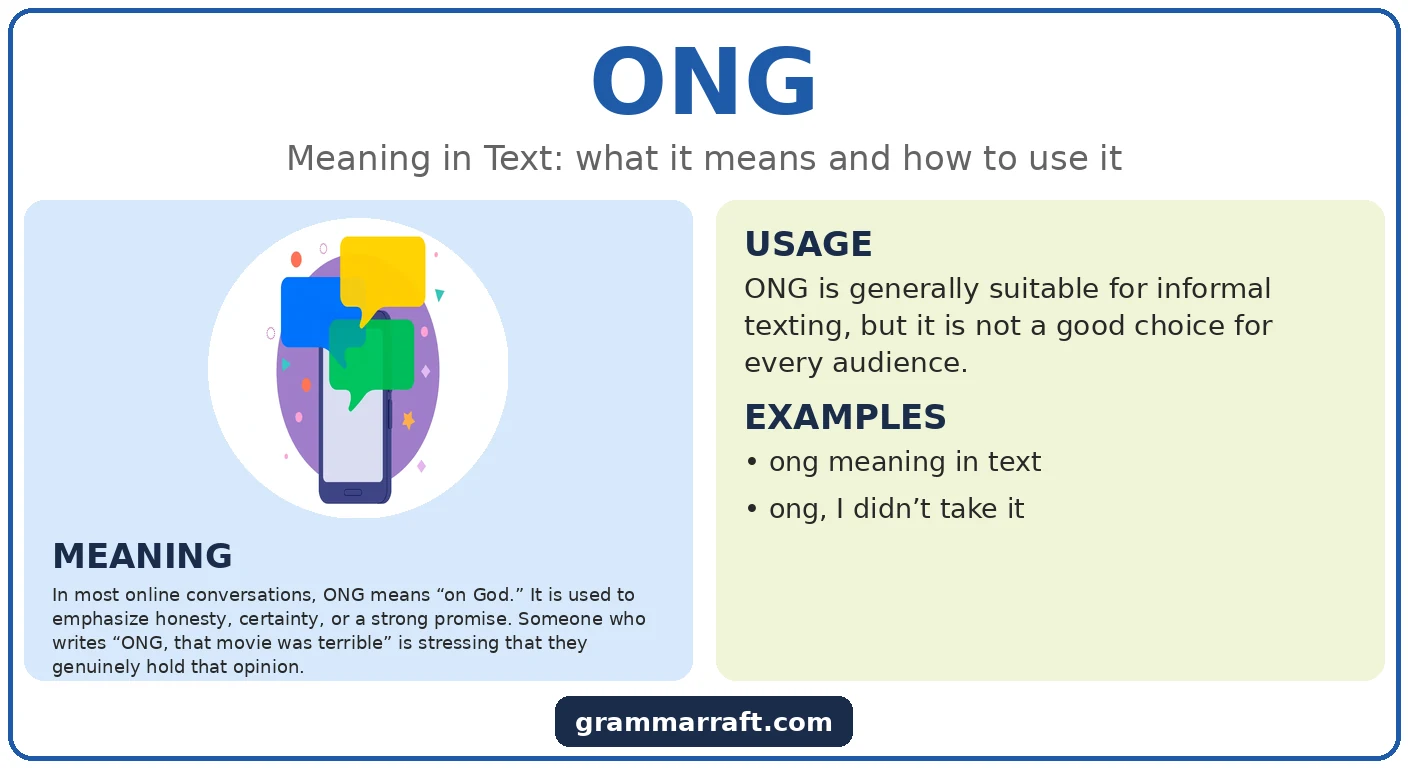
The phrase “ong meaning in text” usually points to “on God,” a slang expression people use to stress that they’re telling the truth. In a message, “ong, I didn’t take it” means “I swear I didn’t take it” or “I’m being completely honest.”
ONG appears in texting, group chats, TikTok comments, gaming messages, and other social media conversations. Its tone can be serious, playful, defensive, or exaggerated, depending on the sentence and the relationship between the people speaking.
This article explains what ONG means, where the expression comes from, how it differs from similar phrases, and how to read it without misunderstanding the sender. You’ll also see examples of ONG used naturally, including cases where it means something else.
What Does ONG Mean in Text?
In most online conversations, ONG means “on God.” It is used to emphasize honesty, certainty, or a strong promise. Someone who writes “ONG, that movie was terrible” is stressing that they genuinely hold that opinion.
The phrase borrows the seriousness of saying something “on God,” which traditionally means making a statement with God as a witness. In casual texting, however, many people use ONG without intending a formal religious oath. It often functions as an intensifier, much like “I swear,” “for real,” or “honestly.”
Context decides how strong the expression sounds. “Ong, I left my keys at home” may be a simple defense against doubt, while “ONG this is the best pizza ever” is probably enthusiastic exaggeration rather than a solemn declaration.
| Text example | Likely meaning | Natural interpretation |
|---|---|---|
| “Ong, I didn’t say that.” | On God; I swear | The sender strongly denies saying it. |
| “That test was hard ong.” | Seriously; honestly | The sender strongly agrees with the statement. |
| “ONG? You actually won?” | On God, really? | The sender is surprised and seeking confirmation. |
| “Onggg, stop sending spoilers.” | Seriously, please stop | The spelling adds emotion or playful frustration. |
ONG can appear at the beginning, middle, or end of a sentence. In lowercase, “ong” usually feels casual; in capitals, “ONG” may signal stronger emphasis, although many people use uppercase simply because it looks more expressive.
Why People Say “On God”
“On God” is an affirmation. The speaker places the statement under the authority of God, which gives it more weight than an ordinary “yes” or “I agree.” In everyday slang, the phrase has often become less formal while keeping its central purpose: showing that the speaker wants to be believed.
The expression can work as a standalone reply. If one person says, “You really got tickets?” another might answer, “ONG.” In that exchange, the short response means, “Yes, I’m telling the truth.”
It can also reinforce an adjective or opinion. “That game was boring ong” means the sender strongly agrees that the game was boring, while “She’s actually the funniest person here, ong” adds conviction to the compliment.
Religious language and casual slang
Not everyone interprets “on God” in exactly the same way. For some people, invoking God is serious and connected to faith, while others use the phrase as ordinary internet slang with no deliberate religious message.
That difference matters in mixed groups. A sender may use ONG casually, but a recipient could view religious swearing as inappropriate or disrespectful. If the conversation is formal, sensitive, or unfamiliar, “honestly” or “I’m serious” is usually clearer and less likely to cause confusion.
The phrase is also not proof that the speaker is religious. Slang crosses communities quickly, and people often repeat expressions they encounter on social media without adopting every cultural or religious association behind them.
How ONG Is Used in Texting and Social Media
See Also: What Does WTW Mean in Text? Meaning, Examples & Replies
ONG is common in short, fast-moving conversations where people want to add force without typing a full explanation. It appears in direct messages, public comments, text messages, gaming chats, and private group conversations. The abbreviation saves time, but it also carries attitude.
People may use ONG to defend themselves, agree with someone, express shock, or underline an emotional reaction. The word before or after it often reveals the intended function.
- To promise honesty: “Ong, I wasn’t at the party.”
- To agree strongly: “That song is catchy, ong.”
- To show surprise: “Ong? You met her?”
- To emphasize a complaint: “Ong, this app keeps crashing.”
- To support a friend: “Ong, you handled that perfectly.”
- To sound humorous or dramatic: “Ong, I’m never eating that again.”
On TikTok and similar media platforms, ONG may appear in comments that are intentionally brief. A commenter might write “ong this is so real” to show strong agreement with a video, or “ONG I thought the same thing” to claim that the creator expressed an experience they share.
The expression can also be combined with other slang. “Ong fr” means something close to “on God, for real,” although the combination may be redundant. “Ong bro” adds a direct address, while “onggg” stretches the ending to make the message sound more emotional.
Position changes the tone
At the start of a message, ONG often introduces a denial or promise: “Ong, I forgot.” At the end, it usually reinforces the entire sentence: “I forgot, ong.” The meaning remains similar, but the second version can sound more conversational.
With a question mark, the expression changes again. “ONG?” may mean “Seriously?” or “Are you telling the truth?” A sender who writes “Ong, you did that?” could be expressing disbelief, admiration, or criticism, so the surrounding conversation matters.
ONG Meaning for Gen Z and Younger Internet Users
Searches for “ONG meaning Gen Z” often assume the term belongs to one specific age group. It is more accurate to say that ONG is part of contemporary internet slang used by many younger people, especially in informal online conversations. Age, location, friend group, and platform all influence whether someone uses it.
Gen Z slang changes quickly because expressions spread through videos, music, gaming communities, and private chats. A term may be common in one group and unfamiliar in another, even when both groups use the same social media app.
That is why a dictionary-style definition only gives part of the answer. “ONG” may mean “on God” in one conversation, but the same letters could have a different meaning in a workplace, technical document, username, or family message.
Is ONG always serious?
No. ONG can be sincere, but it is often used for emphasis rather than a literal oath. Someone might write “ONG I’m starving” after missing lunch, even though the statement is not meant as a serious appeal to God.
Humor is common too. A friend could say “ONG, this homework is trying to end me” to exaggerate frustration. The phrase adds theatrical force, similar to “I swear,” without necessarily making the statement more factual.
Capital letters, repeated letters, and punctuation provide clues. “ong” looks relaxed, “ONG” looks emphatic, and “ongggg” can signal excitement, annoyance, or playful drama. None of these signals is absolute, though.
Examples of ONG in Realistic Conversations
Examples make the meaning easier to recognize because the same abbreviation can serve several conversational purposes. The following exchanges show how ONG works in ordinary texting rather than treating it as a fixed translation.
Example: denying an accusation
A: “Did you tell Maya about the surprise?”
B: “Ong, I didn’t say anything.”
Here, ONG means “I swear” or “I’m telling the truth.” The sender is trying to sound credible and reassure the other person.
Example: agreeing with an opinion
A: “The new update made the app worse.”
B: “Ong, it was better before.”
In this exchange, ONG means “seriously” or “I agree completely.” The sender is not necessarily making a religious statement; they are strongly supporting the opinion.
Example: reacting to surprising news
A: “I got tickets for the final.”
B: “ONG? How?”
The question mark shows disbelief or surprise. Depending on the relationship, the response could be enthusiastic, skeptical, or both.
Example: expressing frustration
A: “The bus is late again.”
B: “Ong, it’s never on time.”
Here, ONG strengthens a complaint. It works like “honestly” and signals that the sender shares the frustration.
Example: playful exaggeration
A: “Want another slice?”
B: “Ong, I’m too full to move.”
This use is humorous. The sender is not making a literal religious oath; they are exaggerating how full they feel for comic effect.
ONG Compared With Similar Texting Terms
ONG is easy to confuse with other short internet expressions, especially OMG, FR, and ISTG. These terms overlap, but they do not communicate precisely the same thing. Choosing the right interpretation requires attention to what the sender is trying to do.
| Term | Common expansion | Main function | Example |
|---|---|---|---|
| ONG | On God | Emphasizes truth, certainty, or agreement | “ONG, I told you.” |
| OMG | Oh my God | Shows surprise, excitement, or alarm | “OMG, that was close.” |
| FR | For real | Shows agreement or asks for confirmation | “FR, that was funny.” |
| ISTG | I swear to God | Stronger promise, warning, or frustration | “ISTG, I checked twice.” |
| IKR | I know, right? | Expresses agreement with a previous remark | “IKR, the ending was strange.” |
ONG and FR are particularly close. “FR” usually means “for real,” while ONG adds the idea of swearing or invoking a strong guarantee. In practice, many people use them interchangeably in casual messages.
ONG and OMG are different despite their similar letters. OMG usually reacts to an event, while ONG supports the truth or intensity of a statement. “OMG, you won” expresses surprise; “ONG, you earned that win” expresses strong agreement or conviction.
ISTG can sound more forceful than ONG. It may carry irritation, especially in a message such as “ISTG, if you do that again…” ONG is often lighter, although tone depends on the sender.
Other Meanings of ONG
Although “on God” is the dominant slang meaning in text, ONG does not always refer to slang. Abbreviations depend on context, and the same three letters can represent an organization, a name, a place, or an unrelated technical term.
One important possibility is a surname. “Ong” is a surname found in Chinese and Southeast Asian communities, including among people whose family names have been romanized in different ways. If a message says “I’m meeting Ong at six,” it probably refers to someone named Ong rather than the slang expression.
ONG may also appear as an organizational abbreviation. In a formal email, document, news item, or professional database, the surrounding words should guide interpretation rather than internet slang assumptions.
How to identify the intended meaning
Ask what role the term plays in the sentence. If it intensifies an opinion or denial, “on God” is likely. If it appears as a person’s name, part of a company name, or an abbreviation in a formal setting, the slang reading may be wrong.
- Check whether the message is casual or formal.
- See whether ONG is followed by a comma, as in “ONG, I forgot.”
- Look at nearby words such as “seriously,” “swear,” “fr,” or “really.”
- Consider whether “Ong” is capitalized like a name.
- Read the previous message before interpreting the abbreviation.
Meaning also depends on the sender. A friend who regularly uses slang may write “ong” automatically, while a business contact may use ONG as an acronym with no connection to texting culture.
Is ONG Appropriate to Use?
ONG is generally suitable for informal texting, but it is not a good choice for every audience. It can sound natural among friends and out of place in a job application, school assignment, customer-service message, or formal email.
The religious reference may also matter. Some people use “on God” casually, while others prefer not to swear by God or use sacred language as slang. A respectful communicator should consider the recipient instead of assuming everyone reads ONG the same way.
Better alternatives in formal writing
If the goal is clarity, replace ONG with a direct phrase. “Honestly,” “I’m serious,” “I can confirm,” and “That’s correct” communicate the intended meaning without relying on slang.
For example, “ONG, I submitted the form” is appropriate only in an informal chat. In a professional message, “I submitted the form yesterday” is clearer and more credible because it gives the fact directly.
There is also a difference between using slang with people who know your style and using it with someone who may not recognize the term. If the recipient has to search for the abbreviation, the message has failed to communicate efficiently.
When ONG can create confusion
A message such as “ONG, fine” can be difficult to read because the sender’s emotion is unclear. It might mean genuine agreement, reluctant acceptance, sarcasm, or annoyance. Tone of voice is absent, so punctuation and surrounding messages become important.
Similarly, “Ong?” can be either friendly surprise or disbelief. If the matter is important, ask a brief follow-up question instead of guessing. “Do you mean you’re serious?” can prevent a small slang misunderstanding from becoming a larger argument.
Texting rewards speed, but speed can remove nuance. A full sentence is often better than an abbreviation when the topic involves money, commitments, conflict, health, or anything else that needs a precise record.
How to Reply When Someone Uses ONG
See Also: What Does GW Mean in Text? Meaning, Uses & Examples
Most of the time, you don’t need a special response. Read ONG as a signal that the sender wants emphasis, then reply to the actual content of the message. If someone writes “Ong, I didn’t take your charger,” the useful response concerns the charger, not the abbreviation.
If you agree, you can answer with “for real,” “same,” or a complete sentence. If you doubt the claim, ask for clarification without treating the slang itself as proof. ONG expresses confidence, but it does not independently verify what someone says.
Simple response examples
- “For real? I thought you had it.”
- “Same, that was my first thought too.”
- “Okay, I believe you.”
- “Wait, do you mean seriously?”
- “I didn’t know ONG meant ‘on God.’”
When the sender uses ONG as a joke, matching the light tone may be natural. When the message concerns an accusation or disagreement, a calm and direct reply is safer than responding with more slang.
People who want to confirm the broader meaning can consult a trusted language reference, such as Merriam-Webster’s entry for “on God”. Even then, the conversation’s context remains the best guide to the sender’s precise intention.
Frequently Asked Questions About ONG
What does ONG mean in a text message?
ONG usually means “on God.” In a text message, it emphasizes that the sender is being truthful, serious, or strongly in agreement. Depending on the sentence, it can also mean “I swear,” “honestly,” or “for real.”
What does ONG mean on TikTok?
On TikTok, ONG commonly means “on God” and appears in comments or captions to express strong agreement or emphasis. A comment such as “ong this is exactly what happened” means the person strongly relates to or confirms the video.
Is ONG the same as OMG?
No. ONG usually means “on God” and emphasizes truth or certainty, while OMG means “oh my God” and usually expresses surprise, excitement, or shock. Their similar appearance can cause confusion, but they serve different purposes.
What does ONG mean from a girl or a guy?
ONG does not have a different fixed meaning based on who sends it. A girl, guy, or anyone else may use it to mean “on God,” “I swear,” or “seriously.” The message’s wording and the relationship between the people matter more than the sender’s gender.
Can ONG mean something other than “on God”?
Yes. ONG can be a surname, an organizational abbreviation, or another name in a formal context. If it appears as part of a person’s name or in a professional document, don’t automatically interpret it as texting slang.
Conclusion
The most common ong meaning in text is “on God,” an informal way to stress honesty, agreement, or strong feeling. It can sound serious, funny, defensive, or surprised, and capitalization or extra letters may change the tone without changing the basic meaning.
Use the surrounding words, punctuation, platform, and relationship to interpret it accurately. If the conversation is formal or sensitive, write “honestly,” “I’m serious,” or a clear full sentence instead. Once you recognize the pattern, ONG is usually easy to understand without overthinking it.
Explore more helpful guides on GrammarRaft.