Huh Meaning in Text: Tone, Uses & Examples
A short message can carry more attitude than its sender intended, and the huh meaning in text depends heavily on context. The word may signal confusion, surprise, disbelief, or a request for clarification rather than a fixed definition.
In a conversation, “huh?” often means “What did you say?” or “What do you mean?” A plain “huh” without punctuation can sound more skeptical, annoyed, or emotionally flat, especially if it follows an unexpected claim.
Understanding the surrounding message, punctuation, relationship, and conversational tone helps you read it correctly. The examples below show what huh means in texting, how it differs from similar chat abbreviations, and how to reply without creating more confusion.
What Does Huh Mean in Text?
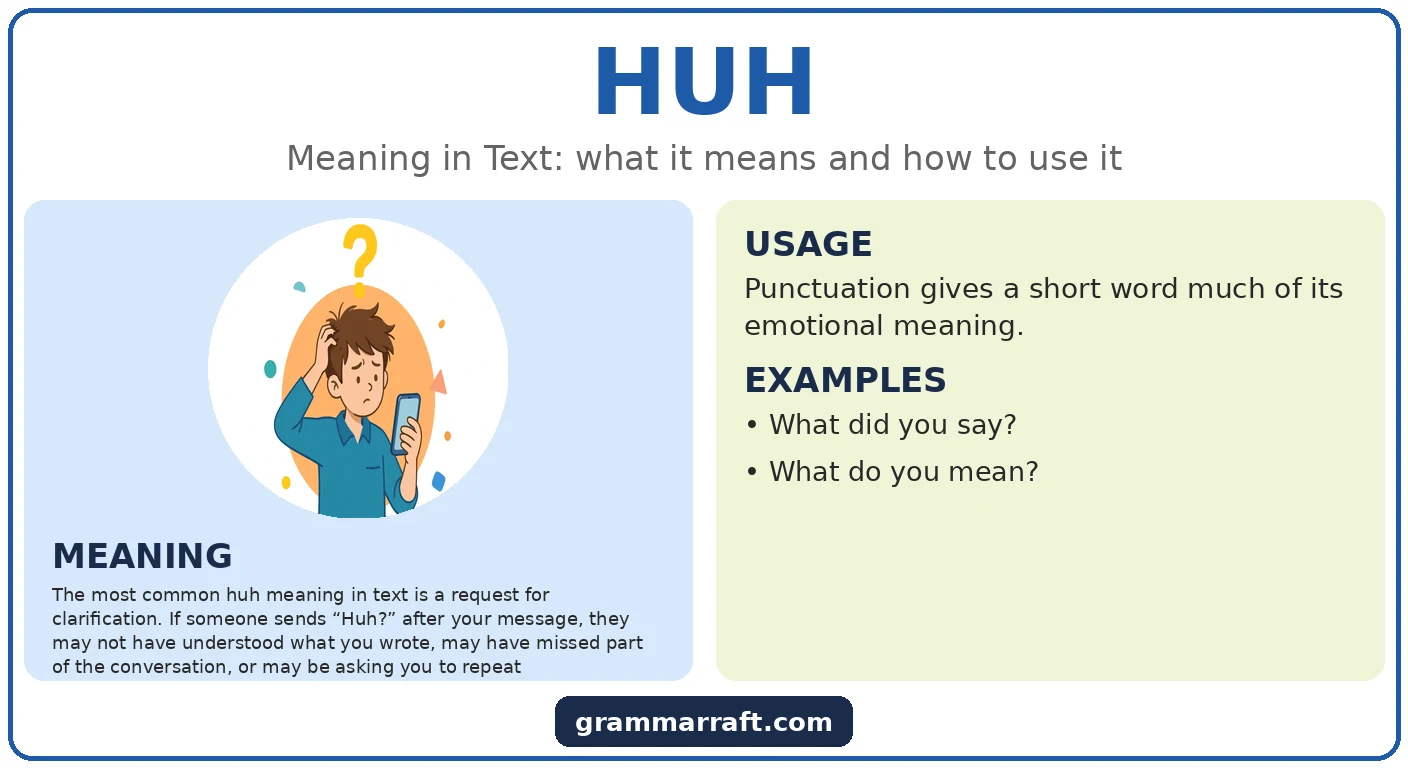
The most common huh meaning in text is a request for clarification. If someone sends “Huh?” after your message, they may not have understood what you wrote, may have missed part of the conversation, or may be asking you to repeat yourself.
For example, imagine texting, “The meeting got moved to Thursday.” A reply of “Huh?” probably means the other person is surprised or did not expect the change. In that situation, it does not necessarily express anger; it signals that your message needs more explanation.
“Huh” can also communicate disbelief. If you write, “I saw Jordan at the airport in Madrid,” the response “Huh” might mean “That’s unexpected” or “I’m not sure I believe that.” The reader’s relationship with you and the subject being discussed can change the emotional force of the word.
Unlike a formal abbreviation, huh is an interjection. It represents a small spoken reaction in written form. The [Cambridge Dictionary definition of “huh”] also reflects its use as a sound associated with surprise, uncertainty, or a request for repetition.
In practical terms, “what does huh mean” has several answers:
- Confusion: “I don’t understand what you mean.”
- Clarification: “Could you repeat or explain that?”
- Surprise: “That was unexpected.”
- Disbelief: “That sounds hard to believe.”
- Annoyance: “I’m frustrated that this is happening.”
- Sarcasm: “That statement seems obvious or ridiculous.”
The safest interpretation is usually the simplest one: the sender wants you to respond to something unclear or surprising. Before assuming hostility, check the rest of the conversation and consider how that person normally texts.
Huh in Texting: Punctuation Changes the Tone
Punctuation gives a short word much of its emotional meaning. Since text messages remove facial expressions, vocal pitch, and pauses, a question mark or exclamation mark can act like a substitute for spoken delivery.
“Huh?” is generally the clearest form. It often asks for repetition, as in “Huh?
I didn’t see that message,” or expresses immediate surprise, as in “Huh? They approved it already?” The question mark makes the message feel active and responsive rather than finished.
“Huh!” usually carries stronger surprise. Someone might write it after hearing an unexpected fact, although “Huh!” is less common than “Wow,” “Really?” or “Wait, what?” It can sound positive, negative, or neutral depending on the information that came before it.
A plain “huh” without punctuation is more ambiguous. It may sound thoughtful, doubtful, bored, or annoyed because the reader has no clear grammatical signal. In a tense conversation, “huh” can feel dismissive even if the sender intended only mild confusion.
| Form | Likely meaning | Possible tone | Example situation |
|---|---|---|---|
| “Huh?” | Request for repetition or clarification | Confused or surprised | “Huh? Which address?” |
| “Huh!” | Strong reaction to new information | Surprised or impressed | “Huh! I didn’t know that.” |
| “huh” | Unclear acknowledgment or doubt | Flat, skeptical, or reflective | “Huh. That’s one way to do it.” |
| “huh??” | Intense confusion or disbelief | Confused, shocked, or incredulous | “Huh?? You already left?” |
| “huh…” | Uncertainty or a pause for thought | Hesitant, suspicious, or reflective | “Huh… I hadn’t considered that.” |
Multiple question marks increase intensity, but they do not create one universal meaning. “Huh??” might be playful among friends and confrontational in a disagreement. The surrounding words are more reliable than punctuation alone.
Common Uses of the Huh Expression
The huh expression appears in several conversational roles. In face-to-face speech, people use it almost automatically, sometimes before they have decided whether they are confused, impressed, or doubtful. Texting preserves that flexibility, which is why the word can be difficult to interpret without context.
Asking Someone to Repeat Themselves
The most ordinary use is a request to repeat information. “Huh?” can mean “I didn’t hear you,” even though no sound is involved in a text conversation. A person may have skimmed the message, missed an earlier notification, or not understood a reference.
A clearer version would be “Huh? Could you explain that?” or “Sorry, I missed the last part.” If you are the recipient, replying with a short explanation usually works better than treating the message as an insult.
Showing Surprise
People also use huh as a small marker of surprise. “Huh, that’s earlier than I expected” acknowledges new information without making the reaction dramatic. This use is common in casual conversations where the sender wants to show interest but not excitement.
Expressing Doubt
In another context, “huh” suggests that a claim does not fit the sender’s expectations. A message such as “Huh.
I thought you said the store was closed” may challenge the earlier statement. The period makes the reaction feel more deliberate and skeptical than “Huh?”
Buying Time
Sometimes huh is a thinking sound. A person may write “Huh…” while deciding how to answer, especially if the topic is complicated or emotionally sensitive. It can mean “Let me think about that,” not “I have no idea what you’re saying.”
These meanings overlap. A sender can be surprised because they are confused, or doubtful because they want clarification. Treat huh as a signal that something in the exchange deserves attention, not as a complete explanation of the sender’s mood.
Huh Slang, Internet Language, and Chat Abbreviations
Huh slang is not the same as an acronym or a shortened phrase such as “IDK,” “BRB,” or “IMO.” Those chat abbreviations normally stand for specific words. Huh is a written representation of a spoken interjection, so its meaning comes from use and tone rather than from a fixed expansion.
That distinction matters because some readers search for a “huh abbreviation” as if the letters represent a longer expression. In most ordinary texting, huh is not an abbreviation. It is simply the sound people make when they are puzzled, surprised, or asking someone to repeat something.
The word also belongs to a broader group of casual internet language. Expressions such as “wait,” “what,” “hmm,” “oh,” and “really?” can perform similar conversational work, but they are not interchangeable in every situation.
- “What?” can sound direct, impatient, or confrontational.
- “Huh?” often sounds more informal and conversational.
- “Hmm.” usually suggests thought, doubt, or evaluation.
- “Wait, what?” commonly signals sudden confusion or disbelief.
- “Oh?” may show interest, surprise, or a request for more detail.
- “Really?” can express genuine interest, skepticism, or sarcasm.
Age, region, platform, and personal habits influence these choices. Someone who frequently uses short replies may send “huh” with no negative intention, while another person may use it only when annoyed. There is no universal texting dictionary that assigns one emotional value to every use.
Internet slang also changes quickly, but huh remains closely connected to ordinary spoken English. It is not a specialist term tied to one platform or online community. That makes context especially important: the same word may appear in a private text, a group chat, a gaming conversation, or a public comment and carry slightly different social signals.
How Context Determines the Huh Response
The message immediately before huh is usually the strongest clue. If someone responds to a complicated explanation with “Huh?”, confusion is likely. If they respond to an unbelievable story with “Huh,” disbelief becomes more plausible.
The relationship between the people matters too. Friends may use a blunt “huh” playfully because they share a conversational history. A coworker, customer, or new acquaintance may appear rude when they use exactly the same wording, particularly in a professional discussion.
Timing can provide another clue. A quick “Huh?” sent immediately after a message often indicates that the recipient did not understand or wants you to repeat yourself. A delayed “Huh…” after a long discussion may suggest reflection, suspicion, or uncertainty about how to respond.
Look at the sender’s usual habits rather than judging one isolated message. If they regularly write “huh,” “hmm,” and “okay” as short acknowledgments, the word may be neutral. If they normally use full sentences and suddenly send “huh,” a change in tone may be meaningful.
Several contextual signals are useful:
- Earlier disagreement: “Huh” may carry annoyance or disbelief.
- Unexpected news: Surprise is more likely than anger.
- Complex instructions: Confusion or clarification is the likely purpose.
- Repeated explanations: The sender may be frustrated.
- Joking language: Sarcasm or playful disbelief may be intended.
- Formal conversation: The reply may simply be too brief, not deliberately rude.
Text message interpretation becomes harder when messages lack surrounding detail. A single huh cannot reveal the sender’s exact intention. It only tells you that the previous message produced a noticeable reaction, and you need more information to identify which reaction it was.
When “Huh” Sounds Sarcastic or Annoyed
A huh response can sound sarcastic when the sender treats an obvious point as though it were surprising. For example, someone might reply “Huh, who could have predicted that?” after a plan fails exactly as expected. In this case, huh is part of a larger sarcastic sentence, not a sincere request for clarification.
Short replies also become sharper during conflict. “Huh” after a correction may imply, “I heard you, but I don’t accept that explanation.” A sequence such as “Huh. Right. Sure.” usually communicates skepticism or irritation even though none of the individual words is openly aggressive.
Annoyance often appears through repetition. If a person sends “Huh?” after every explanation, they may be struggling to follow the conversation, but they may also be signaling that they do not want to engage. The pattern matters more than one occurrence.
Capitalization can add force without settling the meaning. “HUH?” looks louder and more confrontational than “huh?” but may be playful in a close friendship. Emojis, previous jokes, and the sender’s normal style can either soften or intensify that appearance.
If the meaning is uncertain, ask instead of escalating. A useful reply might be:
- “Do you mean you want me to explain?”
- “Was that surprising, or did my message not make sense?”
- “I may have worded that badly. I meant…”
- “Are you disagreeing with me?”
These responses make the hidden issue explicit. They also prevent a small huh from turning into a larger argument based on assumptions. In digital communication, a calm clarification is usually more productive than trying to infer emotion from punctuation alone.
How to Reply to “Huh?” in a Text Message
Your best reply depends on what you were trying to say. If the original message contained unfamiliar information, explain it in plain language. If the message was vague, acknowledge that and provide the missing detail instead of repeating the same wording.
For example, after “Huh?” follows “The appointment is at the annex,” you could write, “The smaller building behind the main office—the one we used last month.” That answer addresses possible confusion directly and gives the recipient a concrete reference point.
If you suspect surprise, a brief acknowledgment can keep the conversation natural: “I know, I didn’t expect it either.” If you suspect disbelief, provide the relevant evidence without sounding defensive: “I checked the confirmation email, and it lists Thursday.”
When the reply seems annoyed, do not mirror the tone immediately. Ask a neutral question such as “Did something about that bother you?” A direct but calm question can distinguish a genuine misunderstanding from sarcasm or frustration.
Some replies are less helpful. “Never mind,” “Forget it,” or “Whatever” may end the exchange, but they can make the other person feel blamed for asking. If the conversation matters, one extra sentence of context is usually a better investment.
For professional messages, replace vague reactions with specific language. Instead of writing “Huh?” to a colleague, try “Could you clarify which deadline you mean?” Instead of replying to a customer with “huh,” use “I’m not sure I understand the issue; could you share the order number?”
These alternatives preserve the conversational tone while reducing ambiguity. They also show that text communication does not have to depend on interpreting a single informal sound.
Huh Compared With Similar Texting Expressions
Readers often compare huh with “what,” “hmm,” and “eh” because all four can appear in casual conversations. Their meanings overlap, but their usual conversational functions are different.
“What?” is often a direct request for repetition. It can be perfectly neutral, yet it may sound more abrupt than huh. “Hmm” generally indicates that the sender is thinking or evaluating an idea, while “eh” can express indifference, uncertainty, or a mild lack of enthusiasm.
| Expression | Typical function | Common risk in texting |
|---|---|---|
| Huh? | Confusion, surprise, or clarification | May sound skeptical or annoyed |
| What? | Request for repetition | Can seem abrupt or angry |
| Hmm | Thinking, doubt, or evaluation | May seem unconvinced or evasive |
| Eh | Indifference or uncertainty | Can sound dismissive |
| Wait, what? | Sudden confusion or disbelief | May dramatize a small misunderstanding |
| Really? | Interest, surprise, or doubt | May be read as sarcasm |
The difference is not purely grammatical. Speakers develop personal habits, and their choices can be shaped by culture, age, social group, and platform. One person’s “huh” is another person’s “wait, what?”
If you need an unmistakable message, state the intended meaning directly. “I’m confused—can you explain?” is clearer than “Huh?” Likewise, “That surprises me” avoids making the recipient guess whether you are asking a question or expressing doubt.
Learning these distinctions helps with text message interpretation, but it should not turn every short reply into a psychological puzzle. Most ordinary uses are resolved by one follow-up question.
FAQ About Huh Meaning in Text
Does “huh?” mean the person is confused?
Usually, yes, but confusion is only one possibility. “Huh?” can also show surprise, disbelief, or a request for repetition. The message before it, punctuation, and the sender’s usual texting style help identify the intended meaning.
Is “huh” rude in a text message?
It can sound rude because it is very short and provides no explanation. However, many people use it casually without intending disrespect. If you are unsure, respond with “Do you want me to explain?” rather than assuming the sender is being hostile.
What is the difference between “huh?” and “what?”
Both can ask someone to repeat or clarify information. “What?” often sounds more direct, while “huh?” tends to feel more informal and conversational. Either word can become impatient or sarcastic depending on the surrounding text.
What does “huh” without a question mark mean?
Without punctuation, “huh” may show reflection, doubt, surprise, or a flat acknowledgment. It is more ambiguous than “huh?” because the reader cannot tell as easily whether the sender is asking a question.
Additional wording, such as “Huh. I hadn’t thought of that,” makes the intention clearer.
Is huh an abbreviation or internet slang?
In ordinary texting, huh is not usually an abbreviation for a longer phrase. It is an interjection that represents a spoken reaction. It can appear in internet slang and casual chat, but its meaning comes from context rather than from a fixed set of initials.
Conclusion
The huh meaning in text is flexible: it can signal confusion, clarification, surprise, disbelief, sarcasm, or annoyance. “Huh?” most often asks for repetition, while “huh” without punctuation leaves more room for doubt and emotional interpretation.
Read the surrounding message, consider the sender’s normal style, and ask a calm follow-up question before assigning a negative motive. If you have a particularly unclear exchange, share the wording and context with someone you trust; a little extra context usually makes the intended huh response much easier to understand.
Related Articles
- IMA Meaning in Text: What Does IMA Mean?
- SYBAU Meaning in Text: What Does SYBAU Mean?
- GMFU Meaning in Text: What Does GMFU Mean?
Explore more helpful guides on GrammarRaft.