SA Meaning: What Does SA Mean in Text, Slang, and Social Media?
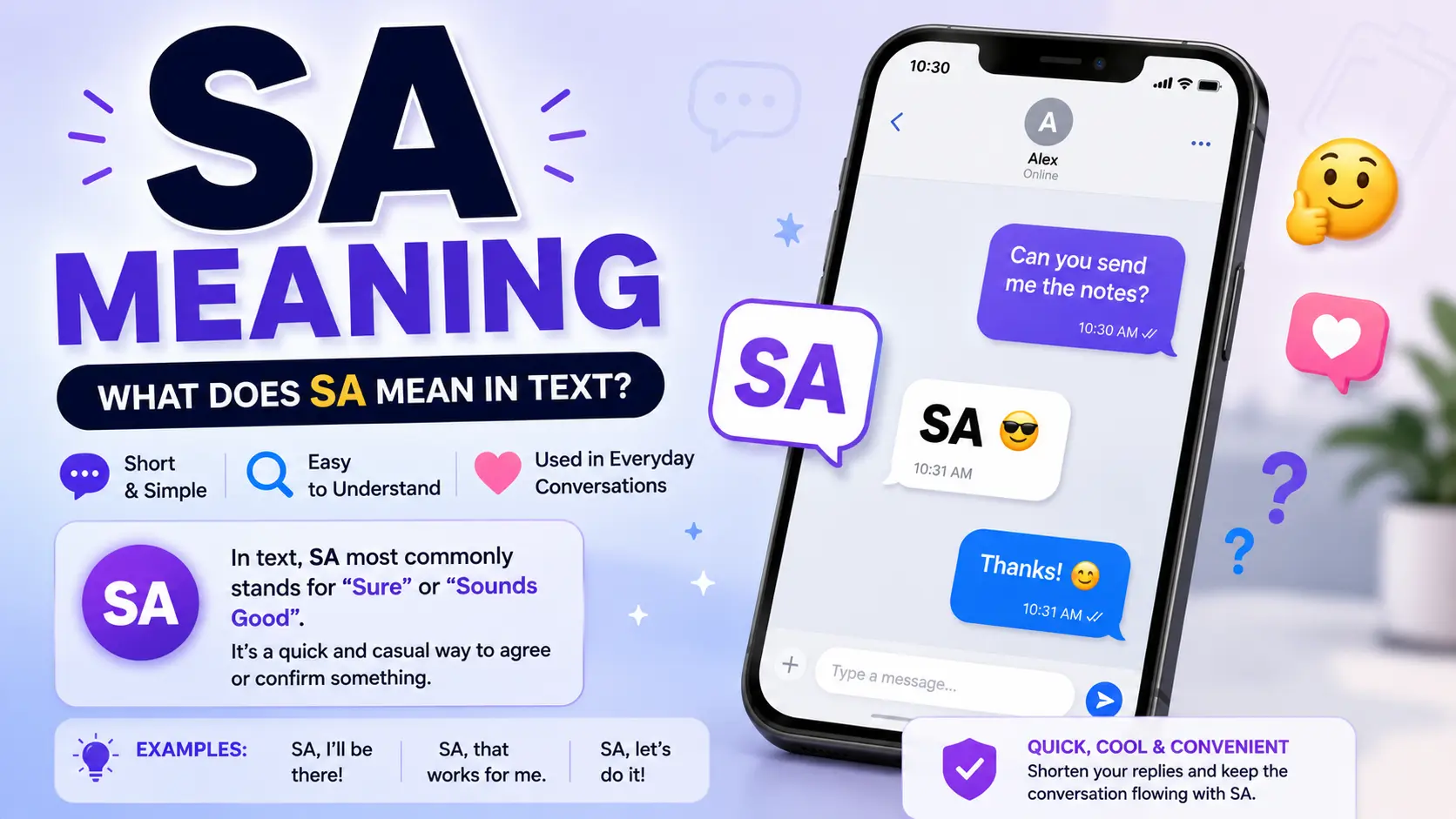
Seeing “SA” in a message can leave you wondering what the sender actually meant. Unlike abbreviations such as “LOL” or “BRB,” SA does not have one universal meaning. Its definition changes according to the conversation, platform, culture, and even the people involved.
In texting and online communication, SA can refer to South Africa, sexual assault, social anxiety, situational awareness, South Asia, or other context-specific phrases. In some communities, it may also be used as a shortened greeting such as “Salam Alaikum.”
That is why context matters so much. A message about travel may use SA for South Africa, while a serious awareness post may use it for sexual assault. The same two letters can carry completely different meanings.
SA Meaning: Quick Meaning
The simplest answer is that SA is a context-dependent abbreviation. There is no single definition that works in every conversation.
Common meanings include:
- South Africa, especially in travel, sports, geography, and online discussions
- Sexual assault, particularly in sensitive conversations, awareness posts, and support communities
- Social anxiety, often in conversations about emotions, mental well-being, or social situations
- Situational awareness, especially in gaming, security, military, and safety discussions
- South Asia, particularly in regional, academic, travel, or cultural discussions
- Same as, occasionally used as informal shorthand
- Salam Alaikum, in some South Asian and Muslim online communities
For example:
“I’m traveling to SA next month.”
Here, SA probably means South Africa.
“The post talks about SA awareness.”
Here, it may refer to sexual assault.
“My SA makes parties difficult.”
In this situation, SA could mean social anxiety.
The surrounding words usually provide the strongest clue.
Origin & Background of SA
There is no single origin story for SA because it is an abbreviation used for several unrelated expressions. Different communities adopted the same two letters for different purposes.
For example, South Africa has long been shortened to SA in geographical, sporting, travel, and political contexts. Online communication made this abbreviation even more convenient because people naturally favor shorter expressions when typing quickly.
The abbreviation also became common in discussions about sensitive subjects. In online communities, sexual assault is frequently shortened to SA when people discuss awareness, personal experiences, support, or content warnings.
Another development comes from social media culture. Younger users frequently shorten phrases when discussing feelings and personal experiences. That is one reason SA may appear as social anxiety in posts and conversations.
Digital communication did not create every meaning of SA, but it helped different meanings exist side by side. TikTok comments, Instagram captions, WhatsApp groups, gaming chats, and online forums all encourage quick communication.
The result is an abbreviation that looks simple but requires context to interpret correctly.
Real-Life Conversations
The easiest way to understand SA is to see how the surrounding conversation changes its meaning.
WhatsApp Conversation
Person A:
“SA everyone! Are we still meeting after lunch?”
Person B:
“Wa Alaikum Salam! Yes, I’ll be there around 2.”
Here, SA is being used as a shortened greeting based on Salam Alaikum. This usage is particularly recognizable in communities where the greeting is already familiar.
Instagram DM
Person A:
“I saw your post about SA awareness. Are you okay?”
Person B:
“Yes, I’m okay. I just wanted people to understand how serious the issue is.”
In this conversation, SA refers to sexual assault. The serious subject makes the intended meaning clear.
TikTok Comments
Person A:
“My SA makes it impossible for me to speak in front of a huge crowd.”
Person B:
“I completely understand. Even small groups can feel overwhelming sometimes.”
Here, SA most likely means social anxiety.
Text Message
Person A:
“Are you flying to SA this summer?”
Person B:
“Yep! Cape Town first, then Johannesburg.”
Here, SA clearly means South Africa because the conversation is about travel.
These examples show why interpreting SA from the letters alone can be risky. The surrounding words reveal the intended meaning.
Emotional & Psychological Meaning
SA can carry very different emotional weight depending on what it represents.
When it means South Africa, there is usually no particular emotional meaning. It is simply a convenient abbreviation.
When SA means social anxiety, however, it may communicate vulnerability. Someone saying “My SA is really bad today” may be describing discomfort, fear, nervousness, or difficulty being around other people.
When SA refers to sexual assault, the emotional weight is considerably more serious. People may use the abbreviation because the full phrase feels difficult to repeat, because they are discussing a sensitive experience, or because the abbreviation is already understood within a support community.
This is an important lesson about digital communication: short words do not always represent small ideas.
I have often found that the safest approach with ambiguous abbreviations is to slow down rather than immediately react. If someone sends “SA” and the context is unclear, asking “What do you mean by SA here?” is usually better than making an uncomfortable assumption.
Usage in Different Contexts
Social Media
SA appears frequently on Instagram, TikTok, Facebook, X, and other platforms because social media encourages short-form communication.
A travel creator might write “SA trip,” meaning South Africa. A mental health creator might discuss SA as social anxiety. An awareness account might use SA when discussing sexual assault.
The platform itself does not determine the meaning. The subject of the post does.
Friends and Relationships
Among friends, SA may be used as an informal shortcut. However, people should not assume that everyone interprets the abbreviation in the same way.
If one friend knows SA as “social anxiety” and another understands it as “South Africa,” confusion can happen very quickly.
Work and Professional Settings
SA can appear in professional communication, but its meaning depends heavily on the industry.
It may refer to situational awareness, service account, South Africa, systems architecture, or another field-specific term.
Because professional communication depends on clarity, it is better to define an unfamiliar abbreviation the first time you use it.
Casual vs. Serious Tone
The tone surrounding SA is especially important.
“SA vacation photos” is casual and likely geographic.
“SA awareness campaign” is much more serious.
“My SA makes this difficult” may involve a personal or emotional issue.
The same abbreviation can therefore move from completely ordinary to deeply sensitive depending on context.
When NOT to Use SA
There are situations where writing the full phrase is much safer.
Avoid Unexplained SA in Formal Writing
Academic papers, official reports, business documents, and professional emails should prioritize clarity.
If you use SA, explain what it means first unless the abbreviation is universally understood within that field.
Be Careful With Sensitive Meanings
If SA refers to sexual assault, avoid using it casually or jokingly. It represents a serious subject involving real experiences and trauma.
Avoid Guessing Someone’s Meaning
If someone says “My SA is getting worse,” do not automatically assume what they mean. Ask for clarification if the context does not make it obvious.
Consider Your Audience
A phrase that is completely familiar within one online community may be confusing elsewhere.
Clear communication is more important than saving two or three characters.
Common Misunderstandings
One of the biggest mistakes people make is assuming that SA always has the same meaning.
For example, someone may see SA in a travel conversation and interpret it as social anxiety. Another person may see the same letters in a mental health discussion and assume South Africa.
There is also a difference between literal context and emotional context.
If the message mentions airports, cricket, Cape Town, Johannesburg, or travel, South Africa is a strong possibility.
If it mentions nervousness, crowds, conversations, or fear of social situations, social anxiety may be more likely.
If it discusses awareness, survivors, abuse, or support, sexual assault may be the intended meaning.
The safest habit is simple: read the entire sentence before deciding what SA means.
Comparison Table
| Term | Likely Meaning | Typical Context | Key Difference |
|---|---|---|---|
| SA | Context-dependent abbreviation | Texting, social media, work | Several possible meanings |
| LOL | Laugh out loud | Casual chats | Usually expresses amusement |
| BRB | Be right back | Texting | Usually describes an action |
| TBH | To be honest | Social media, chats | Introduces an honest opinion |
| NGL | Not gonna lie | Casual online speech | Signals personal honesty |
| Same | Agreement or shared feeling | Friends, comments | Clearer than ambiguous SA |
| South Africa | Country name | Travel, sports, geography | Specific geographic meaning |
Key Insight
Unlike many popular internet abbreviations, SA should not be interpreted in isolation. The topic, sentence, relationship between speakers, and surrounding vocabulary usually matter more than the abbreviation itself.
Variations and Types of SA
Because SA has several established uses, recognizing the category can make interpretation much easier.
1. SA as South Africa
Meaning: South Africa.
Used in travel, sports, geography, news, and everyday conversation.
2. SA as Sexual Assault
Meaning: Sexual assault.
Common in awareness, educational, support, and sensitive online discussions. This meaning requires respectful handling.
3. SA as Social Anxiety
Meaning: Social anxiety.
Often appears when people discuss nervousness, social situations, relationships, school, work, or personal experiences.
4. SA as Situational Awareness
Meaning: Awareness of what is happening around you.
This can appear in gaming, security, safety, military, and high-pressure environments.
5. SA as South Asia
Meaning: South Asia.
Used in discussions about the region, including countries such as Pakistan, India, Bangladesh, Sri Lanka, Nepal, Bhutan, and the Maldives.
6. SA as Same As
Meaning: Same as.
This is an informal and less common interpretation. It can appear in quick messages where the meaning is obvious from the previous sentence.
7. SA as Salam Alaikum
Meaning: A shortened written form associated with the greeting “As-salamu alaykum.”
This usage can occur in Muslim and South Asian digital conversations, especially when participants already understand the greeting.
8. SA as Service Account
Meaning: An account used by a software system or service.
This is more likely to appear in IT, cloud, software, or technical discussions than ordinary texting.
9. SA as Systems Architecture
Meaning: Systems architecture.
This is a professional or technical usage and should be interpreted from the surrounding workplace or technology context.
10. SA as Social Awareness
Meaning: Awareness of social situations, people, or social dynamics.
This interpretation is less universal and should only be assumed when the surrounding discussion supports it.
How to Respond When Someone Uses SA
Your response should depend on what you believe the person means.
Casual Replies
If SA is being used as a greeting:
- “Wa Alaikum Salam!”
- “Hey! How are you?”
- “SA! What’s up?”
Funny Replies
If the context is clearly casual:
- “Wait, SA means what this time? 😂”
- “Two letters and five possible meanings 😭”
- “You’re going to have to give me some context here 😂”
Mature Replies
When the meaning is unclear:
- “What do you mean by SA here?”
- “Just checking, what does SA stand for in this message?”
- “I want to make sure I understand you correctly.”
Respectful Replies
For sensitive subjects, avoid jokes and respond thoughtfully.
You might say:
- “Thanks for explaining.”
- “I understand what you mean.”
- “I’m sorry you’re dealing with that.”
- “I appreciate you sharing that.”
A thoughtful response shows that you are paying attention not only to the abbreviation but also to the person behind it.
Regional & Cultural Usage
Western Culture
In Western online spaces, SA may commonly be encountered as sexual assault, social anxiety, South Africa, or situational awareness, depending on the topic.
Social media and gaming communities can give the abbreviation additional specialized meanings.
Asian Culture
Across South Asian online communication, abbreviations can mix English with local language and cultural expressions.
SA may refer to South Asia, South Africa, or a shortened greeting in communities familiar with “Salam Alaikum.” The surrounding conversation remains essential.
Middle Eastern Culture
In Middle Eastern and Muslim communities, abbreviated forms of familiar greetings may appear in digital conversations.
However, not every person will use SA in this way. It should not automatically be interpreted as a greeting without supporting context.
Global Internet Usage
The internet has brought different communication communities together. As a result, one abbreviation can travel across cultures and develop multiple interpretations.
That is why SA may mean one thing in a gaming server and something completely different in a family WhatsApp group.
Gen Z vs. Millennials
Younger internet users may be more comfortable with highly compressed communication, particularly on TikTok, Instagram, Discord, and messaging platforms.
Millennials may recognize many of the same abbreviations but can interpret them differently depending on their online communities and professional background.
The important point is that age alone cannot determine the meaning. Context still wins.
Is SA Safe for Kids?
SA itself is not automatically unsafe. The concern comes from what it represents in a particular conversation.
If a child sees SA in a geography lesson, it may simply mean South Africa. In another online discussion, however, SA could refer to sexual assault or another sensitive subject.
Parents and educators can teach children a useful digital-literacy habit: do not guess unfamiliar abbreviations from the letters alone.
If something seems confusing or concerning, asking a trusted adult about the context is a better response than searching for a single definition and assuming it applies everywhere.
FAQs
What does SA mean in texting?
SA can have several meanings in texting, including South Africa, sexual assault, social anxiety, situational awareness, South Asia, and other context-specific expressions.
Is SA a slang word?
SA is better described as an abbreviation or initialism rather than one fixed slang word. Its meaning changes according to context.
What does SA mean on social media?
On social media, SA can mean different things. The most likely interpretation depends on whether the post discusses travel, mental health, awareness, geography, gaming, or another topic.
Does SA mean sexual assault?
It can. SA is commonly used as a shortened reference to sexual assault in serious discussions and awareness content.
Can SA mean South Africa?
Yes. SA is widely used as a shortened form of South Africa, particularly in travel, sports, geography, and online discussions.
What does SA mean when talking about anxiety?
When the conversation concerns fear of social situations, nervousness, crowds, or difficulty interacting with others, SA may mean social anxiety.
How can I know which SA meaning is correct?
Look at the surrounding words and subject of the conversation. If the meaning is still unclear, simply ask the sender what they mean.
Conclusion
The real SA meaning cannot be reduced to one definition. It is a flexible abbreviation whose interpretation changes with context, culture, platform, and conversation.
It can refer to South Africa in a travel discussion, sexual assault in an awareness post, social anxiety in a personal conversation, situational awareness in gaming, or South Asia in a regional discussion. In some communities, it can also function as a shortened greeting.
The most useful rule is simple: do not read SA by itself. Read the message around it.
Two letters can carry a surprisingly large amount of meaning. Understanding that is not just useful for decoding internet slang. It is a reminder that good digital communication depends on context, empathy, and knowing when to ask instead of assuming.