When to Use a Semicolon: Rules, Examples & Easy Guide
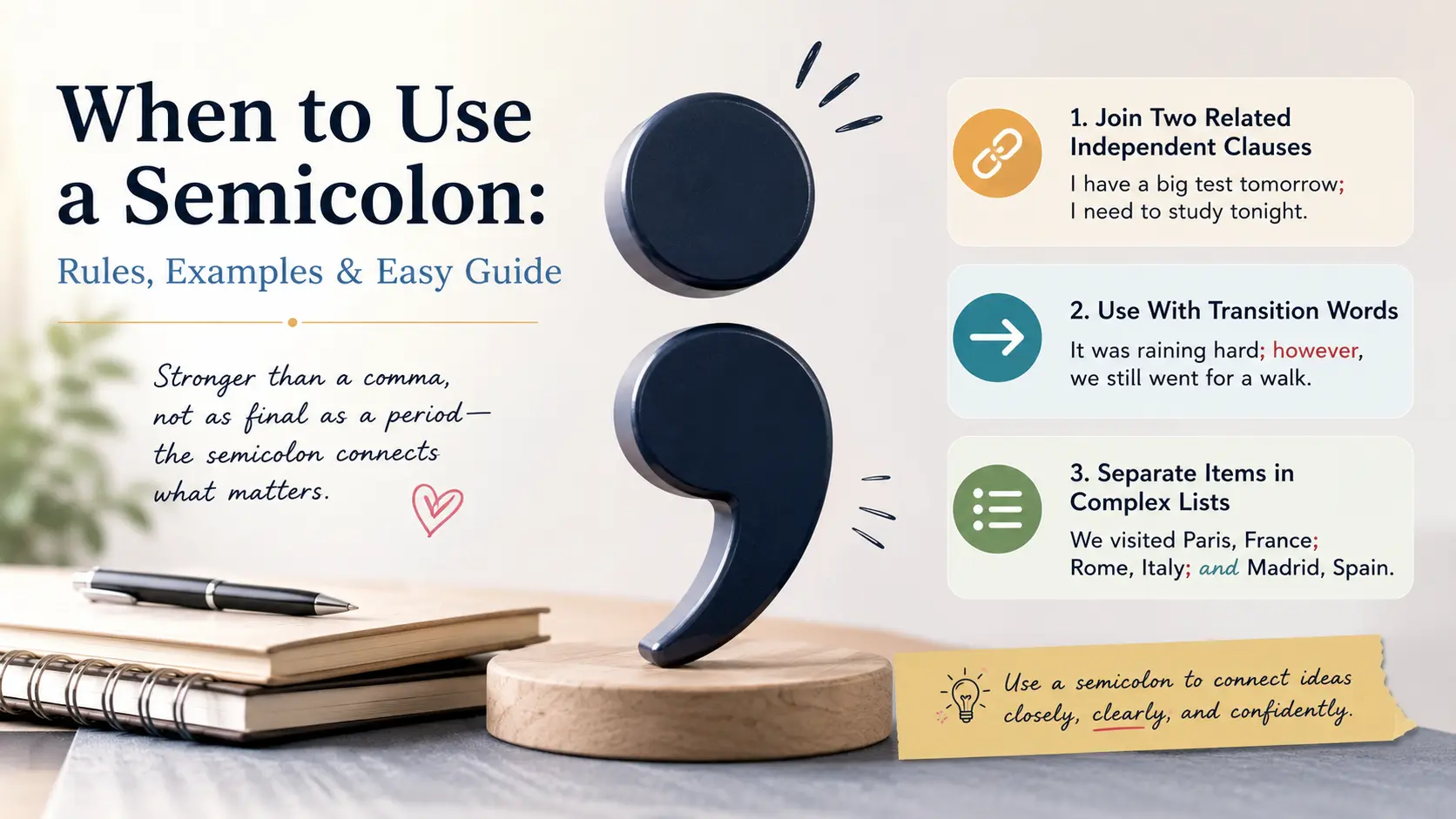
A semicolon (;) is one of the least understood forms of punctuation in the English language. It is a more powerful form of punctuation than a comma, yet a less powerful form than a period.
Knowing how to apply a semicolon is not about memorizing technical grammar terminology. After learning just a couple of basic rules, you will be able to apply semicolons in your writing effortlessly.
What Is a Semicolon?
A semicolon is a punctuation mark that looks like a period placed above a comma: ;
Its most common job is to connect two independent clauses that are closely related.
An independent clause contains a subject and a verb and can work as a complete sentence.
Example:
I wanted to go for a walk; the weather changed suddenly.
Both sides can stand alone:
- I wanted to go for a walk.
- The weather changed suddenly.
The semicolon shows that these two thoughts belong closely together.
Think of a semicolon as a bridge between two complete thoughts. A period separates them completely, while a comma is usually too weak to connect them by itself.
When to Use a Semicolon
There are three especially useful situations where a semicolon belongs in a sentence.
1. To Join Two Related Independent Clauses
Use a semicolon when you have two complete sentences that are strongly connected in meaning.
Example:
The store was closing; we decided to leave.
Both clauses are complete:
- The store was closing.
- We decided to leave.
The semicolon makes the relationship between the two ideas clear without adding a conjunction such as and, so, or because.
More examples:
She studied all night; she wanted to be prepared for the exam.
The road was covered with snow; driving conditions were dangerous.
I finished my work early; I went home before sunset.
The key is relationship. The two clauses should feel naturally connected.
2. Before Conjunctive Adverbs
A semicolon can appear before transition words such as however, therefore, moreover, nevertheless, meanwhile, instead, and consequently when those words connect two independent clauses.
The usual pattern is:
Independent clause + semicolon + transition word + comma + independent clause
Example:
I wanted to attend the meeting; however, I had another appointment.
Notice the punctuation:
meeting; however, I
The semicolon separates the two complete clauses, while the comma after however sets off the transition word.
More examples:
The project was difficult; nevertheless, the team completed it on time.
The restaurant was crowded; therefore, we decided to eat somewhere else.
Maria had already finished her assignment; meanwhile, her classmates were still working.
A common mistake is to write a comma instead of a semicolon:
❌ I wanted to attend the meeting, however, I had another appointment.
In formal writing, this creates a comma splice. The stronger punctuation is:
✅ I wanted to attend the meeting; however, I had another appointment.
3. To Separate Items in a Complex List
Semicolons can make complicated lists easier to read when individual items already contain commas.
Consider this sentence:
We visited Austin, Texas; Denver, Colorado; and Portland, Oregon.
Each location contains a comma between the city and state. If ordinary commas were used between every item, the list could become difficult to follow.
The semicolons create clear boundaries.
Another example:
The conference included speakers from Boston, Massachusetts; Seattle, Washington; Toronto, Ontario; and London, England.
Here, each item contains its own comma, so semicolons provide a higher level of separation.
This is sometimes described as using a semicolon as a “super-comma.”
Semicolon Rules You Need to Know
Understanding a few basic rules will prevent most semicolon mistakes.
Rule 1: Both Sides Should Usually Be Complete Clauses
When joining two independent clauses, each side should be capable of standing alone.
✅ The sun was setting; we headed home.
Both parts are complete sentences.
But:
❌ Because the sun was setting; we headed home.
“Because the sun was setting” cannot stand alone, so a semicolon does not belong there.
The correct sentence is:
✅ Because the sun was setting, we headed home.
Rule 2: Do Not Capitalize the Next Word Automatically
A semicolon does not normally require capitalization of the word immediately after it.
✅ The meeting ended early; everyone went home.
Not:
❌ The meeting ended early; Everyone went home.
The exception is when the next word is a proper noun or another word that would normally be capitalized.
We left early; Sarah stayed behind.
Rule 3: Do Not Use a Semicolon and a Coordinating Conjunction Together
When two independent clauses are connected with and, but, or, nor, for, so, or yet, a comma is generally used instead of a semicolon.
✅ I wanted to stay, but I was tired.
You usually do not need:
❌ I wanted to stay; but I was tired.
However, a semicolon can be useful when the clauses are especially long or contain internal commas, but ordinary sentences usually work better with a comma and conjunction.
Rule 4: Do Not Use Semicolons Everywhere
A semicolon is useful because it creates a particular relationship between ideas. It should not replace every comma or period.
Good writing uses punctuation intentionally.
Semicolon vs. Comma
One of the most common questions is whether to use a semicolon or comma.
A comma is generally not strong enough to join two independent clauses by itself.
❌ The weather was beautiful, we went hiking.
This is a comma splice.
You have several options:
✅ The weather was beautiful, so we went hiking.
✅ The weather was beautiful; we went hiking.
✅ The weather was beautiful. We went hiking.
The choice depends on the relationship you want to create.
A comma plus conjunction explicitly connects the ideas.
A semicolon creates a close connection without a conjunction.
A period gives the ideas greater independence.
Semicolon vs. Colon
Semicolons and colons can look similar in some sentences, but they perform different jobs.
A semicolon usually connects related complete thoughts.
The weather was getting worse; we decided to leave.
A colon often introduces an explanation, example, definition, or list.
We decided to leave for one reason: the weather was getting worse.
A useful way to remember the difference is:
Semicolon = connection
Colon = introduction or explanation
Consider another example:
She had one goal: to finish the project.
The words after the colon explain the goal.
But:
She had one goal; she wanted to finish the project before Friday.
Here, the semicolon connects two related thoughts.
Semicolon vs. Period
A semicolon and period can sometimes separate the same two independent clauses.
The store was closing; we left.
The store was closing. We left.
Both are grammatically correct.
The difference is subtle but meaningful.
The period creates a stronger break. It makes the two sentences feel more independent.
The semicolon keeps them visually and logically connected.
If the relationship between the ideas matters, a semicolon can be effective.
If you want a clear pause or a fresh sentence, use a period.
Semicolon vs. Em Dash
An em dash (—) is more flexible and expressive than a semicolon.
Compare:
The plan seemed simple; nobody expected problems.
The semicolon creates a calm, logical connection.
Now:
The plan seemed simple—nobody expected problems.
The em dash feels more dramatic and conversational.
Use a semicolon when you want logical connection and balance. Use an em dash when you want emphasis, interruption, or a stronger change in rhythm.
When Not to Use a Semicolon
Knowing when not to use a semicolon is just as important as knowing when to use one.
When the Second Part Is Not a Complete Sentence
Do not use a semicolon if the second part cannot stand alone.
❌ I stayed home; because I was sick.
Instead:
✅ I stayed home because I was sick.
When a Comma Is Enough
A semicolon is unnecessary between items in a simple list.
❌ I bought apples; oranges; and bananas.
Use commas:
✅ I bought apples, oranges, and bananas.
Save semicolons for lists that are complicated enough to need additional separation.
When a Coordinating Conjunction Is Used
If you already have and, but, so, or, or another coordinating conjunction, a comma is normally enough.
✅ She was tired, but she continued working.
When a Colon Is More Appropriate
If the second part introduces an explanation or list, a colon may be clearer.
❌ She brought everything she needed; a notebook, a pen, and a laptop.
Better:
✅ She brought everything she needed: a notebook, a pen, and a laptop.
The colon tells the reader that the list is coming.
How to Know if You Need a Semicolon
If you are unsure, use this simple test.
Step 1: Look at the Words Before the Punctuation
Can they form a complete sentence?
Step 2: Look at the Words After the Punctuation
Can they also form a complete sentence?
Step 3: Ask Whether the Ideas Are Closely Related
If both parts are complete and closely connected, a semicolon may work.
For example:
The library was closing; I needed one more book.
Both sides are complete, and the ideas are related.
Step 4: Check for a Better Connector
Ask whether and, but, so, because, or another conjunction would communicate the relationship more naturally.
If so, use it.
The semicolon is an option, not a requirement.
20+ Examples of Semicolons in Sentences
Here are practical examples showing different uses.
Semicolon Examples With Related Ideas
- The coffee had gone cold; I had ordered a new cup.
- The kids were tired; they slept early.
- I had forgotten my umbrella; it began to rain.
- The road was blocked; we took an alternative route.
- She enjoys reading; her brother loves watching movies.
- The deadline was near; everybody worked faster.
Semicolon Examples With Transition Words
- It was tempting to ring her up; but it was already very late.
- The procedure appeared complex; nonetheless, we managed to follow it.
- The team practiced every day; thus, they were prepared for the competition.
- He finished his first assignment; at the same time, I started preparing the second.
- The initial plan was costly; so, we went for an easier one.
- The evidence was scarce; hence, the conclusion was questionable.
Semicolon Examples in Lists
- We traveled to Miami, Florida; Dallas, Texas; and Phoenix, Arizona.
- The guests came from Lahore, Punjab; Karachi, Sindh; and Islamabad, Pakistan.
- The course covers writing, grammar, and editing; reading, research, and analysis; and communication, presentation, and discussion.
Semicolon Examples in Academic Writing
- The first study focused on memory; the second examined attention.
- The results were encouraging; additional research is still necessary.
- The theory explains the first observation; it does not explain the second.
Semicolon Examples in Everyday Writing
- I need to finish this article; then I can relax.
- The movie starts at eight; we should leave by seven.
- My phone battery is almost dead; I need a charger.
- She wanted to cook dinner; there were no vegetables at home.
Common Semicolon Mistakes
Using a Semicolon Between a Dependent and Independent Clause
This is one of the most common errors.
❌ Although I was tired; I finished my work.
“Although I was tired” is not a complete sentence.
Correct:
✅ Although I was tired, I finished my work.
Using a Comma After a Semicolon
When a conjunctive adverb follows a semicolon, the comma belongs after the transition word, not immediately after the semicolon.
❌ I was tired;, however, I continued.
✅ I was tired; however, I continued.
Capitalizing the Next Word Incorrectly
A semicolon does not automatically start a new sentence.
❌ The room was quiet; Everyone was studying.
✅ The room was quiet; everyone was studying.
Overusing Semicolons
Some writers use semicolons because they believe they make writing sound more sophisticated.
That can make prose feel unnecessarily complicated.
Compare:
The sun was setting; the birds were returning; the children were going home; the streets were becoming quiet.
This is grammatically possible, but it may be more natural as:
The sun was setting, the birds were returning, and the children were going home. The streets were becoming quiet.
Good punctuation should improve clarity, not simply make a sentence look formal.
Using Semicolons Where Colons Belong
If the second part directly explains or introduces the first part, consider a colon.
❌ I have one important rule; always check your work.
Better:
✅ I have one important rule: always check your work.
Semicolon With Transition Words
Transition words help readers understand how two ideas relate.
However
The task was difficult; however, we completed it.
However signals contrast.
Therefore
The roads were flooded; therefore, the event was canceled.
Therefore signals a result.
Moreover
The hotel was affordable; moreover, it was close to the airport.
Moreover adds information.
Nevertheless
The forecast was unfavorable; nevertheless, they continued with the trip.
Nevertheless signals contrast despite the previous statement.
Meanwhile
Sarah prepared dinner; meanwhile, Tom cleaned the kitchen.
Meanwhile shows that two actions happened during the same period.
Instead
We planned to walk; instead, we took a taxi.
Instead shows an alternative.
How to Use a Semicolon in a List
The semicolon becomes especially useful when list items contain commas.
Compare a simple list:
I bought bread, milk, eggs, and cheese.
Commas are perfectly adequate.
Now consider a list of locations:
We stopped in Paris, France; Rome, Italy; and Athens, Greece.
The semicolons make the boundaries obvious.
A helpful pattern is:
Item containing commas; item containing commas; item containing commas
For example:
The finalists were James Carter, the senior manager; Priya Shah, the lead designer; and Daniel Lee, the project coordinator.
Each item contains an internal comma, so semicolons make the structure easier to understand.
Semicolon in Academic and Professional Writing
Semicolons can be particularly useful in formal writing because they allow writers to connect related ideas without relying on repetitive conjunctions.
For example:
The initial findings were promising; further testing is required before a final conclusion can be reached.
The semicolon creates a clear relationship between the positive finding and the need for additional research.
In professional writing:
The client approved the proposal; the development team can now begin work.
In academic writing:
The evidence supports the hypothesis; however, the sample size was relatively small.
The goal should always be precision and readability, not simply using more sophisticated punctuation.
Semicolon in Everyday Writing
You do not need to write formally to use a semicolon.
It can appear naturally in emails, messages, personal writing, and casual communication.
I have a lot to do today; I might stay home tonight.
Bring your jacket; it is getting cold outside.
I wanted to watch the movie; my internet stopped working.
In casual writing, though, a period or conjunction may sometimes sound more natural.
The semicolon is a stylistic choice when the relationship between the ideas is important.
Quick Trick to Remember Semicolon Rules
Remember this simple formula:
Complete sentence + semicolon + complete sentence
For example:
I was hungry; I made a sandwich.
Then remember the second major use:
Complex list item; complex list item; complex list item
For example:
New York, New York; Chicago, Illinois; and Seattle, Washington.
Finally, remember the transition pattern:
Complete sentence; however, complete sentence.
If you can remember these three patterns, you will handle most everyday semicolon situations correctly.
Related guides: Advice vs Advise: Meaning, Examples and Usage · Parents vs Parents Apostrophe: Meaning and Usage · Greatly Appreciated: Meaning, Usage and Better Alternatives
Frequently Asked Questions About Semicolons
What is the main purpose of a semicolon?
The main purpose of a semicolon is to connect closely related independent clauses without using a coordinating conjunction. It can also separate complicated list items that contain commas.
When should I use a semicolon instead of a comma?
Use a semicolon when you are connecting two complete, closely related sentences and are not using a coordinating conjunction.
I finished my work; I went home.
A comma alone would not correctly join those two independent clauses.
Can a semicolon connect two complete sentences?
Yes. This is one of its most common uses.
The weather improved; we went outside.
Both sides can stand as independent sentences.
Do you capitalize after a semicolon?
Normally, no. The word after a semicolon begins with lowercase unless it is a proper noun or would otherwise require capitalization.
The class ended early; everyone left.
Can you use a semicolon before “however”?
Yes. When however connects two independent clauses, use a semicolon before it and a comma after it.
I wanted to go; however, I was too busy.
What is the difference between a semicolon and a colon?
A semicolon primarily connects related independent clauses or separates complicated list items. A colon commonly introduces an explanation, example, or list.
She had one concern: the deadline.
She had one concern; the deadline was approaching quickly.
Can a semicolon be used in a list?
Yes. Semicolons can separate list items when those items already contain commas.
We visited Paris, France; Madrid, Spain; and Lisbon, Portugal.
Final Takeaway: When to Use a Semicolon
The semicolon is best employed when you wish to demonstrate that there is an intimate relationship between two complete thoughts without breaking them apart with a full stop. It is also good for organizing complex lists and linking independent clauses using transition words like “however” and “therefore.”
And of course, one of the simplest rules is as follows: when the clauses on either side can form separate sentences and these ideas belong together, you can consider using a semicolon. This punctuation mark should be used for clarification, not merely to impress. When you can use punctuation to clarify the relationship between ideas, your writing improves.