
GMFU Meaning in Text: What Does GMFU Mean?
<meta name="description" content="Learn what GMFU means in text, Snapchat, and social media, including its tone, variations, and examples.”>
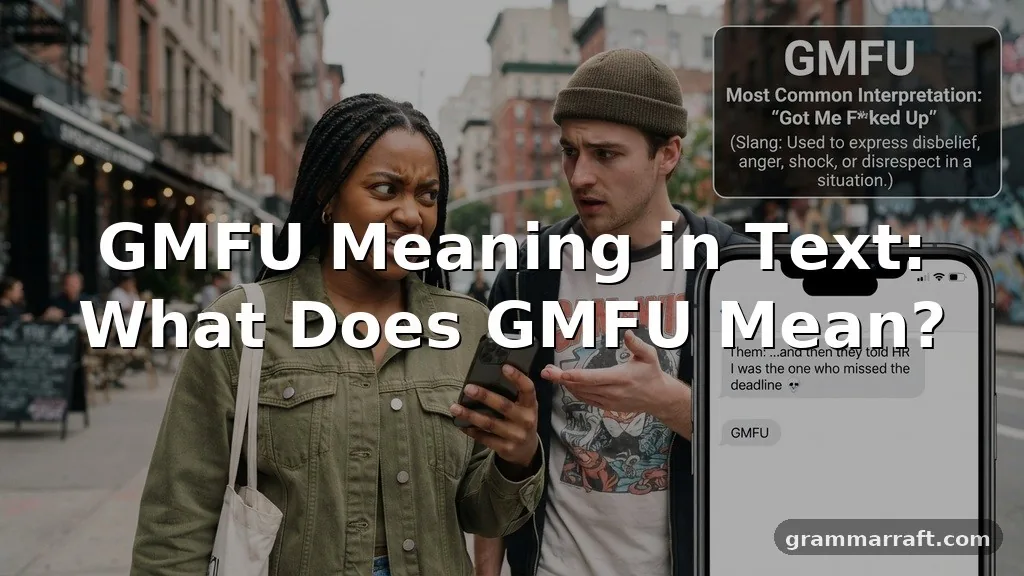
GMFU usually means “got me fucked up” in text messages, comments, and social media posts. People use it to show disbelief, anger, frustration, or the feeling that someone has misunderstood or disrespected them.
The exact tone depends on context. A friend may use GMFU jokingly after hearing an unbelievable story, while someone else may use it as a sharp reaction to an insult, lie, or unfair request. Understanding the surrounding words is the key to reading it correctly.
What Does GMFU Mean?
In most texting and social media conversations, GMFU is an acronym for “got me fucked up.” The phrase does not usually describe being physically confused or intoxicated. Instead, it communicates a strong reaction to something another person said or did.
Depending on the situation, GMFU can mean “you have the wrong idea about me,” “you must be joking,” “you’re seriously irritating me,” or “I can’t believe you said that.” It is flexible slang, so the same acronym may express humor in one message and genuine anger in another.
For example, if a friend says, “You still owe me for dinner,” and you already paid, you might reply, “GMFU—I sent it yesterday.” Here, the acronym suggests irritation and disbelief.
In a playful conversation, someone might write, “You really watched the entire season without me? GMFU 😂.” The words still carry the basic idea of disbelief, but the emoji and relationship make the message sound teasing rather than hostile.
The most common interpretation

The most common definition GMFU readers encounter is the profane phrase “got me fucked up.” The profanity gives the acronym emotional force, which is why it appears most often in casual, expressive conversations rather than formal writing.
It can also be understood as a shortened reaction rather than a complete grammatical sentence. Text slang often removes subjects, helping verbs, and punctuation because the reader is expected to infer the full meaning from the situation.
Why context matters
GMFU does not have one fixed emotional value. A laughing emoji, a heart, or an exaggerated story can soften it, while an insult, accusation, or string of capital letters can make it sound confrontational.
Consider these two examples:
- “You ate the last slice? GMFU 😂” — probably playful annoyance.
- “You think I’m going to apologize for that? GMFU.” — likely serious defiance or anger.
The relationship between the speakers matters just as much as the words. Close friends may use GMFU casually, but the same message from a stranger, coworker, or customer could feel aggressive.
Is GMFU a Bad Word or Offensive?
GMFU contains a shortened form of a strong profanity, so it can be offensive in many settings. Even when the sender does not intend serious hostility, the expression is still more vulgar than “you’re kidding” or “I can’t believe that.”
The underlying word is generally classified as a profanity in standard dictionaries and usage references, including Merriam-Webster’s entry for the underlying profanity. That classification helps explain why GMFU is best treated as informal slang rather than neutral everyday English.
Some online communities use the acronym so frequently that it may feel mild to their members. That familiarity does not make it suitable everywhere, especially in professional, academic, customer-service, or family settings where the audience may expect cleaner language.
When GMFU sounds serious
GMFU is more likely to sound serious when it appears without an emoji, follows a disagreement, or is written in all capital letters. A message such as “You really GMFU right now” can signal that the sender feels insulted or believes someone is treating them unfairly.
The phrase may also be serious when it appears alongside words such as “disrespectful,” “lying,” “seriously,” or “done.” In that context, it is not merely a funny reaction. It is a direct expression of anger or disbelief.
When GMFU sounds playful
Friends often use GMFU as exaggerated comedy. A person might send it after discovering that a friend finished a shared snack, posted an unflattering photograph, or revealed a harmless surprise.
Playful usage usually includes clues such as laughing emojis, a familiar nickname, dramatic punctuation, or an obviously minor complaint. Even then, people differ in how comfortable they are with profanity, so tone cannot be assumed automatically.
How GMFU Is Used in Texting and Social Media
See Also: NWS Meaning in Text: What Does NWS Mean?
GMFU appears in text messages, Instagram comments, Snapchat conversations, TikTok captions, gaming chats, and private messages. It is especially common when users want to react quickly without typing a full sentence.
On social media, the acronym may be directed at a specific person or used as a general reaction. A comment saying “GMFU” under a surprising video can mean “this situation is unbelievable,” even if the commenter is not personally involved.
Texting encourages short acronyms because speed and emotional impact matter. GMFU is more expressive than a plain “no way,” while remaining shorter than the full phrase it represents.
What does GMFU mean on Snapchat?
On Snapchat, GMFU normally has the same meaning as in other social apps: “got me fucked up.” A sender may use it in a direct snap, a chat, or a caption to react to something surprising, irritating, or funny.
Snapchat messages often rely heavily on images, filters, facial expressions, and timing. A laughing selfie with “GMFU” may be playful, while a message sent after an argument may be confrontational. The visual context can change the meaning significantly.
What does GMFU mean on Instagram?
On Instagram, GMFU can appear in comments, direct messages, stories, and captions. A comment such as “GMFU for posting this” may be a joking response to an embarrassing photograph, but it could also be a genuine complaint depending on the relationship.
Public comments deserve extra caution because other readers may not understand the relationship between the people involved. A phrase intended as an inside joke can look hostile when viewed without the private context behind it.
Capitalization and punctuation
GMFU is commonly written in uppercase because it is an acronym, but lowercase forms such as “gmfu” are also normal in casual texting. Capitalization does not change the dictionary meaning, although all caps can make a message appear more forceful.
Punctuation has a similar effect. “GMFU?” may express disbelief or ask whether someone is serious, while “GMFU.” can look more final and confrontational. “GMFU 😂” usually signals a lighter reaction.
| Message style | Likely tone | What it may suggest |
|---|---|---|
| “gmfu” | Casual or understated | Disbelief, annoyance, or joking reaction |
| “GMFU?” | Surprised or challenging | “Are you serious right now?” |
| “GMFU.” | Firm or irritated | Strong disagreement or offense |
| “GMFU 😂” | Playful | Exaggerated amusement or mock outrage |
| “YOU GMFU” | Confrontational | Direct accusation or anger |
GMFU Variations and Related Text Slang
Several similar acronyms appear in online conversations. They are related, but they are not interchangeable in every sentence. The subject and wording can change the emphasis from a speaker’s reaction to another person’s behavior.
What does YGMFU mean?
YGMFU commonly means “you got me fucked up.” It is more directly aimed at another person than GMFU. The speaker is usually saying that someone has misunderstood them, underestimated them, or treated them in a way they reject.
For example, “YGMFU if you think I’m paying for that” means something like “You have the wrong idea if you think I’m going to pay for that.” It is often defiant and can sound more aggressive than the shorter GMFU.
What does GFU mean?
GFU has several possible meanings, so it requires caution. In some conversations, people use it as a shortened or altered form of a profane phrase, while others may use it to mean something entirely different, such as “good for you.”
Because GFU is ambiguous, do not automatically interpret it as GMFU. Read the full message, consider the platform, and look at the relationship between the speakers.
What does GMFO mean?
GMFO is not as standardized as GMFU. Some users may intend it as a variation of the same expression, while others may be using a personal abbreviation or a different phrase altogether.
If the meaning is unclear, asking a simple question is safer than guessing. “What do you mean by GMFO?” avoids an unnecessary argument and recognizes that slang changes quickly between communities.
What does GYFU or similar slang mean?
Online acronyms often differ by one letter, and those small changes can produce completely different phrases. Some are deliberate variations designed to avoid platform filters, while others are typing mistakes or community-specific slang.
There is no universal dictionary for every acronym used in private chats. The surrounding sentence remains the most reliable guide.
When Should You Use GMFU?
GMFU is most appropriate in informal conversations with people who already understand your style. Close friends, gaming partners, and familiar online groups may accept it without concern, especially when the tone is clearly humorous.
It is usually a poor choice in professional messages, formal education, public customer communication, or conversations with someone you do not know well. The recipient may interpret the profanity as disrespectful even if you intended it as a joke.
- Usually acceptable: private chats with close friends, informal group messages, and familiar online communities.
- Use caution: public comments, conversations with new acquaintances, and messages where the tone could be misunderstood.
- Usually avoid: business emails, job applications, customer support, school communication, and messages to senior managers.
Can you say GMFU to a friend?
You can use GMFU with a friend if profanity is normal in your relationship and the situation supports that tone. A message such as “You watched the finale without me? GMFU 😂” is likely to be understood as playful by a close friend.
Still, friendship does not guarantee that every joke will land well. Avoid using the acronym during a sensitive disagreement unless you deliberately want to communicate anger.
Can you say GMFU to a family member?
That depends on the family member and the family’s communication style. A sibling may understand it as harmless teasing, while a parent, grandparent, or younger relative may find it disrespectful or confusing.
Cleaner alternatives such as “You’ve got to be kidding me” or “You’re messing with me, right?” preserve the reaction without the profanity.
Can you use GMFU at work?
In most workplaces, avoid GMFU in official communication. A private message to a very close coworker may be different from a message in a company-wide channel, but professional judgment still matters.
Workplace conversations can be forwarded, archived, or read by people who lack the original context. If the message could embarrass you when shown to a manager or client, choose a cleaner phrase.
Professional Alternatives to GMFU
See Also: DHZ Meaning in Text: What Does DHZ Mean?
Professional alternatives communicate surprise, disagreement, or frustration without profanity. The best replacement depends on whether you want to sound neutral, firm, amused, or concerned.
| Alternative | Tone | Best use | Example |
|---|---|---|---|
| “I’m surprised by that.” | Neutral | Work emails and meetings | “I’m surprised by that result; can we review the figures?” |
| “That’s not what I understood.” | Professional and corrective | Clarifying a disagreement | “That’s not what I understood from our earlier discussion.” |
| “Are you serious?” | Direct and informal | Trusted coworkers | “Are you serious? The deadline moved again?” |
| “I’m having trouble understanding this.” | Polite and measured | Clients and managers | “I’m having trouble understanding this change in scope.” |
| “That caught me off guard.” | Professional and warm | Unexpected news | “That caught me off guard, but I’m happy to discuss next steps.” |
Cleaner ways to express disbelief
Use “I can’t believe that,” “That’s unexpected,” or “You’re kidding” when you want to show surprise without sounding hostile. “I’m honestly surprised” works well in both workplace chats and personal messages.
If you need clarification, “Could you help me understand?” is more productive than an emotional acronym. It keeps the conversation focused on the issue instead of the speaker’s reaction.
Cleaner ways to express disagreement
For disagreement, try “I see it differently,” “I don’t think that’s correct,” or “That doesn’t match my understanding.” These phrases make the conflict specific and give the other person a chance to respond.
In a business setting, direct but calm wording is generally stronger than vague irritation. “The figures in this version don’t match the approved report” communicates more than “That makes no sense.”
Cleaner ways to express frustration
Say “This is frustrating,” “I’m concerned about this change,” or “We need to revisit this decision.” Such wording is especially useful in emails because it leaves a clear written record of the problem without adding unnecessary hostility.
A professional alternative does not need to sound emotionless. You can be warm and firm at the same time.
GMFU in Different Relationships
The same acronym can have different consequences depending on who receives it. Audience awareness is more important than the acronym itself because tone comes from the relationship, the channel, and the topic.
With a boss or manager
Generally, do not send GMFU to a boss or manager. Even if your manager uses informal language, mirroring profanity can create an awkward record or make a legitimate concern sound immature.
Use “I’m surprised by that,” “Could we discuss the reasoning?” or “I may be misunderstanding the change.” These responses show that you have a strong reaction while keeping the conversation constructive.
With a coworker
A close coworker may understand GMFU as a joke, particularly in a private chat. However, a team channel or shared project thread is a different environment from a personal conversation.
For work groups, “That’s unexpected,” “Wait, seriously?” or “Well, that changes things” is safer. These phrases can still sound natural without making the entire team interpret your profanity.
With a client or customer
Do not use GMFU with a client or customer. Customer communication should avoid language that could be read as insulting, dismissive, or emotionally uncontrolled.
Replace it with “I understand your concern,” “Let me clarify what happened,” or “I’m sorry this was unexpected.” Those phrases move the conversation toward a solution rather than intensifying the reaction.
With a new acquaintance
Wait until you understand the person’s communication style before using strong slang. A new contact may not know whether you are joking, annoyed, or criticizing them.
Neutral language gives you room to build rapport. Once the relationship is established, you can adjust your style more confidently.
How to Interpret GMFU in a Message
See Also: HBU Meaning in Text: What Does HBU Mean?
When someone sends GMFU, do not focus only on the acronym. Examine the sentence before it, the punctuation, any emoji, and what happened immediately before the message.
The sender may be expressing anger, teasing you, rejecting an assumption, or reacting to surprising news. A single acronym cannot identify the emotion with complete certainty.
Questions to ask yourself
- Was the conversation already tense?
- Is the sender usually comfortable with profanity?
- Did they include a laughing emoji or another softening signal?
- Are they reacting to a serious issue or a minor inconvenience?
- Does “you got me wrong” make more sense than “you’re joking” in this context?
If the tone is unclear, respond to the apparent issue rather than matching the profanity. “Are you saying you disagree?” or “I didn’t mean to upset you” can clarify the situation without escalating it.
How to reply when GMFU sounds playful
If the context is clearly joking, a light reply may fit. You could say, “Relax, I’m kidding,” “You know I had to,” or “I knew you’d say that.”
Do not assume humor if the subject involves money, relationships, work, privacy, or an accusation. A playful response to a serious message can make the conflict worse.
How to reply when GMFU sounds angry
When GMFU appears during an argument, slow down rather than responding with another insult. Try “I can see you’re upset,” “That wasn’t my intention,” or “Let’s clear up what happened.”
If you made an error, a direct apology is more useful than debating the acronym. If the sender is being abusive, you can set a boundary and end the conversation.
Common Search Questions About GMFU
Is GMFU correct English?
GMFU is understandable and widely used as informal internet slang, but it is not standard formal English. It functions as an acronym in texting and social media rather than as a phrase suitable for academic or business writing.
What does GMFU mean from a girl?
GMFU has the same basic meaning regardless of who sends it. A girl may use it to express disbelief, annoyance, humor, or the feeling that someone has misunderstood her; the surrounding context determines the tone.
Is GMFU always angry?
No. GMFU can be playful, sarcastic, surprised, or genuinely angry. Emojis, punctuation, the topic, and the relationship between the speakers help show which meaning is intended.
What does YGMFU mean?
YGMFU usually means “you got me fucked up.” It directly tells another person that they have the wrong idea, are underestimating the speaker, or are behaving in an unacceptable way.
What is a polite alternative to GMFU?
Polite alternatives include “I’m surprised,” “Are you serious?” “That’s not what I understood,” and “I’m having trouble with that.” Choose the phrase that matches whether you want to sound curious, firm, or concerned.
Final Takeaway on GMFU Meaning in Text
The central point behind GMFU Meaning in Text is simple: the acronym usually means “got me fucked up,” but its emotional force depends on context. It can be a joking reaction between friends, a sharp expression of disbelief, or a sign that someone feels disrespected.
Use it only where informal profanity is clearly acceptable, and choose cleaner wording for work, clients, new contacts, and sensitive conversations. If you receive GMFU, read the surrounding message before deciding whether the sender is joking or genuinely upset.
One Comment