
Northeast vs North East: Meaning, Spelling and Usage
The choice in northeast vs north east usually depends on meaning, regional convention, and the style rules you’re following. In most American English writing, northeast is the standard one-word form for the direction and the northeastern region of the United States.
British English uses more than one accepted form, including north-east and, increasingly, northeast. That variation explains why maps, dictionaries, newspapers, and search results sometimes appear inconsistent.
You’ll learn when to write northeast, north-east, or north east, how the terms work as nouns and adjectives, and why proper names such as the Northeast region may follow different rules from an ordinary compass direction.
The short answer: northeast is usually correct
Northeast is normally written as one word when it names the compass direction between north and east. For example, “The road runs northeast” and “A cold wind came from the northeast” use the standard American English form.
The same spelling is common when the word acts as an adjective before a noun. You might write “the northeast coast,” “a northeast corner,” or “a northeast-facing window.” In each example, the word identifies a direction or position.
North-east is also a legitimate form, especially in British English and in publications that retain traditional hyphenation. It is not automatically an error, but it may look unusual if the surrounding text follows American spelling conventions.
North east, written as two separate words, is less common as a general compass term. It can appear in older writing, informal usage, or certain proper names, but most modern style systems prefer either the closed form “northeast” or the hyphenated form “north-east.”
| Form | Typical use | Most associated with |
|---|---|---|
| northeast | Direction, adjective, or regional noun | American English and modern general usage |
| north-east | Direction or adjective | Traditional and British English usage |
| north east | Occasional open compound or part of a name | Older, local, or name-specific usage |
If you need one safe choice for ordinary English, use northeast. If you’re writing for a British audience or following a publication’s house style, check whether it prefers “north-east.”
What northeast means
Northeast is one of the four intermediate or intercardinal compass directions. It lies halfway between north and east, corresponding to an angle of approximately 45 degrees on a conventional compass.
The term can describe movement, location, orientation, or origin. A plane may fly northeast, a town may lie northeast of another town, and a building may have a northeast entrance.
Northeast as a direction
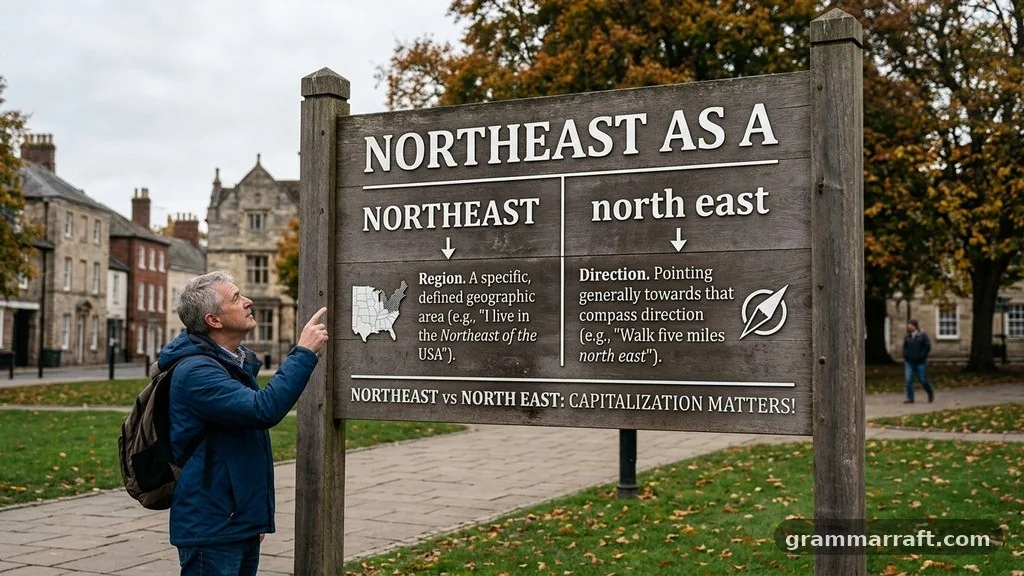
When northeast functions as an adverb, it commonly describes movement or position without a following noun. “The hikers walked northeast” means they moved in that direction.
As a noun, it usually takes an article or a preposition. Examples include “the northeast of the island,” “from the northeast,” and “toward the northeast.” In these sentences, northeast names the directional area itself.
The word can also identify a wind or weather system. “A strong northeast wind” means the wind comes from the northeast, while “the storm moved northeast” describes the direction in which the storm traveled.
Northeast as an adjective
As an adjective, northeast modifies another noun. Common examples include “northeast England,” “a northeast border,” “the northeast wall,” and “a northeast route.” The compound normally remains closed in American English.
Some phrases can create confusion because the direction may describe either the location of something or the direction from which it comes. A “northeast wind” traditionally blows from the northeast; a “wind moving northeast” travels toward the northeast.
That distinction matters in weather reports, navigation, aviation, and technical writing. If the direction could be misunderstood, rewrite the sentence rather than relying on punctuation alone.
Northeast, north-east, and north east in American English
American English generally closes the basic compass compounds: northeast, northwest, southeast, and southwest. This pattern applies to both the names of directions and many ordinary adjective forms.
You will therefore usually see “the Northeast,” “the northeastern states,” and “a southwest wind” in American publications. The closed forms are familiar in school textbooks, maps, news coverage, government documents, and everyday writing.
The related adjective northeastern is also normally one word in American English. For example, “Northeastern Pennsylvania” and “northeastern weather” follow the same general pattern.
Capitalization in the United States
Capitalization depends on whether the term identifies a broad direction or a recognized region. Lowercase “northeast” refers to direction or a general area, as in “the northeast side of the building.”
Uppercase “Northeast” can refer to a named cultural or geographic region of the United States. A sentence such as “She grew up in the Northeast” treats the word as a regional name.
There is no universal agreement on every regional label. A writer may capitalize Northeast when discussing the established U.S. region, while using lowercase in a purely directional phrase. The surrounding context usually makes the intended meaning clear.
- Use northeast for a compass direction: “Drive northeast.”
- Use northeastern for a related adjective: “northeastern counties.”
- Consider Northeast for the recognized U.S. region: “The Northeast has cold winters.”
- Follow the publication’s style guide if its capitalization policy differs.
One practical rule is to ask whether the word could be replaced by “the area in the northeast of a place.” If so, lowercase is often appropriate. If it names a familiar regional division with a distinct historical or cultural identity, capitalization may be justified.
How British English handles north-east
British English has traditionally favored hyphenated compass compounds such as north-east, south-west, and north-west. This convention remains common in British newspapers, books, maps, and formal writing.
British usage is not completely uniform, however. Some modern dictionaries and publications also accept or use closed forms, particularly where compound words have become familiar. That is why British readers may encounter both “north-east” and “northeast.”
For a British audience, north-east is a safe traditional choice when you are writing about the direction. The same applies to expressions such as “north-east England,” “the north-east coast,” and “a north-east wind,” although a specific publication may use another form.
North-east England
North East England is a recognized English region that includes places such as Tyne and Wear, County Durham, Northumberland, and parts of the broader historical northeast of England. The exact boundaries can vary depending on whether the writer means an administrative region, a cultural area, or a general location.
Names of official bodies and regional organizations may use a particular capitalization and spacing. A government website, local authority, university, or transport organization can preserve “North East” as part of its formal name even if ordinary prose would use “north-east.”
That is an important exception. Proper names do not always follow the general spelling rule for compass compounds, so changing the wording of an official title may introduce an error.
British style and consistency
British writers should not switch between “north-east” and “northeast” without a reason. Readers may not find either choice confusing, but inconsistency can make a document look poorly edited.
Choose the form used by your publisher, employer, school, or news organization. If no style guide applies, the hyphenated form is a conventional British choice, while the closed form is increasingly visible in contemporary usage.
The same principle applies to related words. If you write “north-east,” you may also choose “north-eastern” in the same document. A consistent system is usually more valuable than trying to impose one spelling on every English-speaking audience.
Is north east ever correct as two words?
“North east” can be correct in a limited number of situations, but it is not usually the preferred spelling for the ordinary compass direction. Two-word forms are more likely to appear in proper names, historical documents, quoted material, or writing influenced by a particular local convention.
For example, an organization might officially call itself “North East Development Council,” or a place name might be recorded as “North East” in a government database. If the phrase is part of an established name, preserve the official form.
Some writers also use open compounds when the first word modifies a larger phrase. In practice, though, most modern editors would examine the exact sentence and often recast it as “northeast,” “north-east,” or “the northeast part of.”
Proper names and official titles
Proper names deserve special care because capitalization and spacing may carry legal, administrative, or branding significance. A regional authority’s name, for instance, may use “North East” even if a newspaper describes the same area as “the north-east.”
Do not standardize a formal title merely because another spelling looks more familiar. Check the organization’s own published materials, official records, or current branding before changing it.
The same caution applies to street names, electoral districts, university departments, and transportation services. Place names can preserve older forms long after ordinary language has changed.
Historical and quoted writing
Historical documents may use “north east” because spelling conventions were less standardized or because the phrase was treated as an open combination of two words. A quotation should normally retain its original spelling if the wording matters.
If the historical form is not important, modernize it only according to the rules of the publication or project. In academic writing, explain any editorial changes when the original document is being analyzed closely.
The key question is not whether “north east” can ever appear. It can. The question is whether it is the best form for your sentence, audience, and chosen style.
When to use a hyphen in north-east
The hyphen in north-east joins two words that work together as one directional unit. It signals that “north” and “east” should be read as a single compound rather than as two unrelated modifiers.
Hyphenation is especially useful when the term comes before a noun. In “a north-east entrance,” the hyphen makes the compound adjective immediately visible. In “the entrance lies to the north-east,” the same form acts as a noun phrase after the preposition.
American English generally does not need that hyphen because the closed form “northeast” is standard. British English may retain it as part of a wider convention for compass compounds.
Hyphenation and readability
Hyphens can prevent ambiguity, but they should not be added randomly. A style guide may recommend hyphens in some compound modifiers and closed forms in others, especially when a word has become familiar through frequent use.
Words such as “northeastern” are often written without a hyphen in American English. Writing “north-eastern” may still be acceptable in British English, but it should match the form used for “north-east” elsewhere in the document.
Technical writing benefits from precision. If a map, measurement, or instruction could be interpreted in more than one way, use a clear phrase such as “at an angle of 45 degrees” or “on the side facing northeast.”
Examples of correct forms
These examples show how the spelling changes with regional convention rather than with a change in basic meaning:
- American English: “The village is northeast of the capital.”
- British English: “The village is north-east of the capital.”
- American English: “A northeast wind brought colder air.”
- British English: “A north-east wind brought colder air.”
- Either, depending on the official name: “The North East regional office opened in May.”
The important point is consistency. Do not use “northeast” in one paragraph and “north-east” in the next unless you are deliberately discussing differences between varieties of English.
Northeast as a region in the United States
In the United States, “the Northeast” often refers to a broad region containing New England and the Mid-Atlantic states. Definitions vary, but common discussions include Connecticut, Maine, Massachusetts, New Hampshire, Rhode Island, Vermont, New Jersey, New York, and Pennsylvania.
Some official statistical systems divide the area differently or include additional states in a larger northeastern grouping. A classroom lesson, travel article, census table, and business report may therefore use slightly different boundaries.
That variation does not make the regional term useless. It means writers should define the scope when the exact membership matters, especially in research, policy, demographics, or market analysis.
| Context | Likely form | Example |
|---|---|---|
| Compass direction | Lowercase, closed | “Travel northeast.” |
| General American region | Capitalized, closed | “The Northeast has many older cities.” |
| British directional style | Lowercase, hyphenated | “The coast lies north-east of London.” |
| Official name | Follow the recorded title | “North East Regional Office” |
Capitalization and regional identity
Capitalizing “Northeast” can signal more than direction. It may refer to a region with shared historical, economic, cultural, or political associations rather than simply an area located toward the upper-right portion of a map.
Compare “the northeast corner of the state” with “industries in the Northeast.” The first describes a position; the second likely refers to the named U.S. region.
Not every reference requires a capital letter. A writer discussing the northeast section of a park should normally use lowercase, even if the park lies within the broader Northeast.
Defining the region for readers
If your audience could reasonably disagree about which states belong to the Northeast, provide a short definition. “In this article, Northeast refers to New England and the Mid-Atlantic states” removes uncertainty without interrupting the discussion.
This practice is particularly helpful in data-driven writing. A percentage, ranking, or comparison has little value if readers do not know which locations were counted.
Regional terms also change meaning across countries. The Northeast of the United States is not the same kind of label as northeast England, northeastern Brazil, or the northeast of Australia, so country and context should do some of the explanatory work.
How to choose the right form in your writing
The best choice depends on four questions: What does the word mean, where is your audience, is it part of a proper name, and does a house style apply? Answering those questions usually resolves the spelling issue quickly.
Start with meaning. If you are describing a direction, use the convention expected by your variety of English. If you are reproducing a formal title, preserve that title even when it differs from ordinary usage.
Next, consider the audience. American readers expect “northeast,” while British readers may expect “north-east.” International readers usually understand both, but consistency still improves the quality of the page.
A practical editing checklist
- Identify whether the term is a noun, adjective, or adverb.
- Decide whether it describes direction or names a region.
- Check whether the phrase is part of an official title or place name.
- Apply the spelling convention used by your audience.
- Search the document for every related form, including northwest and southeast.
- Make capitalization consistent across headings, captions, and body copy.
For general American English, a simple approach is to use “northeast” and “northeastern,” capitalizing “Northeast” only for the recognized regional name. For British English, use “north-east” and “north-eastern” if that is the established convention of the publication.
Editors who need a broader explanation of compound-word treatment can consult the Merriam-Webster guide to compound words. It is useful because compounds do not all become closed, hyphenated, or open at the same speed.
Common mistakes with northeast and north east
One common mistake is assuming that the open form “north east” is always more grammatically logical because it visibly contains two compass words. English spelling does not work that mechanically; frequent compounds often become hyphenated or closed over time.
Another mistake is treating every use as a proper noun. “The northeast wall” does not need a capital letter simply because the wall faces that direction. Capitalization should reflect meaning, not the visual importance of the location.
Writers also sometimes mix national conventions. A document may use American spellings such as “center” and “color” while switching to “north-east” without a specific reason. That combination is not impossible, but it can make the style feel accidental.
Confusing northeast with east-north
Northeast is the established name for the direction halfway between north and east. “East-north” is not the normal English term for that compass point.
Compass directions follow a conventional order: north, east, south, and west. The intermediate points are northeast, southeast, southwest, and northwest, not east-north or west-south.
Technical systems may use bearings, degrees, or specialized directional labels, but ordinary navigation and general prose use the familiar intercardinal terms.
Overcorrecting official names
A writer may see “North East” in an organization’s title and change it to “Northeast” during editing. That can be a genuine mistake if the original wording is legally or publicly established.
Check the source before making the correction. An official name may intentionally preserve an open form, while a sentence about the same area may use a closed or hyphenated form.
Good editing respects both standard usage and proper-name accuracy. The two goals sometimes point to different spellings.
Examples northeast readers can use
Examples are often more helpful than abstract rules because the correct form depends on grammar and context. The following sentences use common situations in travel, geography, weather, and regional description.
Direction and movement
- “The trail turns northeast after the bridge.”
- “The aircraft continued north-east after leaving the coast.”
- “The village is northeast of the lake.”
- “The hikers moved toward the northeast before sunset.”
In these examples, the word identifies a direction or destination. The American and British versions communicate the same geographic relationship; only the spelling convention changes.
Location and physical features
- “The northeast corner of the building receives morning light.”
- “A north-east-facing slope may have different exposure conditions.”
- “The station is on the northeastern edge of the city.”
- “The river flows through the northeast part of the county.”
Compound adjectives can become longer when the direction combines with a suffix such as “-ern” or a word such as “facing.” Check the complete phrase rather than applying a rule to only one part.
Regions and proper names
- “The Northeast is known for a dense network of older cities.”
- “Northeastern states have different climates from one another.”
- “The North East regional program began in the spring.”
- “North-east England has a distinct regional identity.”
These examples show why capitalization and spacing are not purely mechanical. Regional names, ordinary descriptions, and official titles can coexist in the same article with different forms.
FAQ: northeast vs north east
Is northeast one word or hyphenated?
In American English, northeast is normally one word. British English traditionally uses north-east, although the closed form also appears in modern British writing.
Does north east need a hyphen?
If you are using a hyphenated convention, write north-east rather than “north east” for the ordinary compass direction. The open form may still be correct in an official name, historical quotation, or local title.
Should I say northeast or east-north?
Use northeast or north-east. “East-north” is not the standard English name for the direction halfway between north and east.
Is Northeast capitalized in the United States?
Capitalize Northeast when it refers to the recognized U.S. region, as in “the Northeast.” Use lowercase for a general direction or location, as in “the northeast side of the street.”
Which form should I use for a British audience?
North-east is the safest traditional choice for British English, particularly in formal prose. Follow the specific publication or organization’s style if it uses “northeast” or preserves “North East” as part of a proper name.
Conclusion
The choice between northeast vs north east is mainly a question of compound-word spelling, regional English, and context. Use northeast in standard American English, consider north-east for traditional British English, and preserve North East when it belongs to an official name.
Before publishing, check whether the word describes a direction, identifies a region, or appears in a title. Once that distinction is clear, apply one style consistently throughout your writing and let the intended audience guide the final choice.
Related Articles
- Adapter vs Adaptor: Meaning, Spelling and Usage
- Absence vs absense: Meaning, Spelling and Usage
- Envelop vs Envelope: Meaning, Spelling, and Usage