
Paucity Meaning: Definition, Origin and Usage
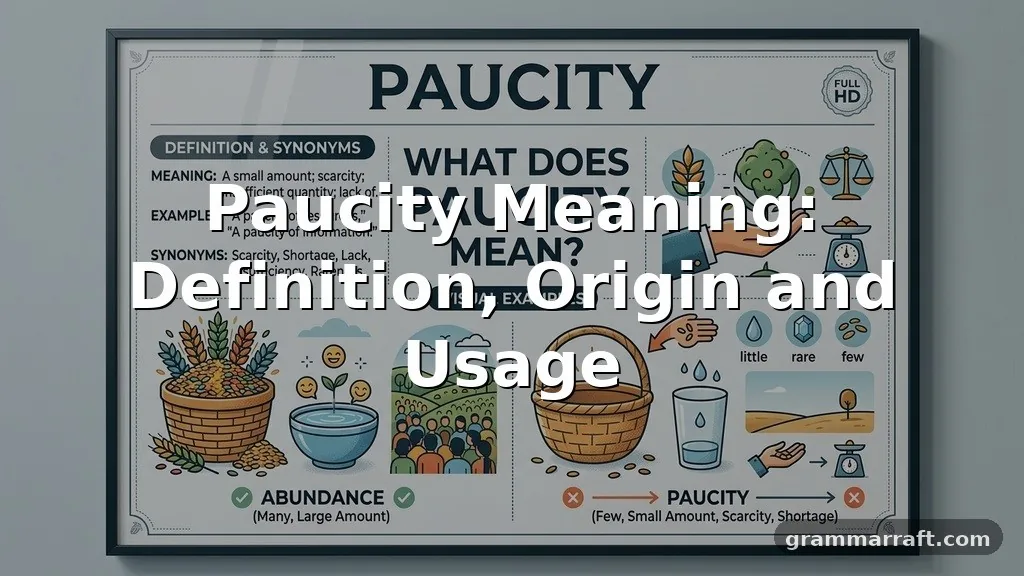
The phrase paucity meaning points to a shortage or an unusually small amount of something. If a report mentions a paucity of evidence, it says there is not enough evidence to support a confident conclusion.
This English word often appears in formal writing, journalism, academic discussion, medicine and law. It usually describes a quantity that is smaller than expected or needed, rather than simply saying that something is absent.
Below, you’ll find the definition, pronunciation, history, synonyms, grammar, examples and common contexts. You’ll also see how paucity differs from scarcity, lack and shortage, so you can choose the right word with confidence.
What Does Paucity Mean?

Paucity means a small quantity or an insufficient amount of something. It is a noun, and it normally refers to things that can be counted or measured in some way, such as evidence, resources, opportunities, staff, data or time.
For example, “the paucity of reliable information made the decision difficult” means that there was very little reliable information available. The sentence does not necessarily say there was no information at all; it emphasizes that the amount was limited.
The word usually carries a negative or concerned tone. A person may describe a “paucity of affordable housing” because the available number is too low for the people who need it.
In simple terms, you can remember the definition like this:
- Paucity: a notably small amount or number.
- Typical sense: less than is needed, expected or desirable.
- Part of speech: noun.
- Common pattern: “a paucity of” followed by a noun.
- Opposite idea: abundance, plenty or a large supply.
The word does not describe a particular object by itself. It describes the limited quantity of that object. Thus, “paucity” is not the same as “poor,” “weak” or “low-quality.” A paucity of excellent candidates means there are too few candidates, not that the candidates are poor.
For a concise dictionary definition and pronunciation reference, consult the Merriam-Webster dictionary entry for paucity.
How to Pronounce Paucity
Paucity is pronounced “PAW-suh-tee.” In phonetic form, it is commonly represented as /ˈpɔːsəti/, although the exact vowel sound can vary slightly between English accents.
The first syllable sounds like “paw” in many pronunciations. The middle syllable is usually weak, similar to “suh,” and the final syllable sounds like “tee.” The stress falls on the first syllable, not the second or third.
| Feature | Information |
|---|---|
| Word | paucity |
| Pronunciation | PAW-suh-tee |
| Part of speech | Noun |
| Plural form | paucities |
| Common pronunciation mistake | Putting the main stress on “city” |
Because paucity is not used in everyday conversation as often as “lack” or “shortage,” some speakers first encounter it in books, newspapers or formal presentations. Hearing the word in context can make its pronunciation easier to remember.
It is also useful to distinguish pronunciation from spelling. The ending is written -city, but it does not sound like the separate word “city.” The final sound is closer to “tee,” which is why “PAW-suh-tee” is a helpful pronunciation guide.
If you are studying for school, a vocabulary test or the SAT, say the word aloud while connecting it to its meaning: “a paucity of evidence” means “too little evidence.” That association is more useful than memorizing the spelling alone.
Paucity Word Origin and History
Paucity comes through French from the Latin word paucitas, meaning fewness or scantiness. The Latin adjective paucus meant “few” or “little,” and it is also connected to other words associated with limited quantity.
The historical root explains why paucity focuses on amount. It is related to the idea of having fewer items, less material or a smaller supply than expected.
English has used paucity for centuries, particularly in formal prose. It became a useful choice for writers who wanted to describe limited evidence, resources or opportunities without repeating simpler words such as “lack” and “shortage.”
The origin also helps explain why paucity tends to sound formal. Many words that entered English through Latin and French became especially common in government, law, education, science and literary writing.
Consider these related ideas:
- Fewness: a small number of countable things.
- Scantiness: a small or inadequate supply.
- Insufficiency: not enough for a particular purpose.
- Rarity: uncommonness or infrequency, which does not always imply a problem.
These related words overlap, but they are not interchangeable in every sentence. A paucity of evidence means there is too little evidence, while the rarity of an event means the event does not happen often. Rarity may be neutral or even desirable; paucity usually signals a deficiency.
The word “paucity” should not be confused with the imaginary phrase “pauper prince.” A pauper prince is a literary or descriptive expression for someone who is both royal in status and poor in circumstances. It has no connection to the meaning or origin of paucity.
Paucity Synonyms and Antonyms
The best synonym for paucity depends on the noun that follows it and the tone you want. “Lack” is the most common everyday alternative, while “scarcity” often suggests that supplies are difficult to obtain.
| Word | Meaning | Typical tone or use |
|---|---|---|
| Paucity | A notably small or insufficient amount | Formal and analytical |
| Lack | Absence or insufficiency | Everyday and flexible |
| Shortage | Less supply than demand | Practical, economic or logistical |
| Scarcity | Limited availability, often over time | Economic, environmental or formal |
| Deficiency | An inadequate amount needed for a standard or function | Technical, medical or formal |
| Abundance | A very large or plentiful supply | Opposite of paucity |
For example, “a paucity of qualified teachers” and “a shortage of qualified teachers” can describe the same situation. The first sounds more formal and emphasizes the small number; the second often suggests that demand exceeds supply.
“Deficiency” is more precise when a required amount is missing. A vitamin deficiency concerns an inadequate level in the body, while a paucity of medical research concerns the limited amount of research available.
Antonyms include abundance, plenty, profusion, wealth, surplus and adequacy. The right opposite depends on the intended contrast. “A paucity of rainfall” contrasts naturally with “an abundance of rainfall,” while “a paucity of staff” may contrast with “adequate staffing.”
Do not assume every synonym has the same emotional force. “A few books” is neutral, but “a paucity of books” suggests disappointment or concern about the number available.
How Paucity Is Used in a Sentence
The most common grammatical structure is “a paucity of + plural count noun”. Examples include “a paucity of opportunities,” “a paucity of witnesses” and “a paucity of reliable statistics.”
Although the word refers to a small quantity, the noun after “of” is often plural when it describes countable items. You would write “a paucity of studies,” not normally “a paucity of study,” unless “study” is being used as an uncountable concept.
Example sentences
- The committee delayed its decision because of a paucity of verified data.
- The village faced a paucity of clean water after the supply system failed.
- Researchers acknowledged the paucity of long-term evidence.
- A paucity of affordable homes has pushed rents higher in the area.
- The biography is interesting, but it suffers from a paucity of primary sources.
In each example, paucity signals that the amount is not merely small. It is small in a way that affects a decision, situation or outcome.
The word normally takes the singular article “a”: “a paucity of evidence.” The phrase is grammatically singular because the subject is “paucity,” not “evidence.” Therefore, formal writing would usually say, “The paucity of evidence is troubling,” rather than “The paucity of evidence are troubling.”
The plural form, paucities, is possible but uncommon. It may appear when a writer is comparing several separate shortages, as in “the region’s multiple paucities of labor, fuel and housing.” In most ordinary sentences, rewriting with “several shortages” will sound more natural.
Use paucity with care in casual speech. “There’s a paucity of snacks” is grammatically correct, but “There aren’t many snacks” sounds more natural in conversation.
Paucity, Lack, Scarcity and Shortage
These words are close in meaning, but their differences matter. Lack is the broadest term. It can mean complete absence or an insufficient amount: “a lack of interest” may mean very little interest, while “a lack of evidence” may suggest that evidence is missing altogether.
Paucity usually means that something exists in a small amount. If a lawyer refers to a paucity of evidence, the statement normally suggests that some evidence exists, but not enough to make the case strong or conclusive.
Shortage often describes a supply problem. It suggests that the quantity available is below the quantity needed or demanded. A newspaper might report a shortage of nurses, fuel or building materials.
Scarcity often has a broader or longer-term sense. Economists may discuss the scarcity of resources because resources are limited in relation to human wants. Environmental writing may describe water scarcity in regions where low supply affects communities over time.
| Sentence | What the wording emphasizes |
|---|---|
| There is a lack of evidence. | Evidence is absent or insufficient. |
| There is a paucity of evidence. | Only a small amount of evidence exists. |
| There is a shortage of evidence. | The available supply is below what is needed. |
| There is scarcity of evidence. | Evidence is difficult to obtain or generally limited. |
These distinctions are not absolute. Native speakers sometimes use the words interchangeably, especially in general writing. Still, choosing the most precise term can make an argument clearer.
A useful test is to ask what you want to emphasize: absence, small quantity, unmet demand or limited availability. That answer will usually point you toward lack, paucity, shortage or scarcity.
Paucity in Medicine, Law and Academic Writing
In medical writing, paucity generally means that a body, sample, test or research field contains too little of something. A clinical note might mention a paucity of cells in a specimen, while a review article might report a paucity of high-quality trials.
The medical meaning is usually contextual rather than a separate dictionary definition. It does not automatically identify a disease. The noun following it supplies the important information.
For instance, “paucity of hair” may describe unusually sparse hair growth, while “paucity of symptoms” means that few symptoms are present. “Paucity of data” in a medical study warns readers that the conclusions may be limited by the amount of available information.
In law, the phrase often concerns evidence, precedent, authority or testimony. A court opinion may refer to a paucity of precedent when there are few earlier decisions that directly address an issue.
That wording does not by itself determine the legal outcome. It simply identifies a limitation in the available legal material. The effect depends on the jurisdiction, the facts, the governing statute and the court’s reasoning.
Academic writers use paucity to identify a research gap. A sentence such as “There is a paucity of research on rural language education” says that relatively little research has been conducted or published on that subject.
- Use paucity of evidence when the support for a claim is limited.
- Use paucity of research when few studies address a question.
- Use paucity of data when the available observations or measurements are limited.
- Use paucity of symptoms when only a small number of symptoms are present.
- Use paucity of precedent when few earlier legal decisions provide guidance.
In all of these fields, the word is useful because it signals a limitation without making a stronger claim than the facts support.
Paucity of Time and Other Common Expressions
“Paucity of time” means a shortage of available time. It is understandable and grammatically valid, but “lack of time” or “limited time” is more common in ordinary English.
A formal report might say, “Because of the paucity of time, the panel considered only the most urgent proposals.” A less formal version would be, “Because time was limited, the panel considered only the most urgent proposals.”
Other frequent expressions include “paucity of resources,” “paucity of information,” “paucity of opportunities,” “paucity of funding” and “paucity of talent.” Each one means that the relevant supply is unusually small or inadequate.
| Expression | Plain-English meaning | Example context |
|---|---|---|
| Paucity of time | Not enough time | A rushed review process |
| Paucity of resources | Too few materials, funds or staff | A public service under pressure |
| Paucity of information | Very little useful information | An uncertain investigation |
| Paucity of opportunities | Few chances for advancement or participation | A weak job market |
| Paucity of funding | Insufficient financial support | A project facing budget limits |
The phrase “paucity of time” is more natural in formal prose than in friendly conversation. If you are speaking to a colleague, “We have very little time” is usually clearer and warmer.
Location and audience matter, too. New Yorkers, Londoners and speakers of English in other regions may recognize the word, but familiarity varies by age, profession and reading experience. A writer should choose the phrase that the intended audience will understand immediately.
Formal vocabulary is useful when it adds precision. It is not useful merely because it sounds impressive.
Paucity Meaning in Other Languages and Contexts
People searching for “paucity meaning in Farsi” or “paucity meaning Arabic” are usually looking for a translation or a close equivalent. The exact translation can change according to context, so a single fixed word may not work in every sentence.
In general, the English idea can be translated as scarcity, shortage, lack, fewness or insufficiency. A translator must decide whether the source sentence emphasizes a small number, an inadequate supply or complete absence.
For example, “a paucity of evidence” should be translated in a way that preserves the idea of insufficient evidence. “A paucity of rainfall” may call for a word meaning scarcity or low precipitation rather than a direct equivalent of “fewness.”
The same principle applies to religious and literary translation. If a Bible passage or older text refers to poverty, fewness or want, it may express a related idea without using the modern English word paucity.
The word itself is not a standard biblical keyword in most familiar English Bible translations. Readers should examine the wording of the specific translation rather than assume that every reference to lack or scarcity is a direct use of paucity.
Translation choices can differ for several reasons:
- The target language may distinguish countable and uncountable quantities differently.
- A formal English noun may require a simpler phrase in another language.
- The original sentence may describe poverty, absence, scarcity or weakness rather than mere small quantity.
- Professional fields may use established technical terms that differ from everyday vocabulary.
For reliable translation, read the complete sentence and identify what is limited. Translating the isolated word without its noun can produce an awkward or inaccurate result.
Common Mistakes with the Word Paucity
One common mistake is treating paucity as a synonym for total absence. “A paucity of volunteers” normally means there are very few volunteers, not that there are none.
Another mistake is using it to describe quality rather than quantity. “The paucity of the proposal” is unclear if the writer means that the proposal is weak. Better choices might be “the weakness of the proposal” or “the poor quality of the proposal.”
Writers also sometimes use the word where “poverty” is intended. Poverty concerns insufficient money or material resources, while paucity can describe any limited amount, including a paucity of jokes, colors or historical records.
Errors to avoid
- Wrong idea: “The paucity of the argument made it unconvincing” when the intended meaning is that the argument was badly reasoned.
- Clearer wording: “The weakness of the argument made it unconvincing.”
- Wrong idea: “There was a paucity of one witness” when describing a single witness.
- Clearer wording: “There was only one witness.”
- Awkward wording: “A paucity of few resources.”
- Clearer wording: “A paucity of resources” or “very few resources.”
Do not add “small” before paucity unless there is a special reason. The word already contains the idea of a small amount, so “a small paucity of evidence” is usually repetitive.
Another issue is tone. Replacing every instance of “lack” with “paucity” can make writing stiff. A school assignment, business email or public notice may be easier to understand if it says “not enough information” instead.
Use paucity when the formal tone is appropriate and the emphasis on limited quantity helps the reader. Otherwise, choose the plainest accurate alternative.
How to Remember Paucity Meaning
A useful memory aid is to connect paucity with “few”. Both ideas point toward a small number or limited amount. The first sound of paucity, “paw,” can also remind you of an animal with only a few treats left in its bowl, although the sound association is simply a learning device.
Another method is to learn the word in a phrase instead of alone. “A paucity of evidence,” “a paucity of resources” and “a paucity of time” are common enough to show how the noun behaves in real English.
Vocabulary lists can help, but active use is stronger than passive recognition. Write three original sentences about familiar subjects, then replace paucity with lack or shortage and notice how the tone changes.
For example:
- There is a paucity of reliable information about the abandoned building.
- The clinic faces a shortage of trained staff.
- The team has little time to complete the review.
All three sentences concern limitation, but they do not sound identical. The first is formal and analytical, the second focuses on supply, and the third is direct and conversational.
If you are preparing for an SAT or another vocabulary exam, remember three points: paucity is a noun, it means a small or insufficient quantity, and it commonly appears in the structure “a paucity of.” Those details are usually more valuable than memorizing a long list of rare synonyms.
Keep a vocabulary log if you encounter the word in books or articles. Record the full sentence, the noun after “of,” and a simpler replacement such as “lack” or “too little.” That approach shows both meaning and usage.
When Should You Use Paucity?
Use paucity when you need to describe a limited quantity in a formal, precise or analytical way. It works especially well in essays, research papers, reports, legal writing, policy documents and serious journalism.
It is a good choice when the small amount creates a meaningful problem. “A paucity of funding” suggests that a project cannot proceed as planned, while “a paucity of evidence” suggests that a claim cannot be evaluated with confidence.
Use a simpler alternative when clarity matters more than formality. In a message to a friend, “There aren’t many seats left” is better than “There is a paucity of available seats.”
Before using the word, ask yourself three questions:
- Am I describing quantity rather than quality?
- Is the amount unusually small or insufficient for the situation?
- Would a formal word improve the sentence for this audience?
If the answer to all three is yes, paucity may be the right choice. If the answer to the final question is no, use “few,” “little,” “lack” or “not enough.” Plain English is not less intelligent; it is often more efficient.
One final style point: avoid repeating the word in nearby sentences. A paragraph that uses paucity three times may sound mechanical. Use a related phrase such as “limited supply,” “small number” or “insufficient evidence” when the meaning remains clear.
Frequently Asked Questions About Paucity Meaning
What is the simplest meaning of paucity?
Paucity means a very small amount or number of something, especially an amount that is less than needed or expected. In everyday English, it can often be replaced with “lack,” “shortage,” “few” or “not enough,” depending on the sentence.
Is paucity a positive or negative word?
Paucity usually has a negative or concerned tone because it highlights insufficiency. However, the word itself does not always identify a serious problem; context determines whether the small amount is undesirable, neutral or merely notable.
Does paucity mean lack?
Yes, paucity can mean a lack or shortage, but it more specifically emphasizes a small quantity. “Lack” may suggest complete absence, whereas “paucity” usually suggests that a small amount exists.
What is the opposite of paucity?
Common opposites include abundance, plenty, profusion, surplus and adequacy. The best choice depends on the sentence: “an abundance of resources” is a natural opposite of “a paucity of resources,” while “adequate evidence” may be the clearest contrast in a research context.
What does paucity mean in medical language?
In medical language, paucity means that a body component, symptom, sample or body of research is present in a small or insufficient amount. It is not a diagnosis by itself, so the words that follow it are essential for understanding the medical meaning.
Conclusion
The central idea behind paucity meaning is simple: a paucity is a notably small or insufficient quantity. It is a formal noun commonly used with phrases such as “a paucity of evidence,” “a paucity of resources” and “a paucity of time.”
Choose it when you want to emphasize limited supply in a precise context, but use “lack,” “few” or “not enough” when plain English is clearer. The next time you see paucity in a dictionary, report or vocabulary list, read the noun after “of”; it will usually reveal exactly what is in short supply.
Related Articles
- Sweet Tooth Meaning: Definition, Origin and Usage
- Have a Good Day: Meaning, Usage, and Better Alternatives?
- Other Ways to Say Safe Travels: 30+ Thoughtful Alternatives