What Does Ubiquitous Mean? The Powerful Word for Things You See Everywhere
Have you ever noticed something so common that it seems impossible to escape it? Maybe smartphones are everywhere, social media appears in almost every part of daily life, or a particular brand suddenly seems to be on every street.
The word ubiquitous perfectly sums up this concept. For something to be ubiquitous, it means that the thing in question is almost present or noticeable everywhere.
However, there is much more to the term ubiquitous than just “everywhere.” It can refer to technology, emotions, practices, culture, organisms, fear, concepts, and everything else in between. Learning about its definition allows you to convey your understanding of commonness in a sophisticated manner.
In this guide, you will find out what does ubiquitous mean, how it is pronounced, where it came from, how it is used by native English speakers, and what it means in various specialized branches, including microbiology.
What Does Ubiquitous Mean? – Quick Meaning
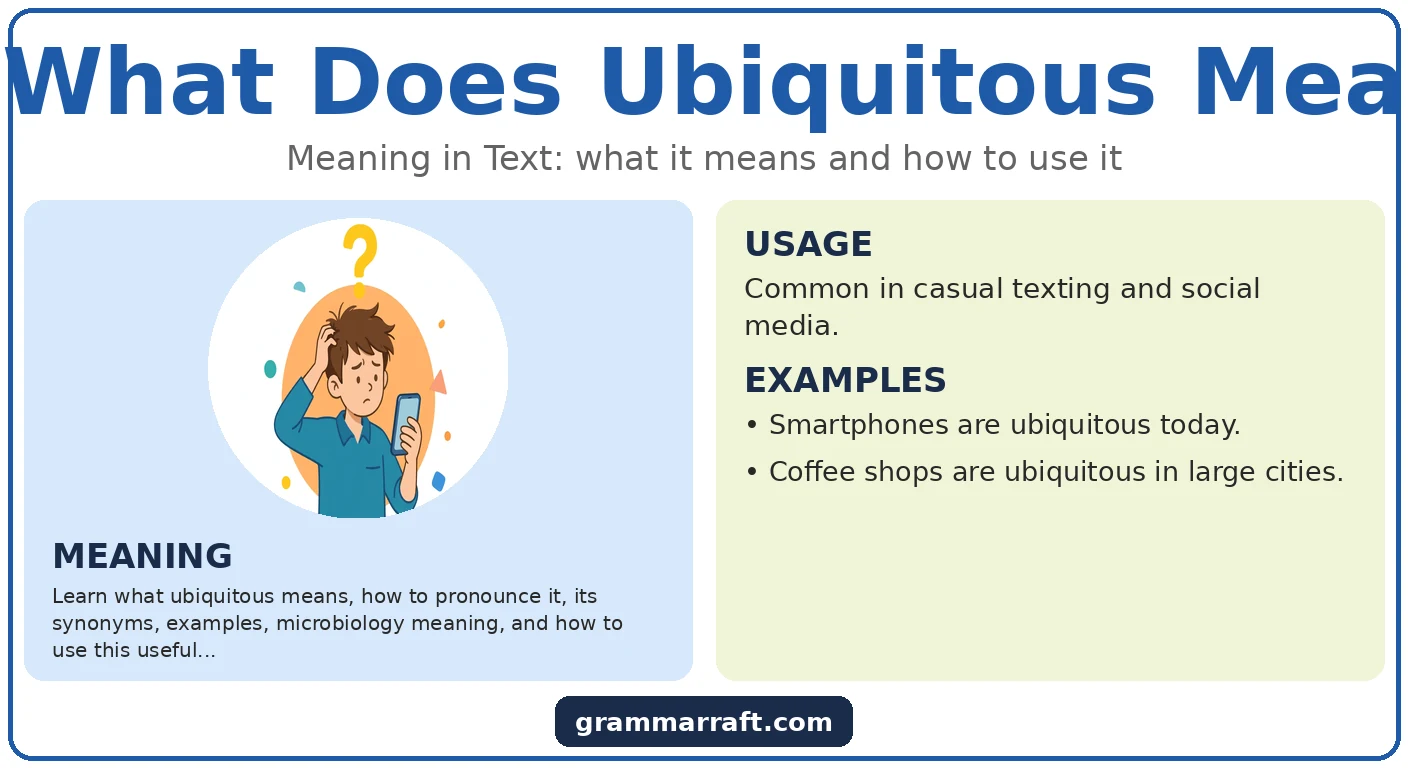
Ubiquitous means something is present or found everywhere, or in many places at the same time.
In simple English, you can usually understand it as:
- Everywhere
- Present in many places
- Very common
- Seemingly impossible to avoid
- Widely encountered
For example:
“Smartphones are ubiquitous today.”
This means smartphones are found almost everywhere and have become a normal part of modern life.
Another example:
“Coffee shops are ubiquitous in large cities.”
The sentence suggests that coffee shops are extremely common and can be found throughout the city.
And:
“Social media has become ubiquitous among young adults.”
Here, ubiquitous emphasizes how widespread social media has become.
The word often sounds more formal than everywhere or common, which is why it frequently appears in journalism, academic writing, business discussions, and professional communication.
Origin and Background of Ubiquitous
Ubiquitous stems from the Latin word ubique, which means “everywhere.”
The word entered English in the 19th century and developed into an adjective that describes something that appears to be everywhere.
The initial meaning of ubiquitous has stayed surprisingly consistent over the years. No matter what examples you consider—ancient bacteria or contemporary smartphones—the core meaning is still that of widespreadness.
Culture has played a role in making the word applicable as well.
Technological advancement is one example where the word works particularly well. The internet, smartphones, digital currency, streaming services, and social media have spread so much that they are sometimes described as being ubiquitous.
Social media itself has contributed to how people encounter the word ubiquitious as well. Users might encounter terms like “ubiquitous technology” and “ubiquitous advertisement” on websites, in captions and comments.
It should be mentioned that ubiquitous does not literally mean everywhere. Ubiquitous means something that is everywhere in everyday English usage.
Ubiquitous Pronunciation
The standard pronunciation of ubiquitous is:
yoo-BIK-wih-tuhs
It is commonly represented phonetically as:
/juːˈbɪkwɪtəs/
The strongest stress falls on the second syllable:
u-BIQ-ui-tous
A common mistake is trying to pronounce every letter exactly as it appears. The middle of the word sounds more like “bik-wi” than a slow, letter-by-letter pronunciation.
Try saying it naturally:
“yoo-BIK-wih-tuhs.”
Once you’ve heard the rhythm, the word becomes much easier to use confidently.
What Does Ubiquitous Mean in English?
In English, ubiquitous describes something that appears to be present everywhere or is extremely widespread.
It is an adjective, so it normally comes before a noun or after a linking verb.
For example:
- Ubiquitous technology
- Ubiquitous advertising
- Ubiquitous smartphones
- The brand is ubiquitous.
- Digital communication has become ubiquitous.
The word is especially useful when “common” feels too weak.
Compare these sentences:
“Mobile phones are common.”
This simply says many people have mobile phones.
“Mobile phones are ubiquitous.”
This creates a stronger picture. It suggests mobile phones are so widespread that you encounter them almost everywhere.
There is also an important distinction between ubiquitous and universal.
Universal usually suggests something applies to everyone or everything.
Ubiquitous focuses on being widely present or encountered.
So something can be ubiquitous without literally being universal.
What Does Ubiquitous Mean in Microbiology?
In microbiology, ubiquitous has a more scientific application.
When microbiologists describe a microorganism, gene, protein, or biological feature as ubiquitous, they generally mean it is widely distributed across many environments or organisms.
For example, some microorganisms can be found in soil, water, air, plants, animals, and other environments. A scientist may describe such organisms as ubiquitous because their distribution is extremely broad.
You might encounter a sentence such as:
“Microorganisms are ubiquitous in the environment.”
This means microorganisms occur across a vast range of environments.
However, ubiquitous does not necessarily mean that every individual species exists in every environment. Scientists use the word according to the context and the scope of their observation.
In microbiology, therefore, the word emphasizes broad distribution, not simply popularity or frequency.
Ubiquitous in a Sentence
See Also: How to Avoid Passive Voice in Writing (With Examples)
Seeing ubiquitous in different sentences is one of the easiest ways to understand its natural use.
Everyday examples
“Wi-Fi has become ubiquitous in modern hotels.”
Wi-Fi is now widely available in hotels.
“Coffee is ubiquitous in office culture.”
Coffee is extremely common in workplaces.
“Smartphones are ubiquitous among commuters.”
Many commuters use or carry smartphones.
Technology examples
“Artificial intelligence is becoming ubiquitous in digital services.”
The technology is appearing across many types of digital services.
“Online advertising is ubiquitous on modern websites.”
Online advertisements are extremely widespread.
Social examples
“Social media influencers have become ubiquitous in online culture.”
Influencers appear across many parts of internet culture.
Environmental examples
“Plastic products are ubiquitous in modern life.”
Plastic products are found throughout many areas of everyday life.
The key idea remains the same: something is widespread enough to be encountered almost everywhere.
Ubiquitous Fear Meaning
The phrase “ubiquitous fear” means a fear or sense of anxiety that seems to be everywhere or widely shared within a particular situation or community.
For example:
“There was a ubiquitous fear of economic uncertainty.”
This does not necessarily mean every person felt exactly the same fear. Instead, the fear was widespread and noticeable throughout the community.
You might also hear:
“A ubiquitous fear of failure can affect young professionals.”
The phrase suggests that fear of failure is widespread among the group being discussed.
This expression is particularly interesting because ubiquitous can describe both physical things and abstract experiences.
Fear cannot be physically seen everywhere, but it can exist across conversations, behavior, media, and social attitudes.
That gives the word emotional power.
Ubiquitous in Real-Life Conversations
WhatsApp Conversation
Person A:
“Why is everyone talking about that new phone?”
Person B:
“Because it’s basically ubiquitous now. I see it everywhere.”
Person A:
“Honestly, same. Three people at work have it.”
Here, ubiquitous means the phone has become extremely common.
Instagram DM
Person A:
“Do you think social media is too much these days?”
Person B:
“Sometimes. It’s become ubiquitous. You see it at work, at home, even when you’re hanging out with friends.”
Person A:
“Exactly. It’s hard to switch off.”
The word expresses more than simple popularity. It suggests social media has become deeply embedded in everyday life.
TikTok Comments
Person A:
“Why does every video have this same sound?”
Person B:
“Because it’s ubiquitous on TikTok right now 😂”
Person A:
“Give it a week and we’ll all be sick of it.”
This is a casual, slightly humorous use of the word.
Text Messages
Person A:
“Do you think people still carry cash?”
Person B:
“Some do, but digital payments are pretty ubiquitous now.”
Person A:
“True. I barely use cash anymore.”
Here, the word describes something that has become widespread in society.
Emotional and Psychological Meaning of Ubiquitous
Although ubiquitous is technically a neutral adjective, the feeling it creates depends on the thing being described.
If you say:
“Music is ubiquitous.”
The word may feel positive or comforting because music is deeply present in people’s lives.
But:
“Advertising is ubiquitous.”
may feel slightly negative because it suggests people cannot escape advertisements.
Similarly:
“Fear was ubiquitous.”
creates a much heavier emotional atmosphere.
The word can therefore communicate pervasiveness without directly telling the reader whether that presence is good or bad.
This is useful in emotional writing because it allows the reader to feel the atmosphere.
I once heard someone describe notifications as “ubiquitous,” and the word immediately captured something that “common” could not. Notifications weren’t merely frequent; they seemed to follow the person everywhere.
That is the psychological strength of the word: it can make widespread presence feel almost unavoidable.
Ubiquitous Synonym
The best synonym depends on the sentence.
Common alternatives include:
- Everywhere — simple and conversational
- Widespread — common across a large area or group
- Pervasive — spread throughout something
- Omnipresent — seemingly present everywhere
- Universal — applying to everyone or everything
- Prevalent — very common within a particular group or situation
- Commonplace — ordinary because it is frequently encountered
- Extensive — covering a broad area or range
- All-pervading — strongly present throughout something
- Ever-present — continuously or consistently present
Not every synonym works perfectly in every sentence.
For example, widespread is often natural in news writing, while omnipresent can sound more dramatic. Commonplace emphasizes familiarity, whereas ubiquitous emphasizes widespread presence.
Usage in Different Contexts
See Also: Work Like a Charm: Meaning, Origin, Usage, Examples, and Grammar
Social Media
On social platforms, ubiquitous can describe trends, sounds, memes, advertisements, creators, and technologies.
“That meme became ubiquitous online.”
This means the meme appeared across many corners of the internet.
Friends and Relationships
In personal conversations, the word can describe habits, emotions, or experiences.
“Phones are ubiquitous during family dinners now.”
It sounds slightly more formal than ordinary conversation, but it can work when you’re making an observation.
Work and Professional Settings
The word fits naturally into presentations, reports, research, and workplace discussions.
“Cloud-based software is now ubiquitous across the industry.”
This sounds professional and precise.
Casual vs. Serious Tone
Ubiquitous is generally more formal than everywhere.
In a casual text, someone might say:
“That song is literally everywhere.”
In an article, they might write:
“The song has become ubiquitous in popular culture.”
Both communicate a similar idea, but the tone is different.
When Not to Use Ubiquitous
Avoid ubiquitous when you simply mean one thing is popular.
Something can be popular without being widespread.
For example, saying:
“That restaurant is ubiquitous.”
would sound strange if the restaurant has only one location.
It is also better to avoid the word when your audience may not understand formal vocabulary and a simpler alternative would communicate the idea more clearly.
In everyday speech, everywhere is often more natural.
Cultural sensitivity matters, too. Don’t describe a belief, behavior, or practice as ubiquitous unless you have enough context to support such a broad statement.
Saying “This belief is ubiquitous in Asia,” for example, makes a very broad cultural claim. Asia contains many countries, languages, traditions, and communities.
More precise language is usually better.
Common Misunderstandings About Ubiquitous
1. It does not always mean literally everywhere
Ubiquitous often uses exaggeration to communicate extremely widespread presence.
2. It does not mean “popular” by itself
Popularity concerns how many people like or support something. Ubiquity concerns how widely it is present or encountered.
3. It is not always positive
The word is neutral. The surrounding noun determines the emotional effect.
4. It is not only used for physical objects
You can describe ideas, fears, technology, habits, and social trends as ubiquitous.
5. It does not mean “permanent”
Something can become ubiquitous temporarily.
A viral song, for example, may be ubiquitous for a few months and then disappear from public attention.
Ubiquitous: Related Search Intent and Meaning Guide
| Search phrase | What it means |
| What does ubiquitous mean? | Asks for the definition of the word ubiquitous. |
| How to use ubiquitous | Asks how to correctly place and use the adjective in a sentence. |
| Examples of ubiquitous | Looks for real sentences demonstrating its meaning and grammar. |
| Ubiquitous vs widespread | Compares two words that describe broad or common presence. |
| Ubiquitous vs omnipresent | Compares two similar words associated with being present everywhere. |
| Ubiquitous synonym | Looks for alternative words such as widespread, pervasive, or commonplace. |
Key Insight
The easiest way to remember ubiquitous is to connect it with the idea of “almost everywhere.” It describes something so widespread that you repeatedly encounter it across places, situations, or experiences.
Variations and Related Uses of Ubiquitous
Unlike internet abbreviations, ubiquitous does not have standard text-message or chat abbreviations. Instead, learners usually encounter it through related phrases and expressions.
1. Ubiquitous Technology Meaning
Ubiquitous technology means technology that is present across many parts of everyday life.
2. Ubiquitous Presence Meaning
A ubiquitous presence is something that seems to be present everywhere within a particular environment.
3. Ubiquitous Nature Meaning
The phrase describes something whose presence is extremely widespread.
4. Ubiquitous Culture Meaning
Ubiquitous culture can describe cultural elements that appear broadly throughout a society or media environment.
5. Ubiquitous Advertising Meaning
This describes advertising that appears across many platforms, locations, or parts of daily life.
6. Ubiquitous in Text
When ubiquitous appears in text, it usually means widely present, extremely common, or seemingly everywhere.
7. Ubiquitous in Chat
There is no special slang meaning for ubiquitous in chat. If someone uses it casually, they normally mean everywhere or very common.
8. Ubiquitous Abbreviation
There is no widely accepted standard abbreviation for ubiquitous. Avoid inventing one in formal writing.
9. Ubiquitous Slang
Ubiquitous is not slang. It is a standard English adjective with formal and academic uses.
10. Ubiquitous Online
Ubiquitous online means something appears across many websites, platforms, communities, or parts of the internet.
How to Respond When Someone Uses “Ubiquitous”
See Also: Die on the Vine: Meaning, Origin, Examples & Correct Usage
If someone uses the word in conversation, your response depends on the situation.
Casual Replies
- “Yeah, I know what you mean. It’s everywhere.”
- “Exactly. You can’t really escape it.”
- “True, I see it all the time.”
Funny Replies
- “At this point, it has officially taken over 😂”
- “Basically impossible to escape!”
- “Ubiquitous is a fancy way of saying ‘everywhere,’ right? 😂”
Mature Replies
- “I agree. It has become deeply integrated into everyday life.”
- “That’s a good observation. Its presence really has expanded.”
- “Yes, it’s become remarkably widespread.”
Respectful Replies
- “I understand what you mean.”
- “That’s an interesting way to describe it.”
- “Yes, I can see why you’d call it ubiquitous.”
Regional and Cultural Usage
The dictionary meaning of ubiquitous remains the same across English-speaking communities, but the way people use it can vary.
Western Culture
In American and British English, ubiquitous is common in journalism, business writing, technology discussions, and academic contexts.
In casual conversation, speakers often choose simpler words such as “everywhere” or “all over the place.”
Asian Culture
English is widely used in education and professional environments across many Asian countries. Ubiquitous may therefore appear in academic, business, and technical English.
However, everyday speakers may prefer simpler expressions.
Middle Eastern Culture
In professional and academic English, ubiquitous can be used to describe widespread technology, social trends, or environmental phenomena.
The exact level of formality depends on the speaker and setting.
Global Internet Usage
Online communication has exposed English learners around the world to vocabulary that once appeared mainly in books, newspapers, and academic writing.
As a result, words like ubiquitous increasingly appear in social media discussions, technology articles, and online commentary.
Gen Z vs. Millennials
Gen Z speakers are more likely to use informal alternatives such as “everywhere,” “literally everywhere,” or “all over my feed.”
Millennials may also use these casual expressions but are familiar with ubiquitous in professional or written contexts.
Neither group has a different dictionary meaning for the word.
Is Ubiquitous Safe for Kids?
Yes. Ubiquitous is a completely safe, neutral English vocabulary word.
Children can learn it as an advanced synonym for “everywhere” or “very common.”
For younger learners, it is helpful to teach the word through simple examples:
“Toys were ubiquitous in the playroom.”
Then explain:
“That means toys were everywhere.”
The concept is easy; the vocabulary is simply more advanced.
FAQs About Ubiquitous
What does ubiquitous mean in simple words?
Ubiquitous means found or present almost everywhere. A simple synonym is “everywhere.”
Is ubiquitous a positive or negative word?
Neither. Ubiquitous is neutral. The emotional meaning depends on what is described as ubiquitous.
What is a synonym for ubiquitous?
Common synonyms include widespread, pervasive, omnipresent, prevalent, commonplace, and ever-present.
How do you pronounce ubiquitous?
It is commonly pronounced “yoo-BIK-wih-tuhs.”
What does ubiquitous mean in microbiology?
In microbiology, it means an organism, feature, or biological element is widely distributed across many environments or organisms.
What does ubiquitous fear mean?
Ubiquitous fear means a fear or anxiety that is widespread and seems to exist throughout a particular community, situation, or environment.
Can I use ubiquitous in everyday conversation?
Yes, but it sounds somewhat formal. In casual conversation, “everywhere” often sounds more natural.
Conclusion
Understanding what does ubiquitous mean becomes much easier when you connect it with one simple idea: being present almost everywhere. The word can describe technology, trends, emotions, organisms, and everyday experiences. While it sounds more formal than “everywhere,” it adds precision when something is exceptionally widespread. Once you understand its meaning, pronunciation, context, and emotional range, you can use ubiquitous confidently in both professional writing and everyday communication.
Explore more helpful guides on GrammarRaft.