Can vs May: Meaning, Usage, and Clear Examples?
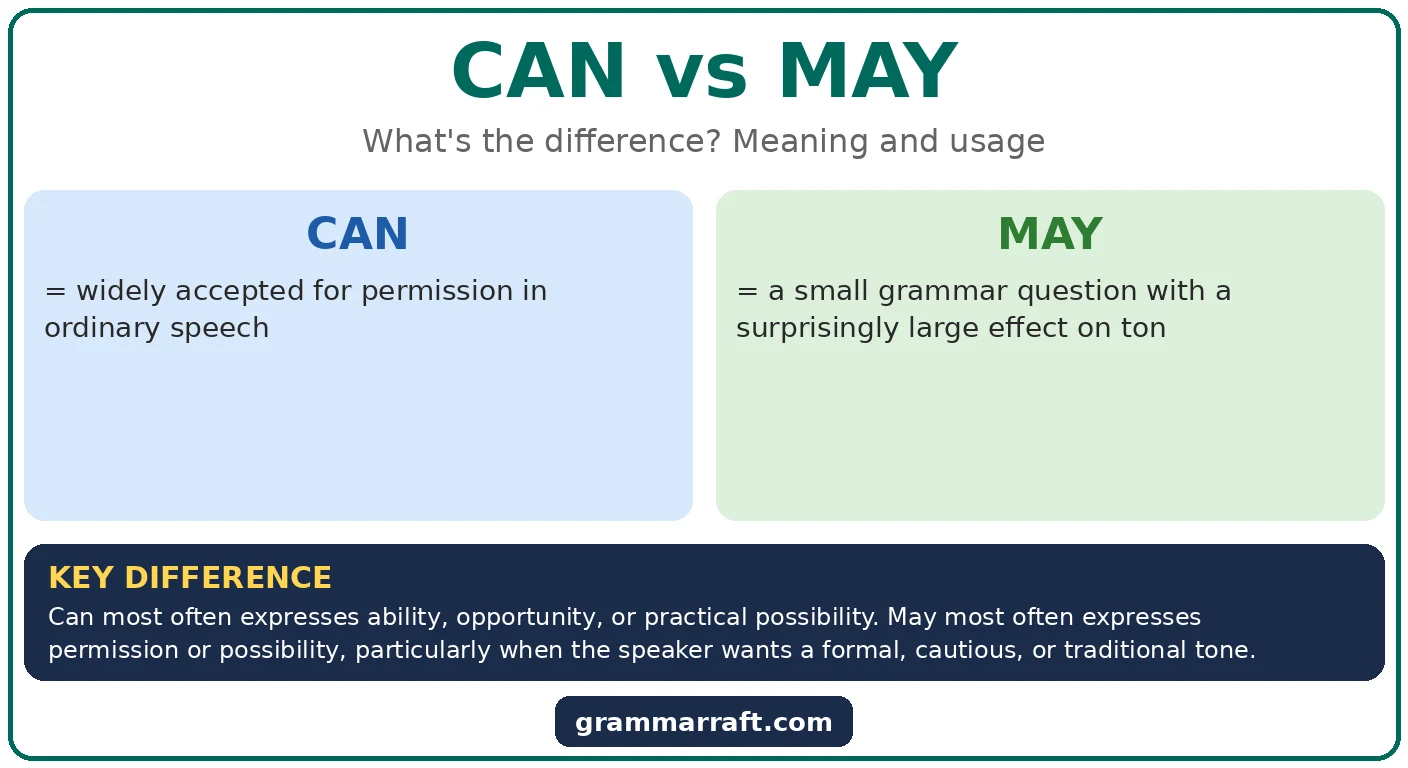
Can vs may is a small grammar question with a surprisingly large effect on tone. Both modal verbs can appear in questions about permission, but they do not always express the same idea. In other sentences, can usually points to ability or practical possibility, while may often signals permission or uncertainty.
The traditional rule says “can” means ability and “may” means permission. That rule is useful, but it is not the whole story of modern English. Native speakers commonly use “Can I…?” to ask permission, especially in conversation, while “May I…?” sounds more formal or deliberately polite.
This guide explains the difference with realistic examples, including “Can I ask?” and “May I ask?”, legal wording, workplace requests, and the related verbs could and might. You’ll also get a quick way to choose the right word without relying on a confusing classroom shortcut.
Can vs May: The Short Answer
Can most often expresses ability, opportunity, or practical possibility. May most often expresses permission or possibility, particularly when the speaker wants a formal, cautious, or traditional tone.
Compare these sentences:
- I can swim. This describes ability.
- Can I swim in the lake? This asks whether swimming is allowed or possible.
- May I swim in the lake? This asks for permission in a more formal way.
- It may rain tomorrow. This expresses possibility.
- The machine can overheat. This describes a possible outcome or general tendency.
The two words overlap because can is widely accepted for permission in ordinary speech. A teacher, friend, or coworker is unlikely to misunderstand “Can I leave early?” The choice of “may” changes the tone more than the basic request.
A useful starting point is this: choose can for ability and everyday requests, and choose may for formal permission or uncertain possibility. Then check the setting, because a legal document, a classroom, and a conversation with a friend follow different expectations.
| Word | Common meaning | Example | Typical tone |
|---|---|---|---|
| can | Ability or practical possibility | I can solve the problem. | Neutral and direct |
| can | Everyday permission | Can I use your phone? | Conversational |
| may | Permission | May I enter? | Formal or polite |
| may | Possibility | The train may be late. | Neutral or cautious |
When Can Means Ability
The clearest use of can describes what someone or something is able to do. In “Maria can speak Spanish,” the verb tells us about Maria’s ability. It does not ask for permission, and it does not predict an uncertain event.
Can also describes a learned skill, a physical capacity, or the function of an object. “This camera can record in low light” means the camera has that capability. “The child can read” means the child has acquired the ability to read.
Ability in statements

Use can before the base form of a verb. The form stays the same for every subject: “I can drive,” “she can drive,” and “they can drive.” Do not add “to” after can, so “I can to drive” is incorrect.
- I can finish the report today.
- Our team can meet on Thursday.
- That small printer can produce color documents.
- He can explain the process clearly.
The negative form, cannot or can’t, shows a lack of ability or an impossibility. “I can’t lift the box” may mean the speaker lacks the strength, while “The store can’t accept cash” may describe a current operational limitation.
Context decides whether “can” refers to skill or circumstances. “I can attend the meeting” often means attendance is possible because the speaker’s schedule allows it. It does not necessarily mean attendance is a physical ability.
Can and general possibility
Can also describe something that sometimes happens or is generally possible. “Winters can be harsh here” does not predict that every winter will be harsh. It states that harsh winters are a real possibility in that place.
This use differs slightly from “may.” “A laptop can overheat” suggests a known potential problem or general tendency. “The laptop may overheat” focuses on the possibility that this particular laptop will overheat in the situation under discussion.
That distinction matters in instructions and warnings. A manufacturer might write, “The device can become hot during use,” because overheating is a recognized condition. A support agent might say, “Your device may become hot if the vents are blocked,” because the statement concerns a specific situation.
When May Means Permission
May has a long-established connection with permission. “May I come in?” asks whether the listener will allow the speaker to enter. “You may begin” grants permission to start.
This use is especially common in formal speech, official announcements, schools, customer-service language, and ceremonial settings. A judge, chairperson, or supervisor might say, “You may proceed,” because the wording marks an authorized next step.
See Also: Discreet vs Discrete: Meaning, Usage and Easy Ways to Remember
May is also useful when a request needs to sound respectful without sounding overly casual. “May I ask a question?” is more formal than “Can I ask a question?” Both are grammatical, but they create different impressions.
Permission in questions
“May I…?” is traditionally treated as the clearest form for asking permission. It works well in a professional email, a formal meeting, or a situation where the speaker wants to acknowledge another person’s authority.
- May I use the bathroom?
- May I ask for clarification?
- May we submit the form tomorrow?
- May I have a copy of the agreement?
In everyday English, however, “Can I…?” is not automatically wrong. “Can I borrow your pen?” normally means “Is it possible or acceptable for me to borrow your pen?” The listener hears it as a request for permission because the social context supplies that meaning.
The old correction—“I don’t know; can you?”—is a joke based on the narrow ability rule. It treats the question as if the speaker were asking about physical capability rather than permission. In real modern conversation, “Can I use your bathroom?” is natural and widely understood.
May in statements that grant permission
May is more common than can in formal statements granting access or approval. A notice might say, “Visitors may enter through the main door,” while a teacher might say, “Students may use calculators during this section.”
These sentences sound official because may presents permission as a rule or authorization. “Visitors can enter through the main door” is also grammatical, but it may sound more like a statement about practical access than a formal policy.
That difference can be important in written instructions. If a policy says employees “may work remotely,” readers may understand that remote work is permitted but perhaps subject to conditions. If it says employees “can work remotely,” the sentence may emphasize that the arrangement is feasible or available.
Can vs May in Everyday Questions
The question “Can I or may I?” usually has a simple answer: both forms can ask for permission, but can I is more conversational and may I is more formal. Neither form is automatically rude.
“Can I leave early today?” sounds direct and normal between coworkers who have an informal relationship. “May I leave early today?” sounds more deferential, which may be suitable when speaking to a supervisor or requesting an exception.
Still, politeness does not come from one modal verb alone. Tone, timing, facial expression, and the rest of the sentence matter. “May I have that file now?” can sound demanding if spoken sharply, while “Can I possibly have that file when you have a moment?” can sound considerate.
Can I ask or may I ask?
Both “Can I ask a question?” and “May I ask a question?” are correct. The first is common in ordinary conversation; the second has a more formal or careful tone.
There is also a difference in what the question may imply. “Can I ask?” often checks whether the conversation is open to a question. “May I ask?” can sound like a request for permission to raise a sensitive or formal issue.
Consider these examples:
- Can I ask why the schedule changed? Natural in a conversation with a coworker.
- May I ask why the schedule changed? More formal and possibly more cautious.
- Can I ask you something? Friendly and informal.
- May I ask you something? Polite, formal, or slightly serious.
Neither sentence guarantees that the question itself will be welcome. The modal verb only frames the request. If the topic is sensitive, adding “if you don’t mind” or “when you have a moment” may do more for politeness than replacing can with may.
Can I use the bathroom?
“Can I use the bathroom?” is standard conversational English. The speaker is not usually asking whether they possess the physical ability to use a bathroom. They are asking whether they are allowed to go or whether the bathroom is available.
“May I use the bathroom?” is also correct and sounds more formal. Teachers may prefer it in a classroom because the setting involves an explicit request for permission, but modern usage does not make “Can I use the bathroom?” ungrammatical.
A third option, “Could I use the bathroom?”, sounds polite and less formal than “May I use the bathroom?” It is often a good choice when the speaker wants to make a respectful request without sounding ceremonial.
Can vs May for Possibility
Both can and may can express possibility, but they tend to frame that possibility differently. May often refers to a specific uncertain event, while can often refers to general possibility, capability, or a condition that sometimes occurs.
“It may rain tomorrow” predicts an uncertain event. The speaker does not know whether rain will occur, but considers it possible. “It can rain heavily in this region” describes a general fact about the region’s weather.
| Sentence | Main idea | Why the choice fits |
|---|---|---|
| It may rain tomorrow. | Specific forecast | Rain is possible on a particular day. |
| It can rain heavily here. | General possibility | Heavy rain is a known condition in this place. |
| The package may arrive today. | Uncertain event | The speaker is making a cautious prediction. |
| Road closures can cause delays. | General consequence | The sentence describes a recurring potential effect. |
The distinction is not absolute. “The package can arrive today” may be grammatical if the speaker means delivery today is operationally possible. Yet “The package may arrive today” is usually the more natural sentence if the speaker is making a prediction.
May, might, and degrees of uncertainty
Might also expresses possibility and often sounds more uncertain than may. “She may join us” leaves open the possibility that she will join. “She might join us” can suggest that the chance is weaker, although speakers do not always preserve a strict difference.
May can also appear in formal warnings or cautious claims. “This change may affect processing times” avoids presenting the result as certain. In a scientific, business, or public-information context, that restraint is often more accurate than a definite statement.
Can is usually less suitable for a single uncertain prediction. “The meeting can be canceled tomorrow” may mean cancellation is allowed or feasible. “The meeting may be canceled tomorrow” clearly means cancellation is a possibility.
Could and conditional possibility
Could often presents a possible result, especially in a conditional sentence. “The delay could affect the launch” means the delay has the potential to affect the launch. It does not say that the effect is likely.
Compare “The delay can affect the launch” with “The delay could affect the launch.” The first sounds like a general warning about a known relationship; the second focuses on a particular possible outcome.
These subtle differences are useful, but they should not become a mechanical test. Speakers choose modal verbs based on certainty, politeness, formality, and context. The surrounding verb and situation matter as much as the modal itself.
Can vs May in Formal and Professional English
Professional writing often requires precision about permission, capability, and probability. Choosing can or may carefully helps readers understand whether a sentence describes what is possible, what is authorized, or what is merely expected.
For example, “Employees may access the archive after approval” states a permission rule. “Employees can access the archive from any network” describes technical capability or practical access. The two sentences could both be true, but they answer different questions.
Formal writing also benefits from avoiding unnecessary ambiguity. If an instruction intends to grant permission, may can make that purpose unmistakable. If it intends to describe a system’s function, can is generally clearer.
Policies, contracts, and legal wording
In policies and contracts, may commonly signals discretion or permission. “The company may terminate the agreement” often means the company has the authority or option to terminate it, not that termination is inevitable.
See Also: Allusion vs Illusion: Meaning, Examples, and Usage
However, legal meaning depends on the document, jurisdiction, and surrounding language. A single modal verb cannot settle every question about obligation or authority. Terms such as “must,” “shall,” “may,” and “can” can be interpreted within a larger statutory or contractual framework.
“Can” in legal or technical writing may describe capacity rather than permission. “The tenant can access the storage area” could mean access is physically possible, while “The tenant may access the storage area” is more likely to describe an authorized right. Writers should define rights and conditions directly instead of relying on a vague implication.
For general explanations of modal auxiliary verbs, the Purdue OWL overview of modal auxiliary verbs provides a useful reference. Specific legal documents should still be reviewed according to the applicable law.
Workplace emails and requests
In a workplace email, “Can you send me the revised file?” usually asks whether the recipient is able and willing to send it. “May I send the revised file tomorrow?” asks whether the sender has permission to delay submission.
Those meanings are easy to confuse because the verbs appear in similar-looking requests. A helpful rewrite is to identify the hidden question: “Are you able to do this?” points toward can or could, while “Is this allowed?” points toward may.
- Can you attend the meeting? Are you available or able to attend?
- May I attend the meeting? Do I have permission to attend?
- Could you review this draft? A polite request for someone’s help.
- May we publish the draft? A request for authorization.
Business writing does not require “may” for every polite request. “Could you…” is often warmer and more natural than “May you…,” which is uncommon in ordinary requests. Use the modal that matches the intended meaning rather than choosing the most formal-looking word.
Common Mistakes With Can and May
The most common mistake is treating the classroom rule as complete: can equals ability, and may equals permission. That rule helps beginners distinguish two important meanings, but it ignores the fact that “Can I…?” has long been used as an everyday permission request.
A second mistake is using “may” whenever a sentence needs to sound formal. May does not automatically make a request polite, and it is not the normal replacement for can in every sentence. “May you send the file?” sounds unusual because English speakers generally use “Could you send the file?” or “Would you send the file?” for that kind of request.
Incorrect forms and better alternatives
| Less suitable sentence | Better alternative | Reason |
|---|---|---|
| I can to drive. | I can drive. | Can takes the base verb without “to.” |
| May you send the report? | Could you send the report? | Could is more natural for a polite request. |
| The train can be late today. | The train may be late today. | May better expresses a specific uncertain event. |
| Can I enter? Formal notice. | May I enter? | May better suits a formal permission request. |
Another problem is confusing “may” with “might” in situations that require certainty. “You may receive a confirmation email” means receipt is possible or expected, depending on context. It does not guarantee that the email will arrive.
Writers sometimes also use “can” where they mean permission in a policy and create uncertainty. “Members can bring one guest” might mean members are capable of bringing a guest. “Members may bring one guest” clearly presents the rule as permission.
Watch the negative forms
Cannot and may not have different meanings. “You cannot enter” may mean entry is impossible, or it may mean entry is forbidden. “You may not enter” normally means entry is prohibited.
That difference makes “may not” especially important in rules. “The applicant may not submit additional documents” usually states a restriction. “The applicant cannot submit additional documents” could mean the system does not allow submissions, the applicant lacks the ability, or the deadline has passed.
When a prohibition must be clear, use direct wording such as “is not permitted” or “must not.” Direct language reduces the risk that readers will mistake a technical limitation for a rule, or a rule for a technical limitation.
A Practical Decision Guide
Choosing between can and may becomes easier if you identify the purpose of the sentence before selecting the modal verb. Ask what the speaker wants the listener to understand, not simply which word sounds more formal.
- Is the sentence about skill or ability? Use can: “She can repair the bicycle.”
- Is it about general practical possibility? Can often works: “This route can become dangerous after dark.”
- Is someone asking for permission? Use may for formal situations and can for everyday conversation.
- Is it a specific uncertain event? May or might usually fits: “The supplier may call this afternoon.”
- Is it a polite request for help? Use could or would: “Could you check these figures?”
- Is it a formal rule granting authorization? May is often clearest: “Applicants may appeal the decision.”
Now test the sentence against its context. “Can we start?” may ask whether the group is ready or whether circumstances allow a start. “May we start?” asks for authorization, perhaps from a chairperson or instructor.
Choosing the right tone
Use can when you want a plain, natural, conversational style. It is usually the best choice among friends, family members, and coworkers who communicate informally.
Use may when permission itself is important or when the setting is formal. It suits official notices, traditional classroom instruction, ceremonies, and respectful requests to someone with decision-making authority.
Use could when you want a polite request for another person’s action. “Could you open the window?” asks for help, while “May I open the window?” asks for permission to act yourself.
That contrast is one of the most useful distinctions in everyday English. The subject of the request often tells you the correct modal: Could you…? for the listener’s action, and May I…? for your own authorized action.
A quick editing test
Replace the modal with a longer phrase and see which meaning remains. If “be able to” works, can is probably appropriate. If “be permitted to” works, may is probably the clearer choice.
- I can finish the task. → I am able to finish the task.
- May I leave now? → Am I permitted to leave now?
- It may snow tonight. → It is possible that it will snow tonight.
- Road salt can damage plants. → Road salt has the potential to damage plants.
This test is not a rigid grammar law, but it reveals the sentence’s intended meaning. If both substitutions seem possible, the sentence may involve the natural overlap between ability, opportunity, and permission.
How Usage Changes by Context
English is shaped by situation as much as by dictionary definition. A student answering a teacher, a lawyer drafting a contract, and a friend asking to borrow a jacket may all use different modal verbs without violating the basic grammar of English.
See Also: Advice vs Advise: Meaning, Examples and Usage
In school, “May I leave the room?” is a traditional formula for asking permission. In a home, “Can I go outside?” sounds entirely natural. In a public notice, “Visitors may not enter this area” is more precise and formal than “Visitors can’t enter this area,” which could suggest a locked door rather than a rule.
American and British usage
Both American and British English use can for ability and may for possibility or permission. Differences tend to involve style, age, formality, and personal preference rather than a simple national division.
Some speakers associate “May I…?” with careful or traditional English, while others use it frequently in formal settings. “Can I…?” is widespread in both varieties, especially in ordinary conversation.
There is no need to treat everyday permission questions as errors merely because they use can. A formal editor may recommend may for a particular audience, but an informal speaker is not breaking communication by saying “Can I sit here?”
Why the traditional rule survives
Teachers often present the ability-permission distinction because it gives students a manageable starting point. It helps them see that “can” has a meaning beyond asking for permission and that “may” can function as more than a formal substitute.
The rule also remains useful in edited writing. If a sentence could be misunderstood, choosing may for authorization and can for capability creates a clear contrast. The problem arises only when the simplified rule is treated as the full description of actual usage.
Good grammar instruction should explain both ideas: the traditional distinction and the modern overlap. Students then learn not only what a form can mean, but also how real speakers use it in different situations.
FAQ: Can vs May
Is “Can I?” grammatically correct for asking permission?
Yes. “Can I?” is grammatically correct and extremely common in conversational English as a request for permission. “May I?” is also correct and usually sounds more formal or traditional, so the best choice depends on the setting and desired tone.
Is “May I?” more polite than “Can I?”
“May I?” often sounds more formal and deferential, but it is not automatically more polite. A respectful tone depends on the whole sentence, the relationship between speakers, and how the request is delivered. “Could I?” is another natural option for a polite request.
Should I say “May I ask?” or “Can I ask?”
Use either form. “Can I ask?” is common and conversational, while “May I ask?” sounds more formal or careful. If you are raising a sensitive question in a professional or official setting, “May I ask?” may better match the tone.
What is the difference between can, may, and might?
Can commonly expresses ability, general possibility, or informal permission. May expresses permission or the possibility of a specific event, while might often presents a less certain possibility. For example, “I can attend,” “May I attend?” and “I might attend” communicate three different ideas.
Is “may not” the same as “cannot”?
Not always. “May not” usually means that something is not permitted, while “cannot” can mean that something is impossible, unavailable, or forbidden. If a rule must be unmistakable, phrases such as “must not” or “is not permitted” often provide clearer wording.
Conclusion
The central lesson in can vs may is simple: can usually describes ability, practical possibility, or everyday permission, while may commonly marks formal permission or an uncertain possibility. “Can I?” is natural in conversation, and “May I?” is a useful choice when authorization or formality deserves emphasis.
Before choosing a modal verb, identify the real meaning: ability, permission, prediction, or a request for help. That quick check will make your English clearer without forcing every sentence into an outdated rule, and it will help you use can vs may with confidence in both casual and professional writing.
Explore more helpful guides on GrammarRaft.