Suffix Definition: Meaning, Types, and Examples
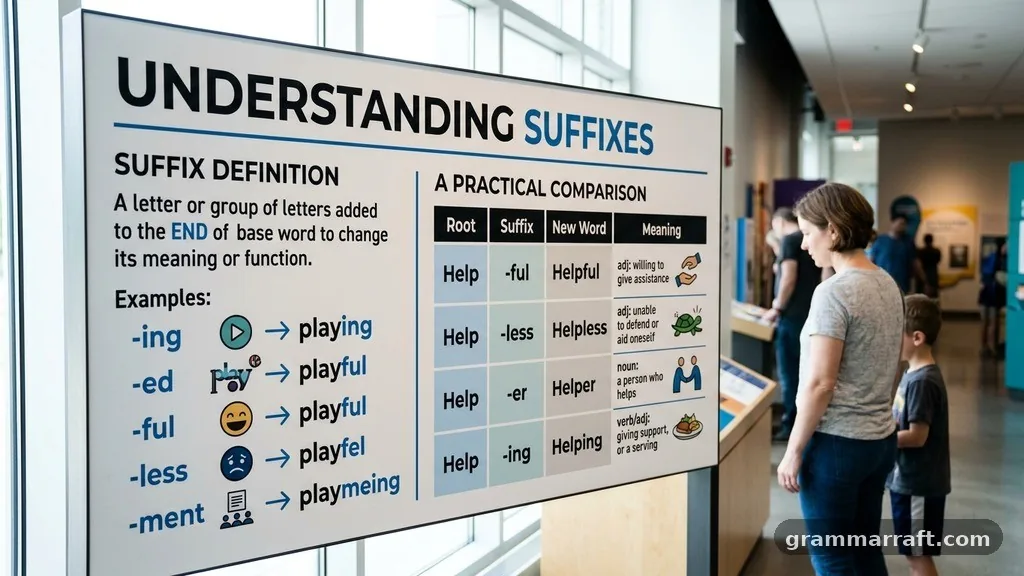
A suffix definition is simple: a suffix is a letter or group of letters added to the end of a word or root word to change its meaning, grammatical form, or both. In unhappy, for example, -y helps form an adjective, while -ness turns happy into the noun happiness.
Suffixes matter because they show how English words are built. They can change a verb into a noun, describe a person’s job, indicate tense, create a comparison, or alter a word’s meaning without replacing its root.
This explanation covers common suffixes, the difference between inflectional and derivational endings, suffixes in names and application forms, spelling changes, and easy ways to identify them. The examples also show why a suffix’s meaning depends on the word it joins.
What Is a Suffix?
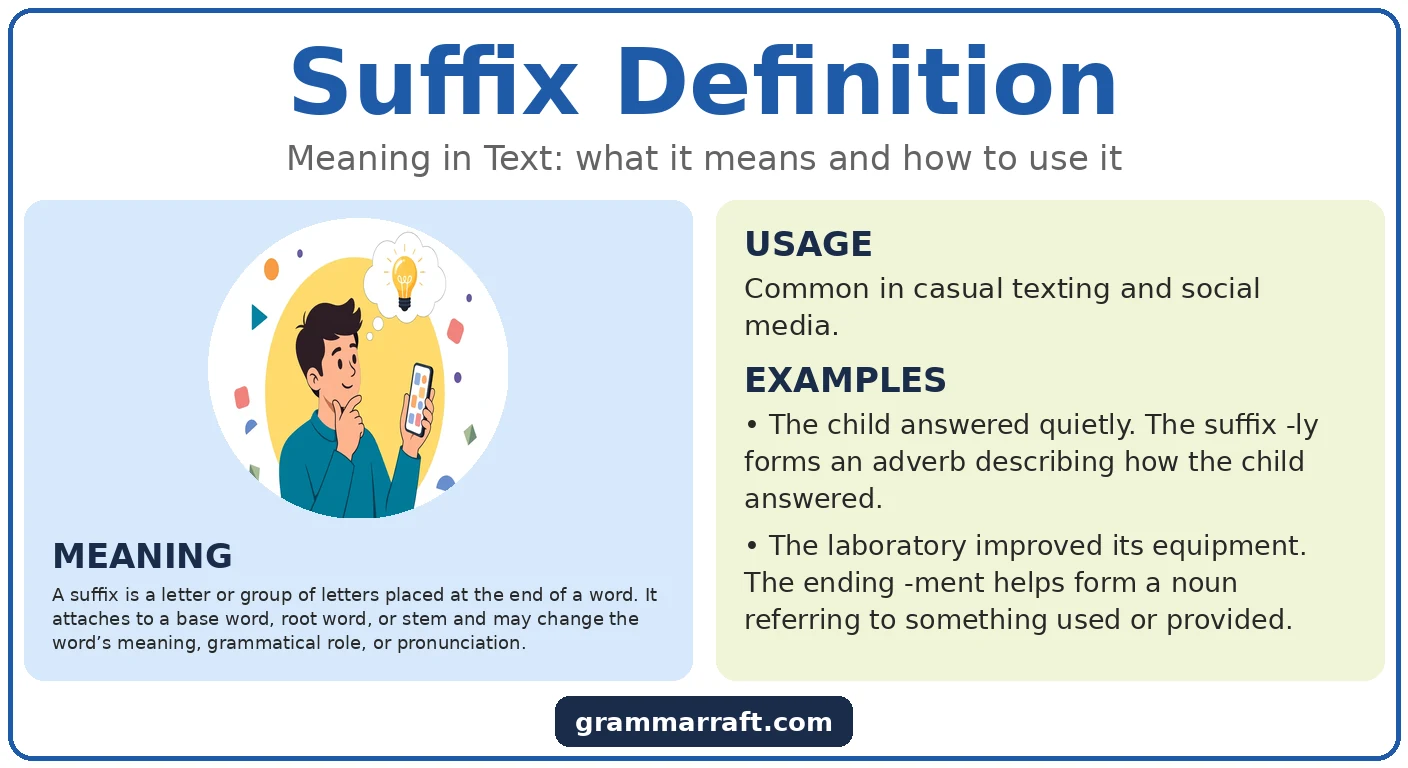
A suffix is a letter or group of letters placed at the end of a word. It attaches to a base word, root word, or stem and may change the word’s meaning, grammatical role, or pronunciation. The word careful, for instance, combines care with the suffix -ful, producing an adjective that means “full of care” or “showing care.”
The word receiving the suffix is often called the base word. In quickly, quick is the base word and -ly is the suffix. The resulting word remains connected to the original meaning, but it changes from an adjective into an adverb.
Not every ending is a suffix. The final letters in a word may simply be part of its root or spelling pattern. For example, the -er in water is not functioning as the suffix that appears in teacher; in teacher, -er helps indicate a person who performs an action.
A useful suffix definition therefore needs more than a location. A suffix is an ending that performs a grammatical or meaning-related job within a word.
- Base word: the word to which an ending is added, such as help.
- Root word: the central part carrying the core meaning, such as act in action.
- Suffix: the added ending, such as -ful in helpful.
- New word: the result, such as helpful, helpfulness, or helpfully.
Suffixes can be short, such as -s, or longer, such as -tion and -ment. Their role is easier to understand by examining what changes after the ending is added.
How Suffixes Change Word Meaning
Some suffixes change a word’s meaning while keeping it in the same broad word family. Adding -less to hope creates hopeless, meaning without hope. Adding -ful creates hopeful, meaning full of hope or expecting a positive result.
The contrast between -less and -ful is especially useful for learners. A person who is careless does not give enough attention, while a person who is careful gives attention and avoids mistakes. The endings point in opposite directions.
Other suffixes express a person, object, or condition. The ending -er can identify someone associated with an action: teach becomes teacher, write becomes writer, and drive becomes driver. The suffix -ist can indicate a person connected with a belief, activity, or profession, as in artist, scientist, or cyclist.
Some endings create abstract nouns. The suffix -ness changes adjectives into nouns: kind becomes kindness, dark becomes darkness, and polite becomes politeness. Similarly, -ity appears in nouns such as ability, equality, and activity.
| Base word | Suffix | New word | Effect |
|---|---|---|---|
| hope | -less | hopeless | Means without hope |
| kind | -ness | kindness | Forms an abstract noun |
| teach | -er | teacher | Names a person who teaches |
| quick | -ly | quickly | Forms an adverb |
| enjoy | -ment | enjoyment | Forms a noun for a state or result |
Meaning can shift in less predictable ways, too. A dictionary remains useful because the meaning of a derived word is not always the direct sum of its parts. For example, apartment does not mean “a place that is apart” in ordinary modern English.
Inflectional and Derivational Suffixes
English suffixes are commonly divided into two broad groups: inflectional suffixes and derivational suffixes. The distinction helps explain whether an ending creates a new dictionary word or simply changes the grammatical form of an existing word.
An inflectional suffix usually keeps the word’s basic meaning and word class. In walked, -ed shows past tense, but walk remains a verb. In cats, -s marks plural number, but cat remains a noun.
Derivational suffixes often create a new word or change the word class. The suffix -ness changes the adjective soft into the noun softness. The suffix -able changes read into readable, an adjective describing something that can be read.
English has a relatively small set of common inflectional endings. They include plural -s, possessive -’s, third-person singular -s, past tense -ed, past participle -en or -ed, progressive -ing, comparative -er, and superlative -est.
See Also: People Do vs People Does: Which Is Correct?
Derivational suffixes are more varied. They include endings such as -ness, -ment, -tion, -ful, -less, -ly, -ize, and -ity. Some are productive, meaning speakers can use them with new or less familiar words, while others occur mainly in established vocabulary.
A practical comparison
Compare small, smaller, and smallness. Smaller is an inflected form used to compare two things; smallness is a new noun naming a quality. The endings look different in function even though both occur at the end.
Inflection generally comes after derivation when both occur in one word. In quickly, -ly creates an adverb, and in quickly there is no additional inflection. In teachers, -er first creates teacher, then plural -s marks more than one teacher.
For a clear overview of English word formation and grammatical terminology, the Cambridge Dictionary guide to word formation is a useful reference.
Common English Suffixes and Their Uses
Many suffixes appear frequently in everyday English. Learning them as meaning patterns can help readers work out unfamiliar words, although context and a dictionary should confirm the interpretation.
Suffixes that form nouns
-ness forms nouns from many adjectives: happiness, weakness, readiness, and fairness. -ment often forms nouns connected with an action, process, or result, as in movement, payment, development, and agreement.
-tion, including related forms such as -sion and -ation, appears in nouns such as education, decision, expansion, and creation. These endings are common in formal and academic vocabulary. The spelling may change depending on the base word, so learners should treat the whole word as a unit rather than applying one rule mechanically.
-er and -or can identify a person or thing that performs an action: baker, actor, visitor, and projector. The choice between them is usually determined by established spelling and word history.
Suffixes that form adjectives
-ful and -less create opposite kinds of descriptions in many cases. Meaningful means having meaning, while meaningless means lacking meaning. Other common adjective endings include -ous, as in dangerous and famous, and -al, as in natural and personal.
The suffix -able often means “capable of being” or “suitable for”: washable means capable of being washed, and dependable describes something that can be depended on. It does not always have a perfectly literal meaning, however. Comfortable, for example, is not normally understood as “able to comfort” in every context.
Suffixes that form verbs and adverbs
-ize can form verbs such as modernize, organize, and recognize. In British English, some words may also appear with -ise, as in organise, although usage depends on the variety of English and the word.
-ly commonly changes an adjective into an adverb: slow becomes slowly, and careful becomes carefully. Not every word ending in -ly is an adverb; friendly, lonely, and lovely are adjectives despite their spelling.
Suffix Examples in Sentences
Seeing suffixes in complete sentences is more helpful than memorizing disconnected word lists. The surrounding sentence reveals whether the ending changes meaning, word class, tense, number, or comparison.
- The child answered quietly. The suffix -ly forms an adverb describing how the child answered.
- The laboratory improved its equipment. The ending -ment helps form a noun referring to something used or provided.
- Several artists displayed their work. The ending -s marks a plural noun.
- This route is shorter than the other one. The ending -er marks a comparative adjective.
- Her explanation was helpful. The suffix -ful forms an adjective meaning useful or providing help.
- The old bridge was unsafe. Here, un- is a prefix, not a suffix; the example shows why word position matters.
Consider the sentence, “The runner finished quickly.” The base word quick describes the runner or an object, but quickly describes the action finished. The suffix has changed the grammatical role of the word.
Now compare, “The runner finished the race.” The ending -ed in finished signals past tense. It does not create an entirely different dictionary entry in the same way that happy and happiness represent different parts of speech.
Some words contain more than one suffix. In carelessness, care combines with -less to form careless, and then -ness creates the noun carelessness. This layered structure shows that suffixes can be added in stages.
Pronunciation can change after a suffix is added. The noun photograph and the related word photography do not stress the same syllable, and the vowel sounds may change as well. Spelling, pronunciation, and meaning should therefore be considered together.
Suffix Spelling Rules and Word Changes
Adding a suffix sometimes changes the spelling of the base word. These changes make pronunciation or conventional spelling easier, but they can create problems for learners who expect the base to remain untouched.
Changing a final y
When a consonant comes before a final y, the y often changes to i before a suffix such as -ness: happy becomes happiness, and easy becomes easier. Before -ing, the y usually remains: studying and carrying.
If a vowel comes before the final y, the y commonly stays in place. Enjoy becomes enjoyment, and play becomes playful. English has exceptions, so the spelling of a familiar word should take priority over a rule remembered in isolation.
Doubling a final consonant
A short stressed word may double its final consonant before a vowel-starting suffix. Run becomes running, and big becomes bigger. The doubling rule depends on syllable structure, stress, and the letters involved.
Words ending in a silent e often drop that e before a suffix beginning with a vowel. Make becomes making, and hope becomes hoping. The e usually remains before a consonant-starting suffix: hopeful and safely.
Dropping or keeping letters
Some suffixes trigger spelling changes that are based on word history rather than a simple modern rule. Electric becomes electricity, and permit becomes permission. In these cases, the related words must often be learned together.
Use a dictionary when the spelling looks uncertain, especially with endings such as -able, -ible, -ance, and -ence. Sound alone may not tell you which form is correct.
Suffixes in Names and Application Forms
In a person’s name, a suffix is an added title or designation that follows the family name. Common examples include Jr., Sr., II, III, and professional or academic designations in contexts where they are officially used.
Jr. usually means Junior and may identify a son who has the same name as his father. Sr. means Senior and may distinguish the older person. These labels are not automatically part of every person’s legal name, so official documents should be completed according to the person’s records.
Roman numerals such as II, III, and IV generally indicate that a name has been repeated across generations or family members. Their use can vary by family tradition and legal documentation. A person named after a grandparent may use II, while another family may use III only when the exact name has passed through two earlier generations.
See Also: Simile vs Metaphor: Meaning, Examples, and Key Differences
Application forms often include a separate field labelled “suffix.” That field is asking whether a designation follows the applicant’s name, not whether the applicant’s surname has an English word ending such as -son or -sen.
If the applicant has no name suffix, the field may be left blank or marked “None,” depending on the form’s instructions. Do not enter a professional qualification unless the form specifically asks for credentials, and do not place a prefix such as Mr., Ms., Dr., or Rev. in the suffix box.
| Designation | Typical meaning | Where it may appear |
|---|---|---|
| Jr. | Junior; often a younger person with the same name as a parent | Personal names and official records |
| Sr. | Senior; often distinguishes an older person from a junior namesake | Personal names and correspondence |
| II | Second; a repeated family name or designation | Names, forms, and records |
| III | Third; the third person using the relevant name | Names and legal or institutional records |
Requirements differ by country, institution, and document system. The safest approach is to copy the suffix exactly as it appears on the relevant official identification or follow the form’s stated instructions.
Suffixes for Children and English Learners
A child-friendly suffix definition can be short: a suffix is a word part added to the end of a word to make a new word or show a grammar change. In play, a teacher might write help, helpful, and helpless so children can see how the ending affects meaning.
Hands-on word building works well. Give learners a base such as paint and let them add -er, -ing, or -ed to make painter, painting, and painted. The activity connects spelling with meaning instead of treating suffixes as labels to memorize.
Start with common, transparent endings. Plural -s, past-tense -ed, progressive -ing, comparative -er, and superlative -est are easier to observe in familiar words than less predictable endings such as -tion or -ity.
A simple learning routine
- Read the whole word aloud.
- Underline the ending that may be the suffix.
- Identify the base word, if one is present.
- Ask what changed: meaning, word class, tense, number, or comparison.
- Use the word in a sentence to test the explanation.
For English learners, suffixes provide clues to grammar. An ending such as -s may signal a plural noun or a third-person singular verb, while -ed may signal past tense or act as part of an adjective such as bored.
Teachers should also explain that one suffix can have more than one use. The -er in runner identifies a person, but the -er in faster marks comparison. Context tells the reader which function is active.
Visual word families can support memory: act, action, active, actively, actor, and activity. Students can see that the root remains related while the added suffix changes the grammatical form or meaning.
Suffix, Prefix, Root, and Ending: Key Differences
A suffix comes at the end of a word, while a prefix comes at the beginning. In unhelpful, un- is a prefix, help is the root, and -ful is the suffix.
The root carries a central meaning, although the root may not always appear as an independent English word. In biology, the elements bio and -logy contribute meaning, but analyzing complex words often requires knowledge of Greek or Latin roots as well as modern English suffixes.
A word ending is simply the final part of a word. It becomes a suffix only when it functions as an added meaningful or grammatical element. This distinction prevents incorrect analysis of words such as corner, where -er is not necessarily the person-forming suffix seen in baker.
The phrase “suffix suffix” is not a standard grammatical category. If someone writes or searches those two words together, they may be repeating the term while looking for a suffix definition, asking about a suffix within a word, or referring to a particular ending whose label they do not yet know.
Prefixes and suffixes can appear together. In unhappiness, un- changes the meaning of happy, and -ness changes the adjective into a noun. The order matters because each added part operates on the form created before it.
| Word part | Position | Example | Main role |
|---|---|---|---|
| Prefix | Beginning | un- in unhappy | Often changes meaning |
| Root | Central element | help in helpful | Carries core meaning |
| Suffix | End | -ness in kindness | Changes form, meaning, or grammar |
| Word ending | Final letters | -er in corner | May have no separate function |
Breaking a word into parts is helpful, but it should not replace checking the whole word. Historical relationships, pronunciation changes, and exceptions mean that modern meaning cannot always be predicted perfectly from spelling.
How to Identify a Suffix Correctly
Begin by looking at the end of the word, but do not assume that every final group of letters is a suffix. Ask whether removing the suspected ending leaves a recognizable base and whether the ending contributes a consistent grammatical or meaning-related function.
Take fearless. Removing -less leaves fear, and the suffix contributes the meaning “without.” That is strong evidence that -less is functioning as a suffix.
Now take business. It ends in the letters -ness, but the word is not normally analyzed as busy plus ness in modern spelling. The relationship between business and busy is historical and involves spelling changes, so a simple cut-and-paste approach can mislead.
Five useful questions
- Does the suspected suffix occur in other words with a similar function?
- Does the remaining part connect clearly to the word’s meaning?
- Has the word’s part of speech changed?
- Does the ending mark tense, number, possession, or comparison?
- Does a reliable dictionary recognize the related word family?
Next, identify the word class before and after the ending. If quiet becomes quietly, the change from adjective to adverb supports the analysis. If a word remains a noun but gains a plural marker, the ending is more likely inflectional.
Pronunciation can offer another clue, although it is not decisive. The plural ending written -s may sound like /s/, /z/, or an extra syllable in words such as cats, dogs, and buses. The spelling is the same, but the pronunciation changes according to the final sound of the base word.
Finally, use context. The ending -ing can appear in running as a verb form, in swimming as a noun, or in interesting as an adjective. A suffix’s exact function depends on the sentence, not only on the letters visible at the end.
See Also: Advice vs Advise: Meaning, Examples and Usage
Why Suffixes Matter in Reading and Writing
Suffix knowledge helps readers infer unfamiliar vocabulary. If a learner knows that -ist can identify a person associated with an activity, the word environmentalist becomes less mysterious even before the reader checks a dictionary.
Suffixes also reveal relationships among words. Creation, creative, creatively, and creator share a connection with create, but each has a different grammatical role. Recognizing the family helps writers choose the form that fits a sentence.
In academic writing, suffixes often signal abstract ideas and processes. Words ending in -tion, -ity, and -ism appear frequently in discussions of education, government, science, and culture. Understanding their structure can make dense passages easier to unpack.
For spelling, suffix awareness encourages writers to notice changes instead of adding endings mechanically. A writer who knows happy becomes happiness is less likely to write happyness, while someone who understands the silent-e pattern is more likely to spell make plus ing as making.
Suffixes can also help with translation, but they should not be matched word for word across languages. An English suffix may correspond to a separate word, a grammatical ending, a change in word order, or no single element in another language.
Meaning can shift over time. A suffix that was productive in earlier English may now survive mainly in established words, while newer forms may be created through technology, popular culture, or specialized fields. Dictionaries record accepted usage, but new formations may vary before they become standard.
Good writing depends on choosing the correct derived form, not simply adding the longest ending available. A noun, verb, adjective, or adverb may all express related ideas, yet only one will fit the grammar and tone of a particular sentence.
FAQ About Suffix Definition
What is the simplest suffix definition?
A suffix is a letter or group of letters added to the end of a word or root to change its meaning or grammatical form. In kindness, -ness is the suffix added to kind.
What are five common suffix examples?
Common examples include -s in books, -ed in jumped, -ing in reading, -ly in slowly, and -less in careless. These endings mark grammar or create related words.
What is a suffix on a person’s name?
A name suffix is a designation placed after a person’s family name, such as Jr., Sr., II, or III. It should be entered on an application form only when it officially applies to the person and the form requests it.
What does suffix mean on an application form?
On an application, “suffix” usually asks whether a designation follows your name. If you do not have one, follow the form’s instructions for leaving the field blank or selecting “None.”
How can children recognize a suffix?
Children can start with a familiar base word, add an ending, and compare the results. For example, help, helpful, helpless, and helper show how different suffixes change meaning or identify a person.
Conclusion
The clearest suffix definition is a word part added to the end of a base or root word. It may form a new noun, adjective, verb, or adverb, or it may show tense, number, possession, or comparison. The surrounding sentence determines the suffix’s exact job.
To identify one, separate the possible ending, check the remaining word, and ask what changed. Once you understand that process, suffixes become practical tools for spelling, vocabulary, reading, and grammar—not just labels in a textbook. Keep a few word families nearby and test unfamiliar examples in context.
Explore more helpful guides on GrammarRaft.