May or Might: Meaning, Differences, and Correct Usage?
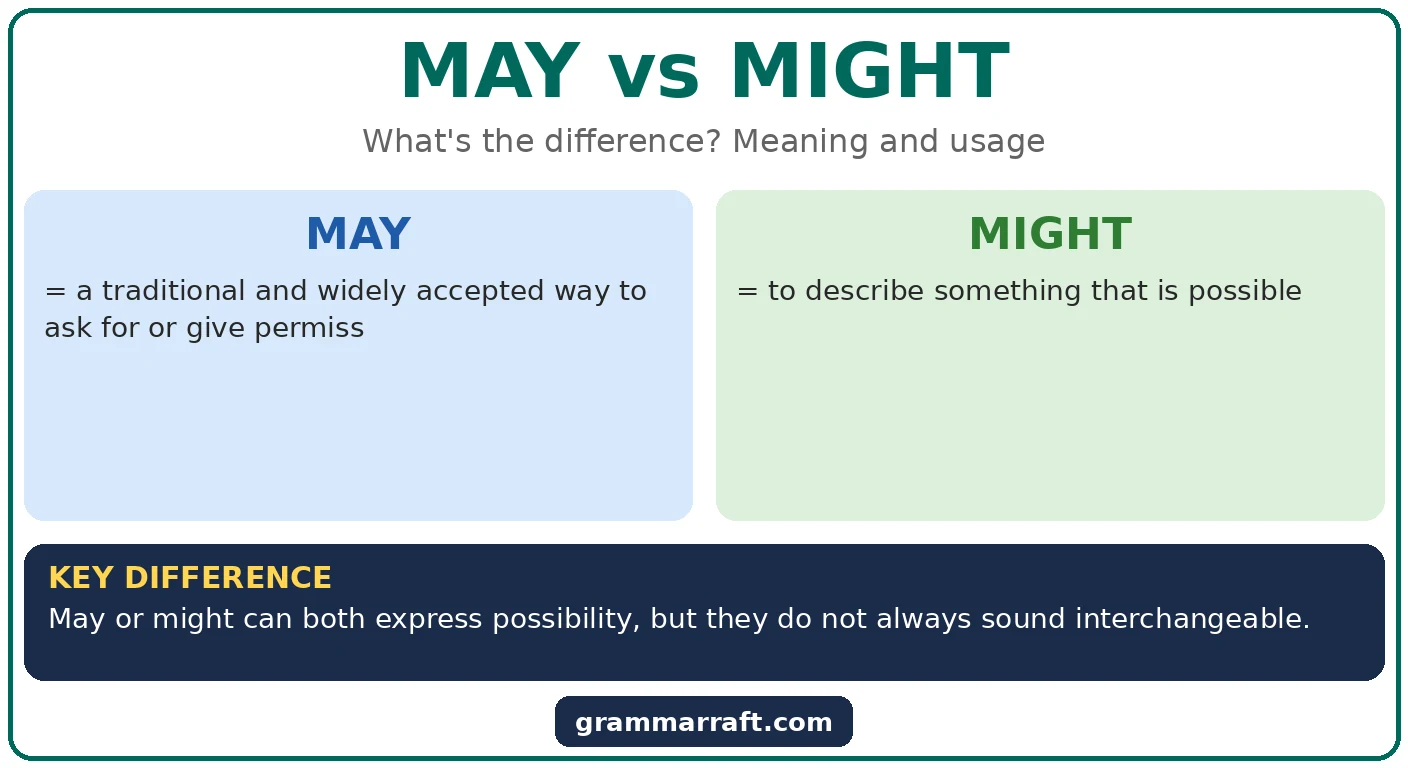
May or might can both express possibility, but they do not always sound interchangeable. The choice depends on certainty, time, formality, and whether you are asking for permission or describing an imagined situation.
These small modal verbs often cause large writing problems. A sentence such as “I may go” can sound more open or more likely than “I might go,” while “May I leave?” is a permission question rather than a prediction.
By the end, you’ll know how may and might work with the main verb, how they behave in the past tense, and which form fits statements, questions, conditionals, and reported speech.
What May and Might Mean
May and might are modal auxiliary verbs. They come before the base form of another verb: “She may arrive,” “They might stay,” and “I may call.” Neither modal takes “to” before the main verb, so “He may to leave” is incorrect.
The two words commonly express a possibility. If someone says, “The train may be late,” the speaker thinks lateness is possible. “The train might be late” communicates the same basic idea, although it can sound a little less certain or more tentative.
They also have different jobs. May can express permission, as in “You may use my phone,” while might usually does not carry that meaning in modern standard English. “You might use my phone” normally sounds like a suggestion or a statement about possibility, not a clear grant of permission.
Both forms are followed by the plain, uninflected verb:
- She may come after lunch.
- He might know the answer.
- We may need more time.
- They might choose the earlier flight.
Do not add an “-s” to the main verb after may or might. “She may likes it” is wrong; “She may like it” is correct. The modal already carries the grammatical structure needed for the verb phrase.
In everyday speech, the difference between the two can be small. Speakers often choose based on rhythm, habit, level of confidence, or the surrounding context rather than a precise percentage of probability.
May or Might for Possibility
The most common use of may and might is to describe something that is possible. The event could happen, but the speaker does not present it as certain. “The package may arrive today” and “The package might arrive today” both leave room for another outcome.
Many grammar explanations say that may suggests a stronger possibility than might. That distinction can help learners, but it is not an absolute rule. Native speakers frequently use “might” for a possibility they consider quite realistic, especially when they want to sound cautious.
| Sentence | Typical effect | What it leaves open |
|---|---|---|
| The meeting may finish early. | A reasonable possibility | The meeting may also finish at the planned time. |
| The meeting might finish early. | A more tentative possibility | The speaker is less ready to predict it. |
| It may rain tonight. | A neutral forecast | Rain is one likely outcome among others. |
| It might rain tonight. | A cautious forecast | The evidence or confidence may be weaker. |
Context can erase the difference. “I might be wrong” is a familiar way to soften an opinion, even when the speaker believes the opinion is probably correct. The word signals humility as much as probability.
May and might can also appear with adverbs such as “possibly,” “perhaps,” and “still.” For example, “She may still be at work” means her presence at work remains possible, while “They might possibly agree” is grammatical but often unnecessarily repetitive because both words already express uncertainty.
A useful test is to ask what the sentence is doing. If it gives a forecast without claiming certainty, either modal may work. If it needs a deliberately cautious or speculative tone, might is often the better choice.
May or Might for Permission
See Also: Few vs Phew: Understanding the Difference in Meaning and Usage
May is a traditional and widely accepted way to ask for or give permission. “May I open the window?” is a formal request. “You may leave when the bell rings” gives official permission.
In ordinary conversation, many people use “can” for permission: “Can I borrow your pen?” This is standard informal English, despite the older classroom rule that “can” should express ability and “may” should express permission. “May” sounds more formal, careful, or respectful in this setting.
Might does not normally replace may in a direct permission question. “Might I use your bathroom?” is possible, but it is an unusually formal and deferential expression. It does not simply mean the same thing as “May I use your bathroom?” in everyday speech.
Permission compared with possibility
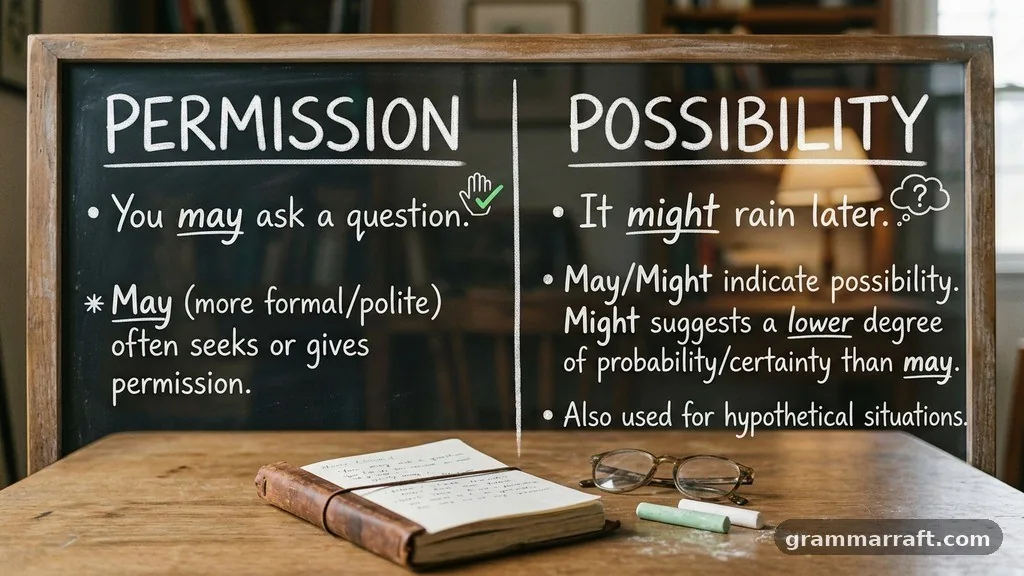
Compare these sentences:
- May I leave early? The speaker is asking whether leaving is permitted.
- I may leave early. The speaker says early departure is possible.
- You may leave early. The listener has permission to leave.
- You might leave early. Early departure is a possibility, perhaps because circumstances could change.
The subject and sentence pattern help reveal the meaning. A question beginning with “May I” almost always concerns permission, while a statement with “I may” usually concerns a future possibility.
Formal organizations sometimes use “may” in policies and instructions: “Applicants may submit one additional document.” Here, the word grants permission within a defined process. It does not necessarily predict that applicants will submit a document.
For a polite request, “Could I” and “Would it be possible to” are also useful. “Could I leave early?” sounds natural in conversation, while “May I leave early?” can sound more formal or more respectful depending on the relationship between the speakers.
May or Might in Different Time Frames
May and might can refer to the present, future, or past. The modal itself does not show every time distinction, so the following verb phrase and context do important work.
For a present possibility, use the modal with the base verb: “She may know the answer” or “He might be waiting outside.” The second example uses the continuous form “be waiting” to show that an activity may be happening now.
For a future possibility, the same structure often works: “We may visit in July” or “They might move next year.” A specific time expression such as “tomorrow,” “next month,” or “later” makes the intended time clear.
For a possible completed event, use may have or might have followed by a past participle:
- She may have missed the bus.
- He might have forgotten the appointment.
- They may have already left.
- We might have taken the wrong line.
These forms do not mean that the event definitely happened. “He might have forgotten” means forgetting is one possible explanation. The speaker does not have enough evidence to state it as fact.
To describe an action that may have been continuing at an earlier time, use “may have been” or “might have been” plus an “-ing” form. “She may have been driving when you called” suggests a possible ongoing activity in the past.
| Time or meaning | May example | Might example |
|---|---|---|
| Present possibility | He may know. | He might know. |
| Future possibility | We may travel soon. | We might travel soon. |
| Possible past event | She may have called. | She might have called. |
| Possible past activity | They may have been sleeping. | They might have been sleeping. |
May and Might in Reported Speech
Reported speech can change “may” to “might,” especially when the original statement referred to a future possibility from a past point in time. Direct speech might be, “I may arrive late.” Reported speech can become, “She said that she might arrive late.”
This change is often called backshifting. It places the possibility in a time frame that is viewed from the past. The shift is common, but it is not always mandatory, particularly if the possibility remains current.
For example, “The manager said the store may close early” can be natural if the early closing is still a live possibility now. “The manager said the store might close early” presents the information more clearly as a possibility reported from an earlier moment.
When the original meaning remains current
English speakers sometimes keep may when the information has not changed. Consider: “The doctor says I may need surgery.” The verb “says” is present tense, so there is no strong reason to shift to might.
With a past reporting verb, both forms can be possible:
- She said she may come later.
- She said she might come later.
- The notice stated that visitors may enter through the side door.
- The notice stated that visitors might enter through the side door.
The third and fourth examples can differ in meaning. “May enter” may preserve permission from the original notice, while “might enter” can describe a possible action rather than an authorized one.
Reported questions require attention too. “May I leave?” can become “He asked whether he might leave” in formal writing. In a less formal version, “He asked if he could leave” is much more common.
For learners, the safest approach is to identify the original meaning before changing the verb. Decide whether may expresses permission or possibility, then decide whether the sentence is being viewed from a later time.
May or Might in Conditional Sentences
See Also: Would vs Will: Understanding the Difference in English Grammar
Conditional sentences often use might to describe a result that is possible but dependent on another event. “If we leave now, we might catch the earlier train” presents catching the train as an uncertain outcome.
May can also appear in conditional sentences. “If the weather improves, we may continue the match” sounds like a neutral possibility. “If the weather improves, we might continue the match” often sounds more tentative or less committed.
The choice can influence the speaker’s attitude toward the result. May leaves the door open without strongly emphasizing doubt; might highlights the conditional nature of the outcome.
Common conditional patterns
- If + present tense, may/might + base verb: If you hurry, you may catch the bus.
- If + present tense, may/might be + -ing: If you call later, she might be working.
- If + past tense, might + base verb: If I had more time, I might study another language.
- If + past perfect, might have + past participle: If we had checked the map, we might have avoided the delay.
In hypothetical situations, might is especially common. “I might buy a bicycle if I found a suitable one” describes an imagined choice rather than a firm plan. The sentence does not say that buying a bicycle is likely; it simply presents the possibility.
May can sound less natural in some unreal or remote conditions. “If I had a free month, I might travel through Japan” is idiomatic. “If I had a free month, I may travel through Japan” is possible in some contexts, but it often sounds less polished because the situation is clearly hypothetical.
Negative conditionals are also useful: “If you don’t save the file, you might lose your changes.” Here, might warns about a possible consequence. It does not predict that the loss will definitely happen.
Politeness, Tone, and Formality
Modal verbs do more than convey grammar. They help speakers manage tone. A direct statement can sound too forceful, while may or might can create distance, caution, or courtesy.
“You are wrong” is direct. “You may be mistaken” softens the claim without abandoning it. The sentence still communicates disagreement, but it gives the other person room to reconsider without feeling openly attacked.
Might can soften suggestions and requests even further. “You might want to check the address” is usually advice, not a prediction. It allows the listener to decide whether to follow it.
That expression does not always describe a literal possibility. In “You might want to bring a coat,” the speaker often believes bringing a coat would be sensible. The phrase is a polite way to give advice rather than an assertion about the listener’s private wishes.
Useful polite patterns
- You may wish to… A formal suggestion used in letters, notices, and professional messages.
- You might want to… A conversational recommendation.
- It may be better to… A tactful alternative to a forceful instruction.
- It might be useful to… A cautious suggestion that leaves the choice with the reader.
- May I suggest…? A formal way to introduce advice or a proposal.
Compare “You should revise this section” with “You might want to revise this section.” The first sounds more authoritative. The second can be better when the writer wants to preserve cooperation, especially in workplace communication.
Politeness does not always mean vagueness. If a safety rule requires action, “You must wear protective equipment” is clearer than “You might want to wear protective equipment.” Use a softer modal only when the situation genuinely allows a choice.
Common Mistakes with May and Might
Several errors appear repeatedly in learner writing. Most involve the verb after the modal, the use of “to,” or confusion between permission and possibility.
Adding “to” after the modal
After may or might, use the base verb directly. “She may go” is correct, while “She may to go” is not. The same rule applies to every main verb: “might see,” “may need,” and “might leave.”
Adding an “-s” to the verb
Modal verbs do not take a third-person “-s” on the following verb. Write “He may work late,” not “He may works late.” The modal has already taken the position that controls the verb phrase.
Using “might” as ordinary permission
“Might I ask a question?” is a formal, polite expression, but “You might enter now” does not normally grant permission. If permission is the intended meaning, choose “may,” “can,” or “could,” depending on the level of formality.
Using “may” for every hypothetical result
May is not automatically wrong in conditional sentences, but might often fits remote or imagined situations better. “If I won the lottery, I might buy a house” sounds natural because the condition is hypothetical and the result is uncertain.
Confusing “may not” and “might not”
“May not” can mean either possibility or prohibition. “The guests may not arrive” means arrival is uncertain, while “Guests may not enter this room” means entry is forbidden. Context is essential.
“Might not” usually expresses an uncertain negative possibility: “She might not answer.” It normally does not mean that she is forbidden to answer.
Using a double modal
Standard English does not normally combine two central modals in one verb phrase. Avoid “He may might come” and “They might can help.” Choose one modal, or restructure the sentence: “He may be able to come” or “They might be able to help.”
For a quick editing check, ask three questions:
- Does the sentence need possibility, permission, advice, or a hypothetical result?
- Is the main verb in its plain form after may or might?
- Does the surrounding time or condition make the chosen modal logical?
How May and Might Work in Real Writing
See Also: Pail vs Pale: Understanding the Difference Between Two Confusing English Words
Good usage depends on the kind of writing. A research report, customer message, school assignment, and casual conversation may all use the same modal differently because each has a different purpose and audience.
In formal writing, may often appears in cautious claims: “The findings may indicate a change in consumer behavior.” This wording avoids presenting an interpretation as proven fact. If the evidence is especially limited, might can make the qualification stronger.
In business communication, might is useful for proposals that are not final. “We might move the launch to Friday” tells colleagues that Friday is under consideration. “We may move the launch to Friday” can sound slightly more likely or more official, although the exact effect depends on the speaker’s style.
In customer-facing notices, may often communicates rules or available options:
- Customers may request a printed receipt.
- Visitors may not enter restricted areas.
- Members may cancel their subscription before renewal.
- Delivery times may vary during public holidays.
In fiction, might can reveal uncertainty inside a character’s thoughts. “He might return before dark” shows the character making a cautious prediction. May can sound more neutral, official, or deliberate, depending on the surrounding dialogue.
Academic and professional writers should avoid using may or might merely to sound intelligent. A sentence should make the uncertainty meaningful. If the evidence establishes a fact, state it directly; if the evidence leaves several outcomes open, a modal can show that limitation honestly.
The Cambridge Dictionary explanation of may and might provides additional examples of possibility, permission, and past forms. Examples are most useful when you compare the grammar pattern with the intended meaning rather than memorize isolated sentences.
A practical editing method is to replace the modal temporarily with a fuller phrase. “She might arrive” becomes “It is possible that she will arrive.” “You may leave” becomes “You have permission to leave.” If the expanded meaning is wrong, the original modal probably needs changing.
FAQ: May or Might
Is may stronger than might?
Often, yes. May can suggest a more realistic or more neutral possibility, while might can make the statement sound more tentative. The distinction is flexible, though, and context matters more than a strict ranking of certainty.
Can I use might for permission?
Usually not in ordinary modern English. Use “May I,” “Can I,” or “Could I” to ask for permission. “Might I” is grammatically possible but very formal and can sound old-fashioned or unusually deferential.
What is the past form of may?
Might is historically related to may and often appears in past-oriented or reported contexts, but it is not a simple past tense in every sentence. For a possible past event, use “may have” or “might have” plus a past participle, as in “She may have left.”
Is “may of” correct?
No. The correct form is “may have” or “might have.” The error comes from hearing the contraction “might’ve,” which sounds similar to “might of” in fast speech. Write “They might have missed the train.”
Should I write may or might in a formal email?
Choose based on meaning and tone, not formality alone. Use “may” for formal permission or a neutral possibility, and use “might” for a cautious suggestion, tentative plan, or uncertain result. Both are appropriate in professional writing when the sentence needs that meaning.
Conclusion
May or might can express possibility, but may also has a clear role in permission, formal rules, and cautious claims. Might often sounds more tentative, works naturally in hypothetical situations, and helps soften advice without turning it into a command.
When choosing between them, identify the intended meaning first, then check the time frame and the verb form that follows. Read the sentence aloud; if the tone feels too certain or too formal, adjust the modal. With that simple habit, may and might become useful tools rather than recurring sources of doubt.
Explore more helpful guides on GrammarRaft.