Envelop vs Envelope: Meaning, Spelling, and Usage
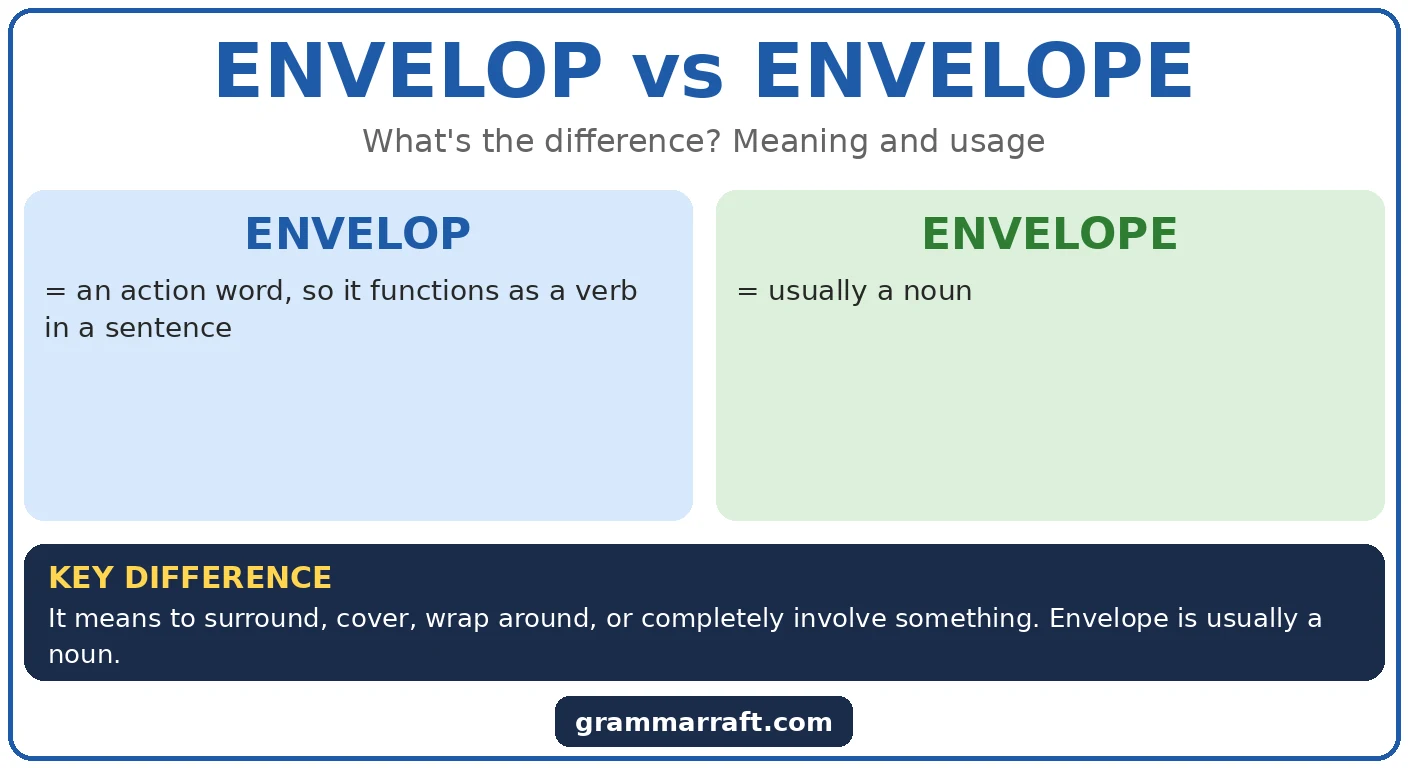
The difference in envelop vs envelope comes down to part of speech, meaning, and spelling. One is usually a verb meaning to surround; the other is a noun for the paper container used to hold a letter or document.
They look and sound similar, which makes the pair easy to confuse in emails, essays, and professional writing. The final e in envelope is the detail that separates the everyday object from the action of surrounding something.
By the end, you’ll know how to choose the right word, pronounce each form, recognize related expressions such as “push the envelope,” and avoid mistakes involving the building envelope, plural forms, and verb agreement.
Envelop vs Envelope: The Quick Answer
Envelop is a verb. It means to surround, cover, wrap around, or completely involve something.
Envelope is usually a noun. It means the paper container in which a letter, card, check, or other flat item is mailed or stored.
| Word | Part of speech | Meaning | Example |
|---|---|---|---|
| envelop | Verb | To surround or cover | Fog began to envelop the valley. |
| envelope | Noun | A paper container for mail | She placed the invitation in an envelope. |
| envelope | Noun | A boundary, range, or surrounding structure | The design stays within the safety envelope. |
A simple memory test helps: if you can put a stamp on it, you probably mean envelope. If you mean that something surrounds, covers, or overwhelms something else, use envelop.
For authoritative definitions and examples, the Merriam-Webster entry for “envelop” confirms its use as a verb meaning to surround or completely cover.
What Does “Envelop” Mean?
Envelop is an action word, so it functions as a verb in a sentence. It describes one thing moving around another thing or completely covering it.
For example, “Darkness began to envelop the town” means that darkness gradually surrounded or covered the town. In “A warm blanket enveloped the child,” the blanket surrounds the child, although the wording is more literary than simply saying that the child was wrapped in a blanket.
The word can describe physical surroundings, such as smoke enveloping a building. It can also describe an atmosphere, emotion, or influence that surrounds someone in a less literal sense.
- Physical: Thick smoke enveloped the aircraft.
- Natural: Mist enveloped the hills before sunrise.
- Emotional: Relief enveloped the family after the missing dog returned.
- Abstract: The music enveloped the audience in a calm mood.
- Strategic: The troops attempted to envelop the opposing force.
In military or strategic writing, envelop can describe an effort to surround an opposing force from several directions. That use is more technical, but it follows the same central idea: the subject closes around or encircles something.
The verb can appear in several forms. “Envelop” is the base form, “envelops” is the third-person singular present form, “enveloped” is the past tense and past participle, and “enveloping” is the present participle.
| Verb form | Example |
|---|---|
| envelop | Clouds envelop the peak by afternoon. |
| envelops | The scent envelops the room. |
| enveloped | Fog enveloped the road. |
| enveloping | An enveloping silence filled the theater. |
Because envelop is a verb, it normally needs a subject that performs the action and an object that receives it. In “The storm enveloped the coast,” the storm is the subject and the coast is the object.
What Does “Envelope” Mean?
Envelope is most commonly a noun for a flat paper container. It has a flap that folds over and is often sealed with adhesive, allowing a letter or document to be mailed.
In ordinary English, you might address an envelope, seal an envelope, open an envelope, or put something in an envelope. These expressions all refer to the physical object, not the action of surrounding.
The spelling includes a final e: e-n-v-e-l-o-p-e. Leaving off that final letter changes the word from a noun into a verb, although the pronunciation also changes in many varieties of English.
See Also: Simile vs Metaphor: Meaning, Examples, and Key Differences
An envelope can hold more than a personal letter. Businesses use envelopes for invoices, official notices, checks, contracts, and forms, while schools and organizations may use them for certificates, invitations, or confidential paperwork.
The noun also has broader meanings. In mathematics, science, engineering, and design, an envelope can mean an outer boundary or a limit within which something operates.
- A plane’s performance envelope describes the conditions in which it can operate safely.
- A machine’s operating envelope identifies its permitted range of speed, temperature, pressure, or movement.
- A curve’s mathematical envelope is a line or curve that relates to a family of curves.
- A building envelope is the physical separation between interior space and the outside environment.
- A sound envelope describes changes in a sound’s volume over time.
These technical meanings are still connected to the basic idea of a boundary surrounding something. The noun does not always mean a paper object, but it continues to describe an outer limit, covering, or range.
That distinction matters in professional writing. “The aircraft exceeded its operating envelope” refers to a safety limit, while “The aircraft exceeded its operating envelop” uses the wrong part of speech and is incorrect.
Envelop vs Envelope Pronunciation
Pronunciation is one reason this word pair causes so much confusion. In many forms of English, envelop is pronounced with the stress on the second syllable: en-VEL-up.
Envelope is commonly pronounced EN-vuh-lope in American English, with the stress on the first syllable and a final sound like “lope.” The exact vowel sounds can vary by accent, but the difference in stress is usually clear.
| Word | Common American pronunciation | Typical stress | Meaning |
|---|---|---|---|
| envelop | en-VEL-up | Second syllable | To surround or cover |
| envelope | EN-vuh-lope | First syllable | A paper container or boundary |
Some speakers, particularly in certain British usage, pronounce envelope with a final sound closer to “envelop.” That pronunciation does not necessarily indicate a spelling mistake.
Written context remains the safest test. If the word names an object, use envelope. If the word describes an action, use envelop, regardless of how a particular speaker says it.
Consider the difference in these two sentences:
- “The envelope was lying on the desk.” The word is a noun because it names an object.
- “The clouds began to envelop the moon.” The word is a verb because it describes an action.
The second syllable can also help you remember the distinction. The verb envelop generally sounds shorter at the end, while the noun envelope ends with the familiar “lope” sound in American speech.
Why the Two Words Are So Easy to Confuse
Envelop and envelope share the same core letters and come from related linguistic history. Their meanings are also connected: an envelope surrounds the contents placed inside it, while to envelop something is to surround it.
The visual difference is small. A single final e changes the noun into a verb, and people often write the word based on how it sounds rather than how it is spelled.
English contains many pairs in which a final letter affects grammar or pronunciation. The confusion here is especially persistent because the noun is common in everyday life, while the verb appears more often in descriptive, literary, scientific, or formal writing.
Writers may also remember the phrase “push the envelope” and then assume that every use involving surrounding or boundaries requires the same spelling. That is not the case.
| Intended meaning | Correct word | Incorrect substitution |
|---|---|---|
| A container for a letter | envelope | envelop |
| To surround a town with fog | envelop | envelope |
| A safety or operating range | envelope | envelop |
| To cover a subject in darkness | envelop | envelope |
Another source of error is autocorrect. Spell-checking software may recognize both forms as valid words, so it may not flag a substitution even when the sentence uses the wrong one.
That is why grammar matters more than spelling alone. Identify whether the word is naming something or describing what something does, then choose the form that matches its role.
Common Uses and Expressions
“Push the envelope”
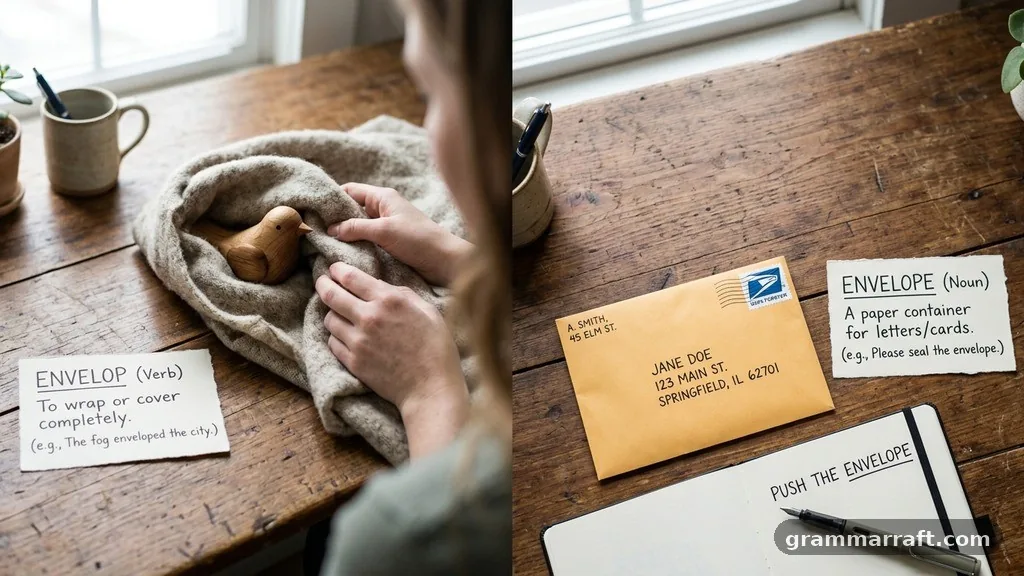
The phrase push the envelope means to test or extend the accepted limits of performance, behavior, design, or possibility. It does not mean to push a paper container across a desk.
For example, “The engineers are pushing the envelope of battery efficiency” means they are trying to move beyond current limits. A filmmaker might push the envelope of visual effects, while a writer might push the envelope of acceptable style or subject matter.
The expression is often used positively, but context determines its tone. It can describe bold innovation, or it can suggest that someone is approaching a boundary that should not be crossed.
“The envelope of possibility”
In phrases such as “the envelope of possibility,” the noun refers to a range or boundary. The phrase is figurative, but it follows the technical meaning of an envelope as an outer limit.
Similar examples include “within the envelope of safe operation” and “outside the normal performance envelope.” These forms are especially common in engineering, aviation, software, and applied science.
“Enveloping” as an adjective
The participle enveloping can function like an adjective. “An enveloping fog” describes fog that surrounds or covers something, while “an enveloping sound” suggests sound that seems to come from all around.
It is not interchangeable with envelope. The first describes a surrounding quality; the second names an object, boundary, or range.
“Envelope” in business and mail
Common collocations include “business envelope,” “self-addressed envelope,” “mailing envelope,” “sealed envelope,” and “envelope flap.” In each case, the word is a noun.
“Please return the form in the enclosed envelope” is correct because the sentence refers to a physical container. Writing “enclosed envelop” would be a spelling and grammar error.
See Also: My vs Mine: Meaning, Rules, and Examples
Building Envelope, Operating Envelope, and Other Technical Meanings
The phrase building envelope refers to the parts of a building that separate the interior from the outdoors. Depending on the context, this can include walls, roofs, windows, doors, foundations, insulation, and air or moisture barriers.
Building professionals study the envelope because it affects heat transfer, air leakage, moisture movement, durability, and indoor comfort. In this phrase, envelope is a noun describing the building’s outer enclosure.
“Building envelop” is not the standard form. Although the word’s meaning involves surrounding, the expression names a structure or system, so it requires the noun envelope.
An operating envelope works in a similar way. It describes the conditions or limits in which a machine, vehicle, aircraft, chemical process, or electronic system is intended to function.
| Expression | Field | What it describes |
|---|---|---|
| building envelope | Construction | The outer enclosure separating indoor and outdoor environments |
| flight envelope | Aviation | Safe or permitted flight conditions |
| operating envelope | Engineering | Permitted working conditions for a system |
| sound envelope | Music and acoustics | How sound characteristics change over time |
| mathematical envelope | Mathematics | A curve or boundary associated with a family of curves |
These examples show why the final letter matters beyond spelling tests. A missing e can turn a recognized technical term into a nonexistent or misleading phrase.
When editing technical material, check the entire expression rather than relying on a spell-checker. Specialized vocabulary often contains words that are individually valid but grammatically wrong in a particular combination.
How to Choose the Correct Word
Start by asking what the word is doing in the sentence. If it names a thing, container, boundary, or range, choose envelope. If it describes an action performed by a subject, choose envelop.
Next, try replacing the word with a simple synonym. If “surround,” “cover,” or “encircle” fits, the verb envelop is probably correct. If “container,” “outer covering,” or “limit” fits, use the noun envelope.
- Ask whether it is an action: “The fog began to surround the harbor.” Use envelop.
- Ask whether it is an object: “The letter is inside a paper container.” Use envelope.
- Check the article: “an envelope” usually signals a noun, while “to envelop” signals a verb.
- Check the technical phrase: “building envelope” and “operating envelope” use the noun.
- Check the verb ending: “envelops,” “enveloped,” and “enveloping” describe surrounding actions.
Here are a few corrected examples:
| Incorrect | Correct | Reason |
|---|---|---|
| Put the check in an envelop. | Put the check in an envelope. | The word names a container. |
| Night began to envelope the street. | Night began to envelop the street. | The word describes an action. |
| The plane left its operating envelop. | The plane left its operating envelope. | The phrase names a range or limit. |
| Smoke enveloped the building. | Smoke enveloped the building. | The verb is already correct. |
Reading the sentence aloud can help, but it should not be the only test. Pronunciation varies among speakers, especially for envelope, while the written distinction remains fixed.
Word Origin and Related Forms
Both words are connected to a French source related to wrapping or surrounding. That shared origin explains their similar spelling and overlapping ideas, even though modern English assigns them different grammatical jobs.
The verb envelop entered English with the meaning of wrapping around or enclosing. Over time, it developed both literal and figurative uses, including surrounding someone with an atmosphere, feeling, or influence.
The noun envelope developed as a name for something that encloses or contains. Its paper-mail meaning became especially familiar as letter writing and postal communication expanded.
Several English words reflect the same general idea of an outer covering or boundary. “Enclose,” “wrap,” “surround,” “cover,” and “encircle” may overlap with envelop, but none is a perfect substitute in every sentence.
For instance, “enclose” often suggests placing something inside a container or boundary. “Envelop” more strongly suggests that the surrounding material or force has moved around the subject, sometimes gradually.
The noun’s technical uses also retain the idea of an outer limit. A performance envelope encloses a range of possible conditions, while a building envelope encloses interior space and separates it from the environment.
These related meanings explain why learners sometimes treat envelop and envelope as interchangeable. They are not synonyms in grammar, but they are related words that developed from a shared concept.
Learning the part of speech is more useful than memorizing an isolated spelling rule. Once you understand that one word is a verb and the other is a noun, the apparently small difference becomes much easier to remember.
Editing Tips for School, Work, and Technical Writing
In formal writing, an incorrect envelop or envelope can distract readers because the intended meaning is usually easy to infer. The sentence may remain understandable, but the error signals that the writer has not checked the word’s grammatical function.
Proofread the sentence rather than the word in isolation. A dictionary can tell you that both forms exist, but only the surrounding sentence reveals which one belongs there.
Search-and-replace tools need special care. Replacing every instance of one spelling with the other can damage correct examples, technical terms, or words that use the form as part of a longer expression.
See Also: Discreet vs Discrete: Meaning, Usage and Easy Ways to Remember
A practical proofreading routine
- Circle every use of envelop and envelope.
- Label each one as a verb or noun.
- Replace the word temporarily with “surround” or “container.”
- Check the spelling of related forms such as envelops and enveloped.
- Read technical compounds such as “building envelope” as complete phrases.
For student essays, verbs such as envelop can be useful when a scene involves fog, darkness, sound, smoke, or emotion. Use the word precisely rather than choosing it simply because it sounds more dramatic than “surround.”
For business writing, envelope will usually appear in practical instructions. “Place the signed agreement in the enclosed envelope” is direct and clear, while “the atmosphere enveloped the room” belongs to descriptive prose.
Editors should also consider tone. Envelop is a legitimate everyday verb, but it can sound formal or literary in some contexts. “The fog enveloped the road” is natural; “the box was enveloped by a sheet of paper” may be technically correct but less direct than “the paper covered the box.”
FAQ: Envelop vs Envelope
What is the main difference between envelop and envelope?
Envelop is a verb meaning to surround, cover, or encircle. Envelope is usually a noun meaning a paper container for mail, although it can also mean an outer boundary or operating range.
Does an envelope have an e at the end?
Yes. The noun is spelled envelope, with a final e. The spelling envelop, without that final letter, is the verb meaning “to surround.”
How do Americans pronounce envelope?
American English commonly pronounces envelope as EN-vuh-lope, with the stress on the first syllable. Regional and individual pronunciation can vary, so spelling and sentence meaning provide the most reliable distinction.
Is “building envelope” or “building envelop” correct?
Building envelope is correct. The phrase refers to the outer parts of a building that separate indoor space from the outside, so it uses the noun envelope.
What does “push the envelope” mean?
“Push the envelope” means to test or extend an accepted limit. The envelope in this expression represents a boundary or range, not a paper mailer being physically pushed.
Final Takeaway
The key to envelop vs envelope is grammatical: envelop is the verb for surrounding, while envelope is the noun for a paper container, outer covering, or defined limit. Remembering the part of speech works better than relying on pronunciation alone.
Before publishing, replace the word with “surround” or “container” as a quick test, then check the full phrase for technical uses such as “building envelope” or “operating envelope.” That small review will keep your spelling accurate in emails, essays, reports, and professional documents.
Explore more helpful guides on GrammarRaft.