Scared vs Afraid: Meaning, Usage, and Examples
Scared vs afraid is a common English comparison because both words describe fear, yet they don’t always sound equally natural in the same sentence. In everyday speech, “scared” is usually more conversational, while “afraid” can sound more formal, literary, or polite.
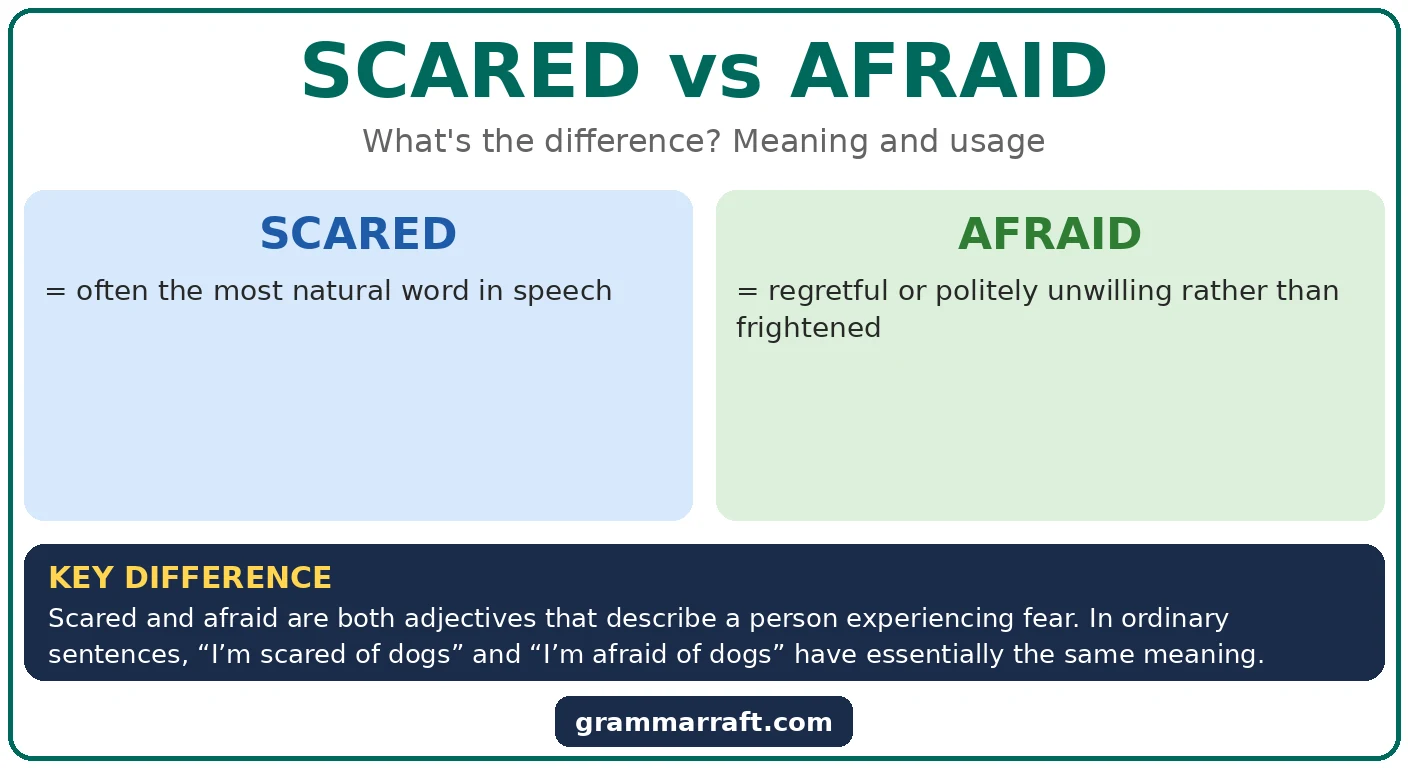
Most of the time, you can use them interchangeably: “I’m scared” and “I’m afraid” both mean that you feel fear. The difference appears in tone, grammar, and special expressions such as “I’m afraid not,” where afraid means regretful or politely unwilling rather than frightened.
This distinction matters in conversation, schoolwork, professional writing, and English-language exams. By the end, you’ll know which word fits common patterns, how scared compares with frightened, why afraid has more than one meaning, and how to avoid confusing scared with scarred.
Scared vs Afraid: The Short Answer
Scared and afraid are both adjectives that describe a person experiencing fear. In ordinary sentences, “I’m scared of dogs” and “I’m afraid of dogs” have essentially the same meaning.
The clearest difference is register. “Scared” is common in casual conversation and often sounds more direct or emotional, while “afraid” is slightly more formal and appears in several fixed expressions that “scared” cannot replace naturally.
| Point of comparison | Scared | Afraid |
|---|---|---|
| Basic meaning | Feeling fear | Feeling fear |
| Typical tone | Casual and conversational | Neutral, formal, or literary |
| Common pattern | Scared of, scared to, scared that | Afraid of, afraid to, afraid that |
| Polite refusal | Not normally used | “I’m afraid I can’t” |
| Before a noun | “A scared child” is natural | “An afraid child” sounds unusual |
If you need a simple everyday choice, scared is often the most natural word in speech. If you are writing formally or using a polite expression, afraid may be the better option.
What “Scared” Means
“Scared” means frightened, worried by danger, or affected by a strong feeling of fear. It is the past participle of the verb “scare,” but it works as an adjective in sentences such as “The noise made me scared” and “The scared cat ran away.”
The word usually points to an immediate emotional response. A child may be scared by thunder, a driver may be scared when a car suddenly stops, and a student may feel scared before speaking in front of a class.
“Scared” is especially common in informal English because it sounds personal and vivid. Someone saying “I was scared when the lights went out” is describing a direct experience in a relaxed, natural way.
It can also describe a continuing fear rather than a single moment. For example, “She’s scared of flying” means that air travel causes her fear generally, not only during one particular flight.
Common patterns with scared
Several grammatical patterns appear frequently with this adjective. Learning the pattern is often more useful than memorizing a dictionary definition because the surrounding words determine how natural the sentence sounds.
- Scared of + noun or -ing form: “He’s scared of snakes” or “She’s scared of falling.”
- Scared to + verb: “I’m scared to ask for help.”
- Scared that + clause: “They’re scared that the plan will fail.”
- Scared by + cause: “The dog was scared by the fireworks.”
- Scare someone: “That sudden movement scared me.”
“Scared to” often focuses on an action someone avoids because of fear. “I’m scared to drive at night” suggests that the person does not want to drive or may choose not to do it.
“Scared of” more often identifies the object, situation, or activity that produces fear. “I’m scared of driving at night” describes the source of the fear, although the two sentences can communicate nearly the same practical concern.
See Also: Could or Can: Meaning, Difference, and Correct Use?
What “Afraid” Means
“Afraid” also means frightened or fearful. “I’m afraid of heights,” “He was afraid during the storm,” and “The child is afraid to go downstairs” all describe fear in much the same way as their versions with “scared.”
The word has a somewhat wider range of use. In addition to describing fear, “afraid” can introduce a worried belief, as in “I’m afraid we may be late,” or a polite refusal, as in “I’m afraid I can’t attend.”
That second meaning is not usually about physical danger. In “I’m afraid I disagree,” the speaker is softening disagreement. The phrase signals politeness and possible regret rather than panic.
Why “afraid” behaves differently
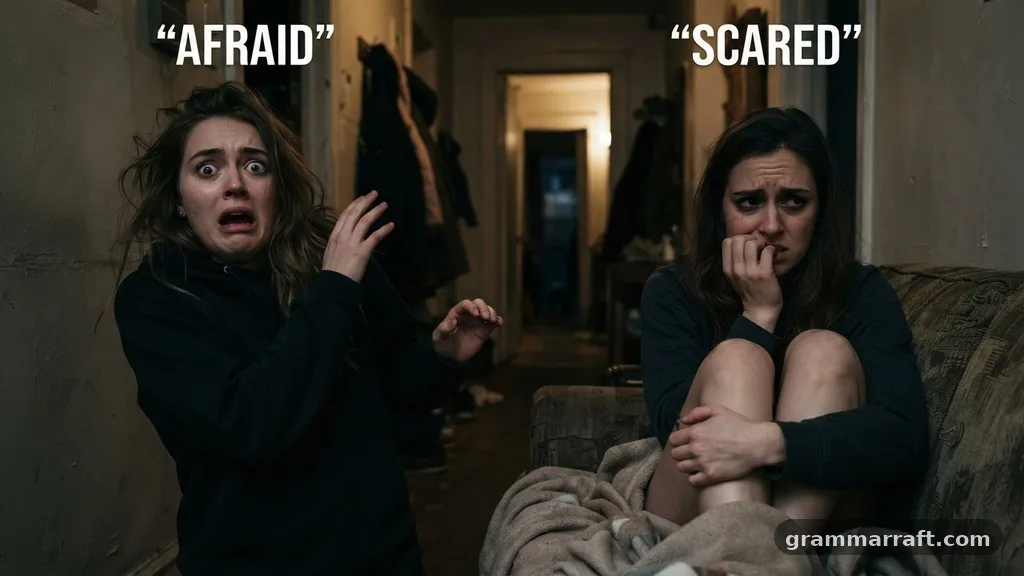
“Afraid” is normally used after a linking verb such as “be,” “feel,” or “seem.” We say “She is afraid,” but “an afraid woman” sounds unnatural in modern standard English.
“Scared,” by contrast, can appear directly before a noun with no problem. “A scared child,” “a scared horse,” and “a scared audience” are all ordinary expressions.
This does not mean afraid is grammatically impossible before a noun in every historical or poetic context. It means that modern speakers usually choose “frightened,” “fearful,” or “scared” when the adjective must come before the noun.
Afraid also appears in expressions that are best learned as complete phrases. Important examples include “be afraid of,” “be afraid to,” “be afraid that,” “I’m afraid so,” and “I’m afraid not.”
Are Scared and Afraid Interchangeable?
In many sentences, yes. “The passengers were scared by the turbulence” and “The passengers were afraid because of the turbulence” communicate the same central idea, even though the sentence structures differ slightly.
The words are not perfectly interchangeable in every context. A phrase can be grammatically correct but still sound unusual because native speakers strongly prefer one expression for a particular purpose.
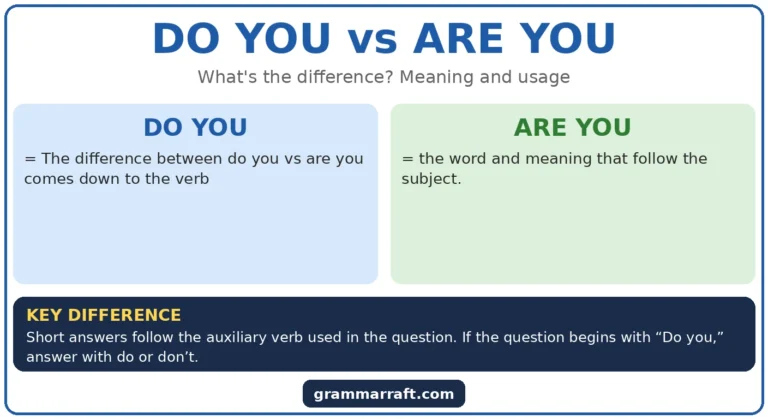
Consider “I’m afraid not.” This is a standard way to give a negative answer politely: “Can I submit it tomorrow?” “I’m afraid not.” Replacing afraid with scared produces “I’m scared not,” which does not work in standard English.
The same issue appears with “I’m afraid so.” If someone asks whether the meeting has been canceled, “I’m afraid so” means that the speaker regrets confirming the bad news. “I’m scared so” is not a normal equivalent.
| Sentence | Natural alternative | Comment |
|---|---|---|
| I’m scared of spiders. | I’m afraid of spiders. | Both are natural. |
| She’s scared to speak. | She’s afraid to speak. | Both describe fear about an action. |
| I’m afraid I can’t help. | No direct “scared” replacement | Afraid softens a refusal. |
| He looked scared. | He looked frightened. | “Looked afraid” is possible but less usual. |
| She is afraid of being judged. | She is scared of being judged. | Both are correct; tone differs slightly. |
A useful test is to ask what the sentence is doing. If it describes fear, either word may work. If it expresses polite disagreement, regret, or a conventional reply, afraid is usually the correct choice.
Scared, Afraid, Frightened, and Terrified
Scared and afraid belong to a group of related adjectives that include frightened, fearful, nervous, anxious, and terrified. These words overlap, but they do not always carry the same strength or emotional focus.
Frightened is close in meaning to scared and often sounds slightly more formal. “The frightened witness spoke to the police” fits formal writing more easily than “the scared witness,” although the latter is not wrong.
Terrified usually suggests an extreme level of fear. Saying “I was terrified during the earthquake” is stronger than saying “I was scared during the earthquake.” It should not be used merely because a person feels mildly uncomfortable.
Nervous often describes worry or uncertainty before an event rather than a response to immediate danger. A person can be nervous before an interview without believing that the interview is physically dangerous.
Anxious can refer to persistent worry, unease, or concern about what may happen. In some contexts, it overlaps with afraid, but “anxious” often has a longer-lasting or more anticipatory quality.
- Scared: common, direct, and conversational fear.
- Afraid: fear, worry, or polite regret depending on context.
- Frightened: a slightly more formal synonym for scared.
- Terrified: very intense fear.
- Nervous: uneasiness before or during a difficult event.
- Anxious: ongoing worry or concern about possible outcomes.
There is no exact scientific scale that assigns one fixed strength to each word. Context, voice, adverbs, and the situation all matter. “A little scared” is mild, while “absolutely terrified” is extreme.
Scared vs Afraid in Grammar and Sentence Structure
Both adjectives commonly follow forms of “be.” Examples include “I am scared,” “They were afraid,” and “He will be scared.” They can also follow verbs such as “feel,” “look,” and “seem.”
The most common preposition with both words is of. Use it before a noun, pronoun, or gerund: “afraid of the dark,” “scared of him,” and “scared of making a mistake.”
Use to before a base verb when the focus is an action: “She is afraid to complain” or “He is scared to enter the room.” The choice between of and to can change the emphasis, even if the overall meaning remains close.
Compare these examples:
- “I’m afraid of dogs.” This describes a general fear of dogs.
- “I’m afraid to approach that dog.” This focuses on the action the speaker will not take.
- “I’m scared of failing.” This identifies failure as the feared possibility.
- “I’m scared to take the exam.” This focuses on the decision or action.
Both words can also be followed by a clause introduced by “that.” “She’s afraid that he’ll forget” and “She’s scared that he’ll forget” are grammatical. The first may sound slightly more restrained, while the second feels more conversational.
See Also: May or Might: Meaning, Differences, and Correct Usage?
One common learner error is placing afraid before a noun as if it behaved exactly like scared. “The afraid student” is understandable, but “the frightened student” or “the scared student” is more idiomatic in contemporary English.
How Tone Changes the Choice
Word choice depends partly on the relationship between speakers and the setting. A friend might say, “I’m scared about tomorrow,” while a formal report might say, “Residents are afraid that the proposed change will affect local services.”
Neither choice is automatically more correct. The difference is one of tone and convention, not a strict rule that separates correct English from incorrect English.
Everyday conversation
Scared is especially frequent in personal statements. “I’m scared,” “That scared me,” and “The kids were scared” sound natural, immediate, and emotionally open.
Afraid is also perfectly normal in conversation, especially in phrases such as “I’m afraid of heights” and “Don’t be afraid.” However, it may sound a little more serious or deliberate in some situations.
Formal and professional writing
Frightened and afraid can fit formal writing more comfortably than scared, depending on the subject. A news report might describe “residents afraid of flooding,” while a personal interview may preserve the speaker’s words as “I was really scared.”
Professional communication often uses “I’m afraid” to soften unwelcome information. “I’m afraid the appointment is unavailable” sounds less abrupt than “The appointment is unavailable,” but it does not suggest that the employee feels frightened.
Creative writing
Writers choose among these words for character and atmosphere. “He was scared” is plain and accessible, “he was afraid” can sound more reflective, and “he was terrified” raises the emotional intensity.
The best choice depends on the scene. A child’s dialogue may sound more believable with scared, while a narrator describing a solemn or historical event may prefer afraid or frightened.
The Psychology Behind Feeling Scared or Afraid
In psychological terms, fear is an emotional response to a perceived threat. That threat may be immediate, such as a speeding vehicle, or anticipated, such as concern about an upcoming medical procedure.
The everyday words scared and afraid describe the person’s experience, not a precise clinical diagnosis. People use them for physical danger, social judgment, uncertainty, memories, nightmares, and imagined events.
Fear can produce several kinds of response. Someone may avoid the feared situation, freeze briefly, seek reassurance, prepare carefully, or act quickly to get away from danger.
These reactions do not determine which adjective is correct. “She felt afraid before the interview” and “She felt scared before the interview” are both ordinary descriptions, even though the experience may be closer to nervousness than danger.
For a reliable general explanation of fear as an emotional and physiological response, readers can consult the Encyclopaedia Britannica overview of fear. English vocabulary describes the feeling, while psychology examines how that feeling arises and affects behavior.
Intensity words add useful detail. “A little scared” suggests mild discomfort, “quite afraid” suggests a stronger response, and “deeply frightened” gives the sentence a more formal tone. The surrounding context often communicates more than the adjective alone.
Common Mistakes and Confusing Words
One frequent mistake is assuming that scared and afraid must have completely different meanings. Usually they do not. The important differences involve style, fixed expressions, and grammar rather than the basic idea of fear.
Another mistake is treating “afraid” as the only formal option or “scared” as incorrect in serious writing. Scared is standard English and appears in dictionaries, literature, journalism, and professional discussion.
Some learners also confuse “scared” with “scarred.” These words sound similar in some varieties of English but mean very different things.
- Scared: feeling fear. “The child was scared by the noise.”
- Scarred: marked by a physical or emotional scar. “The accident left him scarred.”
- Scare: to frighten someone, or a frightening event. “The alarm gave me a scare.”
- Fear: a noun meaning the emotion, or a verb meaning to feel concern about danger.
“Fear” can function as both a noun and a verb, while scared and afraid are generally adjectives. This explains why “I fear spiders” and “I’m scared of spiders” use different sentence structures even though they express related ideas.
A final mistake is using “I’m afraid” without checking the context. It may mean “I feel fear,” but it may also mean “I regret to say,” as in “I’m afraid the store is closed.” The next words usually make the intended meaning clear.
Practical Examples You Can Use
Examples make the difference easier to remember because they show how the words operate in real sentences. In the following pairs, both versions are correct unless otherwise indicated.
- Fear of an object: “Maya is scared of bees.” / “Maya is afraid of bees.”
- Fear of an action: “I’m scared to call him.” / “I’m afraid to call him.”
- Fear of an outcome: “They’re scared that the project will fail.” / “They’re afraid that the project will fail.”
- Reaction to an event: “The loud bang scared me.” / “The loud bang made me afraid.”
- Formal description: “The frightened passengers waited quietly.”
- Polite refusal: “I’m afraid I can’t change the booking.”
- Polite confirmation: “I’m afraid so; the flight has been delayed.”
Notice that “The loud bang scared me” uses scared as part of the verb “scare,” not as an adjective describing the speaker. The equivalent adjective sentence is “The loud bang made me scared” or “The loud bang made me afraid.”
See Also: Whichever vs Whatever: Meaning, Grammar and Usage
For a natural casual tone, choose scared in personal dialogue: “I was scared when I heard footsteps.” For a more formal or restrained tone, choose afraid or frightened: “The witness was afraid to enter the building.”
If you are uncertain, ask whether the sentence describes fear or performs another function. “I’m scared of the result” describes an emotion, while “I’m afraid the result is negative” introduces bad news politely.
FAQ: Scared vs Afraid
Is it correct to say “I am afraid” or “I am scared”?
Both are correct. “I am scared” usually sounds more casual and emotionally direct, while “I am afraid” can sound more formal, restrained, or literary. “I am afraid” may also mean “I regret to say,” so context matters.
Which is stronger, scared or afraid?
Neither word is automatically stronger. In ordinary usage, they describe roughly the same level of fear. Intensity comes from the situation and modifiers such as “a little,” “very,” “deeply,” or “terrified.”
Can afraid and scared be used in the same sentence patterns?
They overlap in patterns such as “afraid of,” “scared of,” “afraid to,” and “scared to.” Afraid also appears in fixed expressions such as “I’m afraid not,” where scared cannot normally be substituted.
Is “frightened” more formal than scared?
Often, yes. Frightened can sound more formal or polished, especially before a noun, as in “a frightened witness.” Scared remains correct and natural, particularly in conversation and informal writing.
What is the difference between scared and scarred?
Scared means frightened, while scarred means marked by a physical or emotional scar. “The accident scared him” means it frightened him; “the accident scarred him” means it left lasting damage or an enduring emotional effect.
Final Takeaway
Scared vs afraid is usually a question of tone rather than basic meaning. Use scared for natural, conversational descriptions of fear, and use afraid when you want a more formal tone or need a phrase such as “I’m afraid so” or “I’m afraid not.”
Remember the grammar patterns, especially “scared of,” “afraid of,” “scared to,” and “afraid to.” Once you notice the context and the purpose of the sentence, choosing between scared and afraid becomes straightforward.
Explore more helpful guides on GrammarRaft.