
Bourgeois vs Bourgeoisie: Meaning and Difference
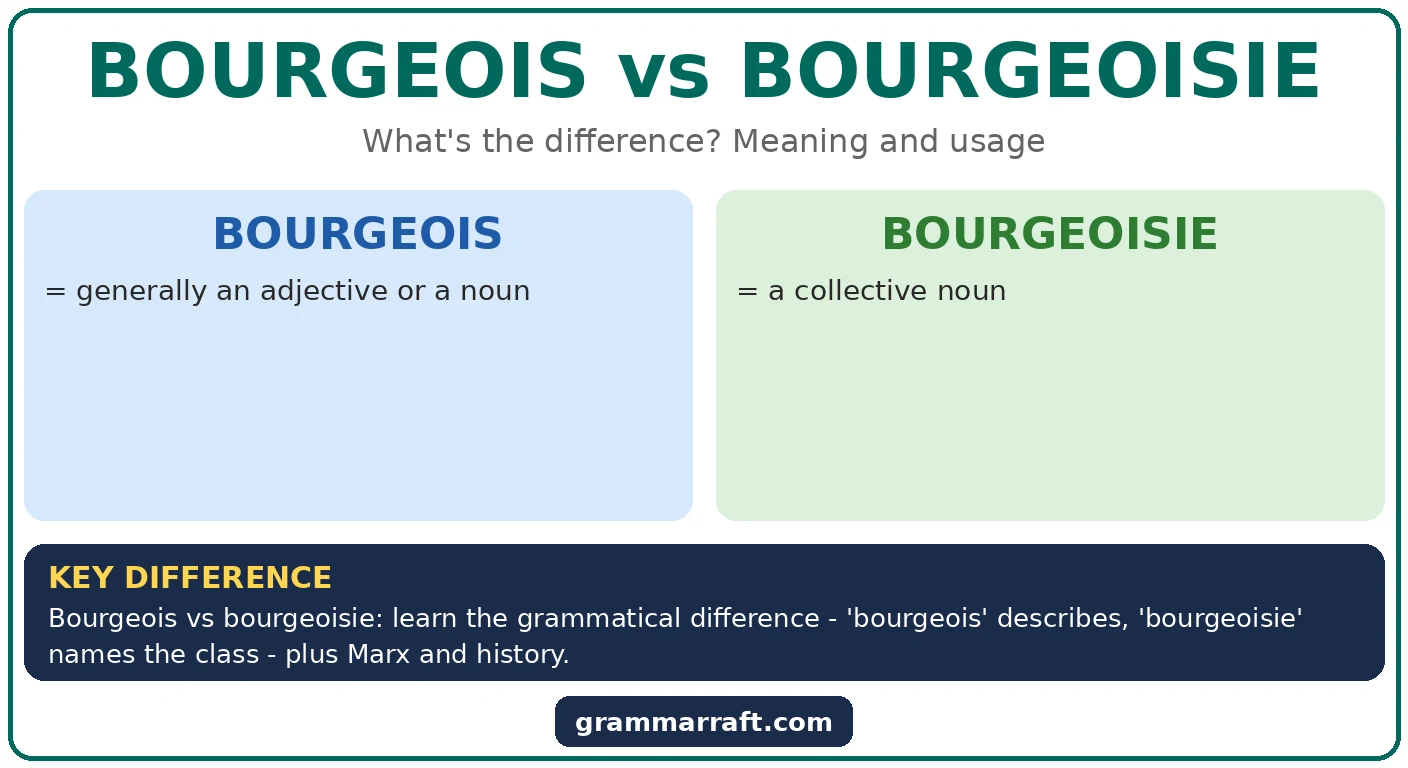
The distinction in bourgeois vs bourgeoisie is mainly grammatical: bourgeois usually describes a person, lifestyle, or attitude, while bourgeoisie names a social class. Both words come from French and are closely linked to the growth of towns, commerce, and private property in Europe.
The difference matters because the terms can sound interchangeable in everyday speech but carry different meanings in history, politics, sociology, and Marxist theory. A bourgeois neighborhood, a bourgeois person, and the bourgeoisie are related ideas, yet they are not identical.
By the end, you’ll be able to use each word accurately, distinguish the bourgeoisie from the proletariat and aristocracy, understand Marx’s argument, and avoid common mistakes involving pronunciation, spelling, and the modern word “boujee.”
The Basic Difference Between Bourgeois and Bourgeoisie
Bourgeois is generally an adjective or a noun. As an adjective, it describes something associated with the middle class, conventional respectability, private property, or material comfort; as a noun, it can mean an individual member of that social group.
Bourgeoisie is a collective noun. It refers to the bourgeois class as a whole, especially in historical or political discussions about people who own businesses, capital, property, or the means of production.
| Term | Grammatical role | Typical meaning | Example |
|---|---|---|---|
| bourgeois | Adjective or singular noun | Middle-class, conventional, or relating to private property | “They live a bourgeois lifestyle.” |
| bourgeoisie | Collective noun | The bourgeois social class as a group | “The bourgeoisie gained political influence.” |
| bourgeois classes | Plural noun phrase | Different groups within the broader bourgeois social order | “The urban bourgeois classes expanded.” |
| proletariat | Collective noun | The wage-working class in Marxist terminology | “The proletariat sold its labor.” |
A simple memory aid works well: bourgeois describes; bourgeoisie groups. You might describe a person as bourgeois, but you would refer to the entire class as the bourgeoisie.
There is one complication. English sometimes uses bourgeois as a noun, as in “a bourgeois,” but the word is less precise than bourgeoisie for formal historical analysis. Saying “the bourgeois” can sound incomplete unless the surrounding sentence makes the plural meaning clear.
What Does Bourgeois Mean?
The word bourgeois can refer to social position, taste, behavior, or political outlook. Its meaning depends heavily on context, so a sentence describing someone as bourgeois may be neutral, analytical, or insulting.
In an ordinary social context, bourgeois often means middle-class or comfortably conventional. A bourgeois lifestyle might involve home ownership, stable professional employment, family security, consumer goods, and respect for established social norms.
That description does not necessarily mean wealthy. A person can be bourgeois without belonging to the upper class, owning a large corporation, or having inherited an aristocratic title. The term usually points toward a social relationship to property, work, and respectability rather than a precise income level.
In cultural criticism, bourgeois may describe preferences that appear conventional or status-conscious. A critic might call a novel bourgeois because it treats marriage, domestic comfort, and private success as unquestioned goals. Another writer might use the same word simply to mean polished, urban, or middle-class.
Bourgeois as an adjective

As an adjective, bourgeois can modify many kinds of nouns. Common examples include bourgeois values, bourgeois morality, bourgeois society, bourgeois culture, bourgeois politics, bourgeois taste, and bourgeois property.
- Bourgeois lifestyle: a comfortable, conventional middle-class way of living.
- Bourgeois values: ideas often associated with family stability, property, individual advancement, and respectability.
- Bourgeois society: a society shaped substantially by private ownership, commerce, and middle-class institutions.
- Bourgeois politics: political arrangements viewed as protecting property and the interests of the owning classes.
These phrases do not all carry the same judgment. “Bourgeois neighborhood” may be a neutral description, while “bourgeois hypocrisy” is clearly critical. The word’s tone comes from the speaker’s purpose and the assumptions surrounding the sentence.
Bourgeois as a noun
As a noun, bourgeois can mean a member of the bourgeoisie. In English, the plural is often written bourgeois or bourgeois people, although many writers avoid the ambiguity by using the bourgeoisie.
For example, “a bourgeois owned the shop” uses the word for one individual. “The bourgeoisie owned the shops and factories” refers to the class collectively and sounds more natural in a political or historical argument.
Modern usage also uses bourgeois in a looser way. Someone might call an expensive brunch, a suburban house, or an interest in etiquette “bourgeois” without making a serious claim about class ownership. That casual sense should not automatically be confused with the technical meaning found in Marxist theory.
What Does Bourgeoisie Mean?
Bourgeoisie refers to a social class or class formation, not merely a style of dress or a preference for comfortable living. In broad historical usage, it describes people who occupied an important economic position between the hereditary aristocracy and the laboring population.
The term became especially associated with urban merchants, manufacturers, financiers, professionals, and property owners. Its members could differ greatly in wealth, occupation, and political views, but they shared some relationship to commerce, property, education, or economic control.
The word has roots in the French bourgeois, which originally referred to a town dweller or citizen of a borough. The connection with towns matters because European cities created social and economic spaces that were different from both feudal estates and rural agricultural communities.
As cities expanded, merchants and business owners gained influence. They could accumulate wealth through trade, production, banking, and property rather than through noble birth or direct control of feudal land. Over time, the bourgeoisie became a major force in the transformation of European society.
The historical bourgeoisie
The historical bourgeoisie was not a perfectly uniform group. A small manufacturer, a shopkeeper, a lawyer, a banker, and a wealthy merchant might all be described as bourgeois, yet their economic interests could conflict.
That variety explains why historians often use the phrase middle classes or urban middle class alongside bourgeoisie. The word can identify a broad social formation while still leaving room for internal divisions between large property owners, independent professionals, and small proprietors.
The class became particularly influential during the transition away from feudal arrangements. Commercial wealth, contract law, literacy, print culture, and representative institutions helped people challenge systems based primarily on hereditary rank.
The bourgeoisie did not simply replace every aristocrat or eliminate every older institution. In many countries, wealthy business families formed alliances with old elites, while in others they supported revolutionary changes that weakened aristocratic privilege.
Bourgeoisie in political language
Political writers use bourgeoisie to talk about power as well as income. The central question is not only who has money, but who owns productive assets, controls workplaces, influences state policy, or benefits from the economic system.
That is why the word often appears in discussions of capitalism, labor, industrialization, class conflict, and political revolution. It describes a group with structural influence, not simply anyone who enjoys a comfortable lifestyle.
A person may have a middle-class income yet lack ownership of a business or significant capital. In a Marxist analysis, that person may occupy a different class position from a factory owner who employs hundreds of workers, even if both live in similar homes.
Where the Words Came From
Both terms are connected to the French word bourg, meaning a town or settlement. A bourgeois was originally a person associated with a town, particularly someone who possessed the rights or status of a town citizen.
This origin separates the word from aristocrat, which is tied to noble rank, and from peasant, which historically referred to rural agricultural labor. The early meaning was social and civic before it became the familiar economic and political term.
In medieval Europe, towns provided space for commerce, craft production, markets, guilds, and local self-government. Urban residents were not automatically rich, but their livelihoods and legal position differed from those of peasants working under feudal obligations.
The growth of cities gradually produced groups with economic interests that did not fit neatly into the older feudal hierarchy. Merchants wanted secure trade routes and enforceable contracts.
Manufacturers needed labor, investment, and access to markets. Educated professionals sought civic influence.
From town citizen to social class
The meaning of bourgeois shifted as the economic system changed. At first, the term could indicate a town resident; later, it increasingly described people whose wealth came from commerce, property, production, or finance.
By the early modern period, commercial and professional groups had become increasingly visible in European public life. The word no longer pointed only to geography. It began to identify a social position shaped by urban economic activity and property ownership.
The French Revolution made class language especially prominent, although the history of the bourgeoisie cannot be reduced to France alone. Similar urban and commercial groups developed elsewhere, with different relationships to monarchy, nobility, religion, and the state.
The word’s history also explains why translations can be confusing. In one passage, bourgeois may mean “town-dwelling” or “middle-class”; in another, it may mean “property-owning” or “ideologically conservative.” Context does the final work.
Readers who want a concise historical reference can consult the Encyclopaedia Britannica entry on the bourgeoisie, which places the term in its wider political and economic setting.
Bourgeoisie and Marxist Theory
Karl Marx gave bourgeoisie a more specific role within his analysis of capitalism. In simplified terms, the bourgeoisie owns or controls the means of production, while the proletariat must sell its labor to earn a living.
The means of production include productive resources such as factories, machinery, commercial enterprises, and other assets used to create goods or services. Marx’s argument focuses on the relationship between classes, not simply on whether someone appears rich or middle-class.
In this framework, the bourgeoisie receives economic power from ownership. The proletariat, by contrast, generally lacks comparable productive property and depends on wages. The relationship can generate conflict because owners seek profit while workers seek better pay, security, and control over working conditions.
Marx did not treat bourgeois society as merely a collection of individuals with similar tastes. He analyzed it as a historical system with institutions, laws, markets, and patterns of power that organize production and shape social life.
Bourgeoisie versus proletariat
The contrast between bourgeoisie and proletariat is one of the most important pairings in Marxist vocabulary. The bourgeoisie owns capital; the proletariat sells labor power. That distinction is about economic position, even though education, lifestyle, and political identity may complicate the picture.
| Class term | Primary relationship to production | Typical source of income | Question Marxist analysis asks |
|---|---|---|---|
| Bourgeoisie | Owns or controls productive property | Profit, interest, rent, or returns on capital | Who controls the enterprise and its output? |
| Proletariat | Works for an employer without equivalent productive ownership | Wages or salary | Who must sell labor to survive? |
| Petty bourgeoisie | Owns a small business or works independently | Business income and personal labor | Does the owner employ others or mainly work personally? |
| Aristocracy | Historically tied to hereditary rank and landed privilege | Land, inherited status, rents, or offices | Is power based primarily on birth rather than commercial ownership? |
The categories are analytical tools, not perfect boxes. A small business owner may work long hours like an employee while also hiring staff and owning equipment. That mixed position is one reason Marxist writers sometimes discuss the petty bourgeoisie separately.
What did Marx mean by bourgeois society?
For Marx, bourgeois society was shaped by commodity exchange, private property, wage labor, and competition. These features affected law, politics, family life, education, and culture, not just factories or markets.
His criticism was directed at the structure of capitalism and the unequal control of production. It was not simply an argument that every person with a comfortable home or professional job was morally bad.
That distinction is useful today. Calling a taste “bourgeois” is often a cultural judgment, while identifying the bourgeoisie in Marxist theory is a claim about class relations and ownership.
Bourgeois vs Aristocracy vs Proletariat
People often understand bourgeois more clearly by comparing it with neighboring class terms. The bourgeoisie is not the same as the aristocracy, and neither term is identical to the proletariat.
Aristocracy traditionally refers to a hereditary elite. Aristocratic status was linked to noble titles, family lineage, landed privilege, and political authority inherited through social rank. A wealthy merchant could surpass a noble in money without becoming an aristocrat.
Bourgeoisie generally refers to an urban, commercial, professional, or property-owning class. Its influence came from economic activity, education, business, and ownership rather than exclusively from inherited noble status.
Proletariat refers, in Marxist usage, to wage workers who do not own the means of production on a comparable scale. The term is often translated as working class, although historical and theoretical uses can be more specific.
Why the middle class creates confusion
In everyday English, “middle class” usually describes income, occupation, education, lifestyle, or self-identification. The bourgeoisie can overlap with the middle class, but the terms are not exact equivalents.
A high-earning employee may be called middle class in a modern survey because of salary and lifestyle. A Marxist analysis may focus instead on whether that person owns productive assets, hires labor, or depends primarily on wages.
Likewise, a small shop owner may be bourgeois in a broad historical sense but economically vulnerable compared with a major industrial owner. Social labels can hide important differences in scale and power.
Use the term that matches the question. If you are discussing household income, “middle class” may be clearer. If you are analyzing ownership and class conflict, “bourgeoisie” may be more precise.
A quick comparison
- Aristocracy: status historically grounded in hereditary nobility and landed privilege.
- Bourgeoisie: a class associated with commerce, property, capital, and urban economic power.
- Petty bourgeoisie: small proprietors, independent producers, and small-business owners who may combine ownership with their own labor.
- Proletariat: wage workers who generally lack ownership of the means of production.
- Middle class: a flexible modern category based on income, occupation, education, or lifestyle.
These terms are not interchangeable labels for “rich people.” Wealth, social rank, occupation, ownership, and political power can overlap, but they are separate dimensions of social analysis.
Pronunciation, Spelling, and Grammar
English pronunciation can make these words seem more mysterious than they are. Bourgeois is commonly pronounced roughly “boor-ZHWAH,” while bourgeoisie is commonly pronounced “boor-zhwah-ZEE.” The final sound in both words resembles the French “zh” sound found in the middle of “measure.”
Pronunciation varies somewhat by speaker and accent. The main practical point is that bourgeoisie has an additional syllable at the end, and its spelling should not be replaced with “bourgeoise” when you mean the social class.
| Expression | Correct use | Example |
|---|---|---|
| a bourgeois | One member of the bourgeois class | “He was a bourgeois merchant.” |
| bourgeois people | Plural individuals described by the adjective | “The novel portrays bourgeois people.” |
| the bourgeoisie | The class considered as a collective group | “The bourgeoisie supported commercial expansion.” |
| bourgeois values | Ideas associated with bourgeois social life | “The essay questions bourgeois values.” |
Common grammar mistakes
One frequent mistake is treating bourgeoisie as an adjective. You would not normally write “a bourgeoisie lifestyle.” The natural form is “a bourgeois lifestyle” because bourgeois is the adjective.
Another mistake is using bourgeois when the sentence needs the name of a group. “The bourgeoisie controlled the factory” is more precise than “the bourgeois controlled the factory,” unless the writer deliberately uses bourgeois as a plural noun.
Writers also sometimes confuse bourgeois with bourgeoisie because the words share the same root. Their relationship is similar to the relationship between an adjective describing a class and a noun naming that class.
Modern Everyday Meaning and the Word Boujee
In contemporary speech, bourgeois often has a lighter or more playful meaning than it did in nineteenth-century political writing. Someone might describe an elaborate coffee order, a carefully decorated apartment, or a preference for expensive organic food as bourgeois.
That use usually signals conventional comfort, consumer taste, or an interest in status. It may be teasing rather than a serious statement about ownership or class structure.
Boujee, also spelled bougie, is related in sound and popular association but is not simply a modern spelling of bourgeoisie. In contemporary slang, boujee often describes something luxurious, flashy, upscale, or aspirational.
The slang can be positive, ironic, or critical. A person may call a restaurant boujee because it feels stylish and expensive, while another speaker may use the word to criticize pretension.
Is bourgeoisie the same as boujee?
No. Bourgeoisie is a formal noun for a social class, especially in historical, political, or Marxist discussion. Boujee is informal slang describing a look, lifestyle, product, or behavior associated with luxury or conspicuous taste.
There is a historical connection through the French word bourgeois, but the modern slang has developed its own meaning. A boujee cocktail bar is not automatically evidence that its owners belong to the bourgeoisie in a technical class analysis.
The difference is similar to the gap between social theory and popular description. One term analyzes economic relationships; the other usually comments on appearance, consumption, or perceived status.
Examples in modern sentences
- “The apartment has a bourgeois character: comfortable, orderly, and socially conventional.”
- “The article examines how the bourgeoisie shaped industrial politics.”
- “That rooftop restaurant feels boujee, but the word is being used casually.”
- “Her criticism targets bourgeois consumer culture rather than one individual’s income.”
These examples show why context matters. The same object can be described as bourgeois in a cultural critique and boujee in casual conversation, but the words do not make the same argument.
How to Choose the Right Word
Choosing between bourgeois and bourgeoisie becomes easier if you first ask what you are naming. If you are describing a person, behavior, institution, taste, or lifestyle, bourgeois will usually fit. If you are naming the class collectively, use bourgeoisie.
Consider the sentence “The city’s bourgeoisie funded new factories.” The subject is a group. Replacing it with “The city’s bourgeois funded new factories” may be grammatically possible in some forms of English, but it is less clear and less natural for most readers.
Now consider “The novel presents a bourgeois family.” Here, bourgeois modifies family and describes the family’s social setting, values, or position. Bourgeoisie would not work because it is a collective noun rather than an adjective.
A practical editing test
Use bourgeois if you could replace the word with “middle-class,” “property-oriented,” “conventional,” or “associated with the bourgeois class,” depending on context.
Use bourgeoisie if you could replace it with “the bourgeois class” or “the property-owning class.” The replacement will not always be perfect, but it reveals whether the sentence needs a describing word or a group noun.
Ask one more question: are you discussing culture or economics? “Bourgeois taste” is a cultural phrase. “The bourgeoisie owns the factory” is an economic and political claim.
Examples of correct and incorrect choices
| Sentence | Assessment | Reason |
|---|---|---|
| She lives a bourgeois lifestyle. | Correct | Bourgeois describes the lifestyle. |
| The bourgeoisie owns the company. | Correct | Bourgeoisie names the collective class. |
| She lives a bourgeoisie lifestyle. | Incorrect | The adjective bourgeois is needed. |
| The bourgeoisie family attended the event. | Usually incorrect | “Bourgeois family” is the natural adjective-noun combination. |
| The bourgeois class expanded in the cities. | Acceptable | Bourgeois modifies class, though “bourgeoisie” could also name the group. |
Precision is especially important in academic writing. A sentence about a “bourgeois lifestyle” makes a cultural observation, while a sentence about “the bourgeoisie” may make a claim about ownership, labor, and political power.
Related guides: Nosy vs Nosey: Meaning, Spelling, and Usage · Could vs Would: Meaning, Differences, and Examples? · Nominator vs Nominee: Meaning, Roles and Examples
Frequently Asked Questions
Are bourgeois and bourgeoisie the same?
They share the same historical root and refer to related ideas, but they are not the same grammatical form. Bourgeois usually functions as an adjective or singular noun, while bourgeoisie is a collective noun naming the social class.
Is bourgeois the same as middle class?
Not always. Bourgeois can mean middle-class in everyday speech, but in Marxist theory it more specifically concerns ownership of capital or the means of production. “Middle class” often refers to income, education, occupation, or lifestyle, so the two terms overlap without being identical.
Was Karl Marx bourgeois?
Marx was born into a relatively comfortable, educated German family and became a university-trained writer and intellectual. Whether he should be labeled bourgeois depends on whether the speaker means family background, lifestyle, occupation, or Marxist class position; the label is therefore too simple to answer without defining the sense being used.
What did Marx call rich people?
Marx did not use one universal word meaning all rich people. His analysis often focused on the bourgeoisie, a class defined by its relationship to capital and the means of production, while the term capitalist could refer more specifically to an owner of capital.
How do you pronounce bourgeoisie?
It is commonly pronounced roughly “boor-ZHWAH-ZEE.” Bourgeois is commonly pronounced “boor-ZHWAH.” Accent and regional variation can change the exact sound, but both words contain the French-style “zh” sound.
Conclusion
The central distinction in bourgeois vs bourgeoisie is straightforward: bourgeois describes a person, lifestyle, value, or institution, while bourgeoisie names a social class. The words share a French urban origin, but their modern uses range from casual cultural criticism to detailed Marxist analysis.
Use the context as your guide. Choose bourgeois for description and bourgeoisie for the collective group, then reserve boujee for informal slang about luxury or style. Once you separate grammar from class theory, bourgeois vs bourgeoisie becomes much easier to understand and use accurately.
Explore more helpful guides on GrammarRaft.



One Comment