
Affect vs Effect Examples: A Simple Guide to Using Them Correctly
In case you’ve been stuck in the middle of your writing process wondering which one to use between affect and effect, you are among many others who have been through this confusion. In fact, these words are quite alike in their pronunciation and structure. The important thing to note is that once you know how each word is used, everything becomes much easier.
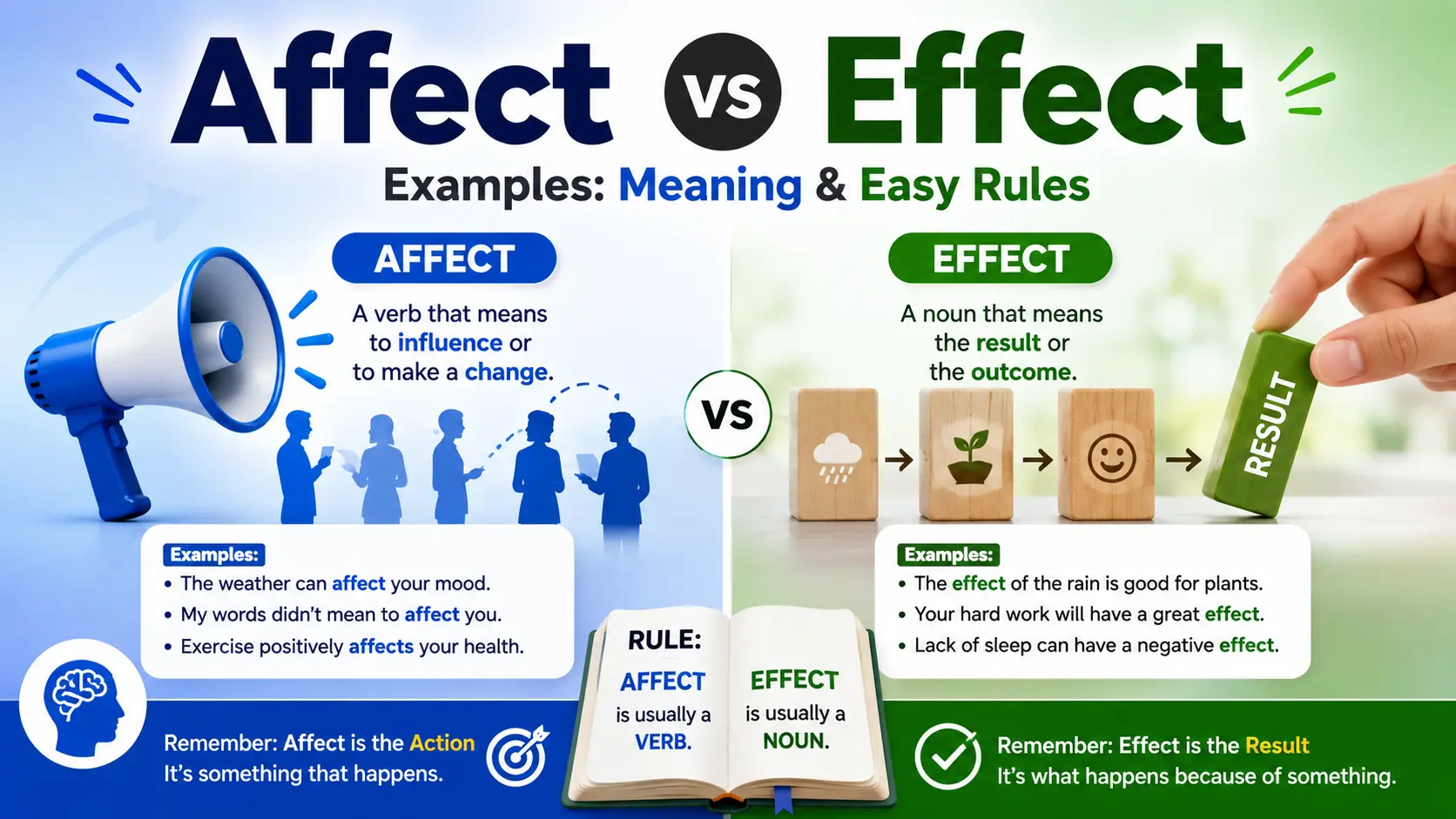
Affect means “to influence” or “to change” in almost all instances, whereas effect is used as a noun to mean “result.” For instance, “Lack of sleep will affect your mood” indicates influence, while “Lack of sleep will have an effect on your mood” indicates results. This is explained in detail in the guide below complete with many affect vs. effect examples and other useful information.
Affect vs Effect: What’s the Difference?
The easiest way to understand these words is to look at their usual grammatical roles.
Affect is generally used as a verb. It describes something influencing, changing, or having an impact on something else.
Effect is generally used as a noun. It describes the result produced by an action, event, or condition.
Think of a simple cause-and-result relationship:
Something affects something → an effect happens.
For example:
The storm affected the town.
The storm influenced or changed the town.
The storm had a serious effect on the town.
The sentence focuses on the result of the storm.
What Does Affect Mean?
Affect usually means to influence, change, or have an impact on something or someone.
Because it is normally a verb, it often appears after a subject that performs an action.
Examples:
- Lack of sleep can affect your concentration.
- The weather may affect our travel plans.
- Music can affect your mood.
- The decision could affect thousands of employees.
- Stress can affect how well you perform.
In each sentence, something is influencing something else.
A useful substitution is influence. If you can replace the word with “influence” and the sentence still makes sense, affect is often the correct choice.
Social media can affect how people communicate.
You could also say:
Social media can influence how people communicate.
That gives you a useful clue that affect is appropriate.
What Does Effect Mean?
Effect is usually a noun meaning a result, outcome, or consequence.
It often appears with words such as the, an, have, positive, negative, significant, or lasting.
Examples:
- The storm had a major effect on the city.
- Exercise can have a positive effect on your energy levels.
- The new policy had an unexpected effect.
- The medication produced several noticeable effects.
- What was the effect of the decision?
A useful replacement is result.
The new rule had a significant effect on attendance.
You could say:
The new rule had a significant result on attendance.
The wording is not always equally natural, but the idea of effect = result is useful for remembering the basic distinction.
The Quickest Way to Remember
A simple memory trick is:
Affect = Action or influence
Effect = End result
Another popular mnemonic is:
A = Affect = Action
E = Effect = End result
This rule works in the majority of everyday situations. However, it is not absolute because affect can sometimes be a noun, and effect can sometimes be a verb. Those less-common uses are explained later.
Affect vs Effect Examples
The best way to learn the difference is to see the words used in real sentences.
Examples With Affect
Here are common examples of affect used as a verb:
Noise may influence your concentration.
The rain influenced our weekend plans.
Sleep deprivation may have an effect on your mood.
The increase in prices may have an effect on the demand of customers.
Stress may influence your performance at work.
This decision will have an effect on the whole team.
Cold weather may influence the battery.
Feedback from the teacher had an influence on my approach to the task.
Poor nutrition may influence your energy level.
This delay may have an effect on our schedule.
Noise from the building site had an effect on the residents of the area.
Personal experience may influence the decision-making process.
This change in the policy will influence future applicants.
Unpreparedness may influence your self-confidence.
The news influenced her deeply.
Note that “affect” links a cause or situation to its consequence.
Examples With Effect
Now compare those sentences with examples using effect as a noun:
- Loud noises can have an effect on your concentration.
- The rain had a major effect on our weekend plans.
- Lack of sleep can have a noticeable effect on your mood.
- The price increase may have an effect on customer demand.
- Stress can have a negative effect on your performance.
- The decision could have a lasting effect on the entire team.
- Cold temperatures can have an effect on battery life.
- The teacher’s feedback had a positive effect on my approach to the assignment.
- A poor diet can have an effect on your energy levels.
- The delay had an unexpected effect on our schedule.
Here, effect refers to the result or consequence.
Affect and Effect Used Together
Sometimes both words can appear naturally in the same explanation.
The long workday affected her concentration, and the effect was noticeable.
Here, affected describes the influence, while effect describes the result.
Another example:
The storm affected transportation, and one major effect was widespread delays.
This relationship is helpful because it shows the basic logic:
Cause → affects something → produces an effect.
Affect vs Effect in Sentences
Understanding sentence patterns can make the distinction much easier.
Affect as a Verb
Because affect is usually a verb, it commonly follows a subject and takes an object.
Common patterns include:
Subject + affect + object
Stress affects concentration.
Subject + can/will/may + affect + object
Poor weather may affect travel.
Subject + negatively/positively + affect + object
The decision could negatively affect employees.
Some common expressions include:
- affect your mood
- affect your health
- affect performance
- affect the outcome
- affect someone’s decision
- affect the quality
- affect the results
- affect your ability
- positively affect
- negatively affect
- adversely affect
Examples:
The new schedule may affect employee productivity.
Lack of preparation can negatively affect your results.
The weather could adversely affect the crops.
Effect as a Noun
Effect commonly appears in these structures:
have + an effect on
Exercise can have an effect on your energy.
the effect of + noun
We studied the effect of temperature on the material.
a positive/negative effect
The change had a positive effect on morale.
a significant effect
The policy had a significant effect on attendance.
a lasting effect
The experience had a lasting effect on her career.
Other common expressions include:
- side effect
- cause and effect
- effect on
- effect of
- immediate effect
- long-term effect
- overall effect
- desired effect
Examples:
The new rule had an immediate effect.
Researchers examined the effect of exercise on sleep.
The medicine may cause several side effects.
How to Know Whether to Use Affect or Effect
When you are unsure, do not simply guess based on spelling. Instead, look at what the word is doing in the sentence.
Step 1: Ask What the Word Is Doing
If the word describes influencing, changing, or producing an impact, you probably need affect.
The new schedule will affect workers.
The schedule is influencing workers.
Step 2: Ask Whether You Mean a Result
If you are talking about what happened as a result, you probably need effect.
The new schedule had a noticeable effect on workers.
The sentence focuses on the result.
Step 3: Try a Replacement Word
Try replacing affect with influence.
The weather affected our plans.
The weather influenced our plans.
The meaning remains clear.
Now try thinking of effect as result.
The weather had a major effect on our plans.
The sentence is talking about the outcome or consequence.
This simple test will solve most everyday cases.
Common Affect vs Effect Examples People Get Wrong
Some phrases cause confusion more often than others. Learning these common examples can prevent many mistakes.
“Will It Affect Me or Effect Me?”
The usual correct form is:
Will it affect me?
Here, affect is a verb meaning “influence.”
Incorrect:
Will it effect me?
Although effect can function as a verb in a different and more specialized sense, it does not normally mean “influence” in this sentence.
“Have an Affect or Have an Effect?”
The usual expression is:
Have an effect
Example:
The decision could have an effect on future employees.
Not:
The decision could have an affect on future employees.
Because effect is functioning as a noun meaning “result.”
“Affect on or Effect on?”
The normal construction is:
effect on
Example:
The policy had a significant effect on students.
You can also avoid the noun construction by using affect:
The policy significantly affected students.
Both sentences communicate a similar idea but use different grammatical structures.
“It Affected Me or It Effected Me?”
For the meaning “it influenced me,” use:
It affected me.
Example:
Her kind words affected me deeply.
The verb effected has another meaning—“brought about” or “caused”—which is less common.
“Positive Affect or Positive Effect?”
Both can be correct, but they do not necessarily mean the same thing.
Positive effect normally refers to a beneficial result:
Exercise had a positive effect on my energy.
Positive affect can refer to a positive emotional expression or emotional state, especially in psychological or clinical contexts.
For ordinary writing about beneficial results, positive effect is usually what you want.
“Negative Affect or Negative Effect?”
Again, context matters.
The lack of sleep had a negative effect on my concentration.
Here, effect means result.
But negative affect can be used in specialized psychological contexts to describe an observable negative emotional state or expression.
For ordinary writing, if you mean a harmful result, negative effect is generally the natural choice.
Affect vs Effect in Everyday English
These words appear in everyday conversations more often than you might realize.
Weather
Bad weather can affect travel plans.
Bad weather can have a major effect on travel.
Sleep
Lack of sleep can affect your concentration.
Lack of sleep can have a negative effect on your concentration.
School
Stress can affect a student’s performance.
Stress can have a significant effect on academic performance.
Work
Long hours can affect employee productivity.
Long hours can have a negative effect on productivity.
Relationships
Arguments can affect relationships.
Repeated arguments can have a lasting effect on a relationship.
Money
Inflation can affect household spending.
Inflation can have a significant effect on household budgets.
Technology
Too much screen time may affect your sleep routine.
Excessive screen time may have an effect on sleep quality.
Social Media
Social media can affect how people communicate.
Social media can have both positive and negative effects on communication.
These examples show why the distinction matters: affect describes the influence, while effect usually names the resulting outcome.
Affect vs Effect in Formal and Academic Writing
Correct word choice becomes particularly important in academic and professional writing because small grammatical errors can make otherwise strong writing appear less polished.
Consider these two sentences:
Poor attendance affected the students’ performance.
Here, affected is the verb.
Now compare:
Poor attendance had a significant effect on student performance.
Here, effect is the noun.
Both sentences can express essentially the same relationship, but their grammatical structures are different.
In Essays
The economic crisis affected employment rates.
Or:
The economic crisis had a significant effect on employment rates.
In Research
Researchers examined how temperature affected plant growth.
Or:
Researchers examined the effect of temperature on plant growth.
In Reports
The new system affected customer response times.
Or:
The new system had a measurable effect on customer response times.
In Professional Writing
The delay may affect the project timeline.
Or:
The delay may have an effect on the project timeline.
Knowing both structures allows you to write more naturally without repeatedly using the same sentence pattern.
When Affect Is a Noun
Although affect is most commonly used as a verb, it can also be a noun.
This use is especially common in psychology, psychiatry, and other specialized contexts. As a noun, affect refers to the observable expression of emotion or emotional state.
For example:
The patient displayed a calm affect during the interview.
This is different from the everyday verb:
The experience affected him deeply.
The pronunciation can also differ depending on the meaning. The noun affect in this specialized sense is commonly pronounced differently from the verb.
For most everyday writing, however, you will encounter affect as a verb much more frequently.
When Effect Is a Verb
Effect can also be a verb, although this use is less common in everyday conversation.
As a verb, effect means to bring about, produce, or cause something to happen.
For example:
The new policy could effect meaningful change.
This does not mean simply “influence change.” It suggests bringing the change about.
Another example:
The organization hopes to effect improvements in the system.
The organization hopes to make those improvements happen.
This distinction is important:
The new policy may affect change.
This means the policy may influence change.
The new policy may effect change.
This means the policy may bring change about.
Because this verb use of effect is more formal, it is less common in ordinary conversation.
Affect vs Effect vs Impact
Impact is another word that can create confusion because it can function as both a noun and a verb.
Affect
Usually a verb meaning to influence or change.
The weather affected our plans.
Effect
Usually a noun meaning a result or consequence.
The weather had an effect on our plans.
Impact
Can be a noun or verb and generally refers to a strong influence or result.
The weather impacted our plans.
The weather had a major impact on our plans.
In many modern contexts, impact works naturally as both a noun and verb. However, affect and effect remain important because they have distinct grammatical roles and meanings.
Affect vs Effect: Common Mistakes to Avoid
Mistake 1: “This Will Effect Me”
If you mean “this will influence me,” write:
This will affect me.
Mistake 2: “It Had a Bad Affect”
If you mean “it produced a bad result,” write:
It had a bad effect.
Mistake 3: Assuming Affect Is Always a Verb
Usually it is, but not always. Affect can be a noun in specialized psychological contexts.
Mistake 4: Assuming Effect Is Always a Noun
Usually it is, but effect can also be a verb meaning “to bring about.”
Mistake 5: Treating the First-Letter Trick as an Absolute Rule
The shortcut Affect = verb, Effect = noun is extremely useful for everyday English, but it has exceptions.
Instead of memorizing a rule without understanding it, ask:
Does the word mean influence/change? → Affect
Does it mean result/outcome? → Effect
Then consider the grammatical context.
Affect vs Effect in Different Tenses
The distinction remains the same when the sentence changes tense.
Present Tense
Noise affects my concentration.
Noise has an effect on my concentration.
Past Tense
The noise affected my concentration.
The noise had an effect on my concentration.
Future Tense
The noise may affect my concentration.
The noise may have an effect on my concentration.
Present Perfect
The noise has affected my concentration.
The noise has had an effect on my concentration.
The tense changes, but the basic difference between the words remains.
Affect vs Effect Practice Quiz
Now test your understanding. Choose affect or effect for each sentence.
- Lack of sleep can ___ your memory.
- The new law had a significant ___ on businesses.
- Loud music can ___ your ability to focus.
- What was the ___ of the decision?
- The storm ___ our travel plans.
- The storm had a major ___ on transportation.
- Stress can negatively ___ your performance.
- The medication had an unexpected ___.
- The new schedule may ___ employee productivity.
- The changes could have a positive ___ on the community.
- Poor communication can ___ workplace relationships.
- The experience had a lasting ___ on her career.
- Will this change ___ the final result?
- Researchers studied the ___ of exercise on sleep.
- The teacher’s advice positively ___ my approach to the assignment.
Try answering all 15 before checking the explanations below.
Affect vs Effect Quiz Answers and Explanations
- affect — It means influence your memory.
- effect — It means the result or consequence of the law.
- affect — Loud music can influence your ability to focus.
- effect — The sentence asks about the result of the decision.
- affected — The storm influenced our travel plans.
- effect — The sentence refers to the result of the storm.
- affect — “Negatively affect” is a common verb construction.
- effect — A medication can have an unexpected result or effect.
- affect — The schedule may influence productivity.
- effect — “Have a positive effect on” is the standard construction.
- affect — Communication can influence workplace relationships.
- effect — The sentence refers to a lasting result.
- affect — The meaning is “influence the final result.”
- effect — The sentence refers to the result of exercise on sleep.
- affected — The advice influenced how the speaker approached the assignment.
Affect vs Effect Quick Reference
When you need a fast reminder, use this chart:
| Word | Usual Role | Basic Meaning | Example |
|---|---|---|---|
| Affect | Verb | Influence or change | Stress can affect your mood. |
| Effect | Noun | Result or outcome | Stress can have an effect on your mood. |
The simplest memory aid is:
Affect → Action / Influence
Effect → End result / Outcome
Another useful pair is:
Affect = to influence
Effect = a result
Just remember that these are the usual meanings, not absolute rules. Specialized uses of both words exist.
Frequently Asked Questions About Affect vs Effect
Is it affect me or effect me?
Usually, it is affect me when you mean “influence me.”
The decision could affect me.
What is an easy way to remember affect vs effect?
Remember:
Affect = Action
Effect = End result
You can also think:
Affect = influence
Effect = result
Is affect always a verb?
No. Affect is usually a verb, but it can also be a noun in specialized psychological contexts referring to emotional expression or observable emotional state.
Is effect always a noun?
No. Effect is usually a noun, but it can also be a verb meaning to bring about or cause something to happen.
Is it “have an affect” or “have an effect”?
For the normal meaning of “have a result or influence,” use:
have an effect
Example:
The change had a noticeable effect on sales.
What is the difference between affect and effect in a sentence?
Affect usually describes an influence or action:
The weather affected our plans.
Effect usually describes the resulting outcome:
The weather had an effect on our plans.
Can effect be used as a verb?
Yes. As a verb, effect means to bring about or cause something.
The organization hopes to effect positive change.
This is different from affect, which usually means to influence.
Can affect be used as a noun?
Yes. In specialized psychological contexts, affect can refer to the observable expression of emotion.
What is the difference between affect and impact?
Affect is usually a verb meaning to influence.
Impact can be either a noun or verb and often refers to a strong influence or consequence.
What are some easy affect vs effect examples?
The weather affected our plans.
The weather had an effect on our plans.
Stress can affect your mood.
Stress can have an effect on your mood.
These examples capture the basic distinction.
Final Thoughts
Understanding affect vs effect does not have to be complicated. In everyday English, start with the most useful distinction: affect is usually a verb meaning to influence or change, while effect is usually a noun meaning the result or outcome.
When you are unsure, ask yourself what you are describing. If you mean influence or action, choose affect. If you mean a result or consequence, choose effect.
The quickest reminder is:
Affect → influence/action
Effect → result/outcome
Once you see these words in real sentences, the difference becomes much easier to recognize—and with practice, choosing the correct word will become almost automatic.
Conclusion
Distinguishing between affect and effect gets easier if one concentrates on their standard usage. Affect is a verb that means to influence or affect, whereas effect is a noun denoting a result or consequence. Bear in mind that Affect stands for “action” and Effect means an “end result.” Both terms have additional definitions, but the above rule will suffice in the majority of situations. With consistent effort and practical experience, one will be able to use the proper term.
Related Articles
- Orientated vs Oriented: Meaning, Usage and Examples
- Can vs May: Meaning, Usage, and Clear Examples?
- Shall vs Should: Meaning, Differences, and Examples?