WYF Meaning in Text: What It Really Means
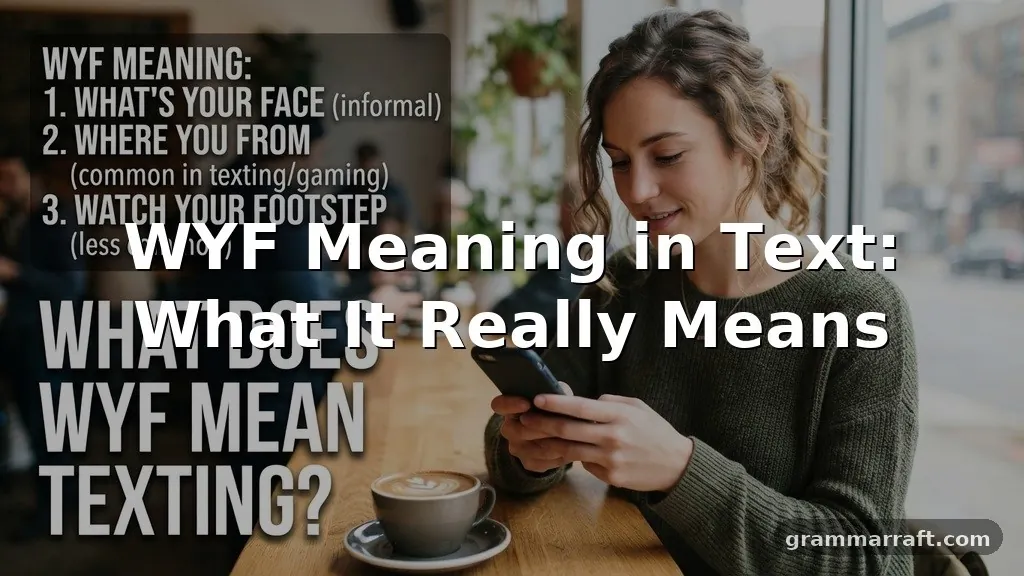
The phrase “wyf meaning in text” usually points to one simple question: “Where you from?” In a message, someone may use WYF to ask about your city, hometown, country, or general location without typing the full sentence.
WYF is casual texting slang, so its exact meaning depends on the conversation. A message such as “Hey, wyf?” often asks where you’re from, while a message with extra words can reveal whether the sender is making small talk, flirting, or trying to place a new contact.
You’ll see this abbreviation in social media comments, Instagram direct messages, Snapchat chats, dating apps, and ordinary texting. The useful part is knowing how to interpret it without assuming too much about the person who sent it.
What Does WYF Mean in Texting?

In most text conversations, WYF means “Where you from?” It is a shortened version of “Where are you from?” or “Where are you from originally?” The missing words are common in informal digital communication, where people often remove pronouns, auxiliary verbs, and punctuation.
For example, if someone sends “wyf,” they may want to know your hometown or the place where you currently live. Some people use it to ask about a country, state, city, neighborhood, or cultural background, so the question is broad rather than strictly geographic.
The abbreviation is usually written in lowercase, but WYF and wyf have the same meaning. Capital letters may appear because of autocorrect, a sentence-start setting, or a sender’s typing style. The capitalization does not normally change the message.
WYF is not formal English. It belongs to text slang and online shorthand, alongside abbreviations such as “wyd” for “what are you doing?” and “hbu” for “how about you?” A person might write it quickly because they expect the other person to understand the compressed wording.
| Message | Likely meaning | Natural reply |
|---|---|---|
| “wyf?” | Where are you from? | “I’m from Denver. You?” |
| “Hey, wyf tho?” | Where are you from, though? | “I grew up in Atlanta.” |
| “New here? wyf?” | Where are you from? | “I’m visiting from Canada.” |
| “wyf and wyd?” | Where are you from and what are you doing? | “I’m from Phoenix, just relaxing.” |
Why People Use WYF
The main reason people use WYF is speed. Typing three letters is faster than writing “Where are you from?” and the shorter version fits naturally into a fast-moving chat. Digital conversations often reward brevity, especially on a phone keyboard.
WYF can also serve as an easy conversation starter. If two people have just connected on Instagram, Snapchat, or a dating app, asking about location gives them a simple subject to discuss. The sender may be trying to find a shared city, nearby event, school, or cultural connection.
Sometimes the question is practical. Someone may ask WYF after noticing an unfamiliar accent, seeing a profile location, or discovering that you have mutual friends. In that context, the sender may be trying to work out whether you live nearby or know the same places.
Other messages have a more social or flirtatious purpose. A person who writes “wyf?” after reacting to your photo may be showing interest, but the abbreviation itself does not prove romantic intent. The surrounding conversation matters more than the three letters.
Text slang also helps people signal an informal tone. “Where are you from?” can sound neutral or polished, while “wyf?” feels quicker and more relaxed. That difference is small, but it can shape how the message feels.
- Conversation starter: the sender wants an easy question to open a chat.
- Location check: the sender wants to know whether you’re nearby.
- Background question: the sender is asking about your hometown or country.
- Shared-interest search: the sender hopes you have a common place or connection.
- Casual flirting: the message appears within a broader exchange showing personal interest.
How Context Changes the Meaning
Abbreviations rarely work in isolation. The meaning of WYF depends on the words around it, the platform, the relationship between the people, and what happened immediately before the message.
Suppose a new Instagram follower writes, “Your food looks amazing, wyf?” That person probably wants to know your location or background after seeing a restaurant post. If a friend writes “wyf rn,” however, the intended question may be closer to “Where are you right now?” rather than “Where are you from?”
The addition of “rn”, meaning “right now,” can shift the interpretation from origin to current location. A reply such as “At home” would fit the second meaning, while “I’m from Chicago” would fit the first. The surrounding words provide the clue.
Timing can help too. If someone asks WYF during a conversation about travel, they may be asking about your home city or country. If they ask after making plans, they may mean your present location, although “where you at?” or “where are you now?” would be clearer wording.
The phrase “wyf tho” usually keeps the same basic meaning but adds emphasis. “Tho” means “though,” and it can suggest that the sender is returning to a question, asking for clarification, or reacting to something unexpected.
Context can also show whether the message is friendly or intrusive. A casual question from someone you know may be harmless. A stranger pressing for your exact address, workplace, or live location is asking for more information than WYF normally requires.
WYF on Instagram, Snapchat, and TikTok
On Instagram, WYF commonly appears in direct messages, story replies, and comments. A person may see a photo, notice that the profile does not list a location, and ask “wyf?” as a low-effort way to start talking.
Snapchat conversations often move quickly, so shortened slang is especially common there. If someone sends “wyf” after viewing a snap from a restaurant, concert, or landmark, they may be asking where the photo was taken rather than asking about your hometown.
TikTok adds another layer because a comment may be visible to many people. Someone could write WYF under a creator’s video because they want to know the creator’s country, accent, or local culture. In other cases, the comment may refer to a location shown in the video.
Platform culture affects how direct the question feels. A private message can be personal, while a public comment may be casual curiosity from a stranger. Neither setting creates a fixed meaning, but each changes the likely purpose of the question.
People also use WYF in group chats. A new participant might ask the whole group where everyone is from, especially if the members live in different countries. In a gaming or fan community, the question may help people compare time zones or find local members.
Social media profiles can make the question easier to answer. If your bio already lists your city, “wyf?” might be a conversation opener rather than a genuine request for information. The sender may have missed the profile detail or simply want you to respond directly.
What WYF Means From a Guy or a Girl
WYF has the same basic meaning whether it comes from a guy, a girl, or someone whose gender you don’t know: the sender is probably asking where you’re from. The abbreviation itself does not carry a male or female meaning.
People sometimes search for “WYF meaning from a guy” or “WYF meaning from a girl” because they want to understand the sender’s intentions. A message from someone you met on a dating app may feel flirtatious, especially if it follows compliments or questions about your interests.
Still, the question alone is weak evidence of romantic interest. Someone may ask WYF simply because they are making conversation, checking whether you live nearby, or responding to a profile with little personal information.
Look at the complete exchange instead. Messages such as “You’re cute, wyf?” or “I like your accent, wyf?” may show personal interest. A message such as “Our group has people from everywhere—wyf?” is more likely a general community question.
Your response can stay friendly without sharing precise personal details. You might say, “I’m from the Chicago area,” rather than naming your street, building, school, or workplace. Broad information is usually enough to answer the question.
If the person immediately demands an exact address or asks you to meet somewhere private, treat that as a separate safety issue. The abbreviation may be innocent, but the follow-up questions can reveal whether the conversation is respectful.
How to Reply to “WYF?”
The simplest reply is a short location answer. You can give your city, region, state, or country, depending on how much information you want to share.
A natural response might be, “I’m from Bristol. What about you?”
If you’re unsure what the sender means, ask for clarification. “Do you mean where I live now or where I grew up?” removes ambiguity without making the exchange awkward.
You don’t have to answer with exact information. A broad response such as “I’m from the Midwest” or “I live near Toronto” gives the sender a useful answer while protecting your privacy.
Here are several reply styles that fit different situations:
- Direct: “I’m from Miami. You?”
- Broad: “I’m in northern California.”
- Background-focused: “I grew up in Jamaica but live in New York now.”
- Clarifying: “Do you mean where I’m from or where I am right now?”
- Privacy-conscious: “I’m near Dallas, but I don’t share my exact location online.”
- Playful: “Guess from the accent.”
If the message arrives from an unknown account, you can also choose not to respond. There is no obligation to answer a stranger’s location question, particularly if the profile seems fake or the conversation becomes pressuring.
Privacy and Safety Considerations
“Where are you from?” is usually less sensitive than “Where are you right now?” Even so, location details can become identifying when combined with your name, school, employer, daily routine, or photos showing familiar places.
A safe answer depends on the relationship. Friends may already know your city, while a stranger on social media does not need your exact neighborhood. Broad geographic details are generally safer than a precise address or live location.
Be especially careful if someone asks for real-time information. Saying “I’m at the mall on Main Street” tells a stranger where you are and may reveal that your home is empty. If a person needs to meet you, choose a public location and tell someone you trust.
Online dating requires the same caution. A new match may ask WYF as ordinary small talk, but you can answer with a city or region and wait before sharing more. The Federal Trade Commission’s information on romance scams explains why pressure for money, secrecy, or rapid emotional commitment deserves attention.
Warning signs include refusing to identify themselves, becoming angry when you set a boundary, asking for private documents, and pushing you to move quickly to another messaging platform. WYF is not dangerous by itself, but the conversation that follows can be revealing.
Use the same rule you would use in person: answer only what you’re comfortable sharing. A clear boundary is a complete response.
Similar Abbreviations and Common Confusion
WYF is easy to confuse with nearby abbreviations because text slang often removes vowels and punctuation. The meaning becomes clearer once you compare the letters with the sentence around them.
| Abbreviation | Common meaning | Example |
|---|---|---|
| WYF | Where you from? | “Nice accent—wyf?” |
| WYD | What you doing? | “Wyd tonight?” |
| WYA | Where you at? | “Wya? We’re ready.” |
| HBU | How about you? | “I’m from Leeds. Hbu?” |
| MYF | Not a single universal meaning | Ask for context before interpreting it. |
MYF is particularly uncertain. Unlike WYF, it does not have one broadly reliable interpretation across ordinary texting, so guessing can lead to a strange reply. If someone writes MYF, ask what they mean or read the complete sentence carefully.
“WYA” is the abbreviation most likely to overlap with WYF in a location conversation. WYA generally asks about someone’s current whereabouts, while WYF generally asks about their origin. The distinction is useful, but real-world texting is not always perfectly consistent.
Some people also use WYF as an internal abbreviation within a particular friend group, fandom, workplace, or game community. A private meaning can override the common slang meaning, which is why context remains more reliable than a dictionary-style definition.
Is WYF Formal or Appropriate for Work?
WYF is best suited to casual communication. It can work among friends, peers, gaming partners, or social media contacts who already use informal language. It is not a good substitute for a complete question in a job application, professional email, customer-service message, or formal announcement.
In a workplace, write “Where are you based?” or “Which city are you from?” instead. Those versions are clearer and avoid making the recipient decode slang. Professional writing benefits from direct wording, particularly when the question affects travel, scheduling, or employment records.
There are exceptions in informal team chats. A group of close coworkers may use WYF jokingly or casually, especially in a conversation about remote work. Even then, the abbreviation can be unclear to new members, international colleagues, or people who do not use English-language texting slang.
Clarity matters more than saving a few keystrokes. If the answer affects a plan, use a full sentence such as “Which time zone are you in?” rather than relying on WYF.
Frequently Asked Questions
What does WYF mean in texting?
WYF most commonly means “Where you from?” It is an informal way to ask where someone is from, where they live, or what place they identify with. The exact interpretation depends on the surrounding conversation.
What does WYF mean on Snapchat?
On Snapchat, WYF usually has the same meaning: “Where you from?” If it appears after a snap showing a restaurant, concert, or location, the sender may instead be asking where the picture was taken. Read the message and image together.
What does WYF mean on Instagram?
On Instagram, WYF commonly appears in direct messages, comments, and story replies. A person may be asking about your hometown, country, or current general location. It can be a conversation starter, but it does not automatically indicate flirting.
What does “WYF tho” mean?
“WYF tho” normally means “Where you from, though?” The word “tho” adds emphasis or signals that the sender still wants an answer. It may sound curious, playful, or slightly persistent depending on the previous messages.
How should I answer WYF from a stranger?
You can give a broad answer such as “I’m near Seattle” or “I’m from southern England.” Don’t share your exact address or live location unless you trust the person and have a clear reason to do so. You can also decline to answer.
Conclusion
The usual wyf meaning in text is “Where you from?” It’s a casual abbreviation used in texting, social media, Instagram, Snapchat, TikTok, and dating-app conversations. Context can shift the question toward someone’s current location, but the surrounding words usually make that distinction clear.
A short reply such as “I’m from Boston—how about you?” is enough in a friendly exchange, while a broad answer is wiser with strangers. If a conversation becomes pushy, keep your location private and set a firm boundary.