
TMI Meaning in Text: Definition, Uses, and Examples
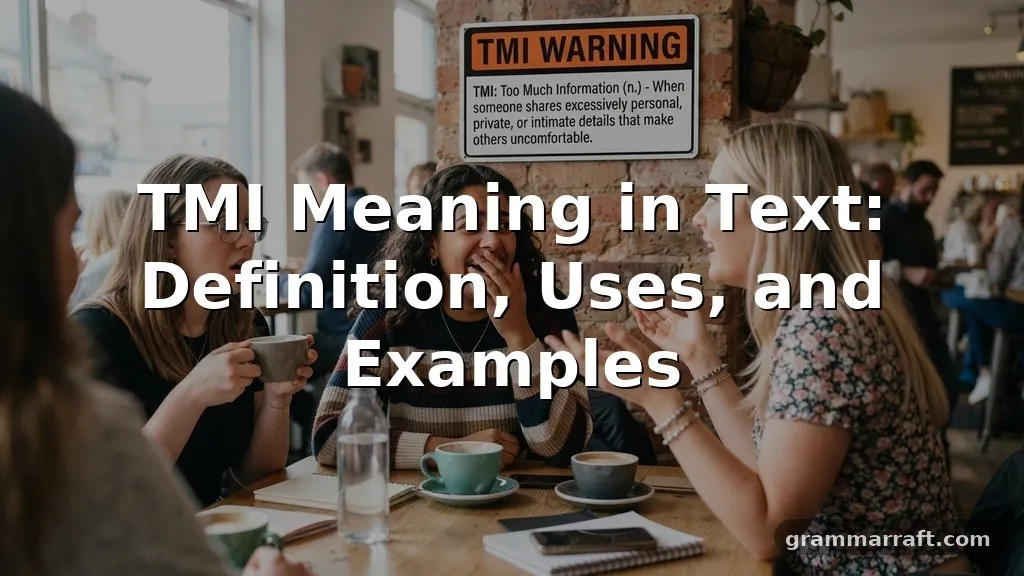
The tmi meaning in text is “too much information.” People use this slang term when someone shares more personal, graphic, or unnecessary detail than the conversation calls for. It can sound playful, embarrassed, annoyed, or genuinely critical depending on the message and the relationship between the people texting.
TMI appears in texting, group chats, comments, and social media posts, including Instagram and Snapchat. The phrase is usually not a serious accusation; often, it is a quick reaction to an awkward story, an intimate detail, or an overshare that catches someone off guard.
Knowing the tone matters. You’ll see what TMI means, how it differs from related expressions, when it can be funny, and how to respond without making the conversation more uncomfortable.
What Does TMI Mean in Text?
TMI means “too much information.” In a text message, it tells someone that the detail they just shared feels overly personal, graphic, embarrassing, or simply unnecessary for the conversation.
For example, if a friend texts, “I’m late because I had terrible stomach problems all morning,” you might reply, “TMI!” The response doesn’t necessarily mean you’re angry. It often means the message included a detail you would rather not picture or discuss.
The abbreviation can be written in capital letters as TMI or in lowercase as tmi. Texting platforms don’t change its definition, so “TMI,” “tmi,” and “Tmi” generally mean the same thing.
| Expression | Basic meaning | Typical tone | Example |
|---|---|---|---|
| TMI | Too much information | Playful, embarrassed, or mildly annoyed | “TMI—I didn’t need that detail.” |
| FYI | For your information | Neutral and informative | “FYI, the meeting starts at nine.” |
| BTW | By the way | Casual and conversational | “BTW, I saw your message.” |
| Overshare | To reveal more personal detail than expected | Often humorous or critical | “That story was a serious overshare.” |
TMI can also describe the information itself rather than act as a direct reaction. Someone might say, “That post was a little TMI,” meaning the post revealed more than the audience needed to know.
How TMI Is Used in Texting
TMI is most often used as a short reaction after a person shares an intimate or uncomfortable detail. Because the abbreviation is familiar, one word can communicate a full response without stopping the flow of the conversation.
It can refer to bodily functions, romantic or sexual experiences, family arguments, health problems, money troubles, or private habits. The subject doesn’t have to be shocking. A detail may count as TMI simply because the people in the chat weren’t expecting it.
Consider these examples:
- “My dentist found three cavities, and I showed everyone the pictures. TMI?” This uses the term as a self-aware question.
- “TMI, but I haven’t slept properly in three days.” Here, the writer warns that a personal detail is coming.
- “You didn’t need to explain exactly what happened in the bathroom. TMI.” This is a direct reaction to an overly graphic explanation.
- “That was TMI, but I hope you’re okay.” This softens the criticism and shows concern.
In casual texting, TMI often carries a joking tone. Friends may use it to tease one another after an unusually honest confession, especially when the person who shared the detail already knows it was a little awkward.
Context changes the meaning. A message such as “TMI 😂” usually sounds lighthearted, while “TMI. Please don’t send details like that again” is a clear boundary.
TMI as a Warning

Some people write “TMI” before sharing a detail rather than after it. In that position, it works as a warning that the next sentence may be personal or unpleasant.
For example, “TMI, but I’m staying home because I feel sick” prepares the reader for information about the writer’s health. The speaker may be asking for understanding while also acknowledging that the subject is not especially pleasant.
This use is common among friends who want to explain an absence, cancel plans, or describe a problem. The warning gives the other person a chance to decide whether they want the full detail.
TMI Tone: Funny, Rude, or Helpful?
The same three letters can sound very different depending on the relationship, subject, and punctuation. TMI between close friends may be affectionate teasing, while TMI from a stranger can feel dismissive or judgmental.
Emojis often provide clues. A laughing face, crying-laughing emoji, or skull emoji can make the response feel humorous. A period after “TMI” can make it sound firmer, particularly if the message concerns a sensitive subject.
| Message | Likely interpretation | Why it sounds that way |
|---|---|---|
| “TMI 😂” | Playful teasing | The emoji signals that the writer is probably joking. |
| “TMI!” | Surprise or mild discomfort | The exclamation mark makes the reaction more energetic. |
| “TMI…” | Awkwardness or disbelief | The ellipsis suggests the writer is searching for a response. |
| “That’s TMI. Please stop.” | A serious boundary | The second sentence removes most ambiguity. |
TMI becomes unhelpful if it dismisses a person who is trying to ask for help. Someone describing symptoms, harassment, grief, or a dangerous situation may share uncomfortable information because they need support, not because they are trying to overshare.
A thoughtful response can acknowledge both the detail and the person’s need. “That is more information than I expected, but are you safe?” works better than making fun of someone who may be distressed.
When TMI Is Usually Harmless
Among friends, TMI is usually harmless when everyone understands the style of humor. A person might respond with the abbreviation after hearing an embarrassing dating story, a detailed account of a minor injury, or an unusually honest comment about daily life.
The exchange is less likely to cause offense when the sender and recipient have similar boundaries. Even then, repeated TMI reactions can make someone feel embarrassed, so the response should fit the situation rather than become an automatic joke.
When TMI May Sound Rude
TMI can sound rude if the other person has clearly shared something vulnerable. It can also be inappropriate in a work group, a public comment thread, or a conversation involving a health concern.
If you don’t know how the message was intended, ask a brief follow-up. “Do you want advice, or are you just venting?” can clarify the purpose without criticizing the person’s choice of words.
TMI in Gen Z Slang and Online Culture
TMI is not a new Gen Z invention. The abbreviation became widely familiar before current social platforms, but younger users continue to use it in texting, memes, short videos, comments, and private messages.
Its basic definition has stayed stable: the sender believes that too much detail has been shared. What changes is the style around it. Online users may combine TMI with emojis, reaction images, exaggerated spelling, or phrases such as “I did not need to know that.”
People also use TMI as part of a humorous performance. A post may deliberately announce “TMI” before telling a ridiculous or embarrassing story. In that setting, the phrase invites the audience to enjoy the overshare instead of treating it as a genuine complaint.
That use is especially common in informal social media captions and story-based posts. The writer knows the detail is excessive and uses the label to create anticipation, surprise, or comic tension.
TMI and Changing Online Boundaries
Digital communication makes private details easy to share with a large audience. A message intended for one friend can be copied, screenshotted, forwarded, or viewed by people who don’t know the original context.
Because of that, TMI can also point to a privacy issue. A person may not object to hearing a story privately but may object to seeing the same details posted publicly with names, photographs, or identifying information.
Before sending a personal message, consider who can see it and whether the details belong to someone else. A funny story about a friend can become an unwanted disclosure if it includes their medical, romantic, financial, or family information.
The phrase also appears in discussions of influencer culture and personal branding. Public figures sometimes share intimate details to appear relatable, while audiences decide whether the disclosure feels authentic, unnecessary, or intrusive.
What TMI Means From a Girl, Guy, or Friend
TMI does not have a separate definition based on whether the sender is a girl, guy, or another person. The abbreviation means “too much information” regardless of gender.
Searches such as “TMI meaning from a girl” often reflect uncertainty about tone rather than a different dictionary definition. A person may want to know whether the message was flirting, joking, rejecting, or expressing discomfort.
The surrounding conversation provides better evidence than the sender’s gender. Look at what detail came before the message, whether the person used an emoji, and whether they continued the conversation afterward.
- “TMI 😂” after a dating story: probably playful embarrassment or teasing.
- “TMI, I’m not comfortable discussing that”: a clear personal boundary.
- “TMI, but I trust you”: an intentional disclosure with some self-consciousness.
- “TMI” followed by a subject change: the person may want the conversation to move on.
It is risky to treat TMI as a secret romantic signal. Someone can flirt and still say TMI, but the abbreviation alone does not prove attraction, rejection, or any particular intention.
When the meaning matters, read the wider exchange. Did the person ask questions, use affectionate language, suggest meeting, or continue engaging? Those details offer more context than a three-letter reaction.
How to Reply Without Misreading It
If someone sends “TMI,” you can answer lightly when the conversation is clearly playful. “Fair enough—I’ll spare you the rest” acknowledges the reaction without escalating the awkwardness.
If you shared something serious, you might respond, “I know it’s a lot, but I needed to tell someone.” That sentence explains your purpose and gives the other person a chance to respond more thoughtfully.
For a confusing exchange, ask directly: “Did that make you uncomfortable?” A short question is usually more reliable than guessing what the sender meant.
Related Meanings and Possible Alternatives
Most people asking about TMI in text want the slang definition, but the letters can appear in other contexts. Abbreviations are not always consistent across workplaces, fandoms, medical settings, or technical documents.
In ordinary texting, however, “too much information” is the dominant meaning. A dictionary reference such as Merriam-Webster’s entry for TMI reflects this common usage.
Some people connect TMI with phrases such as “overshare,” “more than I needed to know,” or “that’s personal.” These expressions overlap, but they don’t always carry the same tone.
| Phrase | What it communicates | Best setting |
|---|---|---|
| TMI | The detail was excessive or awkward | Casual texting and social media |
| That’s personal | The subject should remain private | Serious or boundary-setting conversations |
| Overshare | Someone revealed more than expected | Casual commentary and humor |
| You don’t have to explain | Reassurance that details are not required | Supportive conversations |
TMI may also appear in names for organizations, products, medical terms, school programs, or online communities. Those meanings depend on capitalization and context, so don’t assume every instance refers to texting slang.
Medical information deserves special care. A person searching for “TMI medical meaning” may be asking about a separate abbreviation used in a clinical document, not the casual phrase “too much information.” The surrounding words should determine which definition applies.
How to Use TMI Correctly
Use TMI when the audience understands informal slang and the subject is not so sensitive that the response could feel cruel. It works best in private conversations, friendly group chats, comments, and relaxed social exchanges.
Avoid it in formal emails, professional reports, customer service messages, and serious support conversations unless you are quoting someone or discussing the term itself. “Too much information” written in full is clearer when the reader may not know internet shorthand.
Good Uses of TMI
- Reacting to an overly detailed joke: “TMI, but that story was hilarious.”
- Warning before a personal confession: “TMI, but I’m worried about my health.”
- Responding to a friend’s embarrassing story: “TMI! You really told us everything.”
- Commenting on a public post: “That caption is TMI for a work account.”
Notice that the examples make the relationship or intention clear. Adding “but are you okay?” turns a potentially dismissive reaction into a caring one when the subject is serious.
When to Choose Different Words
If you need someone to stop sharing private information, say so plainly. “Please don’t send me graphic details” communicates a boundary more accurately than a joking “TMI.”
If the other person is asking for help, avoid labeling their request as TMI. Try “Thanks for telling me” or “That sounds difficult” before asking what kind of support they need.
In professional communication, replace slang with a specific statement. For example, “Please keep future updates focused on the project” is clearer and more respectful than “TMI.”
The right response depends on the purpose of the message. A joke, a warning, a serious disclosure, and a public privacy problem may all contain personal details, but they require different language.
Common Mistakes With the Term TMI
One common mistake is assuming TMI always means the speaker is angry. In many conversations, it is a playful expression of surprise, similar to saying, “I could have lived without knowing that.”
The opposite mistake is treating every TMI reaction as harmless. A person may be signaling a real boundary, especially if they repeat the phrase, stop replying, or explicitly ask for fewer details.
Another mistake is using TMI to mock someone’s health, body, identity, or trauma. Humor depends on consent and context, and a quick slang response can feel harsh when the subject is deeply personal.
People also sometimes confuse TMI with FYI. FYI introduces useful information, while TMI suggests that the information is excessive, too personal, or unwanted. The two abbreviations can appear in the same conversation, but they serve opposite purposes.
| Question to consider | Why it matters |
|---|---|
| Who is receiving the message? | A close friend may interpret TMI differently from a manager or stranger. |
| Is the information about someone else? | Sharing another person’s private details can create a privacy problem. |
| Is the sender asking for help? | A serious disclosure deserves support rather than a dismissive joke. |
| Does the tone need to be clear? | Plain language is safer than slang in formal or sensitive conversations. |
Before sending TMI, ask whether you mean “that was funny and excessive” or “please stop sharing this.” If you mean the second, state the boundary directly.
FAQ About TMI Meaning in Text
What does TMI stand for in texting?
TMI stands for “too much information.” It is used when someone shares a detail that feels overly personal, graphic, embarrassing, or unnecessary for the conversation.
Is TMI rude?
TMI can be rude in a serious or vulnerable conversation, but it is often playful among friends. Tone, punctuation, emojis, and the relationship between the people determine how the message is likely to sound.
What does TMI mean from a girl?
It has the same basic definition from a girl as from anyone else: “too much information.” The surrounding messages may reveal whether she is joking, uncomfortable, setting a boundary, or reacting to an awkward detail.
What is the difference between TMI and oversharing?
Oversharing describes the act of revealing more personal information than expected. TMI is commonly the reaction to that disclosure, although people also use it as a warning before they share personal details themselves.
What should I reply when someone says TMI?
For a playful exchange, you can say, “Fair enough—I’ll stop there.” If the information was serious, explain your reason for sharing it or ask whether the person is comfortable continuing the conversation.
Final Takeaway on TMI Meaning in Text
The tmi meaning in text is straightforward: “too much information.” Its real tone depends on the subject, the relationship, and the surrounding words, so a laughing emoji may signal teasing while a firm follow-up may communicate a genuine boundary.
Use TMI casually with people who understand your humor, but choose clearer and kinder language for health concerns, trauma, workplace conversations, and private information about someone else. Once you read the context instead of the abbreviation alone, the meaning becomes much easier to judge.




One Comment