
What Does WSGG Mean in Text? Full Meaning & Examples
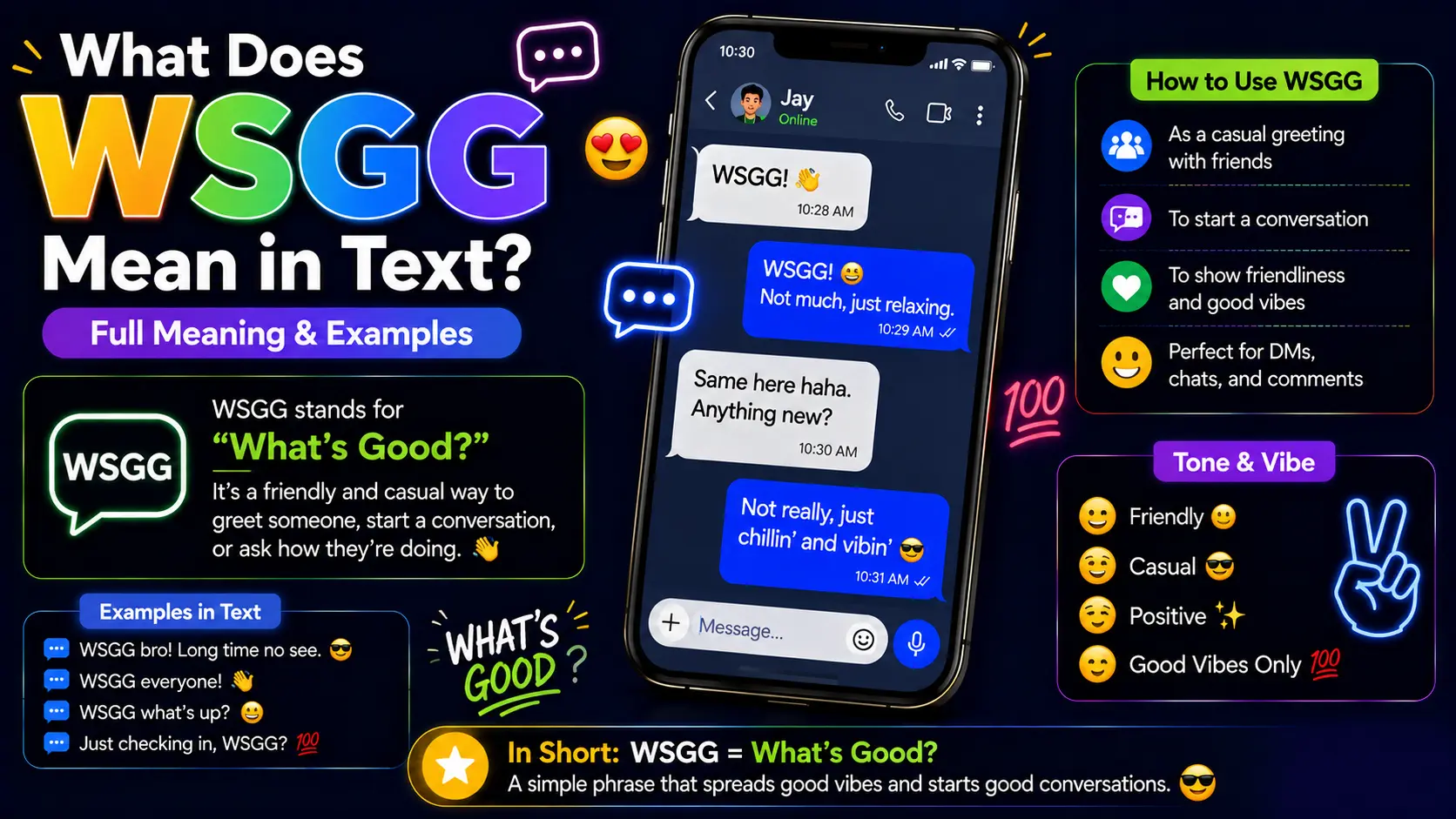
If you received a message saying “WSGG” and wondered whether it was a typo, a new slang term, or an abbreviation you somehow missed, you are not alone. Texting slang changes quickly, and even one extra letter can completely change an expression.
In current casual internet usage, WSGG most commonly means “What’s Good, Gang?” It is a friendly, informal greeting used to address a group or close circle. In practice, it is similar to saying “What’s up, everyone?”, “How’s everyone doing?”, or “What’s going on, guys?”
The important detail is the final G. While WSG generally means “What’s good?”, WSGG adds “gang,” giving the phrase a more group-oriented and playful feel.
WSGG Meaning in Text: Quick Meaning
WSGG = “What’s Good, Gang?”
It is usually a casual greeting directed at friends, followers, group-chat members, or an online community.
You can understand it as:
- What’s good, gang?
- What’s up, everyone?
- How are you guys doing?
- What’s happening, everyone?
- What are you all up to?
For example:
“WSGG everyone 😂”
This usually means:
“What’s up, everyone?”
Another example:
“WSGG, y’all ready for tonight?”
Here, the sender is casually checking whether the group is ready for an event.
You may also see lowercase forms such as wsgg, especially in quick messages. Capitalization rarely changes the meaning.
Origin & Background of WSGG
WSGG is best understood as a newer extension of WSG, which stands for “What’s good?” The phrase “what’s good?” itself has long been used as an informal greeting meaning something close to “what’s up?” or “what’s happening?”
The exact origin of the abbreviation WSGG is difficult to pin to one person, platform, or date. Internet slang normally develops through repeated community use rather than appearing with an official creator.
The underlying phrase “what’s good?” has strong associations with informal American and urban speech and has also been widely circulated through popular culture and hip-hop-influenced language.
Social media then made short greetings easier to spread across communities. Adding “gang” gives WSGG a sense of belonging. The word does not necessarily refer to a literal gang. In this expression, it is generally a casual way to refer to friends, a group, or people someone feels connected to.
That distinction matters. Language often carries social meaning beyond its dictionary definition. “Gang” can function as a friendly group label in online conversations, much like “guys,” “everyone,” or “my people.”
WSGG in Real-Life Conversations
The easiest way to understand WSGG is to see how it works naturally.
WhatsApp Group
Person A:
wsgg everyone 😂 what are we doing tonight?
Person B:
I’m free after 8.
Person C:
Same. Movie?
Here, WSGG is simply a relaxed way to get the group talking.
Instagram DM
Person A:
WSGG 😭 you disappeared
Person B:
Lmaoo I’ve been busy with college.
Person A:
I was wondering where you went 😂
The expression makes the conversation feel familiar rather than formal.
TikTok Comments
Person A:
WSGG chat 😂 who else stayed up for this?
Person B:
Me 😭
Person C:
We’re all here!
On TikTok, WSGG can work almost like a community greeting. The person may be addressing fellow viewers rather than a specific individual.
Text Message
Person A:
wsgg bro, you coming tomorrow?
Person B:
Yeah, definitely. What time?
Here, the greeting is followed by a practical question. The abbreviation simply makes the opening feel relaxed.
Emotional & Psychological Meaning of WSGG
WSGG is more than four letters. Like many forms of internet slang, it can communicate relationship, mood, and social distance at the same time.
When someone writes “WSGG,” they are usually trying to create an informal atmosphere. It can make a group feel like a shared social space rather than a formal conversation.
The word “gang” is especially important. It can create a small sense of belonging. Even when the people involved are not particularly close, the expression can make the interaction feel warmer and more playful.
Imagine joining a group chat after being away for several days. A message like “WSGG, what did I miss?” feels much more relaxed than “Hello everyone. What happened while I was away?”
That difference is psychologically meaningful. Digital communication removes facial expressions, voice, and body language, so people often rely on slang, punctuation, emojis, and word choice to communicate personality.
In my experience with everyday conversational English, these tiny choices often matter more than learners expect. A person can know every word in a sentence and still misunderstand its social tone.
WSGG in Different Contexts
Social Media
On TikTok, Instagram, Snapchat, and similar platforms, WSGG is most likely to appear in informal comments, DMs, group conversations, or community-style posts.
It works especially well when someone wants to address several people at once.
Friends and Relationships
Among friends, WSGG can sound playful and familiar.
For example:
“WSGG 😂 you guys doing anything later?”
It can also be used when reconnecting with friends after some time apart.
However, it does not automatically mean romantic interest. Context matters more than the abbreviation itself.
Work and Professional Settings
WSGG is generally not appropriate for formal professional communication.
A message to your manager such as:
“WSGG, are we still meeting at 3?”
could sound overly casual.
A better option would be:
“Hi everyone, are we still meeting at 3?”
Professional communication usually benefits from clarity and appropriate formality.
Casual vs. Serious Tone
WSGG naturally belongs to a casual environment.
If the conversation concerns a serious problem, emotional conflict, a workplace issue, or an important announcement, using WSGG may feel insensitive or out of place.
When NOT to Use WSGG
Knowing when not to use slang is just as important as knowing what it means.
Avoid WSGG when speaking to someone who expects formal language, particularly in professional, academic, or official communication.
It may also be inappropriate when discussing grief, conflict, emergencies, or another emotionally serious situation.
Cultural awareness matters too. If you are unfamiliar with the group you are communicating with, copying slang simply to sound trendy can sometimes feel unnatural.
There is nothing wrong with saying “Hi everyone” instead.
Good communication is not about using the newest slang. It is about choosing language that fits the relationship and situation.
Common Misunderstandings About WSGG
One common mistake is assuming that WSGG means the same thing as WSG in every situation.
WSG generally means “What’s good?” while WSGG is commonly used as “What’s good, gang?” in casual internet slang.
Another misunderstanding comes from taking the word “gang” literally. In this context, it normally functions as an informal group term, not a reference to criminal activity.
Tone can also cause confusion.
For example:
“WSGG 😂”
sounds playful.
But:
“WSGG.”
with no emoji or follow-up may feel more neutral, depending on the relationship.
Context, punctuation, and the people involved all influence how a short expression feels.
WSGG Compared With Similar Expressions
| Expression | Meaning | Typical Tone | Best Context |
|---|---|---|---|
| WSGG | What’s good, gang? | Friendly, playful | Groups, friends, social media |
| WSG | What’s good? | Casual | Friends, DMs, texts |
| WYD | What are you doing? | Casual | One-to-one chats |
| SUP | What’s up? | Very casual | Friends and quick messages |
| HBU | How about you? | Casual | Continuing a conversation |
| HEY EVERYONE | Group greeting | Neutral | Most situations |
| HI GUYS | Greeting a group | Friendly | Casual or semi-casual settings |
| WHAT’S UP? | How are things? | Casual | General conversation |
Key Insight
WSGG is essentially a group-oriented version of the casual “what’s good?” greeting. If you understand WSG as “what’s up?”, you can usually understand WSGG as “what’s up, everyone?” The extra G adds the group feeling.
Variations and Types of WSGG
These are not separate official definitions of the abbreviation. They are common ways the expression can function depending on context.
1. WSGG?
Meaning: What’s good, gang?
A simple group greeting with no extra information.
2. WSGG Everyone
Meaning: What’s up, everyone?
The sender clearly signals that they are addressing the whole group.
3. WSGG Guys
Meaning: What’s happening, guys?
This adds another group word and makes the message more conversational.
4. WSGG 😂
Meaning: A playful group greeting.
The laughing emoji makes the message feel lighter and more energetic.
5. WSGG Tonight?
Meaning: What are we doing tonight?
The phrase becomes a conversation opener about plans.
6. WSGG Chat
Meaning: What’s up, chat?
This is particularly natural in livestreams, gaming, and online communities.
7. WSGG Bro
Meaning: A casual greeting directed toward a friend or group.
The tone is strongly informal and familiar.
8. WSGG Y’all
Meaning: What’s good, everyone?
“Y’all” makes the group address more explicit and can add a regional American flavor.
9. WSGG, What Did I Miss?
Meaning: What happened while I was away?
Here, the greeting is followed by a request for an update.
10. WSGG!!!
Meaning: An energetic hello to a group.
Multiple exclamation marks can make the message sound excited or enthusiastic.
How to Respond When Someone Uses WSGG
You do not need a complicated response. Treat it like a casual greeting.
Casual Replies
- Not much, you?
- All good! What about you guys?
- Chilling 😂
- Doing good, what’s up?
- All good over here.
Funny Replies
- Surviving 😂
- Just pretending I have my life together.
- Nothing but chaos 😭
- The usual nonsense 😂
- Still alive, somehow.
Mature Replies
- Doing well, thanks. How’s everyone doing?
- I’m good. What’s happening with you guys?
- Everything’s going well. What about everyone else?
Respectful Replies
If you are unsure whether the sender expects slang, simply answer naturally:
“Hi! I’m doing well. How are you?”
You do not have to mirror someone’s slang to communicate comfortably.
Regional & Cultural Usage
Western Culture
In the United States and other English-speaking Western communities, WSGG fits naturally into casual internet communication, especially among younger users.
The underlying phrase “what’s good?” has long functioned as an informal greeting in English.
Asian Culture
In Asian countries where English is widely used online, WSGG may appear in social media and messaging, particularly among younger users who interact with international internet culture.
However, English slang is not necessarily understood equally by every generation or community. A student who spends hours on TikTok may recognize WSGG immediately, while an older family member may not.
Middle Eastern Culture
Among English-speaking internet users in the Middle East, WSGG may be understood through global social media culture rather than traditional local English.
Its meaning usually remains the same, but whether it sounds natural depends on the speaker’s familiarity with online slang.
Global Internet Usage
Social platforms have made slang increasingly international. A phrase that once belonged primarily to particular speech communities can now appear in conversations between people who live thousands of miles apart.
That does not mean everyone uses it identically. Internet slang travels quickly, but local speech habits still influence how people interpret it.
Gen Z vs. Millennials
Gen Z users are generally more accustomed to compressed digital language, though not every Gen Z user uses WSGG.
Millennials may recognize WSGG because of their familiarity with earlier expressions such as “what’s up?”, “sup,” or “what’s good?”
The difference is often less about age and more about someone’s online communities.
Is WSGG Safe for Kids?
WSGG is generally harmless slang when used in its ordinary sense of “What’s good, gang?” The word “gang” in this expression normally refers casually to friends or a group, not criminal activity.
Still, parents and educators should teach children to consider context. Not every slang expression means the same thing in every conversation.
The safest approach is to focus on who is communicating, what the surrounding messages say, and where the conversation is happening, rather than judging a short abbreviation by itself.
FAQs About WSGG
What does WSGG mean in text?
WSGG most commonly means “What’s Good, Gang?” It is a casual group greeting similar to “What’s up, everyone?”
What does WSGG mean on TikTok?
On TikTok, WSGG can be used as a friendly greeting to viewers, followers, or members of a comment community.
Is WSGG the same as WSG?
Not exactly. WSG usually means “What’s good?”, while WSGG commonly adds “gang,” making it a group-oriented greeting.
Is WSGG a bad word?
No. In ordinary texting, WSGG is not inherently offensive. It is casual slang, although the word “gang” can have different meanings outside this expression.
How do I reply to WSGG?
You can reply with “Not much, you?”, “All good!”, “Doing good, what’s up?”, or another casual greeting.
Does WSGG mean “what’s going on”?
It can function conversationally like “what’s going on?” because “what’s good?” and similar greetings often serve the same purpose. The most common expansion, however, is “What’s Good, Gang?”
Can I use WSGG at work?
Usually, no. WSGG is strongly casual. In professional communication, use something clearer such as “Hi everyone” or “How is everyone doing?”
Conclusion
So, what does WSGG mean in text? In most casual online conversations, it means “What’s Good, Gang?”, a friendly way to greet a group and ask what everyone is doing or how things are going.
The expression is closely connected to the older slang greeting “what’s good?”, which functions much like “what’s up?”
Once you understand the extra G, WSGG becomes much easier to read. Just remember that slang works best when it matches the relationship, platform, and mood.
You do not need to force yourself to use every new abbreviation. Understanding the social meaning is more important than sounding trendy. When the setting is right, though, a simple “WSGG 😂” can be an easy, friendly way to open the conversation.
One Comment