DPMO Meaning in Text: What the Slang Really Means
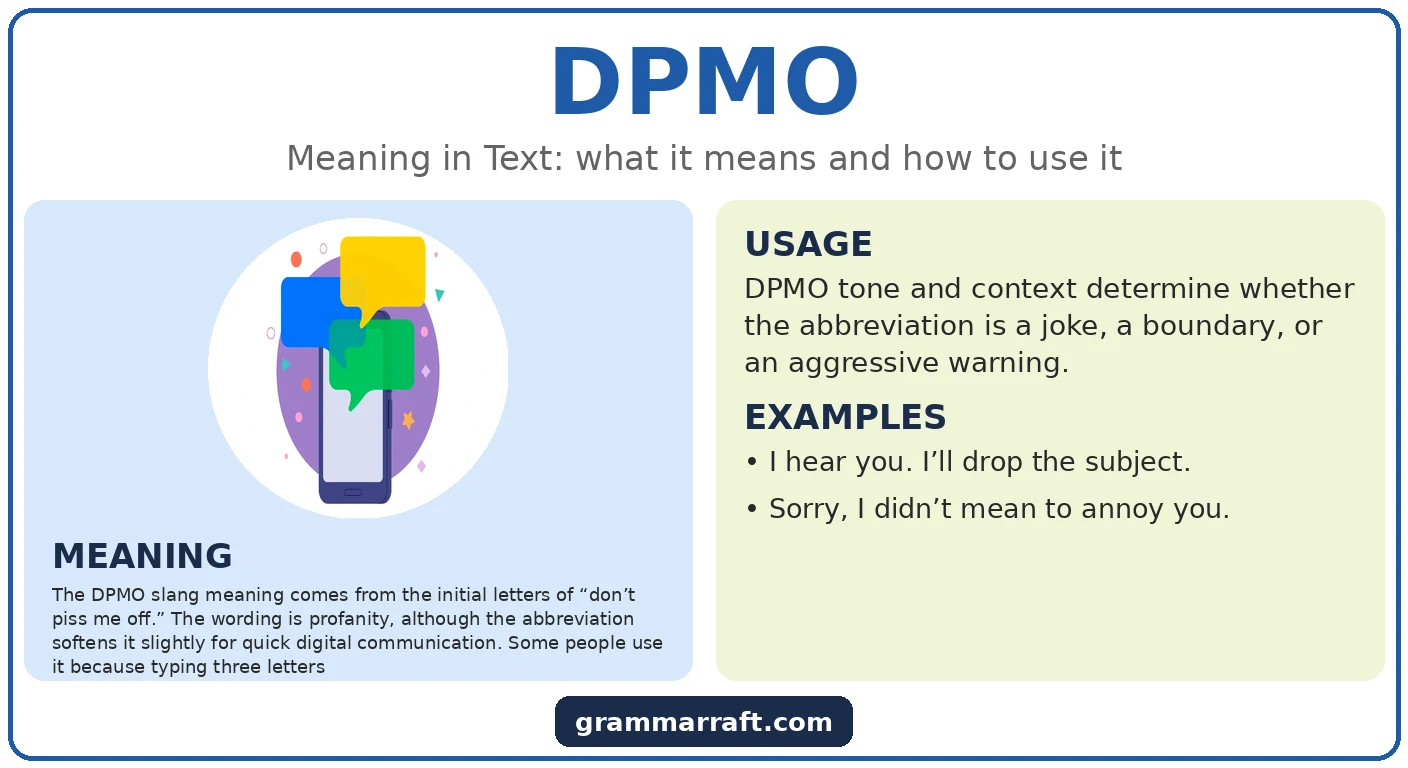
The most common DPMO meaning in text is “don’t piss me off.” It’s a blunt warning that someone is irritated and doesn’t want another problem, argument, or provocative comment.
DPMO can also appear in business and manufacturing, where it stands for “defects per million opportunities,” a Six Sigma quality metric. The surrounding words usually make the intended meaning clear, but short messages on Snapchat, Instagram, or group chats can create confusion.
This guide explains the DPMO slang meaning, how its tone changes by situation, what it may mean from a guy or girl, and how to respond without making the exchange worse. It also separates the texting abbreviation from the quality-control use.
DPMO Meaning in Text: The Short Answer
In casual messages, DPMO usually means “don’t piss me off.” The phrase is direct, mildly aggressive, and often used to tell someone to stop pushing, teasing, questioning, or creating an annoyance.
For example, a person might write, “DPMO today,” after a stressful day, or “DPMO with that nonsense” when they believe someone is being disrespectful. The abbreviation may be aimed at a specific person, but it can also describe a general mood.
It isn’t automatically a serious threat. Among friends, DPMO can be exaggerated or playful, especially when the surrounding conversation includes laughing emojis, teasing, or an established habit of joking. Without that context, though, it’s safer to read it as a warning rather than friendly banter.
| Use of DPMO | Meaning | Typical setting | Likely tone |
|---|---|---|---|
| Texting or social media | Don’t piss me off | Private messages, comments, group chats | Annoyed, joking, or confrontational |
| Manufacturing and quality control | Defects per million opportunities | Six Sigma reports and process reviews | Technical and analytical |
| Typing or search confusion | Possibly a typo for another abbreviation | Fast messages and informal posts | Unclear until confirmed |
Therefore, the answer to “what does DPMO stand for?” depends on where you saw it. In an emotional message, it is slang; beside defect rates, process capability, or production data, it refers to a quality metric.
What Does DPMO Stand For in Slang?
The DPMO slang meaning comes from the initial letters of “don’t piss me off.” The wording is profanity, although the abbreviation softens it slightly for quick digital communication. Some people use it because typing three letters feels faster or less severe than writing the full phrase.
The expression usually communicates irritation rather than a detailed argument. “DPMO” can mean “please stop before I get more angry,” “don’t test my patience,” or “I’m already annoyed, so don’t add to it.” Those interpretations are close, but the exact force depends on the relationship between the people messaging.
Capital letters are common because DPMO is an abbreviation, but users may write “dpmo” in lowercase. Lowercase does not create a different definition. It often reflects the casual style of texting, especially on phones where people do not bother with capitalization.
Why the phrase can sound strong
The word “piss” makes the phrase more forceful than alternatives such as “please don’t annoy me.” A person who sends DPMO may be setting a boundary, showing frustration, or trying to sound tough. It can also be a dramatic reaction to something minor, such as a friend sending an unwanted spoiler.
- Direct warning: “DPMO” may mean the sender wants the other person to stop.
- General mood: “DPMO today” can describe a bad mood without naming a specific offense.
- Playful exaggeration: Friends sometimes use it after harmless teasing.
- Escalating tension: In an argument, it can signal that the sender is close to ending the conversation.
That range is why a dictionary-style definition is not enough. The same abbreviation can sound funny in one chat and openly hostile in another.
DPMO in Texting, Snapchat, and Social Media
DPMO in texting generally has the same meaning across major platforms. The platform does not change what the abbreviation stands for, but it can influence how the message is interpreted because public posts, disappearing messages, and private chats carry different social expectations.
On Snapchat, “DPMO on Snapchat” may appear as a direct message, a caption, or a reply to a story. A person might use it after seeing a post they find irritating, embarrassing, or deliberately provocative. Since Snapchat messages can be brief and visually driven, an emoji or photo may provide the missing tone.
On Instagram, DPMO may show up in comments, direct messages, notes, or captions. “DPMO on Instagram” could be directed at one person, but a public comment makes the warning visible to others and may make it feel more confrontational.
On Twitter/X, the abbreviation can appear in a short post reacting to news, a disagreement, or a viral conversation. “DPMO on Twitter/X” is often broad rather than personal: the writer may be complaining about an event, a group of users, or a recurring online annoyance.
On Facebook, DPMO may be used in a private Messenger exchange or a public status update. “DPMO on Facebook” can carry extra weight in family or community networks because the audience may know the people involved and infer who the message targets.
Where the setting matters most
A private message gives the sender room to explain, while a one-line public post leaves readers to guess. If DPMO appears alongside “lol,” a laughing emoji, or an obviously exaggerated complaint, it may be lighthearted. If it appears after an accusation, insult, or repeated demand to stop, treat it as genuine anger.
The safest interpretation comes from the entire exchange. Look at the message before DPMO, the sender’s usual style, whether the person is addressing you directly, and whether the conversation has already become tense.
DPMO Tone and Context
DPMO tone and context determine whether the abbreviation is a joke, a boundary, or an aggressive warning. Tone is difficult to read in text because the reader cannot hear volume, pacing, or facial expression. A short acronym can therefore appear harsher than the sender intended.
Consider the difference between “You ate my fries again, DPMO 😂” and “DPMO. Stop messaging me.” The first example uses exaggeration and an emoji to frame the phrase as teasing. The second has a clear boundary and should not be treated as a joke.
Timing also matters. If someone sends DPMO immediately after you ask a personal question, they may be telling you to drop the subject. If they post it after a sports loss or an irritating headline, it may be a general emotional reaction rather than a personal attack.
Clues that DPMO is playful
Playful use often appears between people who already tease each other comfortably. The message may include laughing symbols, a clearly minor complaint, an exaggerated scenario, or a follow-up that returns to normal conversation. Even then, a joke stops being harmless if the recipient has asked the sender to stop.
Clues that DPMO is serious
A serious use often follows repeated contact, criticism, pressure, or an argument. Phrases such as “leave me alone,” “I’m done,” or “stop asking” make the meaning unmistakable. Multiple angry messages, personal insults, or threats should be handled carefully rather than answered with more provocation.
Do not assume that a smiling emoji cancels the words. People sometimes add humor markers to soften a real complaint, and others use sarcasm when they are upset. The broader pattern matters more than one symbol.
DPMO Meaning From a Guy or a Girl
Searches for “DPMO meaning from a guy” and “DPMO meaning from a girl” usually reflect uncertainty about romantic or personal intent. The abbreviation itself does not have a male or female definition. A guy, girl, friend, date, coworker, or stranger can use it to mean “don’t piss me off.”
What changes is the relationship and the conversation. If someone sends DPMO after flirting, jealousy, or teasing, the message could be playful possessiveness or irritation.
It could also mean the person genuinely wants a topic dropped. The words alone cannot prove attraction, jealousy, or romantic interest.
Suppose a person sends, “DPMO, you know I hate when you do that.” That sounds like a complaint about a specific behavior. By contrast, “DPMO 😭” after a friend posts an unflattering photo may be joking. Neither message reliably reveals gender-based intent.
How to interpret the message responsibly
Start with the immediate trigger. What happened directly before the message? Was the sender responding to a joke, a repeated question, a public post, or an accusation?
Next, consider the relationship. Close friends may use strong language casually, while a new acquaintance may be signaling discomfort. A romantic partner could be joking, but a partner who repeatedly uses angry abbreviations to control a conversation is presenting a different issue.
If the meaning still isn’t clear, ask a calm question rather than guessing. “Are you joking, or did I actually upset you?” gives the sender a chance to clarify without forcing a fight. That approach is more reliable than treating DPMO as a secret code about feelings.
DPMO Response Examples
The best DPMO response depends on the message’s intensity and your goal. A defensive reply can turn a minor misunderstanding into a longer argument, while a calm acknowledgment gives both people space. You do not need to match the sender’s profanity or anger.
If the message seems playful
When the context is clearly friendly, a light response may fit. For example, “Relax, I’m only joking,” or “My bad—I’ll stop,” can acknowledge the message without escalating it. Keep the reply aligned with the existing relationship, not with an imagined meaning.
If the sender appears genuinely annoyed
A brief apology is often better than a detailed defense. “I didn’t realize that bothered you. I’ll leave it alone” recognizes the boundary and ends the immediate dispute. If you need an explanation, wait until the conversation is calmer.
If DPMO is unclear
Ask directly but without sounding sarcastic. “Do you mean you’re actually upset?” or “Should I stop?” can resolve the ambiguity quickly. Avoid replying with “What does that even mean?” in a mocking tone, because the sender may interpret it as another challenge.
If the message feels threatening
Do not continue trading insults. Save the messages, disengage, and use platform safety tools if the person continues harassing you. If there is a credible threat of harm, contact an appropriate local authority or someone you trust rather than trying to settle it through text.
Useful DPMO response examples include:
- “I hear you. I’ll drop the subject.”
- “Sorry, I didn’t mean to annoy you.”
- “Are you joking, or do you want me to stop?”
- “Let’s talk later when we’re both calmer.”
- “I’m not going to argue over text.”
These replies work because they address the emotion without adding a new insult. They also protect your ability to end the conversation.
DPMO Urban Dictionary and Other Online Definitions
People often search for “DPMO Urban Dictionary” because slang dictionaries collect user-submitted expressions that may not appear in traditional dictionaries. Such pages can reveal how internet users apply an abbreviation, but they may include multiple entries, vulgar wording, jokes, or definitions limited to a particular community.
That matters because slang does not always have one fixed meaning. A person may use DPMO as “don’t piss me off,” while another community assigns the same letters a different expansion. User-generated definitions can be useful clues, not final proof of what a specific sender intended.
Search suggestions such as DPMO meaning in a message, DPMO meaning from a guy, or DPMO meaning from a girl usually point back to the same core slang expansion. The extra words describe the situation, not a separate dictionary definition.
The DMPО typo
A related problem is the “DMPО typo,” where the letters may be entered in the wrong order or one character may come from a different alphabet. The final character in some copied text can look like a Latin “O” while technically being a Cyrillic “О,” which can affect searches and text matching.
Someone may also type DMPО instead of DPMO because the letters are close in memory or entered quickly. If the surrounding message clearly expresses irritation, the intended slang may still be obvious. If the phrase appears in a technical document, ask for clarification before assigning a meaning.
Do not treat every four-letter sequence as slang. Acronyms are reused across workplaces, fandoms, gaming communities, and private groups. Context remains the deciding factor.
The Other DPMO: Defects per Million Opportunities
In quality management, DPMO stands for defects per million opportunities. It measures how many defects occur relative to the total number of chances for a defect, scaled to one million opportunities. This is a technical use, not an expression of anger.
For example, imagine a process that produces 1,000 units, with 5 possible defect opportunities per unit. The process has 5,000 total opportunities. If inspectors find 10 defects, the DPMO is calculated as 10 divided by 5,000, multiplied by 1,000,000: 2,000 DPMO.
The calculation is:
DPMO = (number of defects ÷ total opportunities) × 1,000,000
This metric is useful because units can contain different numbers of features or checkpoints. A single product with ten possible failure points should not be compared casually with one that has only two. DPMO puts the comparison on a common scale.
DPMO is associated with Six Sigma quality metric systems, process improvement, and defect analysis. The American Society for Quality’s explanation of defects per million opportunities provides technical context for the business meaning.
DPMO versus defective units
A defect is a specific problem, while a defective unit is a product or transaction that fails one or more requirements. One unit can contain several defects, so the number of defects may be higher than the number of defective units.
That distinction is central to DPMO. A company must define the opportunities consistently before calculating the rate. If one team counts five checkpoints per unit and another counts eight, their DPMO figures may not be comparable even if both use the same formula.
| Quality term | What it counts | Example question |
|---|---|---|
| Defect | An individual failure or error | How many problems were found? |
| Defective unit | A unit with at least one defect | How many items failed inspection? |
| Opportunity | A defined chance for a defect to occur | How many checkpoints existed? |
| DPMO | Defects normalized to one million opportunities | How does the process compare at a common scale? |
If you see DPMO beside terms such as yield, process capability, control charts, or Six Sigma, the technical definition is almost certainly intended. If it appears in a personal message, the slang definition is far more likely.
How to Tell Which DPMO Meaning Applies
Identifying the correct DPMO meaning is usually a matter of categorizing the surrounding language. Text messages tend to include emotion, direct address, emojis, or informal punctuation. Quality documents tend to include formulas, inspection results, process names, and numerical comparisons.
Use the words around the abbreviation as evidence. “DPMO, stop playing with me” points to slang, while “the line improved from 3,000 DPMO to 1,500 DPMO” clearly describes manufacturing performance. Neither interpretation requires guessing.
A practical context check
- Identify the source: private chat, social post, work report, spreadsheet, or presentation.
- Read the sentence before and after the abbreviation.
- Check for emotional language, profanity, emojis, or direct commands.
- Look for quality terms such as defects, opportunities, yield, or Six Sigma.
- Ask the sender if both interpretations remain possible.
Audience is another clue. A teenager posting “DPMO” on Snapchat is probably not reporting a process defect. A quality engineer writing DPMO in a production review is unlikely to be warning a coworker not to anger them.
Capitalization alone is not enough. Technical reports and slang messages can both use uppercase letters, while casual users may write either “DPMO” or “dpmo.” The subject matter carries more weight than the letter case.
Be careful with search results that present only one definition. An abbreviation can have a dominant internet meaning and a separate professional meaning at the same time. Correct interpretation depends on the sentence, audience, and purpose.
FAQ About DPMO Meaning in Text
What does DPMO mean in slang?
DPMO most commonly means “don’t piss me off” in slang. It usually expresses irritation, a warning to stop, or a strong reaction to something annoying, though close friends may use it jokingly.
What does DPMO on Snapchat mean?
DPMO on Snapchat generally means “don’t piss me off.” The sender may be reacting to a story, a message, or a teasing photo, so check the surrounding snaps and emojis before deciding whether the tone is serious.
Is DPMO meaning from a guy different from DPMO meaning from a girl?
No. The abbreviation has the same basic meaning regardless of who sends it. Romantic interest, jealousy, humor, or genuine anger must be inferred from the conversation and relationship, not from the sender’s gender.
What does DPMO mean in a message about work?
In a work message about production, defects, or Six Sigma, DPMO usually means “defects per million opportunities.” It is a quality measure, not the slang phrase, especially when it appears with a number or a process-performance discussion.
Could DPMO be a typo?
Yes. Someone may type DMPО, reverse letters, or use a visually similar character by mistake. If the message does not clearly indicate anger or quality control, ask what the sender intended instead of assuming the abbreviation has one fixed meaning.
Conclusion
The usual DPMO meaning in text is “don’t piss me off,” but the phrase can be playful, irritated, or genuinely confrontational depending on context. Snapchat, Instagram, Twitter/X, Facebook, and private messages generally use the slang meaning, while manufacturing and Six Sigma documents use DPMO for defects per million opportunities.
Read the surrounding words, consider the relationship, and ask for clarification when the tone is unclear. That simple check prevents both an unnecessary argument and a mistaken reading of a technical abbreviation. If you’ve seen DPMO used in an unusual message, share the surrounding context without private details and interpret the wording from there.
Related Articles
- What Does OHB Mean in Text? Meaning and Examples
- 304 Meaning in Text: Slang, TikTok Use and Context
- IMA Meaning in Text: What Does IMA Mean?
Explore more helpful guides on GrammarRaft.