LMAO Meaning in Text: Definition, Tone and Usage
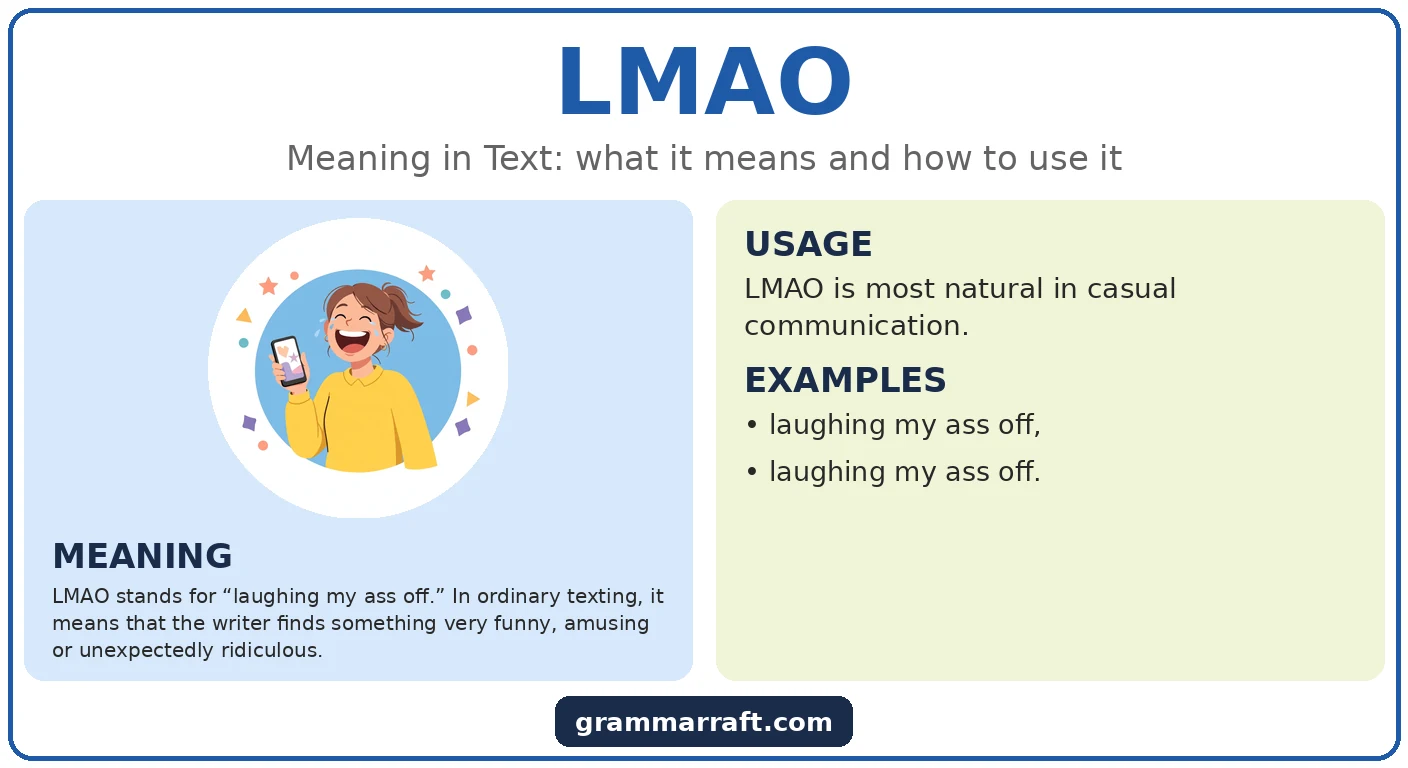
The lmao meaning in text is “laughing my ass off,” an informal way to show that something is very funny or that a message has caused a strong reaction. It belongs to the same family of internet abbreviations as LOL, ROFL and LMFAO, but its tone is often a little more emphatic.
People use LMAO in text messages, group chats, comments and social media posts, usually without intending a literal description of their laughter. The surrounding words, punctuation and relationship between the speakers matter just as much as the abbreviation itself.
By the end, you’ll know what LMAO communicates, how it differs from similar expressions, when it sounds natural, and how to respond without making the conversation awkward. You’ll also see examples that show why the same abbreviation can signal genuine amusement, mild disbelief or simple conversational warmth.
What Does LMAO Mean in Text?
LMAO stands for “laughing my ass off.” In ordinary texting, it means that the writer finds something very funny, amusing or unexpectedly ridiculous. The expression is not usually a precise report about how hard someone is laughing; it is a quick emotional reaction.
For example, someone might text, “My cat tried to chase its own shadow lmao.” The writer may be laughing out loud, smiling at the image, or simply emphasizing that the story is funny.
The phrase includes mild profanity because of the word “ass.” That doesn’t automatically make LMAO offensive, though. In casual communication, many people treat it as a familiar slang abbreviation rather than a serious swear phrase.
Context determines the force of the expression. “Lmao, that’s hilarious” clearly expresses amusement, while “Lmao, you actually sent that?” could combine laughter with surprise, disbelief or teasing.
The abbreviation is normally written in uppercase as LMAO, but lowercase “lmao” is extremely common. Lowercase writing often feels more relaxed, understated or conversational, especially in one-to-one messages.
A message containing only “lmao” can be genuine, but it can also be vague. Depending on the exchange, it may mean “that was funny,” “I don’t know how else to respond,” or “I’m trying to keep this conversation light.”
The basic definition is straightforward, but the emotional meaning can shift. A reader should consider the joke, the timing, the punctuation and the sender’s usual writing style before interpreting it too strongly.
Does LMAO Mean Literal Laughter?
Not necessarily. Text-based communication removes facial expressions, voice and immediate feedback, so people use short reactions to supply emotional clues that would normally be visible in person.
Someone can write “lmao” while genuinely laughing, grinning at a clever line, or merely acknowledging an amusing comment. It works more like a reaction marker than a measurable statement about physical laughter.
That is why LMAO may appear after a mildly funny observation rather than a joke that makes somebody collapse with laughter. The abbreviation adds energy and friendliness, even when the humor is relatively small.
LMAO, LOL, LMFAO and ROFL Compared
LMAO is often confused with several nearby internet expressions. All of them communicate amusement, but they differ in intensity, wording and social tone.
| Expression | Literal expansion | Typical tone | Common use |
|---|---|---|---|
| LOL | Laughing out loud | Light and widely acceptable | A quick reaction to something amusing |
| LMAO | Laughing my ass off | Stronger, casual and mildly profane | Emphasizing genuine amusement or surprise |
| LMFAO | Laughing my fucking ass off | More intense and more profane | Reacting strongly in an informal conversation |
| ROFL | Rolling on the floor laughing | Exaggerated and playful | Showing an especially strong comic reaction |
| Haha | A written representation of laughter | Flexible and natural | Responding warmly without using an abbreviation |
LOL is the safest general-purpose option. It appears in friendly chats, comments and even some semi-professional exchanges because many readers interpret it as mild and familiar.
LMAO sounds more forceful than LOL, although the difference depends on the person. A teenager, a longtime internet user and a workplace colleague may all use it differently.
LMFAO adds another profanity and therefore carries a rougher tone. It may fit a close friend’s group chat but look inappropriate in a message to a customer, manager or unfamiliar person.
ROFL is understood by many people, but it can sound more exaggerated or old-fashioned than LMAO. The phrase was especially common in earlier online chat culture and forum writing.
There is no official scale that proves one abbreviation is always funnier than another. A person’s habits matter. Someone who writes “lol” after nearly every sentence may use LMAO for a genuinely bigger reaction, while another person may use both casually.
Why Lowercase and Uppercase Feel Different
“LMAO” can look emphatic because capital letters create visual weight. “lmao” often feels softer, more spontaneous or less dramatic.
That distinction is not universal. Many phones and messaging apps do not automatically capitalize abbreviations, and users may choose lowercase simply because it is faster.
Repeated letters can also alter the mood: “lmaooo” usually suggests extended amusement, while “LMAO” may look like a sharp, immediate reaction. Neither form has a fixed dictionary rule beyond the underlying abbreviation.
How People Use LMAO in Conversation
The position of LMAO in a message gives readers useful information. At the start, it often introduces the writer’s reaction; at the end, it usually comments on the sentence that comes before it.
- At the beginning: “Lmao, you really wore two different shoes?”
- At the end: “I forgot the meeting was today lmao.”
- By itself: “Lmao” as a short response to a joke, image or surprising story.
- With punctuation: “LMAO!” for a louder or more enthusiastic reaction.
- With repetition: “lmaooo” to suggest prolonged or exaggerated laughter.
Placed before a sentence, LMAO can soften a potentially critical question. “Lmao, why would you do that?” sounds more playful than “Why would you do that?” even though the basic question is unchanged.
At the end of a sentence, it can signal that the writer is not being completely serious. “I just spent ten minutes looking for my phone while holding it lmao” presents an embarrassing mistake as a joke.
A standalone “lmao” needs more interpretation. If the previous message is clearly funny, it probably means exactly that. If the conversation involves conflict or bad news, the same reply may appear dismissive or insensitive.
Some people use LMAO as a conversational bridge. They may not have a detailed response, but they want to show that they saw the message and enjoyed it. In this sense, it performs a social function as well as expressing laughter.
The phrase can also mark self-deprecation. A person might write, “I sent the email to the wrong address lmao,” using humor to acknowledge an error without making the mistake feel too serious.
Texting style matters here. A person who frequently uses slang, emojis and abbreviations will probably use LMAO more broadly than someone whose messages are formal and carefully punctuated.
Examples With Different Meanings
“The dog barked at the vacuum again lmao” expresses amusement at a familiar, harmless event. “Lmao, that excuse is unbelievable” may communicate skepticism rather than simple laughter.
“You’re impossible lmao” can be affectionate teasing between friends. Without a friendly relationship or a clear humorous context, however, it might be read as criticism.
“LMAO I can’t believe that worked” usually shows surprise and relief alongside amusement. The writer is not necessarily laughing at another person; they may be laughing at the absurdity of the outcome.
When Is It Appropriate to Use LMAO?
LMAO is most natural in casual communication. It fits messages between friends, informal group chats, gaming conversations, social media comments and online communities where slang is already common.
It may also work in a relaxed workplace chat if the group regularly uses informal language. Still, the subject matters. A funny scheduling mistake is different from a customer complaint, a serious announcement or a discussion involving someone’s distress.
A useful rule is to match the other person’s level of informality. If they write complete sentences and avoid slang, “That’s funny” or “I laughed at that” may be clearer than LMAO.
Professional communication calls for more care. An abbreviation with profanity can look careless in an email, application, formal report or message to someone whose preferences you do not know.
The same caution applies across age groups. Many adults understand LMAO immediately, but not everyone uses internet slang regularly. If clarity matters more than speed, write the reaction in ordinary words.
LMAO is also risky around sensitive topics. A joke about illness, bereavement, financial stress or a personal failure may not be received as funny, even if the sender intends the abbreviation to reduce tension.
Before sending it, ask what the laughter is aimed at. Laughing with someone about a harmless situation usually feels different from laughing at that person’s embarrassment or pain.
Formal and Informal Alternatives
In a casual chat, “That’s hilarious,” “I’m crying,” “You’re killing me” or “I can’t stop laughing” can communicate a similar reaction. These phrases may be easier to understand and do not depend on knowledge of abbreviations.
For a workplace message, “That made me laugh” is usually a better choice. It remains warm without assuming that profanity or internet slang is welcome.
Even alternatives require context. “I’m crying” is often figurative online, but a reader unfamiliar with current slang could take it literally. Clear wording is the better option whenever confusion would have consequences.
How to Respond When Someone Says LMAO
The simplest response is to continue the conversation naturally. If you shared something funny, you can add another detail, react with a laughing emoji, or explain what happened next.
For example, if someone replies “lmao” to a story about missing a train, you might answer, “And then the next one arrived early, which somehow made it worse.” The response gives the exchange somewhere to go.
You do not need to mirror the exact abbreviation. A reply such as “I know, right?” or “I couldn’t believe it either” is perfectly natural.
If the other person writes “lmao” after making fun of you, consider the relationship and tone. Close friends may be teasing affectionately, while a stranger may be making a sharper comment.
When the meaning is unclear, ask a direct but relaxed question. “Are you laughing with me or at me?” can sound playful among friends, though a more neutral “What do you mean?” may work better in a tense exchange.
A person may use LMAO to soften criticism. “Lmao, you’re terrible at keeping secrets” could be affectionate, but it could also be a complaint hidden behind humor. The surrounding conversation usually reveals which reading is more likely.
Responding with a stronger term such as LMFAO is not always necessary. Matching someone’s energy does not mean copying every expression they use.
Possible Replies
- To continue the joke: “I know, it was completely ridiculous.”
- To share the reaction: “Same. I’m still laughing.”
- To add context: “The funniest part was what happened five minutes later.”
- To respond warmly: “Glad that made you laugh.”
- To clarify a confusing tone: “Wait, are you serious?”
These responses work because they address the actual conversation instead of treating LMAO as a question that requires a dictionary-style answer. Texting is social, not just grammatical.
See Also: What Does CSTM Mean in Text? Meaning, Uses, Examples & More
Related Forms: LMAOOO, LMAOAO and LMBO
Online slang changes quickly, and users often modify abbreviations for comic effect. “LMAOOO” generally stretches the final sound to suggest stronger or longer laughter, though it does not create a new formal meaning.
People may also combine laughter abbreviations with emojis, such as “lmao 😂.” The combination makes the emotional intent easier to see, especially when the words alone could be interpreted as sarcasm.
“LMBO” is commonly understood as “laughing my butt off.” It replaces the profanity in LMAO with a milder word. Some people choose it because they want the same basic expression of amusement without using “ass.”
Questions about LMBO sometimes focus on whether it has a special meaning when sent by a woman or a man. It does not have a gender-specific definition. The sender’s personal style and the conversation are more important than gender.
“LAMO” is different from “LMAO.” It is often a misspelling or typo, although some users may intend another slang term. If someone writes “lamo,” the safest interpretation comes from the surrounding sentence rather than assuming a fixed meaning.
“LMAO” can also be expanded creatively in jokes or memes, but those invented expansions are not the standard definition. In ordinary text, the established meaning remains “laughing my ass off.”
Abbreviations can look almost identical while carrying different levels of profanity. That is why context and audience remain more reliable than a simple list of letter substitutions.
Does “LMAO” Mean the Same as “I’m Dead”?
Not exactly, although the expressions often appear in similar situations. “I’m dead” is online hyperbole meaning that something is extremely funny, shocking or embarrassing.
“LMAO” explicitly references laughter, while “I’m dead” relies on exaggeration. A person may write “I’m dead lmao” to combine both reactions.
Neither phrase should normally be read literally in a casual humorous exchange. Serious surrounding content changes that assumption, so readers should never ignore context simply because slang is present.
The History and Digital Culture Behind LMAO
LMAO developed within internet and text-message culture, where users needed quick ways to express emotion without typing a full sentence. Its exact first use is difficult to establish because early online conversations were scattered across chat rooms, message boards and private services.
The abbreviation became widely familiar alongside other forms of computer-mediated communication. As mobile texting, instant messaging and social platforms grew, short expressions such as LOL and LMAO moved between online communities and everyday speech.
LMAO belongs to a broader tradition of written laughter. People have long used forms such as “ha ha,” “haha” and “hehe” to represent amusement in writing. Digital abbreviations compressed those reactions into letters that could be typed quickly.
Reference works now record many internet abbreviations because they have become recognizable parts of informal English. The Merriam-Webster entry for LMAO is one useful reference for its standard expansion and slang classification.
The abbreviation’s popularity does not mean every generation uses it in the same way. Some people see it as ordinary internet language, while others associate it with older chat-room culture or find the profanity more noticeable.
Digital communication also changes how laughter is performed. A person can respond with an abbreviation, emoji, GIF, sticker or reaction button, each carrying slightly different social information.
LMAO has survived because it is short, recognizable and flexible. It can respond to a joke, soften an awkward confession, underline disbelief or keep a conversation moving with only four letters.
Its meaning is therefore cultural as well as lexical. The dictionary expansion explains the phrase, but community habits determine how intense, friendly or sarcastic it feels in a particular exchange.
LMAO in Social Media, Gaming and Everyday Texting
On social media, LMAO often appears in comments beneath videos, screenshots and personal stories. A comment such as “LMAO the ending” tells the creator that the post produced amusement, even if the commenter does not add a detailed explanation.
In gaming chats, the abbreviation may react to an unexpected mistake, an unusual game outcome or playful competition. “Lmao, you walked straight into that trap” can be friendly banter when the players already share that tone.
Group chats create more complicated interpretations because several people may see the same message differently. One participant may use LMAO sincerely, while another reads it as sarcasm or mockery.
Memes often use LMAO as part of a larger reaction rather than as a standalone definition. The abbreviation can signal that the user understands the joke’s absurdity, even when the content is intentionally exaggerated.
Dating conversations bring another layer of uncertainty. Someone who replies “lmao” may be interested, amused, nervous or simply acknowledging a message. The abbreviation alone cannot prove romantic interest.
The same caution applies to questions about what LMAO means “from a girl” or “from a guy.” No universal gender code changes the phrase. The person’s normal communication habits, response speed, subject matter and broader engagement provide more useful clues.
Social platforms also encourage performance. Users sometimes write “LMAO” because it is the expected reaction to a popular post, even if their response is closer to amusement than uncontrollable laughter.
Reading Tone Without Overthinking It
Look for clusters of signals rather than one abbreviation. Exclamation marks, laughing emojis, follow-up jokes and playful wording usually support a friendly interpretation.
Short replies, delayed responses and a serious preceding message may point toward a different reading. Even then, certainty is difficult without asking the sender directly.
Text has no voice, facial expression or gesture. A phrase that sounds warm aloud may look dismissive on a screen, which is why misunderstandings happen so easily.
Common Mistakes With LMAO
One common mistake is assuming that LMAO always means intense laughter. Many people use it as a light reaction, much like “haha,” so interpreting every instance as a dramatic emotional response can lead to unnecessary confusion.
Another mistake is using it in a serious message simply because the sender feels uncomfortable. Adding “lmao” to an apology, complaint or discussion of someone’s pain may appear to minimize the issue.
Some writers add LMAO to nearly every message. That habit can make the abbreviation lose force and may cause readers to overlook moments when the sender is genuinely amused.
Overusing capital letters can also change the tone. “LMAO” may look louder or more excited than intended, especially when combined with multiple exclamation marks.
Spelling is another source of confusion. “LMAO,” “LMBO” and “LAMO” are not interchangeable in every context, even though readers may infer the intended meaning from a typo.
See Also: SA Meaning: What Does SA Mean in Text, Slang, and Social Media?
People sometimes assume that a dictionary, grammar checker or citation generator can settle every question about slang. Reference tools can identify a standard definition, but they cannot determine the sender’s private intention in one particular text.
Writing tools such as Grammarly may flag slang depending on the selected style or audience. That does not mean the abbreviation is incorrect; it may simply be inappropriate for formal writing.
Conversely, a message can be grammatically clean and still sound rude. Tone depends on social context, not only spelling, punctuation or whether an automated checker accepts the phrase.
How to Avoid Miscommunication
- Consider who will read the message before using profanity-based slang.
- Check whether the subject is genuinely light enough for a laughing reaction.
- Use a clear sentence if the abbreviation could seem sarcastic.
- Match the other person’s level of informality without copying them mechanically.
- Ask for clarification if the response affects an important relationship or decision.
These habits are simple, but they protect against the most common problem with digital language: assuming that four letters carry the same emotional meaning for everyone.
Frequently Asked Questions About LMAO
What does LMAO mean in texting?
LMAO means “laughing my ass off.” It is an informal abbreviation used to show amusement, laughter, surprise or a playful reaction, and it does not always mean the person is literally laughing out loud.
Is LMAO rude or offensive?
LMAO contains mild profanity, so it may be unsuitable for formal, professional or sensitive conversations. Among friends and in casual online communication, many people consider it ordinary slang rather than a serious insult.
What is the difference between LMAO and LOL?
LOL means “laughing out loud” and usually sounds milder and more broadly acceptable. LMAO means “laughing my ass off,” so it often suggests stronger amusement and a more informal tone.
What does LMBO mean?
LMBO usually means “laughing my butt off.” It communicates much the same reaction as LMAO but replaces the profanity with a milder word, making it more comfortable for some audiences.
How should you respond to someone saying LMAO?
You can continue the joke, write “same,” add a related detail or respond with a laughing emoji. If the tone is unclear, ask what the person means instead of assuming that LMAO signals agreement, affection or romantic interest.
Conclusion
The lmao meaning in text is “laughing my ass off,” but its practical meaning depends on tone, timing and the relationship between the people communicating. It can express genuine laughter, mild amusement, surprise, teasing or a quick effort to keep a conversation friendly.
Use LMAO comfortably in casual settings, but choose clearer and less profane wording for formal or sensitive messages. Once you pay attention to context rather than the abbreviation alone, this common piece of internet slang becomes much easier to read and use.
Explore more helpful guides on GrammarRaft.