WTD Meaning in Text: Definition, Uses & Examples
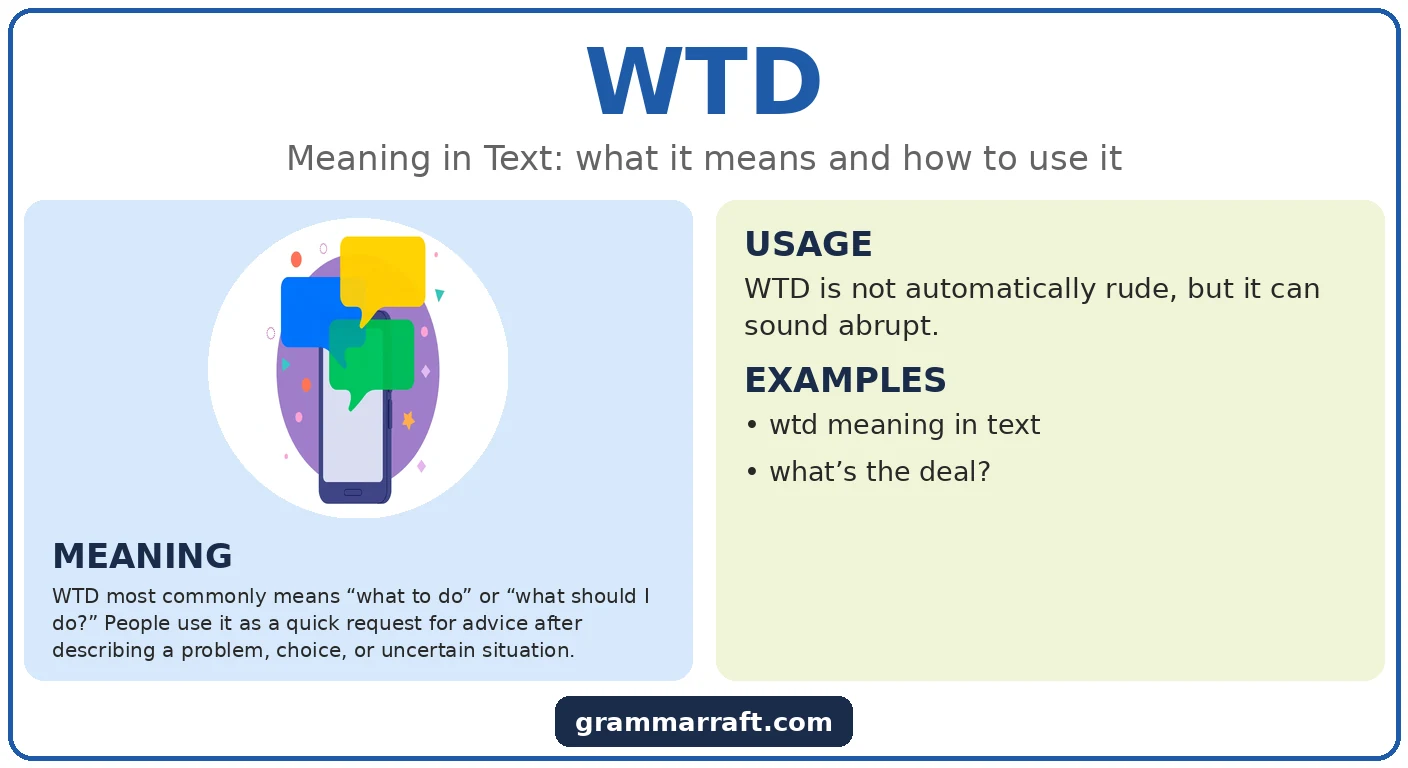
The phrase “wtd meaning in text” usually points to the abbreviation WTD, most often used to mean “what to do” or “what’s the deal?” The correct interpretation depends on the surrounding words, the conversation, and the relationship between the people communicating.
In a text message, WTD can ask for advice, request an explanation, or show confusion. A short example such as “I missed the bus, wtd?” clearly means “what should I do?” while “WTD with that meeting?” is more likely to mean “what’s the deal with that meeting?”
This distinction matters because abbreviations remove tone and detail. By the end, you’ll know how to identify the intended meaning, decide whether WTD sounds rude, and use it naturally in casual online conversations.
What Does WTD Mean in Text?
WTD most commonly means “what to do” or “what should I do?” People use it as a quick request for advice after describing a problem, choice, or uncertain situation. For example, “My phone won’t turn on, wtd?” asks the recipient for a practical next step.
A second common interpretation is “what’s the deal?” In this form, WTD asks for an explanation or expresses confusion about a person, event, rule, or decision. “WTD with the new schedule?” means something close to “What’s the deal with the new schedule?”
Unlike a standard dictionary word, WTD does not have one fixed definition in every text message. It belongs to informal internet slang, where users shorten phrases according to shared habits, limited typing space, and the immediate context.
| WTD meaning | Typical purpose | Example text |
|---|---|---|
| What to do | Asking for advice or a next step | “The store is closed. WTD?” |
| What should I do? | Showing uncertainty about a personal problem | “I sent the wrong file, wtd?” |
| What’s the deal? | Requesting an explanation | “WTD with this new rule?” |
| What the deal? | Expressing surprise or annoyance | “WTD? Nobody told me.” |
Capitalization usually does not change the meaning. “WTD,” “wtd,” and “Wtd” can all represent the same abbreviation, although lowercase is more typical in casual text messages.
Why WTD Has More Than One Meaning
Text abbreviations work differently from formal vocabulary. A word such as “schedule” generally carries the same basic meaning across a conversation, but WTD depends heavily on the sentence around it. The abbreviation leaves out vowels and connecting words, so the reader has to reconstruct the original phrase.
That reconstruction is usually easy if the message includes a problem. “My flight was canceled, wtd?” contains an obvious request for guidance, making “what should I do?” the natural expansion. The same abbreviation after a complaint may instead ask for an explanation.
People also develop personal habits with internet slang. One user may write WTD for “what to do,” while another uses it as a shortened “what’s the deal?” Friends who text regularly often understand each other because they have already established those patterns.
Context supplies the missing words

Look at the grammar surrounding WTD. If it appears alone after a question or problem, such as “No tickets left. WTD?”, it probably means “what should I do?” If it follows “with,” as in “WTD with him lately?”, the intended phrase is almost certainly “what’s the deal with him lately?”
Punctuation can also provide a clue. A question mark after WTD usually signals a request for information or advice, while multiple question marks may add frustration or disbelief. Still, punctuation is not a perfect guide because casual texters often use it inconsistently.
The safest approach is to read the complete message rather than expand the letters automatically. This is the same principle recommended for interpreting unfamiliar language generally: meaning is shaped by context, not by isolated characters alone.
WTD Meaning in Text Messages
In a direct text message, WTD often appears after a short description of a problem. The sender may be in a hurry, may assume the recipient already knows the background, or may want a quick answer rather than a detailed conversation.
- “My car won’t start. WTD?” means “What should I do?”
- “I forgot her birthday. WTD?” asks for advice about repairing the situation.
- “WTD with the group chat?” asks what is happening with the group.
- “WTD, you just left?” may express surprise about someone’s behavior.
- “WTD after the update?” could ask what action to take next or what the update means.
The first two examples are advice-seeking messages. The third is an explanation-seeking message, while the fourth carries an emotional reaction. The final example is genuinely ambiguous and needs more information from the surrounding conversation.
WTD can also be written as part of a longer phrase. “WTD do I say?” is sometimes used to mean “What do I say?” even though the extra “do” makes the abbreviation less consistent. Texting is not edited prose, so people often mix abbreviations with ordinary words.
How the conversation changes the reading
Imagine a friend writes, “My manager wants the report tonight. WTD?” You would probably answer with a suggestion, such as asking for more time or prioritizing the report.
If the friend writes, “WTD with my manager? He changed the deadline again,” the focus shifts from action to the manager’s behavior.
That difference explains why online definitions can seem contradictory. A glossary may list several possible expansions, but only one will make sense in a particular exchange. The message’s topic, syntax, punctuation, and emotional tone work together.
WTD as “What to Do”
The “what to do” meaning is especially common when someone faces a decision or an unexpected problem. The sender may leave out the word “should,” but the intended question is usually “What should I do?” This use is practical and direct.
Typical situations include canceled plans, technical problems, social mistakes, travel changes, and urgent decisions. Someone might write, “The website says my order was delivered, but I don’t have it. WTD?” The recipient understands that the sender wants possible next steps, not a definition of the abbreviation.
The answer can be brief or detailed depending on the seriousness of the problem. For a minor issue, “Call the restaurant” may be enough. For a sensitive situation, a careful response such as “Save the messages and speak with your manager” is more appropriate than matching the sender’s short style.
Examples of the advice-seeking use
“WTD about tomorrow?” usually means “What should we do about tomorrow?” The exact plan might involve meeting, canceling, rescheduling, or waiting for more information.
“I got two invitations, wtd?” asks for help choosing between options. It does not necessarily mean the sender wants the recipient to make the decision; they may simply want an opinion.
“WTD if they don’t reply?” asks about a possible next step. Here, the conditional phrase makes the intended expansion particularly clear.
In these examples, WTD is conversational shorthand rather than a formal expression. It works among friends, relatives, gaming groups, and other informal communities that already share enough background to understand the question.
WTD as “What’s the Deal?”
The second major use asks for an explanation. “What’s the deal?” can be neutral, curious, skeptical, or annoyed depending on tone. Therefore, WTD may carry more emotional weight in one conversation than another.
For example, “WTD with the office closure?” sounds like a request for information. “WTD with you?” can sound more confrontational because it questions someone’s unusual behavior. The same three letters can move from simple curiosity to criticism without changing their spelling.
This use frequently appears with the word “with.” Common patterns include “WTD with this app?”, “WTD with the price?”, and “WTD with everyone leaving?” In each case, the sender is asking for an explanation of something that seems strange, unexpected, or unclear.
Neutral and negative interpretations
A neutral message might be, “WTD with the new bus route?” The sender may simply have missed an announcement and wants the facts. A more negative version could be, “WTD with that attitude?” which suggests irritation or disapproval.
The recipient should consider the relationship before reacting. Close friends may use the phrase playfully, while a coworker or unfamiliar person may make it sound sharper. If the tone is uncertain, responding with a clarifying question can prevent an unnecessary argument.
Good replies include “Do you mean what happened?” or “Are you asking what we should do next?” These responses identify the ambiguity without accusing the other person of writing badly.
Is WTD Rude or Inappropriate?
WTD is not automatically rude, but it can sound abrupt. Its short form removes polite framing such as “Could you explain what happened?” or “What would you suggest I do?” That directness is normal among friends but may seem dismissive in a formal exchange.
Consider the difference between “WTD?” and “Could you tell me what happened with the schedule?” The first is efficient and casual. The second is clearer and more respectful for a workplace, customer-service conversation, school email, or message to someone you do not know well.
Meaning also depends on punctuation and capitalization. “WTD?” may sound like a rushed request for help, while “WTD with you??” can look accusatory. An abbreviation rarely creates the entire tone by itself, but it can amplify an already tense situation.
Where WTD usually fits
- Private messages between close friends
- Casual group chats
- Gaming and social-media conversations
- Quick messages where the background is already known
- Informal discussions about plans or minor problems
It is less suitable for job applications, professional emails, official complaints, academic work, and messages involving serious conflict. In those settings, write the complete question so the recipient cannot mistake your intention.
See Also: IMA Meaning in Text: What Does IMA Mean?
WTD may also be inappropriate if the subject is sensitive. A person dealing with illness, grief, harassment, or a serious financial problem may need a thoughtful response rather than a compressed exchange full of slang.
Common Misunderstandings About WTD
The most common mistake is assuming that WTD always means “what to do.” That interpretation works well after a problem, but it fails in phrases such as “WTD with the policy?” where the sender is probably asking for an explanation.
Another mistake is treating every abbreviation as universally understood. Slang changes across age groups, communities, countries, and platforms. A phrase familiar in one friend group may be unfamiliar to another, particularly if the participants do not share the same online habits.
Some readers also confuse WTD with similar-looking abbreviations. “WYD” commonly means “what are you doing?” and “WYA” commonly means “where you at?” Neither one should be substituted for WTD. A typo can change the entire question.
Watch for the surrounding words
If WTD follows a description of an immediate problem, translate it as “what should I do?” If it appears with “with,” translate it as “what’s the deal with?” If the message is incomplete, ask rather than assume.
| Message | Most likely meaning | Useful response |
|---|---|---|
| “I lost my keys, wtd?” | What should I do? | Suggest practical next steps. |
| “WTD with this rule?” | What’s the deal with this rule? | Explain the rule or share its background. |
| “WTD after the error?” | What should I do after the error? | Ask what kind of error occurred if needed. |
| “WTD with Sam today?” | What’s the deal with Sam today? | Discuss Sam’s unusual behavior. |
Dictionary-style websites can list possible meanings, but a definition list cannot replace the full conversation. The sender’s previous messages often provide the decisive clue.
How to Reply When Someone Says WTD
Start by identifying whether the person wants advice or an explanation. If the message is “The appointment was canceled, WTD?”, respond with a possible action. If it is “WTD with the appointment?”, explain what caused the cancellation if you know.
When the meaning is unclear, ask a short follow-up question. “Do you mean what should you do, or what happened?” is direct without sounding critical. This is especially helpful when the topic has consequences and guessing could make the situation worse.
You can also answer both possible meanings if the context allows it. For example: “If you mean what to do, call the office tomorrow; the cancellation may be because the doctor is unavailable.” That reply saves time and makes your interpretation visible.
Examples of natural replies
- “WTD? My train was canceled.” — “Check the next departure and ask the station staff about a refund.”
- “WTD with the new plan?” — “They moved the deadline to Friday, but the rest is unchanged.”
- “WTD, should I send it?” — “Review the attachment once more, then send it.”
- “WTD with her?” — “I’m not sure. She seemed tired earlier.”
Avoid mocking someone for using slang, particularly if the rest of their message is understandable. Texting habits are informal by design, and a respectful clarification usually works better than a correction.
Should You Use WTD Yourself?
Use WTD when speed and informality matter more than precision. It is suitable for a friend who already understands your texting style, a familiar group chat, or a quick exchange about plans. The abbreviation is most effective when the surrounding words make the intended meaning obvious.
Write the full phrase when the recipient may not recognize the slang or when the message deserves a careful tone. “What should I do?” is only a few extra words, and it eliminates the ambiguity between advice and explanation.
The choice also depends on the topic. A casual question about dinner can tolerate shorthand, while a message about money, health, work, or conflict should be clearer. Informal communication does not have to be careless communication.
A simple decision test
- Ask whether the recipient already knows your abbreviations.
- Check whether WTD could mean both “what to do” and “what’s the deal.”
- Consider whether the subject requires a respectful or precise tone.
- Add enough words to remove uncertainty if the answer matters.
For example, “WTD?” is fine in a close friend’s chat after a minor change of plans. “Could you clarify what I should do about the revised deadline?” is better for a manager, client, or teacher.
WTD Compared With Similar Text Abbreviations
WTD is part of a larger group of shortened questions used in digital communication. These abbreviations save typing time, but their letters can be easy to confuse because several begin with “W” and describe common questions.
| Abbreviation | Common expansion | Typical use |
|---|---|---|
| WTD | What to do / what’s the deal? | Advice or explanation |
| WYD | What are you doing? | Asking about someone’s current activity |
| WYA | Where you at? | Asking for someone’s location |
| WBU | What about you? | Returning a question |
| IDK | I don’t know | Showing uncertainty |
These terms are not interchangeable. “WYD?” asks about an activity, while “WTD?” may ask for a decision or explanation. “WYA?” asks where someone is, so substituting it for WTD could produce a completely different conversation.
Text abbreviations also change over time. People may adopt new meanings, use an abbreviation ironically, or create a private meaning within a group. If a message does not fit any familiar definition, the most accurate answer is to ask the sender what they intended.
FAQ About WTD Meaning in Text
What does WTD mean in a text message?
WTD most often means “what to do” or “what should I do?” It can also mean “what’s the deal?” when the message asks for an explanation, especially in a phrase such as “WTD with that?”
Is WTD the same as WYD?
No. WYD usually means “what are you doing?”, while WTD generally asks what action someone should take or what is happening with a person or situation. The letters look similar, but the meanings are different.
Is WTD rude?
WTD is not inherently rude, but it is informal and may sound abrupt. It is usually fine among friends, but a complete sentence is safer in professional, academic, customer-service, or sensitive conversations.
How can I tell which WTD meaning someone intends?
Read the surrounding message. A problem followed by “WTD?” usually asks for advice, while “WTD with…” usually asks for an explanation. If both interpretations are possible, ask the sender to clarify.
Should WTD be capitalized?
There is no strict capitalization rule in casual texting. “WTD” and “wtd” generally mean the same thing, although lowercase is common in quick messages and uppercase may make the abbreviation more noticeable.
Final Takeaway
The most useful way to read WTD is to treat it as a context-dependent abbreviation. In a problem-focused message, it usually means “what should I do?”; in a question about unusual behavior or a confusing event, it often means “what’s the deal?”
That simple distinction resolves most confusion about WTD meaning in text. Use it freely in relaxed conversations, but choose the complete phrase whenever clarity, professionalism, or sensitivity matters, and ask a quick follow-up if the intended meaning isn’t clear.
Explore more helpful guides on GrammarRaft.