In Route vs En Route: Meaning, Usage, and Examples
The difference in route vs en route comes down to standard English usage, meaning, and origin. Both expressions may appear in messages about travel or delivery, but they don’t have the same status in careful writing.
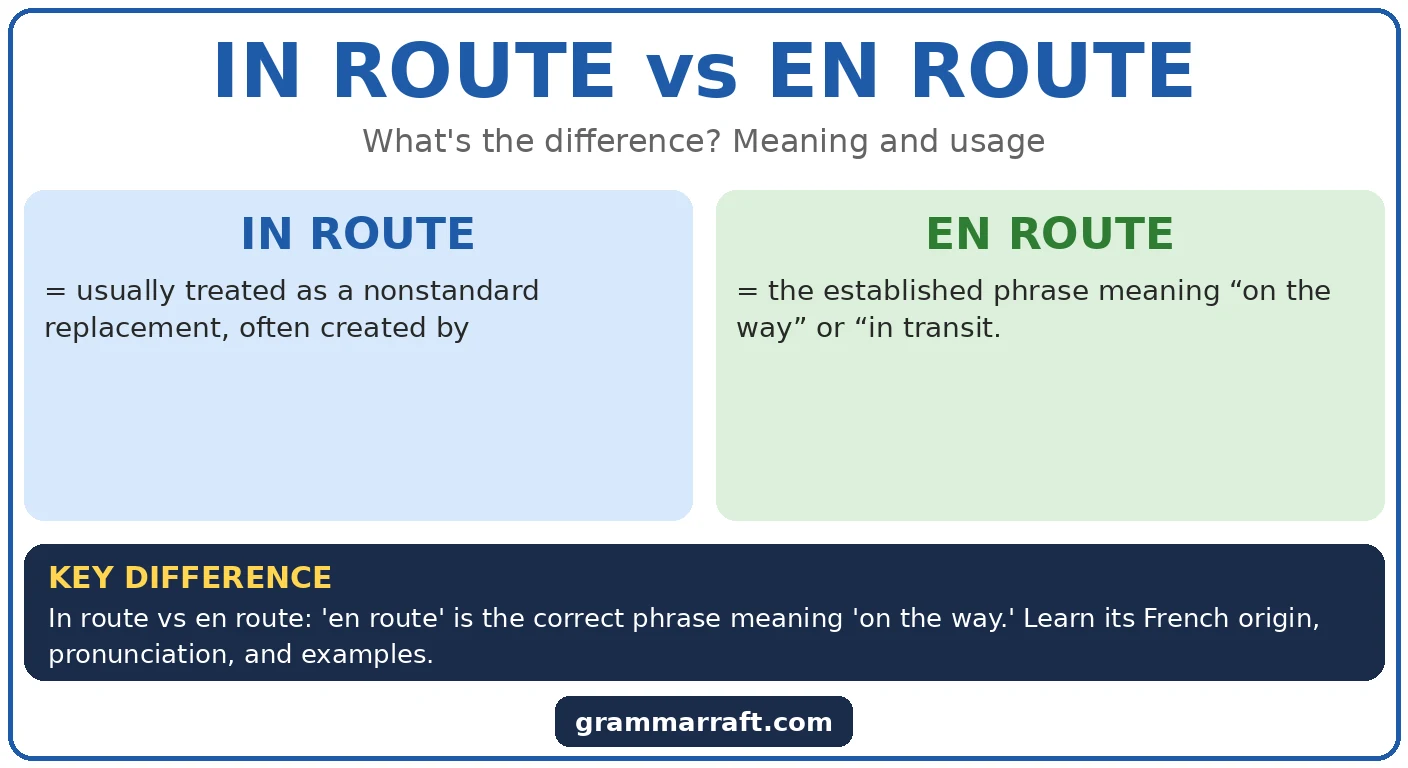
En route is the established phrase meaning “on the way” or “in transit.” In route is usually treated as a nonstandard replacement, often created by hearing or translating the phrase rather than learning its conventional spelling.
Once you know the reason behind the difference, the choice becomes simple. You’ll see how to use en route in sentences, why French accounts for its unusual form, and what to write instead when a plainer expression fits better.
Is It In Route or En Route?
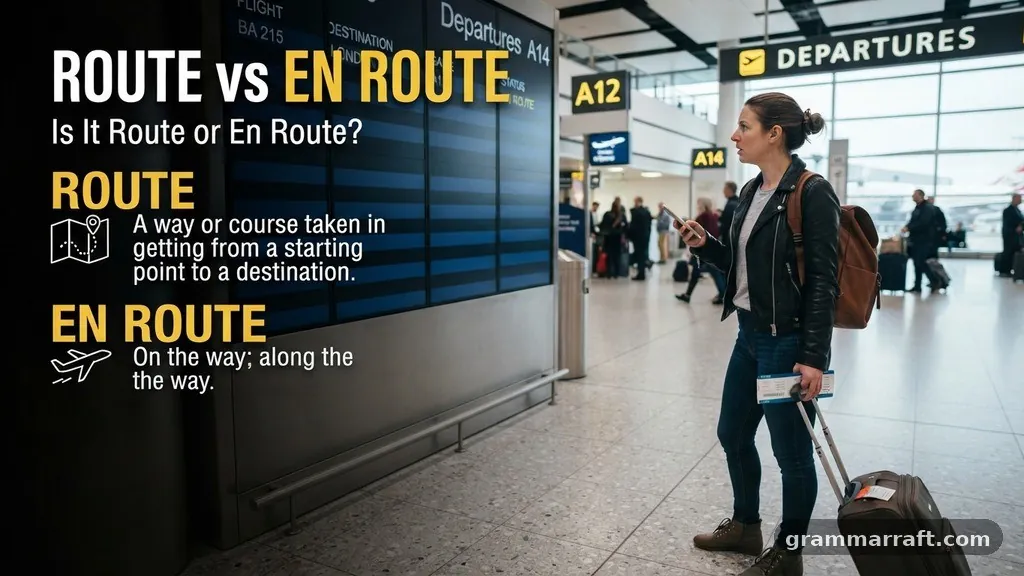
The correct expression in standard English is generally en route, not in route. En route means that a person, vehicle, package, or object is traveling toward a destination but has not arrived yet.
For example, “The parcel is en route to Chicago” means the parcel has been sent and is currently making its way to Chicago. “We’re en route” means “We’re on the way.”
| Expression | Meaning | Typical status in standard writing | Example |
|---|---|---|---|
| en route | On the way; in transit | Established and accepted | The ambulance is en route. |
| in route | Usually intended to mean on the way | Generally nonstandard or mistaken | Use “en route” in formal writing. |
| on the way | Traveling toward a place | Fully standard and plain | I’m on the way home. |
| in transit | Being transported from one place to another | Standard, especially for shipping | Your order is in transit. |
That does not mean every appearance of “in route” makes the sentence impossible to understand. Readers usually infer the intended meaning immediately, especially in casual text messages or online comments.
The issue is correctness and convention. If you are writing an email, report, essay, website, instruction, or customer notification, en route is the safer choice.
What Does En Route Mean?
En route describes movement toward a destination. It can refer to a journey that has just started, one that is already underway, or a stop made during a longer trip.
“The hikers stopped for lunch en route to the summit” means they stopped while traveling toward the summit. The phrase does not require uninterrupted movement; it identifies the broader journey and its direction.
En route can describe people and physical things:
- The driver called while en route to the airport.
- The replacement part is en route from the warehouse.
- We found a small café en route to the coast.
- The rescue team was en route before the weather changed.
- She met an old friend en route to the conference.
It can also be used figuratively, although that use is less central. Someone might say that a project is en route to completion, but “on its way to completion” often sounds more natural because the subject is not literally traveling.
The phrase is especially common in transportation, logistics, emergency services, travel writing, and status updates. A delivery system may mark an order “en route,” while an ordinary speaker may simply say, “Your package is on the way.”
Does En Route Mean the Same as In Transit?
En route and in transit overlap, but they are not perfect substitutes in every sentence. En route emphasizes movement toward a destination, while in transit often emphasizes the period during which something is being transported between locations.
“The technician is en route” focuses on the technician traveling to the customer. “The equipment is in transit” focuses on the equipment’s transportation status, perhaps through a shipping network.
In everyday language, “on the way” is often the clearest option. It avoids the spelling question entirely and works naturally in both speech and informal writing.
Why Is It En Route and Not In Route?
The explanation begins with French. En route is a French phrase that literally relates to being “on the road” or “on the way,” and English adopted it as a travel expression.
In the phrase, en is not the English preposition in. Replacing one with the other changes the established form, just as changing a borrowed word’s spelling can produce a version that looks logical but is not conventional.
English contains many words and phrases borrowed from French, Latin, Italian, and other languages. Some have become fully naturalized, while others retain recognizable features of their original language.
En route belongs to the second group. It functions comfortably in English grammar, but its spelling preserves the French expression. That is why “in route” can feel plausible to someone constructing the phrase from English parts, even though it is not the standard form.
The same pattern appears in other borrowed expressions. English speakers generally write “bon voyage,” not “good voyage,” when using that particular French phrase, and “fait accompli,” not a literal English substitution. Familiarity determines the accepted form.
How Is En Route Pronounced?
Pronunciation varies slightly among English speakers. It is commonly pronounced something like “en ROOT” or “ahn ROOT,” depending on accent and how closely the speaker follows the French pronunciation.
The second part, route, may be pronounced “root” or “rowt” in English. Both pronunciations occur in established English use, although individual regions and speakers often strongly prefer one.
The French pronunciation is different from either fully anglicized version. You do not need to imitate French pronunciation to use the phrase correctly in English, though hearing the phrase pronounced can make its spelling easier to remember.
The key point is that pronunciation does not turn en into English in. The phrase remains spelled en route in standard written English.
Is In Route Ever Acceptable?
For most formal and edited writing, avoid in route when you mean “on the way.” Dictionaries, style references, and ordinary professional usage generally recognize en route as the established expression for that meaning.
In route may appear in informal writing, search queries, social media posts, transcripts, or regional speech. Its presence does not necessarily prevent understanding, but frequency alone does not make it the preferred form.
There is also a possible source of confusion in technical or specialized language. A sentence may contain the words in and route separately, as in “The system stores the request in route tables.” That construction is not the same phrase as en route, and its meaning depends on the technical context.
Likewise, “in route planning” may be a grammatical combination of a preposition, noun, and modifier in a specific field. It should not be automatically “corrected” if route is functioning as a noun in a larger expression.
The spelling question concerns the travel phrase. If you mean that someone or something is traveling toward a destination, write en route, on the way, or in transit.
Why Do People Write In Route?
Several pressures can produce the nonstandard version. The first is sound: in fast speech, en route may be heard as a short phrase whose first syllable resembles “in.”
The second is analogy. English commonly uses in in expressions such as “in motion,” “in transit,” and “in progress,” so “in route” may seem to follow a familiar grammar pattern.
The third is uncertainty about the French origin. Someone who has never seen the phrase written may reasonably spell it according to the sound they hear.
Autocorrect and informal digital writing can reinforce the mistake. Once a version appears repeatedly in messages or online searches, it may look more familiar than the standard spelling.
None of these explanations makes the writer careless. They simply show why a phrase can develop competing forms. For polished writing, the practical solution is easy: choose en route or replace it with on the way.
En Route Examples in Everyday Writing
En route works in several grammatical positions. It can appear after a form of be, after a person or thing acting as the subject, or later in a sentence as a phrase describing when or where something happened.
Here are clear examples:
- After “be”: The repair crew is en route.
- With a destination: They are en route to the stadium.
- With a travel event: We stopped en route to the village.
- With shipping: Your replacement card is en route.
- With an emergency response: Firefighters were en route within minutes.
- With a person: I’ll call you when I’m en route.
The phrase is often followed by to when the destination is named: “en route to Boston,” “en route to the office,” or “en route to the final stop.” It can also stand alone when the destination is understood from context.
“The courier is en route” is complete if everyone already knows which delivery is being discussed. Adding “to your address” supplies more information but is not grammatically necessary.
Formal, Informal, and Customer-Facing Examples
In a formal report, you might write, “The inspection team encountered delays en route to the northern facility.” The phrase is concise and fits a professional register.
In an informal text, “I’m en route” is perfectly natural, although “I’m on my way” sounds more conversational for many speakers. Neither choice changes the basic meaning.
For a customer notification, clarity may matter more than style. “Your package is on the way” is easier for every reader than “Your consignment is en route,” particularly if the audience includes people learning English.
Consider these paired examples:
| Less suitable or less natural | Better alternative | Why |
|---|---|---|
| The nurse is in route. | The nurse is en route. | Uses the standard expression. |
| Your order is in route. | Your order is in transit. | Uses common shipping language. |
| I am en route right now. | I’m on my way right now. | Sounds more natural in casual speech. |
| We ate in route to the lake. | We ate en route to the lake. | Uses the established travel phrase. |
En Route, On Route, and On the Way
Another question is whether to write on route instead of en route. In some varieties of English, especially in British and Irish contexts, “on route” may appear in transportation language, such as “on-route services” or a bus traveling on a particular route.
That use can refer to a designated path rather than simply being in transit. “The bus stopped at three points on the route” has a different structure and meaning from “The bus is en route to the station.”
For the general meaning “traveling toward a destination,” en route remains the broadly recognized choice. If you want plain international English, “on the way” avoids regional uncertainty.
These expressions are close but not interchangeable in every situation:
- En route: traveling toward a destination; slightly formal or polished.
- On the way: traveling toward a destination; ordinary and conversational.
- In transit: being transported between locations; common in logistics.
- On route: usually connected with a specific route or regional usage.
- Along the way: during a journey, often referring to events or stops.
Compare “We bought fruit en route to the cabin” with “We bought fruit along the way.” The first sounds a little more formal; the second emphasizes the journey as a sequence of travel and stops.
Similarly, “The shipment is in transit” may be more precise than “The shipment is en route” if the shipment has passed through several facilities and its exact location is unknown.
Which Expression Should You Choose?
Use en route when you want the conventional phrase and the destination or journey is the main idea. Use on the way when you want a direct, familiar expression that works in almost any conversation.
Choose in transit for shipping records, tracking pages, warehouse updates, and transportation systems. Use route-related wording separately when you are discussing the path itself, such as “the shortest route” or “a change in route.”
A useful editing test is to replace the phrase with “on the way.” If that substitution preserves the meaning, en route may be the expression you need.
Grammar, Punctuation, and Style
En route is commonly treated as a phrase functioning adverbially. It describes the action or condition of traveling, as in “The team worked en route to the conference” or “The aircraft is en route.”
It is often written without hyphens when it follows the verb: “The package is en route.” When it comes before a noun as a compound modifier, style can vary by publication and context.
For example, “an en-route inspection” may appear in edited writing, but many writers would recast the sentence as “an inspection conducted en route.” Rewriting often produces cleaner grammar than debating punctuation.
Capitalization is straightforward. Write en route in lowercase unless it begins a sentence or appears in a title where title-case rules require capitalization.
Do not add an apostrophe. En route is not possessive, and there is no reason to write “en route’s.” Also avoid turning it into a single word such as “enroute”; that spelling is not the standard form.
Checking Your Sentence
Before publishing, ask three questions:
- Does the phrase mean “on the way” or “in transit”?
- Have I written the established form, en route?
- Would “on the way” or “in transit” be clearer for this audience?
For a detailed dictionary definition and pronunciation information, consult the Merriam-Webster entry for en route. A reputable dictionary can also help distinguish the travel phrase from separate technical uses of the word route.
These checks are quick, but they prevent a common spelling mistake from appearing in otherwise careful writing. They also help you select the phrase that suits the tone rather than using a formal expression automatically.
Memory Tricks for the Correct Spelling
A simple way to remember en route is to connect it with the idea of a journey that is already underway. The phrase begins with en, not because English grammar demands it, but because the expression entered English from French in that established form.
You can also associate the spelling with the phrase “en route to.” The three-word pattern is visually distinctive: en + route + to. Writing it several times in useful sentences is more effective than memorizing an isolated definition.
Try these examples:
- The guests are en route to the wedding.
- The documents are en route to the regional office.
- We found a bookstore en route to the hotel.
Another memory aid is substitution. If your intended sentence can use “on the way,” write en route rather than in route. “The doctor is on the way” and “The doctor is en route” express the same basic idea.
Writers who prefer plain English need not use en route at all. Choosing “on the way” is not a failure to use sophisticated language; it is often the clearest choice for a broad audience.
For learners of English, this is an important distinction between a phrase’s literal-looking parts and its actual history. Words do not always behave exactly as their individual pieces suggest, especially when English has borrowed and reshaped them over time.
Related guides: Inter vs Intra: Meaning, Differences, and Examples · Shute vs Chute: Meaning, Spelling and Usage · Inclosed vs Enclosed: Meaning, Usage and Correct Spelling
Frequently Asked Questions
Is “in route” grammatically correct?
“In route” is generally not the standard expression when you mean “on the way.” In formal, professional, academic, and edited writing, use en route, on the way, or in transit instead.
Is en route the same as on the way?
Yes, in most everyday contexts. En route is a slightly more formal or borrowed expression, while “on the way” is plain and conversational. Both can describe a person or object traveling toward a destination.
Why do Americans say en route?
American English uses many borrowed words and phrases, including en route. The expression is not limited to the United States; it is used in several varieties of English, although pronunciation and preference can differ by region.
How do you pronounce en route?
Common English pronunciations sound like “en ROOT” or “ahn ROOT.” The word route itself may be pronounced “root” or “rowt,” depending on the speaker’s accent and regional convention.
Can I use en route for a package?
Yes. “Your package is en route” means it is being transported toward its destination. “Your package is in transit” and “Your package is on the way” are also correct, with the latter usually sounding more conversational.
Conclusion
The standard choice in the in route vs en route question is en route when you mean “on the way.” It comes from French, keeps its established spelling in English, and works for people, vehicles, deliveries, and journeys. If the phrase feels too formal, replace it with “on the way” or use “in transit” for a shipping context.
When you edit your next sentence, check whether you mean movement toward a destination and then choose the clearest expression for your audience. Remembering that distinction will make your writing more precise, whether you’re sending a quick message or preparing formal copy.
Explore more helpful guides on GrammarRaft.