People Do vs People Does: Which Is Correct?
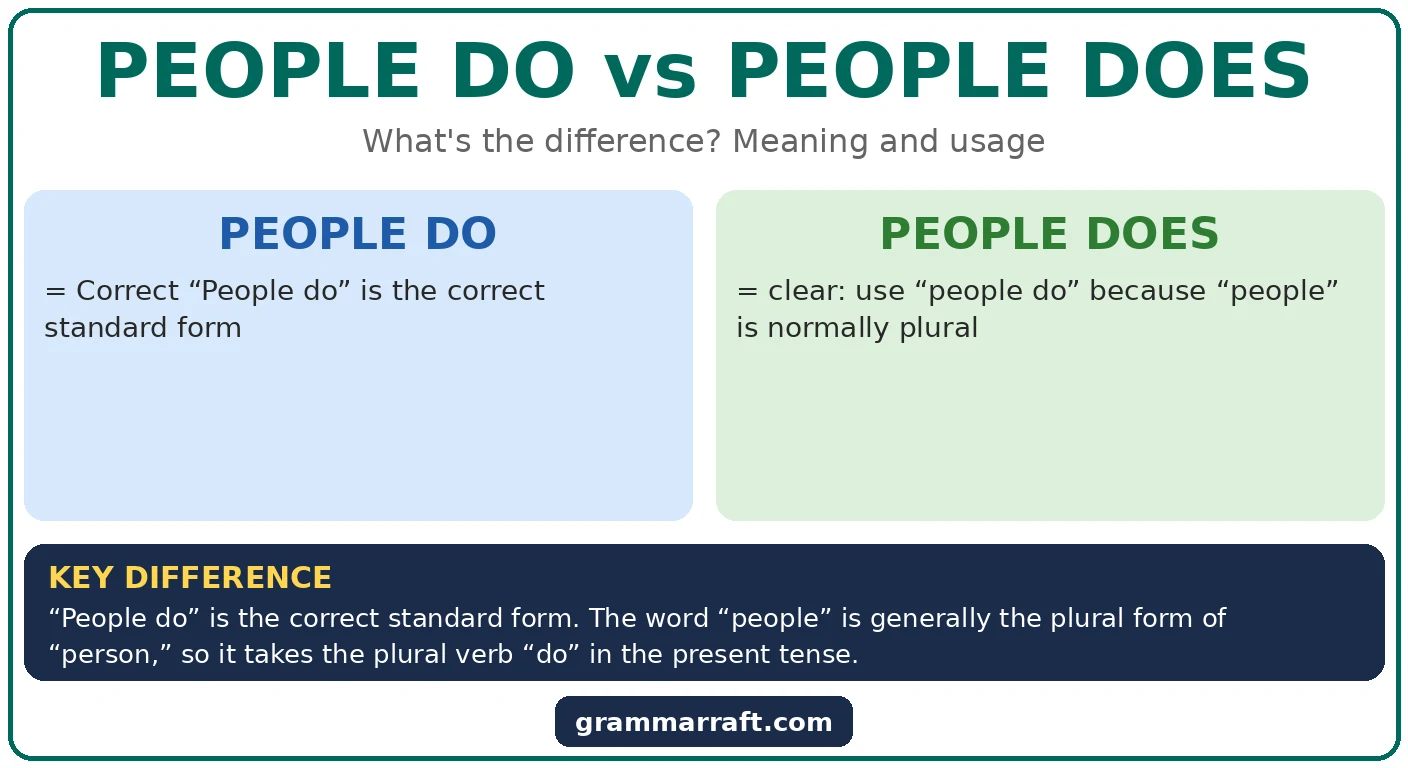
The choice between “people do” and “people does” is straightforward once you identify the subject. In standard English grammar, people do is correct because “people” is normally a plural noun, while “does” belongs with a singular subject such as “a person” or “he.”
This small verb choice matters in questions, negatives, formal writing, workplace messages, and everyday conversation. A sentence such as “Do people agree?” follows a different pattern from “Does a person agree?” even though both sentences discuss human beings.
Below, you’ll see why the plural rule works, how “do” functions as both a main verb and an auxiliary verb, and how to handle words such as “everyone,” “most people,” “a group,” and “each person.”
The Short Answer: People Do Is Correct
“People do” is the correct standard form. The word “people” is generally the plural form of “person,” so it takes the plural verb “do” in the present tense.
| Subject | Correct verb | Example |
|---|---|---|
| One person | does | One person does the work. |
| He or she | does | She does her best. |
| People | do | People do strange things. |
| They | do | They do what they can. |
The same distinction appears in questions. You write “Do people understand the rule?” rather than “Does people understand the rule?” The verb “do” carries the question structure, while the main verb remains in its base form: “Do people understand,” not “Do people understands.”
In negative sentences, the pattern is also consistent. “People do not agree” is correct, and its contracted form is “People don’t agree.” “People does not agree” incorrectly combines a plural subject with a singular verb.
There is one useful way to remember the basic choice: “does” goes with one, while “do” goes with more than one. Since “people” normally refers to more than one person, “people do” is the form you need.
Why People Takes a Plural Verb
English subject-verb agreement requires the verb to match the subject in number. A singular subject usually takes a singular present-tense verb, while a plural subject takes a plural form. “Person” is singular, and “people” is plural.
Compare these sentences:
- A person does what seems reasonable.
- People do what seems reasonable.
- This person does not understand the question.
- These people do not understand the question.
The spelling of “does” can make the rule feel less obvious because “does” is the third-person singular form of the verb “do.” The matching plural form is “do,” even though “do” may look less marked. English often signals number through the subject rather than through a visibly longer verb ending.
“People” is an irregular plural noun. It does not form its plural by adding “-s” to “person”; instead, “person” changes to “people.” That unusual form sometimes causes learners to hesitate, but its grammatical behavior is ordinary: it takes plural verbs and plural pronouns.
For example, “People are waiting” is correct, not “People is waiting.” Likewise, “People have different opinions” is correct, not “People has different opinions.” The related forms “are” and “have” reinforce the fact that “people” is plural.
Person, people, and persons

“Person” refers to one human being. “People” usually refers to two or more human beings, while “persons” is a formal plural that appears in legal, official, or highly formal contexts.
| Noun | Number | Matching example |
|---|---|---|
| person | Singular | That person does good work. |
| people | Plural | Those people do good work. |
| persons | Plural, formal | The persons involved do not agree. |
In normal conversation and general writing, “people” is the natural plural of “person.” You should not choose “does” merely because “people” describes humans. The relevant issue is number, not meaning.
How Do and Does Work as Auxiliary Verbs
The verbs “do” and “does” often appear as auxiliary verbs, also called helping verbs. They help form questions, negatives, and emphatic statements in the simple present tense.
With a plural subject, use “do”:
- Do people enjoy the service?
- People do not trust every advertisement.
- People do notice small changes.
With a singular subject, use “does”:
- Does a person enjoy the service?
- A person does not trust every advertisement.
- She does notice small changes.
When “do” or “does” is helping another verb, the main verb stays in its base form. This is a key point. “Does she work here?” is correct, but “Does she works here?” is not, because the third-person singular marking has already moved to “does.”
The same principle applies to plural subjects. “Do people know the answer?” is correct, and “Do people knows the answer?” is incorrect. After “do,” use “know,” not “knows.”
Do and does as main verbs
“Do” and “does” can also function as the main verb, meaning perform, complete, handle, or carry out. In “People do their homework,” “do” is the main verb rather than a helper.
When “do” is the main verb, the same agreement rule still applies. “A student does the assignment” is singular, while “Students do the assignment” is plural. In a question, the auxiliary “do” appears before the subject, and the main verb returns to its base form: “Do students do the assignment?”
That sentence contains “do” twice, but the two words have different jobs. The first “do” creates the question, and the second “do” means complete or perform the assignment.
Examples of People Do in Real Sentences
Seeing the phrase in different sentence types makes the pattern easier to apply. The subject “people” can appear at the beginning of a statement, after a quantifier, or inside a longer clause, but it remains plural in ordinary usage.
| Sentence type | Correct example | What “do” is doing |
|---|---|---|
| Statement | People do make mistakes. | Main verb with emphasis |
| Question | Do people make mistakes? | Auxiliary verb |
| Negative | People do not make the same choices. | Auxiliary verb |
| Past tense | People did make mistakes. | Past auxiliary or main verb |
| Present perfect | People have made mistakes. | No “do” needed |
In an ordinary statement, “people do” may simply mean that people perform an action: “People do useful work.” It can also add emphasis: “People do care about the result.” In that emphatic use, the speaker is stressing that the statement is true, perhaps in response to doubt.
Questions use “do” at the beginning: “Do people read the instructions?” The subject comes after the auxiliary, and the main verb remains unchanged.
Negative statements place “do not” or “don’t” before the main verb. “People don’t always notice the difference” is natural and correct. In formal writing, “do not” may be preferred; in conversation, “don’t” is common.
Common examples to copy
- People do learn from experience.
- People do not always agree.
- Do people understand the instructions?
- Why do people ask that question?
- Some people do prefer a simpler explanation.
- Most people do what they believe is right.
These examples also show that “people” can work with words such as “some,” “most,” and “many.” Those words do not make “people” singular. “Most people do” remains plural because the noun after the quantifier is still “people.”
People Do vs People Does in Questions and Negatives
Many mistakes occur in questions because English changes word order. A statement such as “People understand the issue” becomes “Do people understand the issue?” The auxiliary “do” moves before the subject, but “understand” stays in its base form.
The same structure works with question words:
- Why do people disagree?
- Where do people find the information?
- How often do people use this expression?
- What do people expect?
“Does” is correct when the subject is singular. “Why does a person disagree?” and “How often does she use this expression?” both follow the singular pattern. The choice depends on the subject that follows the question word, not on the fact that the question concerns human behavior.
Negatives follow a similar rule. With “people,” use “do not” or “don’t”: “People do not need permission.” With “a person,” use “does not” or “doesn’t”: “A person doesn’t need permission.”
A common error is to use “does” and then add an unnecessary singular ending to the main verb. The correct sentence is “Why does he work late?” not “Why does he works late?” With “people,” the equivalent is “Why do people work late?” not “Why do people works late?”
The role of did
In the past tense, “did” works with both singular and plural subjects. You write “Did the person call?” and “Did the people call?” The auxiliary does not change to match the subject in the way that “do” and “does” do.
After “did,” the main verb also stays in its base form. “Did people go home?” is correct, while “Did people went home?” is incorrect. The past tense is already shown by “did,” so “go” is required.
| Time | Singular subject | Plural subject |
|---|---|---|
| Present question | Does the person work? | Do the people work? |
| Past question | Did the person work? | Did the people work? |
| Present negative | The person does not work. | The people do not work. |
Tricky Subjects: Everyone, Most People, and a Group
The hardest examples are often not “people” itself but nearby words that change the subject. “Everyone” means every person, but grammatically it is singular. Therefore, you write “Everyone does their part,” not “Everyone do their part.”
“Every person” is also singular: “Every person does something different.” The meaning involves many individuals, but the grammatical subject is “every person,” which takes “does.” Modern English commonly uses singular “they” after “everyone,” so “Everyone does what they can” is both natural and grammatically accepted in many styles.
By contrast, “most people” is plural. The correct sentence is “Most people do their best.” The word “most” does not control the verb by itself; the noun following it does. “Most of the people do” is also plural because “people” remains the central noun.
“A group of people” usually takes a singular verb in standard American English because “group” is the head noun: “A group of people does not represent everyone.” In British English and some other varieties, collective nouns may sometimes take plural verbs when the members are being considered individually, but the choice depends on style and meaning.
| Subject phrase | Usual verb | Example |
|---|---|---|
| Everyone | does | Everyone does their share. |
| Every person | does | Every person does things differently. |
| Most people | do | Most people do not complain. |
| A group of people | does, usually | A group of people does the work. |
| Groups of people | do | Groups of people do the work. |
Why meaning can mislead you
Speakers sometimes choose a verb based on the idea they have in mind rather than the grammatical subject. “Everyone” feels plural because it includes many people, but English treats it as singular. “People” clearly refers to multiple individuals, so it takes the plural form.
The safest approach is to identify the exact subject before selecting the verb. Ignore extra phrases for a moment. In “A group of people near the entrance does the work,” the subject is “group,” not “people near the entrance.”
Common Mistakes and How to Correct Them
The most frequent error is writing “people does” in a present-tense statement or question. This often happens because “does” is associated with people in phrases such as “What does a person do?” That sentence is correct, but its subject is “a person,” not “people.”
| Incorrect | Correct | Reason |
|---|---|---|
| People does this often. | People do this often. | “People” is plural. |
| Does people agree? | Do people agree? | Plural questions use “do.” |
| People do agrees. | People do agree. | The main verb follows “do” in base form. |
| Why does people leave? | Why do people leave? | “People” requires “do.” |
| People is interested. | People are interested. | “People” is plural with “are.” |
Another mistake is adding “-s” to the main verb after “do.” English normally marks the third-person singular only once in a simple present question or negative. In “Does she work?” the “-s” idea appears in “does,” so “work” remains unchanged.
Some writers also confuse “people” with “person” when using a singular modifier. “One people” is not the ordinary expression for one human being; the correct word is “one person.” As a result, “One person does,” but “Two people do.”
Editing becomes easier if you check the subject and the first verb separately. Ask, “Is the subject one or more than one?” Then ask, “Is there already an auxiliary verb?” This two-step check catches most errors without requiring a complicated grammar analysis.
When People Does Might Appear
In standard modern English, “people does” is almost always incorrect when “people” is the subject. However, the two words can appear next to each other if “people” belongs to a different grammatical structure.
For example, “The people does not appear in the report” is still incorrect if “people” is the subject. But “What the people does affects the outcome” is also generally incorrect in standard English; the natural version is “What the people do affects the outcome.”
A phrase such as “the way people do things” shows the normal pattern. “People do” forms a clause inside a longer sentence, and “things” is the object of “do.” The main verb of the larger sentence might be singular or plural depending on its own subject: “The way people do things changes over time.”
There are also cases where “does” belongs to a singular noun before or after “people.” Consider “The person who helps people does important work.” Here, “does” agrees with “the person,” not “people.” The word “people” is the object of “helps,” while “the person” is the subject of “does.”
In quotations, dialect writing, historical texts, or deliberately nonstandard speech, you might encounter “people does.” That appearance does not make it the correct choice for formal standard English. Unless you are reproducing a particular voice or dialect, use “people do.”
People as a collective noun
“People” can sometimes refer to a nation, ethnic community, or distinct population rather than simply several individuals. Even in that sense, it is normally treated as plural in standard English: “The people do not accept the proposal.”
The meaning can change if a singular collective noun replaces it. “The population does not accept the proposal” uses “does” because “population” is singular. “The populations do not accept the proposal” uses “do” because the subject is plural.
This distinction matters in academic, political, and historical writing. Choose the verb that matches the noun actually serving as the subject, rather than the number of individuals implied by the noun’s meaning.
A Practical Method for Choosing Do or Does
You do not need to memorize every possible sentence. A reliable method is to identify the subject, determine whether it is singular or plural, and then check whether “do” is acting as a helper or a main verb.
- Find the subject. Look for the person, thing, or group performing the action.
- Count the subject grammatically. Decide whether it is one person or thing, or more than one.
- Choose the present-tense form. Use “does” for a singular subject and “do” for a plural subject.
- Keep the next verb in its base form. Write “does work,” not “does works.”
- Check for a collective noun. Words such as “group,” “team,” and “committee” may control agreement instead of “people.”
Apply the method to “Why do most people prefer examples?” The subject is “most people,” which is plural, so “do” is correct. The verb after it is “prefer,” not “prefers,” because the auxiliary has already formed the present-tense question.
Now consider “Why does every person prefer examples?” The subject is “every person,” which is grammatically singular, so “does” is required. The main verb remains “prefer,” not “prefers.”
For an editing shortcut, replace “people” with “they.” If “they do” sounds right, “people do” will usually be right too. Replace “a person” with “he,” “she,” or “it” only as a grammar test, and “does” will usually follow.
How to Practice the Difference
Practice works best when you compare pairs rather than memorize isolated sentences. Start with a singular noun, convert it to a plural noun, and watch the verb change.
| Singular version | Plural version |
|---|---|
| A person does the task. | People do the task. |
| Does the person understand? | Do the people understand? |
| The person does not agree. | The people do not agree. |
| That person does what they can. | Those people do what they can. |
Next, practice changing statements into questions. “People use public transport” becomes “Do people use public transport?” The main verb does not change. This exercise helps prevent the common error “Do people uses,” which contains two competing present-tense markers.
Then practice negative sentences. “People understand the rule” becomes “People do not understand the rule.” In informal English, it becomes “People don’t understand the rule.” Both versions are correct, although the full form can sound more formal or emphatic.
Read your sentences aloud. Native speakers often hear an agreement error before they can explain it, and listening can reveal that “people does” sounds unnatural in ordinary standard English. For formal writing, however, use the grammatical rule rather than relying on sound alone.
For a broader reference on matching subjects and verbs, consult this explanation of subject-verb agreement from Purdue Online Writing Lab. It places the people/do example within the larger system of English agreement.
FAQ: People Do vs People Does
Should I say “people do” or “people does”?
Use “people do” in standard English. “People” is normally plural, so it takes “do” in statements, questions, and negatives: “People do care,” “Do people care?” and “People do not care.”
Do we use do or does for people?
Use “do” for “people.” Use “does” for a singular subject such as “a person,” “he,” “she,” or “everyone.” Compare “Do people agree?” with “Does everyone agree?”
Is “some people does” ever correct?
No, not in standard English when “some people” is the subject. The correct form is “Some people do agree.” The word “some” does not make “people” singular; “people” remains a plural noun.
Why is it “does everyone” but “do people”?
“Everyone” refers to many individuals in meaning, but grammar treats it as a singular indefinite pronoun. Therefore, write “Does everyone understand?” By contrast, “people” is a plural noun, so write “Do people understand?”
Is “people are” also correct?
Yes. “People are” is correct because “people” is plural and pairs with the plural form “are.” For example, “People are waiting,” “People are different,” and “People are responsible for their choices” all follow standard subject-verb agreement.
Conclusion
The answer to people do vs people does is clear: use “people do” because “people” is normally plural. Use “does” with a singular subject such as “a person,” “everyone,” or “the group,” and remember that a verb following “do” or “does” stays in its base form.
When you hesitate, identify the exact subject before choosing the verb. With that habit, sentences such as “Do people agree?” and “People do understand” become automatic, and your English becomes more accurate in both conversation and formal writing.
Related Articles
- Bring vs Take: Meaning, Rules, and Examples
- Layed or Laid: Meaning, Spelling, and Correct Usage
- Addition vs Edition: Meaning, Examples & Usage
Explore more helpful guides on GrammarRaft.