Do You vs Are You: Meaning, Grammar, and Usage?
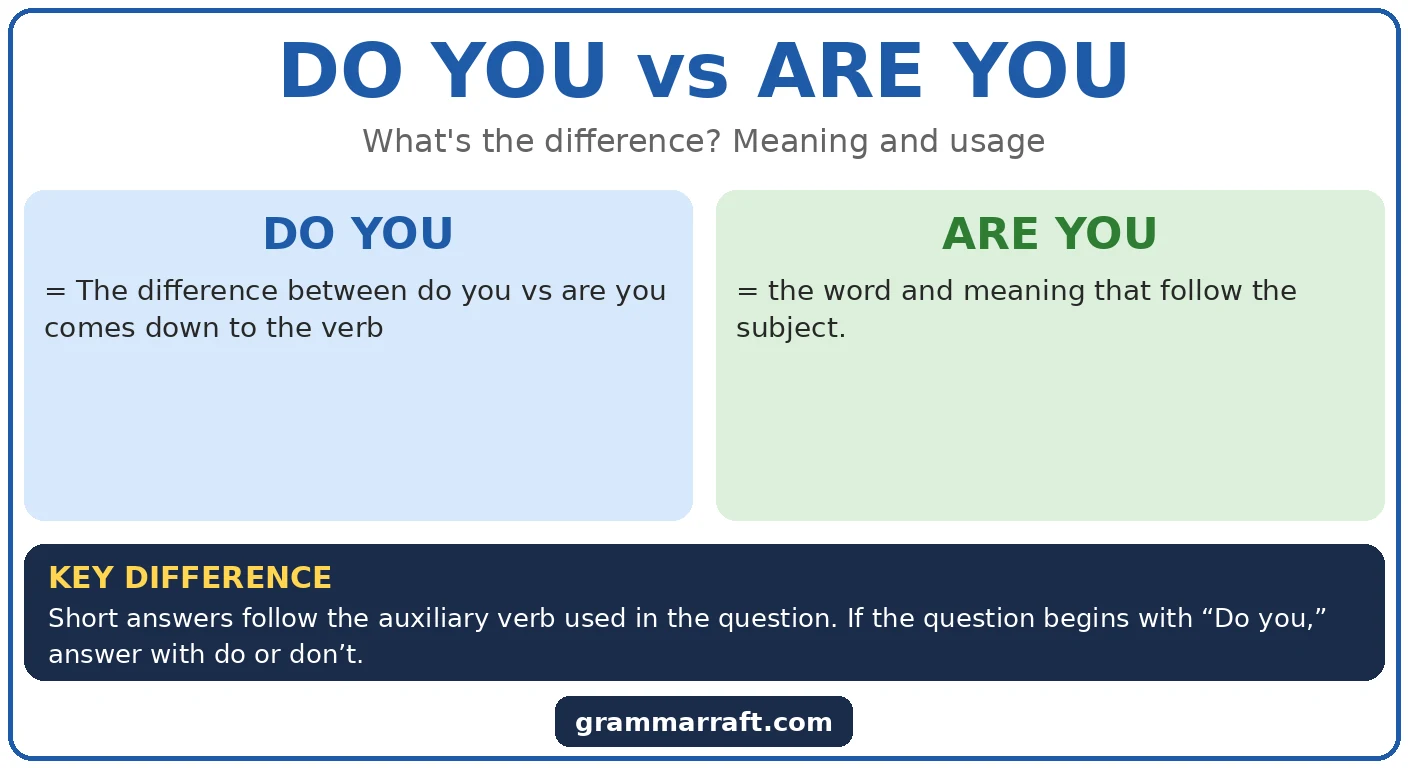
The difference between do you vs are you comes down to the verb that follows and the kind of question you’re asking. “Do you” usually asks about an action, habit, opinion, or possession, while “are you” uses the verb be to ask about a state, identity, location, or activity happening now.
Both forms are correct, but they cannot usually replace each other. “Do you work here?” asks about someone’s job or regular situation; “Are you working here?” asks about their current activity or temporary arrangement.
Once you can identify the main verb and the time or meaning behind the question, the choice becomes much easier. The examples below show the difference, explain common errors, and give you practical patterns for forming natural English questions.
The Core Difference Between “Do You” and “Are You”
The simplest distinction is grammatical. “Do you” uses the auxiliary verb do to form a question with an ordinary main verb, while “are you” uses a form of the verb be as the main verb or as an auxiliary verb.
Compare these two questions:
- Do you play tennis? This asks whether tennis is an activity you do, perhaps regularly or generally.
- Are you playing tennis? This asks whether you are engaged in that activity now or around the present time.
The first question uses the base form play after do. The second uses the present participle playing after are, creating the present continuous tense.
“Are you” can also come before an adjective, noun, or place phrase. For example, “Are you happy?” asks about a state, “Are you a teacher?” asks about identity or occupation, and “Are you at home?” asks about location.
| Question form | What it usually asks about | Example |
|---|---|---|
| Do you + base verb | Actions, habits, preferences, or facts | Do you like coffee? |
| Are you + adjective | A state or condition | Are you tired? |
| Are you + noun | Identity, role, or category | Are you the manager? |
| Are you + place phrase | Location | Are you in London? |
| Are you + verb-ing | An action in progress | Are you reading? |
A useful shortcut is to look at the word immediately after you. If it is a base verb such as know, like, work, or drive, “do you” may be correct. If it is an adjective, noun, place phrase, or -ing verb, “are you” may be the right choice.
How “Do You” Forms Questions
In the present simple tense, English normally needs an auxiliary verb to form a question. With most verbs, that auxiliary is do or does. Because the subject is you, the correct form is do you, not does you.
The basic structure is:
Do + you + base verb + the rest of the sentence?
That produces questions such as “Do you know the answer?”, “Do you live nearby?”, and “Do you understand the instructions?” The main verb stays in its base form, so “Do you knows?” and “Do you understands?” are incorrect.
The auxiliary do carries the question structure, while the main verb carries the meaning. In “Do you like music?”, do signals a question and like expresses the preference being discussed.
Habits and repeated actions

“Do you” is common for habits and routines. “Do you walk to work?” asks about a regular method of travel, not necessarily what the person is doing at this exact moment.
The same pattern works with broader routines: “Do you cook at home?”, “Do you exercise?”, and “Do you check your email in the morning?” The answer may describe a repeated action, even if it is not happening during the conversation.
Opinions, preferences, and knowledge
Many mental and preference verbs follow “do you.” Examples include like, want, need, know, believe, and remember.
Ask “Do you like this song?” for an opinion or preference. Ask “Do you know Maria?” for knowledge or familiarity. These questions are not normally formed with “are you” because like and know are the main verbs, not adjectives or present participles.
Some verbs can describe a current situation but still use the simple form. “Do you need help?” is generally more natural than “Are you needing help?” Standard English usually treats need as a stative verb, meaning that it describes a condition rather than a visible action in progress.
How “Are You” Forms Questions
“Are” is the second-person present form of be. It can work as the main verb in a sentence, as in “You are ready,” or as an auxiliary verb, as in “You are waiting.” Turning either statement into a question places are before you.
The structure changes depending on what follows:
- Are + you + adjective? Are you ready?
- Are + you + noun? Are you a student?
- Are + you + place phrase? Are you at work?
- Are + you + verb-ing? Are you studying?
Unlike “do you,” “are you” does not normally take the base form of an ordinary verb directly. “Are you like jazz?” is incorrect if the intended meaning is “Do you like jazz?” The verb are needs an adjective, noun, location, or participle in these patterns.
States and conditions
Adjectives after “are you” describe states or conditions. “Are you happy?”, “Are you cold?”, and “Are you certain?” all ask about how someone is at a particular moment or in a particular situation.
These questions can refer to temporary conditions or relatively lasting characteristics. “Are you tired?” usually concerns the present, while “Are you patient?” may ask about a general quality.
Identity and roles
A noun after “are you” identifies a person’s role, category, or relationship. “Are you the new director?” asks whether the listener has a particular identity or position.
Use “Are you a doctor?” to ask about a profession. Use “Do you work as a doctor?” to ask about the person’s work activity or employment. The two questions can receive the same answer, but their grammar and emphasis differ.
Location
Place phrases also follow be. Questions such as “Are you at home?”, “Are you in the office?”, and “Are you from Canada?” use “are you” because they describe location or origin.
By contrast, “Do you live in Canada?” asks about residence as an action or life circumstance. “Are you in Canada?” may simply ask where the person is now. Context determines which meaning matters.
“Do You” Versus “Are You” in Different Tenses
The choice is not only about vocabulary. It also reflects tense and aspect, especially the difference between the present simple and the present continuous.
The present simple often describes habits, repeated actions, general facts, and stable situations. The present continuous describes an activity happening now or a temporary arrangement. That is why “Do you work here?” and “Are you working here?” can both be grammatical but communicate different ideas.
| Meaning | Present simple question | Present continuous question |
|---|---|---|
| Regular employment | Do you work here? | — |
| Temporary activity | — | Are you working here this week? |
| General travel habit | Do you travel often? | — |
| Current travel activity | — | Are you traveling now? |
| General reading habit | Do you read novels? | — |
| Activity happening now | — | Are you reading a novel? |
“Do you watch television?” asks about a habit or general interest. “Are you watching television?” asks what is happening now, perhaps because the speaker wants to interrupt or join the activity.
There are also cases where the two forms differ in meaning rather than simply time. “Do you see the sign?” can ask whether someone can perceive or understand it. “Are you seeing someone?” may refer to dating or meeting a person, depending on context.
Why “are” does not always mean “now”
It is tempting to assume that every “are you” question refers only to the present moment. That is not always true. “Are you responsible for this project?” may describe an ongoing role, while “Are you available next week?” concerns a future condition.
The word after are you matters. “Are you studying?” uses the present continuous, but “Are you a student?” uses be as the main verb and may describe a longer-term identity.
Common Pairs That Change Meaning
Small grammatical changes can shift the focus of a question. The following pairs are especially useful because learners often hear both forms in everyday conversation.
“Do you work here?” and “Are you working here?”
“Do you work here?” usually asks whether the person is employed at that place. It may be a natural question from a customer who wants assistance.
“Are you working here?” focuses on a current or temporary arrangement. It could ask whether someone is assigned to that location today, helping with an event, or doing work there for a limited period.
“Do you live here?” and “Are you living here?”
“Do you live here?” asks about someone’s usual home. It sounds natural when asking whether a person is a resident of a house, neighborhood, or country.
“Are you living here?” often suggests a temporary arrangement. The speaker may be asking whether someone is staying in the place for now, perhaps because their permanent home is elsewhere.
“Do you have a car?” and “Are you having a car?”
“Do you have a car?” is correct for possession. The verb have expresses ownership or availability in this sentence.
“Are you having a car?” is generally incorrect for that meaning in standard English. However, have can appear in the continuous form when it describes an event or experience, as in “Are you having lunch?” or “Are you having trouble?”
“Do you feel sick?” and “Are you feeling sick?”
Both questions can be correct. “Do you feel sick?” asks about the person’s physical condition, while “Are you feeling sick?” places more emphasis on the current experience.
In ordinary conversation, the continuous form can sound especially natural when a symptom has just appeared. The simple form may sound more general or direct.
How to Choose the Correct Form
When you are unsure, do not translate the whole question word for word from another language. Identify the English verb and ask what role it is playing.
Use this quick decision process
- Find the main meaning of the question.
- Check whether the next word is an adjective, noun, location, or verb.
- Use “are you” for a state, identity, place, or action in progress.
- Use “do you” with a base verb for habits, preferences, knowledge, and ordinary actions.
- Check whether the question is general or focused on the current moment.
For example, suppose you want to ask about someone’s knowledge. The main verb is know, so the natural question is “Do you know the answer?” If you want to ask about their condition, the key word is the adjective ready, producing “Are you ready?”
Look at the structure rather than the subject alone. Both “Do you” and “Are you” contain the subject you, but the auxiliary verb determines what can follow it.
For a more formal reference on question formation and auxiliary verbs, consult this Cambridge Dictionary explanation of questions with “do”. It is particularly useful for comparing ordinary verbs with forms of be.
A practical substitution test
Try turning the question into a statement. “Do you like tea?” becomes “You like tea.” “Are you tired?” becomes “You are tired.” The statement often reveals which verb belongs in the question.
Another test is to identify whether the sentence already contains a form of be. If the statement is “You are reading,” the question is “Are you reading?” You do not add do because are is already functioning as the auxiliary verb.
Common Mistakes and How to Correct Them
Many errors arise from using two question patterns at the same time. English normally needs one appropriate auxiliary structure, not a combination of several forms.
Using “are” with a base verb
Incorrect: “Are you like pizza?”
Correct: “Do you like pizza?”
Here, like is the main verb in the simple present. It does not follow are. If you use are, the following word must fit a different pattern, such as “Are you hungry?”
Using “do” with an adjective
Incorrect: “Do you happy?”
Correct: “Are you happy?”
Happy is an adjective, so it needs a form of be. The same applies to “Are you busy?”, “Are you nervous?”, and “Are you certain?”
Adding “do” after “are”
Incorrect: “Are you do your homework?”
Correct: “Do you do your homework?” or “Are you doing your homework?”
The first correct version asks about a habit or responsibility. The second asks whether the action is happening now. The repeated word do in “Do you do your homework?” may sound unusual, but it is grammatically correct because the first do is auxiliary and the second is the main verb.
Forgetting the “-ing” form
Incorrect: “Are you study English?”
Correct: “Are you studying English?”
When are forms the present continuous, the main verb needs its present participle form. Depending on the verb, that may involve spelling changes, as in “Are you making dinner?” or “Are you running late?”
Confusing “Do you” with “Did you”
“Do you” refers to the present simple, while “did you” forms a past simple question. Ask “Do you visit your parents often?” about a current habit, but ask “Did you visit your parents last weekend?” about a completed past event.
The same distinction applies to be: “Are you at home?” is present, while “Were you at home?” refers to the past. Selecting the correct auxiliary also communicates time.
Short Answers and Natural Conversation
Short answers follow the auxiliary verb used in the question. If the question begins with “Do you,” answer with do or don’t. If it begins with “Are you,” answer with am, are, or aren’t, depending on the subject and meaning.
| Question | Positive short answer | Negative short answer |
|---|---|---|
| Do you like tea? | Yes, I do. | No, I don’t. |
| Do you understand? | Yes, I do. | No, I don’t. |
| Are you ready? | Yes, I am. | No, I’m not. |
| Are you working? | Yes, I am. | No, I’m not. |
| Are they here? | Yes, they are. | No, they aren’t. |
Do not answer “Do you like it?” with “Yes, I am.” The auxiliary in the answer should match the auxiliary in the question. Similarly, “Are you busy?” takes “Yes, I am,” not “Yes, I do.”
In casual conversation, people often give longer answers instead of short grammatical forms. “Yes, I do—I listen to it every morning” and “No, I’m not; I’m waiting for a friend” both sound natural.
“So do I” and “So am I”
The same auxiliary rule applies when agreeing with another person. Say “I like jazz,” and the agreement is “So do I.” Say “I’m tired,” and the agreement is “So am I.”
“So do you” agrees with a statement containing an ordinary present simple verb: “You play tennis, and so do I.” “So are you” agrees with a statement containing be or the present continuous: “You are ready, and so are you” would only make sense in a specific contrast, while “You are ready, and so am I” is the usual agreement.
Negative agreement works similarly: “I don’t like seafood, and neither do I” is grammatically patterned, while “I’m not tired, and neither am I” uses am.
Questions in Formal and Informal English
The grammar of “do you” and “are you” stays the same in formal and informal settings, but the surrounding words may change. A direct question such as “Do you need help?” is acceptable in most situations.
In a formal workplace, you might choose “Are you available to discuss the report?” rather than “Can you talk about the report?” The difference is not that one auxiliary is more formal; the choice reflects the meaning of the verb and adjective.
Politeness can also be adjusted with indirect questions. “Could you tell me whether you are available?” sounds less direct than “Are you available?” In an indirect question, the word order changes after whether or if: “I’d like to know if you are ready,” not “if are you ready.”
Questions with “who,” “what,” and “where”
Question words can appear before both structures. “What do you do?” commonly asks about someone’s occupation, while “What are you doing?” asks about their current activity.
“Where do you live?” asks about someone’s usual residence. “Where are you living?” may suggest a temporary home or arrangement. “Why are you laughing?” asks about an action happening now, while “Why do you laugh at that?” asks about a general reaction or habit.
These contrasts show why translation alone is unreliable. The English form encodes both the type of verb and the speaker’s intended time frame.
Practice Exercises for Mastering the Difference
Practice works best when you compare similar sentences rather than memorize isolated rules. Begin with a sentence containing an ordinary verb, then decide whether it describes a repeated action, a current action, a state, an identity, or a location.
Choose “do you” or “are you”
- _____ you know the answer?
- _____ you tired after the journey?
- _____ you studying for the exam?
- _____ you usually take the bus?
- _____ you a member of this club?
- _____ you interested in modern art?
The answers are: Do you know the answer? Are you tired? Are you studying? Do you usually take the bus? Are you a member? And Are you interested?
Notice that interested looks like a past participle, but it functions as an adjective in “Are you interested?” It describes a state or reaction, so be is appropriate.
Change statements into questions
“You speak Spanish” becomes “Do you speak Spanish?” The ordinary verb speak requires the auxiliary do in the present simple.
“You are learning Spanish” becomes “Are you learning Spanish?” The statement already contains are, and learning is the present participle. Move are before the subject.
“You are confident” becomes “Are you confident?” Here, confident is an adjective. There is no ordinary action verb that would require do.
Say the question aloud
Reading examples aloud helps you notice rhythm and word order. Native speakers typically stress the main information rather than the auxiliary, but the auxiliary still signals the sentence pattern.
Try contrasting “Do you drive?” with “Are you driving?” The first may invite an answer about ability or habit, while the second normally asks about the activity at this moment. That difference becomes clearer when you imagine a real situation for each question.
FAQ: Do You vs Are You
What is the main difference between “do you” and “are you”?
“Do you” usually introduces a question with an ordinary base verb, such as “Do you work?” or “Do you like music?” “Are you” introduces a question about a state, identity, location, or activity in progress, such as “Are you busy?”, “Are you a musician?”, or “Are you working?”
Is “Are you like it?” ever correct?
Not when you mean “Do you like it?” In that sentence, like is the ordinary main verb, so the correct question is “Do you like it?” “Are you like it?” would only make sense in an unusual structure where like means “similar to,” and even then the sentence would normally need more information, such as “Are you like your sister?”
Should I say “Do you understand?” or “Are you understanding?”
“Do you understand?” is the standard and most natural question for checking comprehension. “Are you understanding?” is possible in limited contexts, but it sounds less usual and may suggest an ongoing process or a particular teaching situation.
Which is correct: “Do you have” or “Are you having”?
Use “Do you have” for possession, relationships, or relatively stable conditions: “Do you have a passport?” or “Do you have any questions?” Use “Are you having” for an event or experience in progress, as in “Are you having dinner?” or “Are you having trouble?”
How can I remember which auxiliary to use?
Use “do you” before a base verb when asking about an action, habit, preference, or knowledge. Use “are you” before an adjective, noun, place phrase, or -ing verb when asking about a state, identity, location, or current activity.
Conclusion
The key to do you vs are you is the word and meaning that follow the subject. “Do you” works with ordinary verbs in the present simple, while “are you” describes a state, identity, location, or action in progress. Context then decides whether the question sounds general, habitual, temporary, or immediate.
When you write or speak, turn the question into a statement first, check the main verb, and match the short answer to the auxiliary. With that habit, choices such as “Do you work here?” and “Are you working here?” become clear rather than confusing.
Related Articles
- Pail vs Pale: Understanding the Difference Between Two Confusing English Words
- Extol vs Extoll: Understanding the Difference and Correct Spelling
- Most Important vs Most Importantly: Master This Common Grammar Difference
Explore more helpful guides on GrammarRaft.