Savanna vs. Savannah: Understanding the Difference in Meaning and Usage
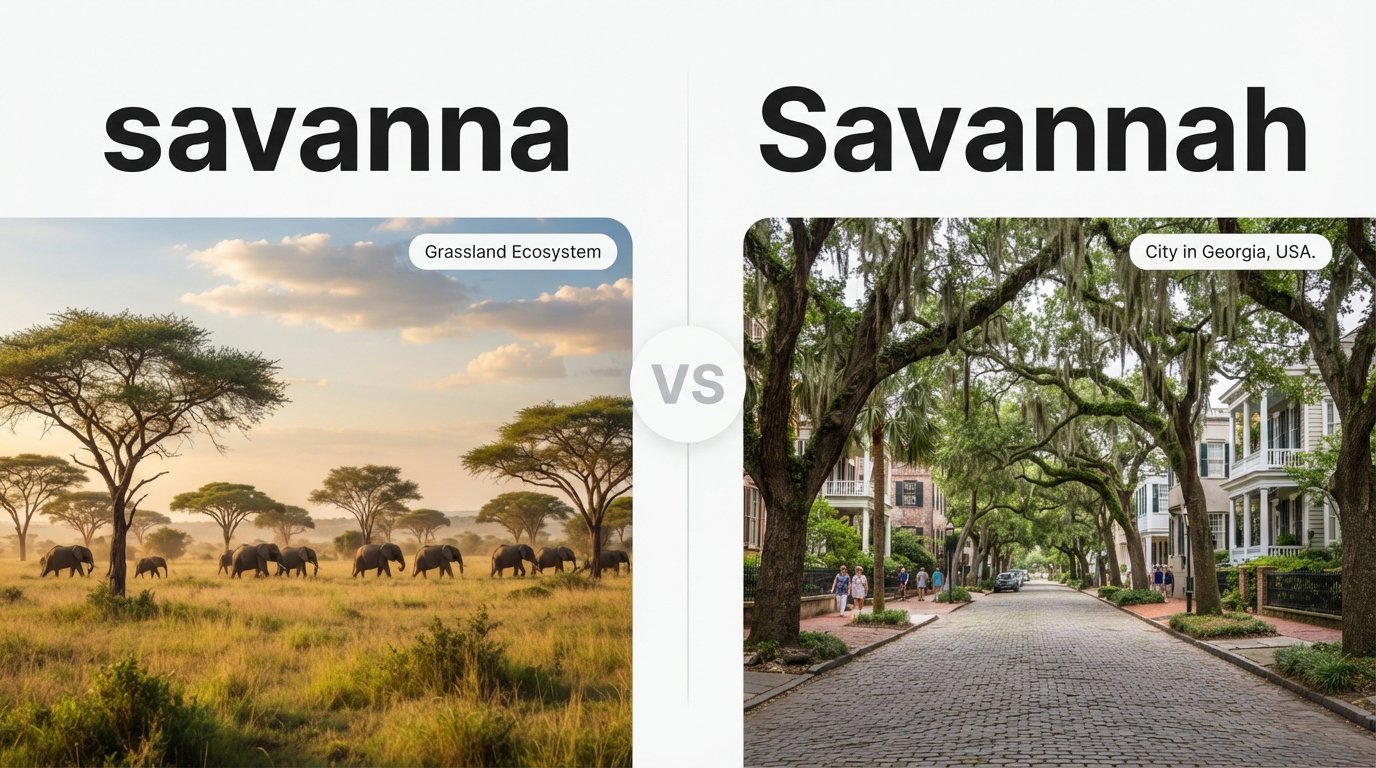
If you’ve ever paused over Savanna vs. Savannah, you’re not alone. These two words look almost the same and are pronounced nearly identically, but they refer to very different things.
Savanna usually describes a tropical or subtropical grassland ecosystem, while Savannah is most commonly used as the name of a historic city in Georgia, United States.
That small extra h and the capital letter make a major difference. Understanding the distinction can help you avoid spelling mistakes, improve your English writing, and choose the right word based on context.
Savanna vs. Savannah: Why Does the Confusion Exist?
The confusion between these words comes mainly from their similar spelling and pronunciation. When spoken aloud, savanna and Savannah sound almost exactly the same.
The visual difference is also easy to overlook. One word has one n followed by an a, while the other has an additional h at the end.
There is also a capitalization difference. Savanna is generally a common noun when it refers to an ecosystem, so it appears in lowercase. Savannah, when referring to the Georgia city, is a proper noun and therefore begins with a capital letter.
Why It Matters in Professional Settings
Correct word choice matters in academic writing, journalism, travel content, geography, biology, and professional communication.
Writing “Savannah ecosystem” when you mean a grassland could make a scientific statement confusing. Similarly, writing “I visited savanna” instead of “I visited Savannah” makes a city name look like a geographical description.
Context should always guide your choice.
Read Also: So Long As vs. As Long As: Understanding the Real Difference
Savanna vs. Savannah: Which One Is Correct?
Both spellings are correct, but they are correct in different contexts.
Use savanna when you’re talking about a grassland ecosystem. A savanna typically contains grasses, scattered trees, seasonal rainfall, and diverse wildlife.
For example:
The African savanna provides food and shelter for millions of animals.
Use Savannah when referring to the city in Georgia.
Savannah is famous for its historic architecture and oak-lined streets.
Therefore, neither spelling is universally “more correct.” The correct choice depends on what you’re describing.
If you’re writing about ecology, wildlife, climate, or geography, savanna is normally the appropriate word. If you’re discussing a city, travel destination, or location in Georgia, Savannah is the correct form.
What Does “Savanna” Mean? Origins, Definition, and Usage
A savanna is a grassland ecosystem found mainly in tropical and subtropical regions. It usually has extensive grass cover with scattered trees rather than dense forest.
Savannas develop where rainfall is enough to support grasses and some trees but not enough to create a closed forest canopy.
Definition of Savanna
In simple terms, a savanna is a landscape dominated by grasses with widely spaced trees.
Typical characteristics include:
- Seasonal rainfall
- Long dry periods
- Open grassland
- Scattered trees
- Drought-resistant vegetation
- Grazing animals and predators
- Periodic natural fires
The ecosystem sits between extremely dry deserts and dense tropical forests.
Because of these conditions, savannas support remarkable biodiversity. Elephants, giraffes, lions, zebras, and wildebeest are among the animals commonly associated with African savanna environments.
Origins of the Word “Savanna”
The word savanna has a long linguistic history. It entered English through Spanish sabana, a term associated with open or treeless plains.
The Spanish word was connected to Indigenous Caribbean languages and was later adopted into English.
Over time, English standardized the spelling as “savanna.” The ecological term therefore developed independently from the name of Savannah, Georgia.
Why Savanna Is a Common Misspelling
One reason people make mistakes is that Savannah is also a familiar personal name and place name.
The extra h can become especially confusing when someone hears the word instead of seeing it written.
Another problem occurs when autocorrect or spell-check software recognizes “Savannah” as a proper noun and suggests it automatically.
That is why writers should consider the meaning before accepting an automatic spelling suggestion.
Exploring the Significance of “Savanna” in the Natural World
A savanna isn’t simply an empty field covered with grass. It is a complex ecosystem shaped by rainfall, temperature, fire, plants, animals, and human activity.
These ecosystems are important for global biodiversity, carbon storage, food chains, and local communities.
African savannas are perhaps the best-known examples. The Serengeti and Maasai Mara support enormous populations of grazing animals and predators.
The Brazilian Cerrado is another major savanna region. It contains exceptional plant diversity but has faced significant pressure from agricultural expansion.
Northern Australia also contains extensive tropical savannas dominated by grasses and eucalyptus trees.
Role of a “Savanna” in a Professional Kitchen
The term savanna does not have a standard culinary meaning or a specific role in a professional kitchen.
If you encounter the word in a food-related article, it may describe ingredients, products, restaurants, or dishes named after a region or place.
For example, a menu might use “Savannah” as part of a restaurant or product name. In that situation, capitalization depends on the specific proper name rather than the grassland ecosystem.
This distinction is important because not every appearance of “Savanna” relates to ecology.
Common Reasons for the “Savanna” Misspelling
Several factors make savanna and Savannah easy to mix up.
First, their pronunciation is almost identical. Speaking doesn’t give you much help.
Second, the spelling difference is only one letter. A writer can easily add or remove the final “h” without noticing.
Third, Savannah is a well-known city and personal name, which makes the spelling familiar.
Finally, capitalization creates another layer of confusion. Writers may capitalize “Savanna” simply because they think it refers to a specific geographical region.
The easiest solution is to ask yourself one question: Am I describing an ecosystem or naming a place?
If you’re describing an ecosystem, choose savanna. If you’re naming the Georgia city, choose Savannah.
See Also: What Does HMPT Mean in Text? Meaning, Uses, and Examples
Side-by-Side Comparison: “Savanna” vs. “Savannah”
| Feature | Savanna | Savannah |
|---|---|---|
| Meaning | Grassland ecosystem | City name |
| Word type | Common noun | Proper noun |
| Capitalization | Lowercase | Capitalized |
| Main context | Ecology and geography | Travel and geography |
| Location | Tropical and subtropical regions worldwide | Georgia, United States |
| Pronunciation | suh-VAN-uh | suh-VAN-uh |
| Spelling | One final “h” absent | Ends with “h” |
| Example | The savanna supports elephants. | Savannah attracts tourists. |
The easiest memory trick is simple:
Lowercase “savanna” = grassland.
Capitalized “Savannah” = city.
Everyday Examples of “Savanna” in Language
Seeing the words in realistic sentences makes the distinction easier to remember.
Here are some examples:
Savanna:
Lions use tall grass on the savanna to hide while hunting.
Seasonal rainfall strongly influences savanna vegetation.
Elephants can significantly change the structure of a savanna ecosystem.
Savannah:
We spent three days exploring Savannah, Georgia.
Savannah is known for its historic squares and Southern architecture.
Tourists often visit Savannah for its preserved historic district.
Notice how the surrounding words reveal the intended meaning.
Terms such as “lions,” “grass,” “vegetation,” and “ecosystem” point toward savanna. Words such as “Georgia,” “city,” “tourists,” and “historic district” point toward Savannah.
“How to Spell Savanna vs. Savannah”: Remember the Correct Spelling
If you’re wondering how to spell Savanna vs. Savannah, focus on the final letter.
Savanna → S-A-V-A-N-N-A
Savannah → S-A-V-A-N-N-A-H
The ecological word ends with a, while the city name ends with h.
A useful memory technique is to associate the extra “h” with the proper name Savannah.
When you’re discussing wildlife habitats, climate science, or grasslands, use lowercase savanna.
When you’re discussing the city in Georgia, use capitalized Savannah.
Practice Sentences
Try completing these sentences mentally:
The African ___ is home to lions and elephants.
We booked a hotel in ___, Georgia.
The ___ ecosystem depends on seasonal rainfall.
___ has many historic buildings and public squares.
The answers are savanna, Savannah, savanna, and Savannah.
Practicing the distinction in context makes the spelling easier to remember than memorizing the words alone.
Literature and Media Mentions: Correct Usage of “Savanna”
The word savanna frequently appears in wildlife documentaries, geography textbooks, environmental reports, nature writing, and scientific literature.
It is often associated with African wildlife because images of elephants, lions, giraffes, and zebras have made the African savanna a familiar cultural image.
Meanwhile, Savannah appears frequently in travel guides, American history, tourism publications, maps, news reports, and discussions about Georgia.
The difference becomes especially important in digital publishing. A travel article about Savannah and a wildlife article about a savanna may contain nearly identical-looking words but discuss completely unrelated subjects.
Understanding context allows readers to interpret the intended meaning immediately.
Frequently Asked Questions About Savanna vs. Savannah
What’s the correct way to spell “Savanna”?
Savanna is correct for a grassland ecosystem, while Savannah is correct for the Georgia city or another established proper name.
Is “Savanna” a French word?
No. Savanna entered English through Spanish sabana, which has roots connected to Indigenous Caribbean language usage.
Why is spelling “Savanna” correctly important?
Correct spelling prevents confusion between a grassland ecosystem and Savannah, Georgia, especially in academic, professional, geographical, and travel writing.
Are Savanna and Savannah pronounced differently?
Usually, no. Both are commonly pronounced approximately “suh-VAN-uh,” which is why their spelling often causes confusion.
Can Savanna and Savannah be used interchangeably?
No. They have different meanings. Savanna describes an ecosystem, whereas Savannah commonly identifies the city in Georgia.
Conclusion: Why It’s Important to Spell “Savanna” Correctly
The difference between Savanna vs. Savannah becomes easy once you connect each spelling with its meaning. Savanna refers to a tropical or subtropical grassland ecosystem, while Savannah is most commonly the proper name of a historic city in Georgia. Although both words sound nearly identical, their spelling, capitalization, and context separate them. Remember the simple rule: lowercase savanna means grassland, while capitalized Savannah means the city. Learning this distinction can improve your grammar, geography writing, academic work, and everyday communication. When in doubt, look at the surrounding context before choosing the spelling.