So Long As vs. As Long As: Understanding the Real Difference
Many English learners wonder about So Long As vs. As Long As because the two phrases look almost identical. In many sentences, they can even express the same idea. However, they do not always work in exactly the same way.
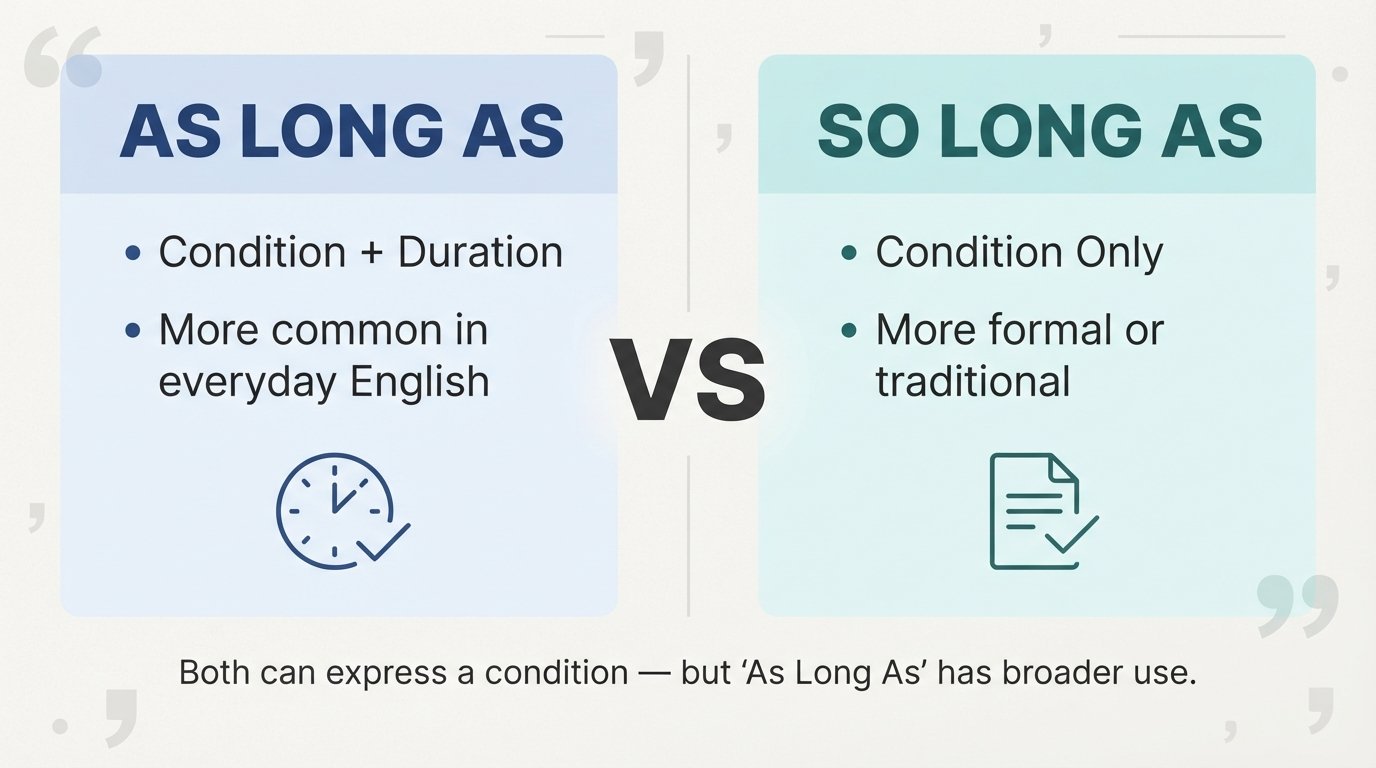
The main difference involves meaning, tone, and flexibility. As long as commonly expresses both a condition and a period of time. On the other hand, so long as usually expresses a condition and often sounds more formal or traditional.
This small difference can affect your writing. Therefore, understanding the correct usage helps you communicate more clearly in everyday English, academic writing, and professional communication.
In this guide, you will learn the difference between So Long As and As Long As, understand their grammar, explore real examples, and discover how to spell “So Long As vs. As Long As” correctly.
So Long As vs. As Long As: Why Does the Confusion Exist?
The confusion exists because both phrases share the words long and as, and both can introduce a condition.
For example:
You can borrow my car as long as you return it tonight.
You can borrow my car so long as you return it tonight.
Both sentences are grammatically correct. Both express a condition.
However, the phrases create a slightly different tone. As long as sounds more natural in everyday English. Meanwhile, so long as can sound more formal, literary, or slightly old-fashioned.
Another reason for confusion is that as long as has more than one meaning. It can refer to a condition, but it can also refer to duration.
For example:
I will wait as long as it takes.
Here, the phrase refers to time. You cannot normally replace it with so long as.
Understanding this distinction makes the difference between So Long As and As Long As much easier to recognize.
Why It Matters in Professional Settings
In professional communication, small language choices can influence how your message sounds.
For example, an employee handbook might say:
Employees may work remotely so long as they meet company requirements.
The phrase sounds formal and structured. However, the following sentence feels more natural in a normal workplace email:
You can work remotely as long as you complete your tasks.
Both phrases are correct, yet their formal English and everyday English associations differ.
Therefore, understanding tone helps you choose the right phrase for professional communication, academic writing, legal English, or casual speech.
See Also: What Does HMPT Mean in Text? Meaning, Uses, and Examples
So Long As vs. As Long As: Which One Is Correct?
The simple answer is that both phrases are correct.
The best choice depends on what you want to say.
Use as long as when you mean:
- on the condition that
- during the time that
- for however much time is necessary
Use so long as mainly when you mean:
- on the condition that
This makes as long as more flexible.
For example:
I will support you as long as you need me.
This sentence can suggest duration depending on context.
Now consider:
You may enter so long as you have a ticket.
Here, the meaning is clearly conditional.
So, when choosing So Long As or As Long As, think about whether you are describing a condition or duration.
What Does “So Long As vs. As Long As” Mean? Definitions and Usage
Both expressions function as important parts of English grammar. They often connect ideas and explain the relationship between two parts of a sentence.
Definition of So Long As and As Long As
As long as has two main uses.
First, it can express a condition similar to if or on the condition that.
Example:
You can join us as long as you arrive on time.
Second, it can express duration meaning.
Example:
Stay here as long as you want.
In contrast, so long as usually expresses a condition.
Example:
You may continue so long as you follow the rules.
Both phrases can work as a conditional phrase and often function as a subordinating conjunction.
They introduce a dependent clause that connects with a main clause or independent clause.
Origins of the Phrases “So Long As” and “As Long As”
Both expressions have existed in English for a long time.
The phrase as long as developed broad usage because English speakers used it to describe both length of time and conditions. Over time, it became especially common in modern English.
So long as also developed as a way to introduce a condition. However, modern speakers generally use it less often in casual conversation.
Today, you may still find it in:
- formal writing
- legal English
- contracts
- academic contexts
- traditional or literary language
Language naturally changes over time. As a result, as long as became the more common choice for modern usage.
Why “So Long As” Is Not the Same as “So Long”
Another source of confusion comes from the phrase so long.
On its own, so long can mean goodbye.
For example:
So long! See you next week.
However, so long as is completely different. It forms a conditional expression.
Example:
So long as you stay focused, you will improve.
Therefore, context matters. The same words can create different meanings when combined in different ways.
Common Reasons for Confusion About So Long As vs. As Long As
English learners often confuse these phrases because they are close in spelling and meaning.
The first reason is their semantic overlap. Both can introduce a condition.
The second reason involves contextual meaning. Readers must examine the full sentence to understand whether as long as refers to time or a condition.
The third reason is tone. Native speakers often choose phrases naturally based on sentence rhythm, writing style, and familiarity.
Finally, some learners treat so long as and as long as as complete replacements for each other. That works in many conditional sentences, but not when as long as expresses duration.
See Also: What Does MDN Mean in Text? Meaning, Uses, and Examples
Side-by-Side Comparison: “So Long As vs. As Long As”
| Feature | As Long As | So Long As |
|---|---|---|
| Expresses a condition | Yes | Yes |
| Expresses duration | Yes | Usually no |
| Common in everyday English | Very common | Less common |
| Suitable for casual speech | Yes | Less common |
| Works in formal writing | Yes | Yes |
| Common in modern English | Very common | More limited |
| Used in legal English | Yes | Yes |
| General tone | Neutral | More formal or traditional |
The most important point is simple: as long as has broader usage.
Therefore, if you are unsure which phrase sounds most natural, as long as will usually be the safer choice in modern English.
Everyday Examples of So Long As vs. As Long As
Examples make the difference easier to understand.
Conditional meaning:
You can stay here as long as you keep the room clean.
You can stay here so long as you keep the room clean.
Both are correct.
Duration meaning:
I will wait as long as it takes.
She stayed outside as long as the weather remained pleasant.
In these examples, as long as refers to time. Using so long as would sound unnatural or change the intended meaning.
Here are a few more examples:
We can start the meeting as long as everyone is ready.
The agreement remains valid so long as both parties follow the terms.
I will keep practicing as long as I continue improving.
These examples show why context is more important than memorizing a single rule.
How to Spell “So Long As vs. As Long As” and Remember Correct Usage
Many people searching how to spell “So Long As vs. As Long As” are actually trying to understand whether one phrase is a spelling variation of the other.
They are not.
Both so long as and as long as are correctly spelled English phrases. The difference involves usage rather than spelling.
So, if you ask, is As Long As a word, the answer requires a small correction.
As long as is not a single word. It is a multi-word English phrase.
Similarly, so long as is also a phrase made up of separate words.
To remember the difference, use this simple idea:
Think of as long as when time or a condition is involved.
Think of so long as mainly when you want to emphasize a condition, especially in a more formal context.
Practice Sentences
Try choosing the correct phrase in these sentences.
You can use my laptop ___ you are careful.
I will stay here ___ necessary.
___ the rules remain the same, the agreement will continue.
She can attend the event ___ she registers first.
The answers are:
as long as or so long as can work in the first sentence because it expresses a condition.
As long as works best in the second sentence because it expresses duration.
So long as fits naturally in the third sentence because the tone sounds formal.
Either phrase can work in the final sentence, although as long as sounds more conversational.
Grammar Rules Behind So Long As and As Long As
Both phrases often function as subordinating conjunctions.
A subordinating conjunction connects a dependent clause to an independent clause.
For example:
You will succeed as long as you keep practicing.
The words after as long as create a dependent clause. It cannot fully stand alone in this context.
Now look at this structure:
As long as you keep practicing, you will succeed.
When the dependent clause comes before the main clause, writers often use a comma for clarity.
The same pattern works with so long as:
So long as you follow the instructions, the process will remain simple.
Understanding sentence structure, syntax, and clause relationships can improve your overall English grammar.
Why Tone and Context Matter
Grammar rules explain what is correct, but communication also depends on tone.
Consider these sentences:
As long as you are happy, I am happy.
So long as you are happy, I am happy.
Both sentences are correct. However, the first sounds more natural in conversation.
The second may sound more formal or dramatic.
This difference comes from language habits. Native speakers often prefer familiar phrases because they create smoother sentence flow.
Therefore, choosing the right phrase involves more than grammatical accuracy. You should also consider:
your audience, your writing style, the level of formality, and the natural rhythm of the sentence.
Common Mistakes to Avoid
One common mistake is using so long as when the sentence clearly describes time.
Incorrect:
I waited so long as it took.
Better:
I waited as long as it took.
Another mistake involves confusing so long as with the farewell expression so long.
For example:
So long! I will see you tomorrow.
Here, so long means goodbye. It has no connection to the conditional phrase.
A third mistake is repeating the same phrase too often. Although the phrase may be grammatically correct, repetition can make writing feel unnatural.
You can sometimes use alternatives such as if, provided that, or on the condition that, depending on the sentence.
This approach improves writing clarity and creates better variety.
Literature and Media Mentions: Correct Usage of So Long As vs. As Long As
Both expressions appear in published English, although their frequency differs.
As long as appears regularly in journalism, conversation, fiction, online writing, and professional communication. Its flexibility makes it useful in many contexts.
So long as often appears in formal statements, legal language, older writing styles, and situations where the writer wants a more traditional tone.
English usage trends also show that common expressions can change over time. Modern speakers generally favor as long as because it sounds natural and works in both conditional and temporal contexts.
However, that does not make so long as incorrect.
Instead, it shows how language usage, tone, and communication habits influence word choice.
Frequently Asked Questions About So Long As vs. As Long As
What’s the correct way to spell “So Long As vs. As Long As”?
Both phrases are spelled correctly as separate words. The choice depends on meaning, context, and tone rather than an alternative spelling.
Is “So Long As” a French word?
No. “So long as” is an English conditional phrase. It developed through English usage and commonly appears in formal or traditional contexts.
Why is choosing “So Long As vs. As Long As” correctly important?
Correct usage improves clarity and tone. It also helps readers understand whether you mean a condition or a period of time.
Can I use “so long as” instead of “as long as”?
You can replace it in many conditional sentences. However, “so long as” generally cannot replace “as long as” when expressing duration.
Is “As Long As” more common in modern English?
Yes. “As long as” is more common in everyday speech and modern writing because it sounds natural and expresses both conditions and duration.
Conclusion: Why It’s Important to Understand So Long As vs. As Long As
Understanding So Long As vs. As Long As helps you make clearer and more confident language choices. Both phrases can express a condition, so they often work in the same sentence. However, as long as is more flexible because it can also describe duration or time. Meanwhile, so long as usually focuses on a condition and may sound more formal or traditional. The best choice depends on context, meaning, audience, and tone. When you understand this small grammatical difference, you can improve sentence flow, avoid common mistakes, and write more naturally. With regular practice, choosing the correct phrase becomes simple.