Would vs Will: Understanding the Difference in English Grammar
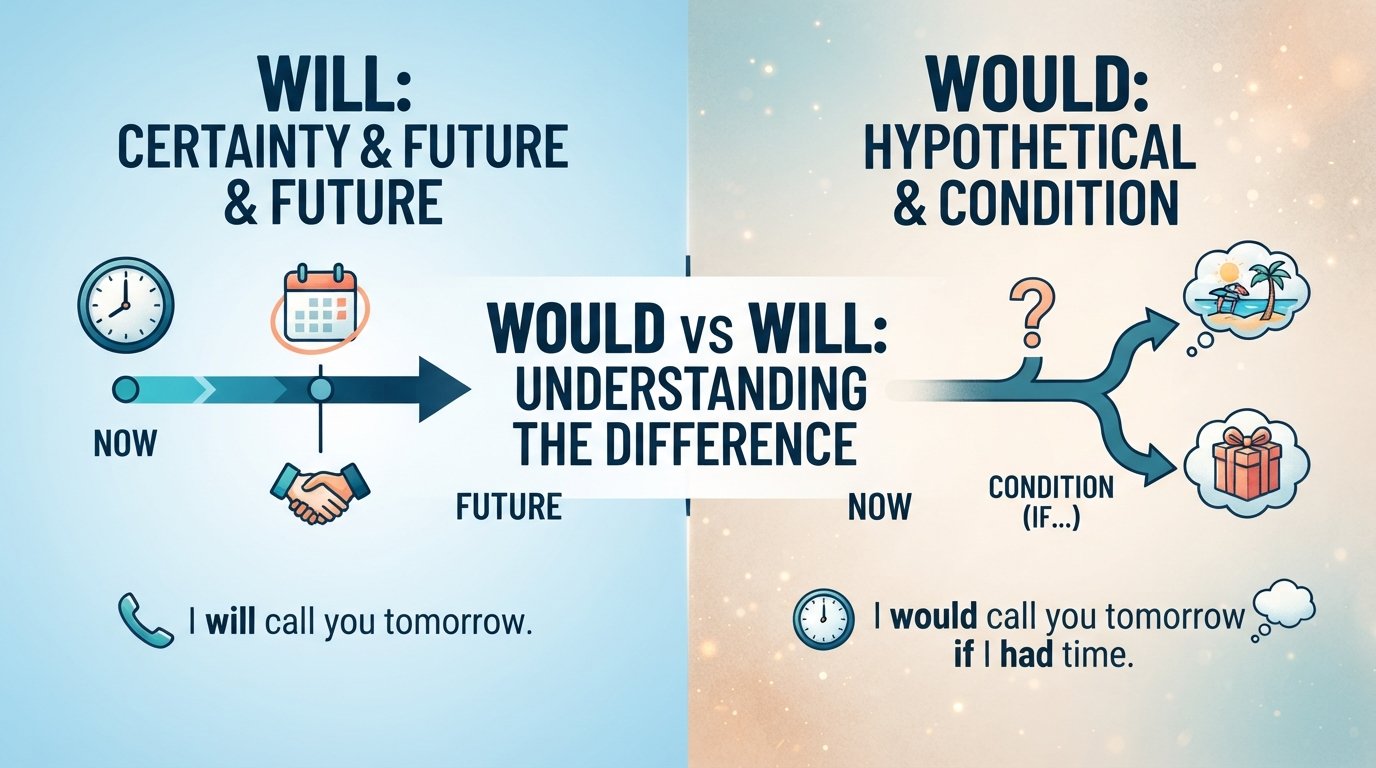
Would vs Will can be confusing because both are modal verbs connected to future actions, intentions, and possibilities. They often appear in similar sentences, but they don’t always communicate the same meaning.
The simplest way to remember the difference is this: will usually expresses a future action, certainty, willingness, or determination, while would often expresses a hypothetical situation, past habit, polite request, or future event viewed from the past.
Understanding when to use each one can make your English sound much more natural and precise.
Would vs Will: Why Does the Confusion Exist?
The confusion between Would vs Will exists because both words are modal auxiliary verbs, and both can refer to actions that haven’t happened yet.
For example:
- I will call you tomorrow.
- I would call you tomorrow if I had your number.
The first sentence presents the call as a definite future intention. The second sentence makes the action conditional.
There is also a historical connection between the two words. Would is traditionally considered the past tense form of will, although modern English uses it for several purposes beyond simply describing the past.
See Also: Die on the Vine: Meaning, Origin, Examples & Correct Usage
Why It Matters in Professional Settings
Using will and would correctly matters in professional communication because these words can change the strength and meaning of a statement.
Compare:
We will send the documents today.
This sounds definite and confident.
Now consider:
We would send the documents today if the client approved the changes.
Here, the action depends on a condition.
In emails, meetings, reports, and business conversations, that distinction helps you communicate your intentions without creating confusion.
Would vs Will: Which One Is Correct?
Both will and would are correct English words. The right choice depends on the context and the meaning you want to express.
Use will when you’re talking about a future event, prediction, willingness, promise, determination, or decision.
For example:
I will finish the report tonight.
Use would when you’re discussing a hypothetical situation, past habit, polite request, past expectation, or future in the past.
For example:
I would finish the report tonight if I had more time.
Therefore, asking whether “will” or “would” is correct isn’t enough by itself. You need to examine the entire sentence.
What Does “Would” Mean? Origins, Definition, and Usage
The word would has several grammatical functions in modern English. Although it developed as the past form associated with will, its meaning now depends heavily on sentence context.
Definition of Would
Would is a modal auxiliary verb commonly used to express hypothetical situations, conditional actions, polite requests, past habits, past expectations, and uncertainty.
It can also describe an action that was expected to happen from a past point of view.
For example:
She said she would arrive at six.
The arrival was in the future relative to the time she spoke, but that conversation happened in the past.
Read Also: Catch You on the Flip Side: Meaning, Origin, and Usage
Origins of the Word “Would”
“Would” developed from an older form of the English verb associated with will and willingness.
Over time, English speakers began using it for past forms, conditional constructions, polite expressions, and hypothetical situations.
That’s why modern English learners may notice that would doesn’t always seem to function like a simple past tense.
Why Would Is Often Confused With Will
The confusion happens because both modal verbs can describe future actions.
Consider these sentences:
I will visit London next year.
I would visit London next year if I could afford the trip.
The first expresses an intention or expectation. The second describes a hypothetical possibility.
The presence of a condition such as “if I could afford it” changes the meaning completely.
Exploring the Significance of Would vs Will in English
The biggest difference between Would vs Will becomes clear when you examine certainty, conditions, and time.
Will generally presents something as more definite.
The train will arrive at 8 p.m.
Would can make the same idea conditional or hypothetical.
The train would arrive at 8 p.m. if there were no delays.
The distinction isn’t always about certainty alone. Would can also create a softer or more polite tone.
For example:
Would you help me with this report?
This sounds more polite than a direct command.
Role of Will in Everyday English
Will is commonly used when speakers discuss the future.
It can express:
- a future prediction
- a decision
- an intention
- willingness
- determination
- a promise
- an offer
- a request
- a rule or order
For instance:
I think it will rain tomorrow.
Here, will makes a prediction.
I will help you with the project.
Here, it expresses willingness or intention.
Role of Would in Everyday English
Would has a wider range of uses.
It can describe:
- hypothetical situations
- conditional actions
- past habits
- past expectations
- polite requests
- future events viewed from the past
- unlikely situations
- imagined outcomes
For example:
I would buy that car if I had enough money.
The purchase is hypothetical because it depends on a condition.
Common Reasons for the Would vs Will Confusion
Several situations make these modal verbs difficult for English learners.
First, both words can appear in sentences about the future.
Second, would can refer to something that was future from a past perspective.
Third, both can appear in conditional sentences, although they normally occupy different parts of the conditional structure.
For example:
If she studies, she will pass.
Here, will appears in the result clause.
But:
If she studied harder, she would pass.
Here, would expresses a hypothetical result.
Another source of confusion is politeness.
Will you open the window?
This can function as a request.
Would you open the window?
The second version is generally softer and more polite.
Side-by-Side Comparison: Would vs Will
| Feature | Will | Would |
|---|---|---|
| Main time reference | Future | Past, hypothetical future, or conditional |
| Certainty | Often stronger | Often less definite |
| Prediction | Common | Less common |
| Willingness | Common | Possible in hypothetical contexts |
| Past habits | Not normally used | Common |
| Hypothetical situations | Not usually | Very common |
| Polite requests | Yes | Yes, often softer |
| Future in the past | No | Yes |
| Conditional sentences | Common in first conditional | Common in second/third conditionals |
| Past expectations | No | Yes |
This comparison shows why simply treating would as “past will” isn’t enough. The two forms have overlapping but different grammatical functions.
Everyday Examples of Would vs Will in Language
Looking at real sentences makes the difference easier to understand.
Will for Future Predictions
The weather will improve tomorrow.
The speaker predicts a future event.
Will for Willingness
I will help you carry those boxes.
The speaker is showing willingness to act.
Will for Determination
I will never give up.
This expresses strong determination.
Will for Promises
I will call you when I arrive.
The speaker makes a promise about a future action.
Would for Hypothetical Situations
I would travel more if I had more free time.
The action depends on an imaginary condition.
Would for Past Habits
When I was younger, I would walk to school every morning.
Here, would describes a repeated past action.
Would for Past Expectations
We thought the meeting would finish early.
The meeting was expected to finish early from a past point of view.
Would for Future in the Past
She said she would call me later.
At the time she spoke, the call was still in the future.
Would for Polite Requests
Would you please close the door?
This is a polite request rather than a statement about the future.
How to Use Would vs Will Correctly
When deciding between these modal verbs, start by asking what you mean.
If you’re making a straightforward statement about the future, will is usually appropriate.
I will meet you tomorrow.
If you’re imagining what could happen under a particular condition, would is usually more appropriate.
I would meet you tomorrow if I weren’t working.
If you’re describing a repeated action in the past, would can also work.
Every summer, we would visit our grandparents.
However, would isn’t normally used for a single completed past action.
You wouldn’t usually say:
I would go to the store yesterday.
Instead, you would normally say:
I went to the store yesterday.
Context determines the correct choice.
“How to Spell Would vs Will” and Remember the Correct Usage
If you’re searching how to spell “Would vs Will”, both words are spelled differently and have different grammatical functions.
Will has four letters, while would has five.
The bigger challenge, however, isn’t spelling. It’s knowing when each word belongs in a sentence.
A useful memory trick is to associate will with a more direct future idea:
I will do it.
Associate would with conditions, imagination, politeness, or a past viewpoint:
I would do it if I could.
That simple contrast can help you remember the difference.
Practice Sentences
Try identifying why each sentence uses will or would:
I will finish my homework after dinner.
This expresses a future intention.
I would finish my homework if I had more time.
This expresses a hypothetical situation.
My father would read to me every night when I was young.
This describes a past habit.
She said she would arrive before noon.
This describes a future action from a past perspective.
Will you help me with this?
This is a request.
Would you help me with this?
This is a more polite or less direct request.
Literature and Media Mentions: Correct Usage of Would vs Will
Writers frequently use will and would to show differences in certainty, time, character intention, and hypothetical situations.
In stories, would is particularly useful for describing repeated past behavior.
For example:
Every evening, the old man would sit by the window and watch the street.
The sentence gives readers a sense of routine and familiarity.
Writers also use would when presenting imagined outcomes:
She would never believe what happened next.
Meanwhile, will can create stronger certainty or determination:
I will find the truth.
This makes will particularly effective in dialogue when a character wants to express resolve.
Understanding these differences can help you recognize why authors choose one modal verb instead of another.
Frequently Asked Questions About Would vs Will
What’s the difference between will and would?
Will commonly expresses future actions, certainty, willingness, promises, and predictions. Would often expresses conditions, possibilities, past habits, or politeness.
Is would the past tense of will?
Traditionally, would is considered the past form of will, but modern English uses it for hypothetical, conditional, polite, and other meanings.
When should I use would instead of will?
Use would for hypothetical situations, conditional results, past habits, polite requests, past expectations, and future actions viewed from the past.
Which is more polite, will or would?
Would is generally more polite or indirect when making requests. For example, “Would you help me?” sounds softer than “Will you help me?”
Can will and would be used in conditional sentences?
Yes. Will commonly appears in real or likely conditions, while would commonly appears in hypothetical or less likely conditions.
Conclusion: Why It’s Important to Understand Would vs Will
Understanding Would vs Will becomes much easier when you focus on meaning instead of memorizing isolated rules. Will generally communicates future actions, predictions, willingness, promises, and determination. Would, meanwhile, commonly expresses hypothetical situations, conditional results, past habits, polite requests, and future events viewed from the past. The context always matters. When you understand whether an action is certain, imagined, conditional, repeated in the past, or viewed from a past perspective, choosing the correct modal verb becomes much more natural. With regular practice, you’ll quickly develop an instinct for when will and would fit your sentences.