Bollocks vs Bollocking: Meaning, Differences, Uses, and Common Mistakes Explained
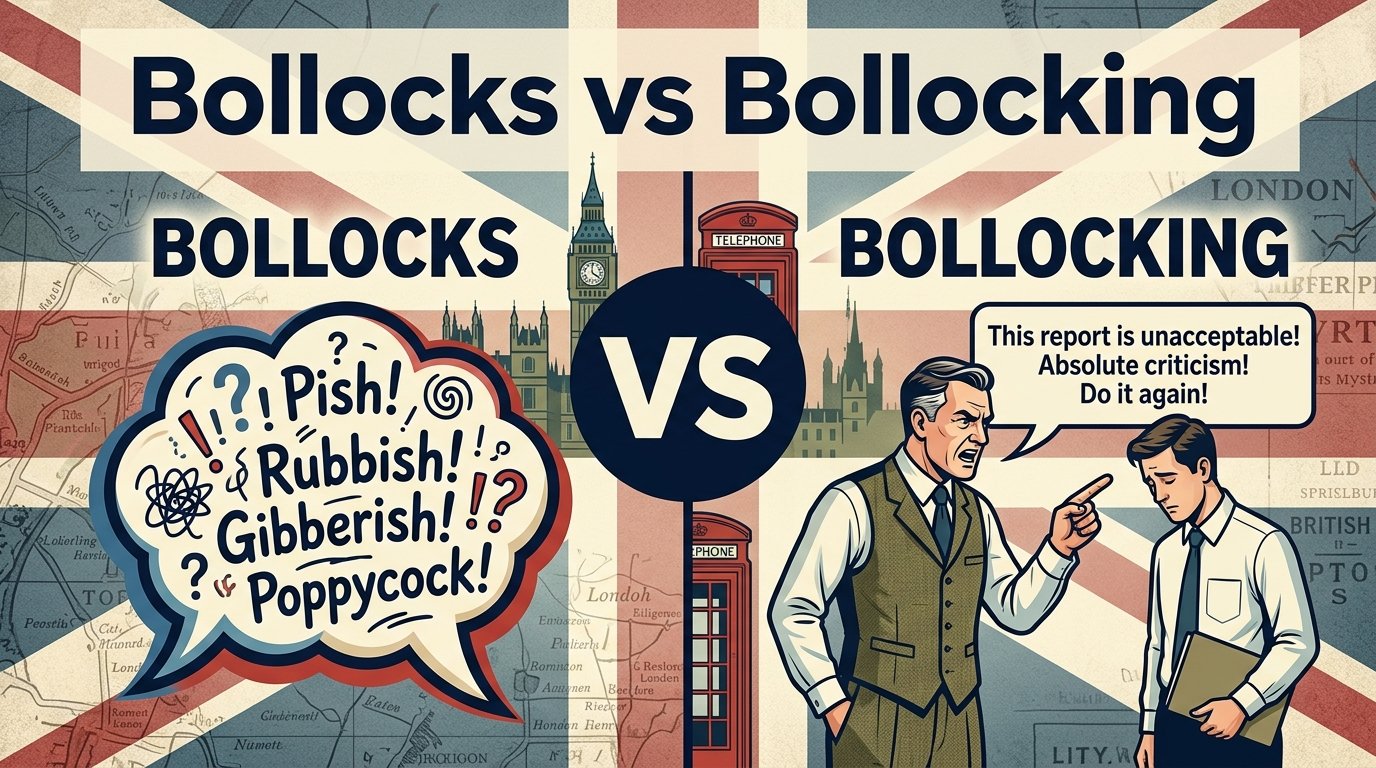
English learners often come across words that look almost identical but work very differently in a sentence. Bollocks vs Bollocking is a good example.
Both words belong to informal British English and share the same root. However, they do not have the same meaning or grammatical function.
Bollocks usually refers to nonsense, rubbish, something untrue, or something ridiculous. In some expressions, especially “the bollocks,” it can also describe something excellent.
Bollocking, meanwhile, means a strong telling-off, serious criticism, or angry reprimand. If someone gets a bollocking, another person has strongly criticized them for something they did.
Knowing this difference makes British casual speech much easier to understand. It also helps learners avoid using rude or informal language in inappropriate situations.
Bollocks vs Bollocking: Why Does the Confusion Exist?
The confusion mainly comes from their similar spelling and shared word family. Both contain “bollock,” so learners may naturally assume that they can be used interchangeably.
They cannot.
When someone says, “That explanation is bollocks,” they are saying the explanation is nonsense or untrue.
When someone says, “I got a bollocking from my manager,” they mean their manager strongly criticized them.
Therefore, one word describes something considered nonsense or, in certain contexts, excellent. The other describes an experience of receiving strong criticism.
The surrounding words usually make the intended meaning clear.
Why It Matters in Professional Settings
Understanding these expressions matters even if you never plan to use them yourself.
British slang appears frequently in television shows, films, books, podcasts, social media, and everyday conversations. Recognizing the words helps you understand what native speakers are actually saying.
Using them yourself requires more care.
Both terms are informal English expressions and can sound vulgar or rude. A phrase that feels funny among close friends could sound disrespectful during a meeting or job interview.
Instead of saying, “That report is bollocks,” a professional speaker could say, “That report contains incorrect information.”
Likewise, instead of saying someone “got a bollocking,” formal English might use “received strong criticism” or “was reprimanded.”
Bollocks vs Bollocking: Which One Is Correct?
Both bollocks and bollocking are correct words. The correct choice depends on what you want to express.
Use bollocks when talking about nonsense, rubbish, an untrue statement, or something ridiculous.
For example:
“That story is complete bollocks.”
Here, the speaker believes the story is false or meaningless.
Use bollocking when describing a strong telling-off or angry criticism.
“The employee got a bollocking for missing the deadline.”
In this sentence, the focus is on the criticism the employee received.
So, if you are wondering bollocks or bollocking, remember this simple distinction:
Bollocks = nonsense or rubbish.
Bollocking = a strong telling-off or criticism.
What Does “Bollocks” Mean? Origins, Definition, and Usage
See Also: Orientated vs Oriented: Meaning, Usage and Examples
The word “bollocks” has several meanings in British English. Its original literal meaning referred to the testicles, making it a vulgar slang term.
Over time, the word developed several figurative uses. In everyday British speech, it can mean nonsense, rubbish, or something considered completely untrue.
It can also appear as an exclamation.
For example:
“Bollocks! I forgot my wallet.”
Here, the speaker is expressing frustration or annoyance.
Another common expression is:
“That’s absolute bollocks.”
This means that something is considered complete nonsense.
Interestingly, the phrase “the bollocks” can have a positive meaning.
“That new restaurant is the bollocks.”
In this informal context, it means the restaurant is excellent or fantastic.
The meaning therefore depends heavily on context, tone, and the surrounding words.
Definition of Bollocks
Bollocks is primarily an informal British English noun and vulgar slang expression.
Its common figurative meanings include:
- nonsense
- rubbish
- false information
- foolish talk
- something ridiculous
Depending on the expression, however, it can also describe something excellent.
The phrase “talk bollocks” means to say silly, meaningless, or untrue things.
For example:
“He talks bollocks whenever he gets nervous.”
The sentence means that he tends to say foolish or meaningless things.
Origins of the Word “Bollocks”
The literal sense of bollocks comes from an old word referring to male testicles. The term developed through English usage and eventually became established as a form of British slang.
Its figurative meaning became common because speakers began using the word to express disbelief, rejection, frustration, or contempt.
Today, people may hear bollocks British slang meaning in many informal settings, although the word remains vulgar.
Its history also explains why learners should be careful. The word may appear harmless when used to mean “nonsense,” but its original sense gives it a stronger and ruder character than neutral alternatives.
Why Bollocks Is a Commonly Misused Word
Learners often assume that bollocks always has a negative meaning. That is not completely accurate.
Consider these two sentences:
“That explanation is bollocks.”
This means the explanation is nonsense.
Now compare:
“That guitar solo was the bollocks.”
Here, the speaker means the guitar solo was excellent.
The positive use is highly informal and depends on the expression “the bollocks.” It is also strongly associated with British slang.
Another common mistake involves grammar. Learners may try to use bollocks as though it were a normal verb when they want to describe criticism.
For example:
“My teacher bollocks me yesterday.”
This is not the standard structure learners should use.
A safer sentence is:
“My teacher gave me a bollocking yesterday.”
Exploring the Significance of “Bollocking” in British English
Bollocking has a much narrower meaning than bollocks.
It refers to a serious telling-off, angry criticism, scolding, or reprimand. Someone usually receives a bollocking because they have made a mistake, broken a rule, arrived late, or failed to complete a responsibility.
For example:
“I got a bollocking from my boss for missing the deadline.”
The speaker means that the boss strongly criticized them.
The expression is common in spoken British English and informal conversations. It can appear in workplace conversations, family situations, school situations, and sports discussions.
However, it remains vulgar slang and should not normally appear in formal communication.
Role of a “Bollocking” in a Professional Conversation
Although people may use the word casually when talking about work, it is not considered professional vocabulary.
Someone might tell a friend:
“The manager gave me a bollocking this morning.”
That sentence is understandable in casual conversation.
A formal version would be:
“The manager strongly criticized me this morning.”
The difference is mainly one of register and tone. Bollocking slang sounds emotional, informal, and sometimes humorous. “Strong criticism” sounds neutral and professional.
This distinction is important when learning British informal language because understanding slang does not mean you should automatically use it.
Common Reasons for the “Bollocks” and “Bollocking” Confusion
Several patterns cause learners to mix these words up.
First, the spelling looks closely related. Both words begin with “bollock,” making them appear interchangeable.
Second, both words can occur when discussing something negative. However, they describe different parts of the situation.
Consider:
“The excuse was bollocks.”
The excuse is considered nonsense.
Now:
“He got a bollocking for making the excuse.”
The person received strong criticism.
Third, learners may confuse the words because textbooks usually focus on standard English. British slang is often learned through movies, television, conversations, or online content instead.
Finally, learners sometimes believe that the ending “-ing” automatically turns bollocking into a normal verb. In this case, bollocking commonly functions as a noun.
The useful structures are:
“give someone a bollocking”
and
“get a bollocking.”
Side-by-Side Comparison: Bollocks vs Bollocking
See Also: When vs Whenever: Understanding the Difference in English Grammar
| Feature | Bollocks | Bollocking |
|---|---|---|
| Word type | Noun / slang expression | Noun / slang expression |
| Main meaning | Nonsense, rubbish, false information | Strong criticism or telling-off |
| Common purpose | Describes an idea, statement, excuse, or thing | Describes criticism received by someone |
| Common structure | “That is bollocks” / “talk bollocks” | “give someone a bollocking” / “get a bollocking” |
| Tone | Informal and vulgar | Informal, vulgar, and usually negative |
| British usage | Common in casual speech | Common in casual British speech |
| Formal use | Not recommended | Not recommended |
| Positive meaning | “The bollocks” can mean excellent | Normally does not have this meaning |
The easiest way to remember the distinction is to focus on what each word describes.
Bollocks describes an opinion about something.
Bollocking describes an action or experience involving criticism.
Everyday Examples of Bollocks and Bollocking in Language
Real-life examples make the difference easier to understand.
If someone hears an unbelievable story, they might say:
“That sounds like bollocks.”
The meaning is “That sounds like nonsense.”
If someone repeatedly arrives late at work, they might say:
“I’m going to get a bollocking.”
This means they expect their manager to criticize them.
A person discussing someone who constantly makes silly claims might say:
“He talks a lot of bollocks.”
This means he frequently says foolish or untrue things.
After a poor football performance, someone could say:
“The coach gave the players a bollocking.”
The coach strongly criticized the players.
The positive meaning can appear in a sentence such as:
“That new phone is the bollocks.”
In this case, the speaker means the phone is amazing.
These examples show why bollocks meaning in British English cannot always be understood from the word alone. The complete expression matters.
“How to Spell Bollocks or Bollocking”: Remember the Correct Spelling
If you’re searching for how to spell “bollocks or bollocking”, both spellings are correct, but they represent different words.
The correct spellings are:
Bollocks
Bollocking
A useful memory trick is to connect the endings with their meanings.
“Bollocks” is the shorter noun commonly used for nonsense or rubbish.
“Bollocking” adds “-ing” and refers to the act or experience of receiving a strong telling-off.
Do not confuse “bollocking” with unrelated spellings such as “bollockingg” or other invented forms.
The easiest way to remember them is to learn the words as complete expressions rather than isolated spellings:
“That’s bollocks.”
“I got a bollocking.”
Practice Sentences
Try these examples:
“His explanation was complete bollocks.”
“She talks bollocks when she is angry.”
“Bollocks! I missed the train.”
“I got a bollocking from my manager.”
“The coach gave the team a bollocking.”
“That film was the bollocks.”
Notice that the first, second, and third examples use bollocks to express nonsense or frustration. The last three show bollocking as strong criticism, except for the positive slang use of “the bollocks.”
Literature and Media Mentions: Correct Usage of Bollocks
See Also: Few vs Phew: Understanding the Difference in Meaning and Usage
British slang appears frequently in literature, television, films, comedy, music, and online conversations. Words such as bollocks can help writers create realistic dialogue between characters.
However, the use of vulgar language depends on the audience and setting.
A fictional character speaking casually with friends may naturally use the word. A formal narrator or professional document would normally choose neutral vocabulary.
This is why understanding informal British English is useful even when you do not intend to use every slang expression yourself.
When watching British media, you may encounter phrases such as “talk bollocks,” “that’s bollocks,” or “get a bollocking.” Recognizing the expressions prevents you from misunderstanding the conversation.
For English learners, this is an important part of understanding spoken English and natural communication.
Frequently Asked Questions About Bollocks vs Bollocking
What’s the correct way to spell “bollocks” and “bollocking”?
Both spellings are correct. Bollocks usually means nonsense, while bollocking means strong criticism or a serious telling-off.
Is “bollocking” a British slang word?
Yes. Bollocking is informal British slang meaning a strong telling-off, angry criticism, scolding, or reprimand after someone makes a mistake.
Why is spelling “bollocks” correctly important?
Correct spelling helps readers understand your intended word, especially because bollocks and bollocking have different meanings, grammatical roles, and sentence structures.
Is “bollocks” a rude word?
Yes. Bollocks is considered vulgar British slang. It can mean nonsense, although “the bollocks” can informally describe something excellent.
Can “bollocks” and “bollocking” be used interchangeably?
No. Bollocks usually describes nonsense or rubbish, while bollocking refers to strong criticism received from another person.
Conclusion: Why It’s Important to Use “Bollocks” and “Bollocking” Correctly
Understanding Bollocks vs Bollocking makes British informal English much easier to follow. Although the words share the same root, their meanings and grammatical uses are different.
Bollocks usually means nonsense, rubbish, or something untrue. In the expression “the bollocks,” it can also mean something excellent. Bollocking means a strong telling-off, scolding, or angry criticism.
The easiest memory trick is simple: bollocks describes something you reject as nonsense, while bollocking describes criticism someone receives.
Because both are vulgar slang, use them carefully. They work best in informal conversations, entertainment, and casual British English rather than professional or academic settings.