
Few vs Phew: Understanding the Difference in Meaning and Usage
If you’ve ever written few and wondered whether phew could be the right word, you’re not alone. Few vs Phew is a common English spelling and meaning confusion because both words are pronounced exactly the same.
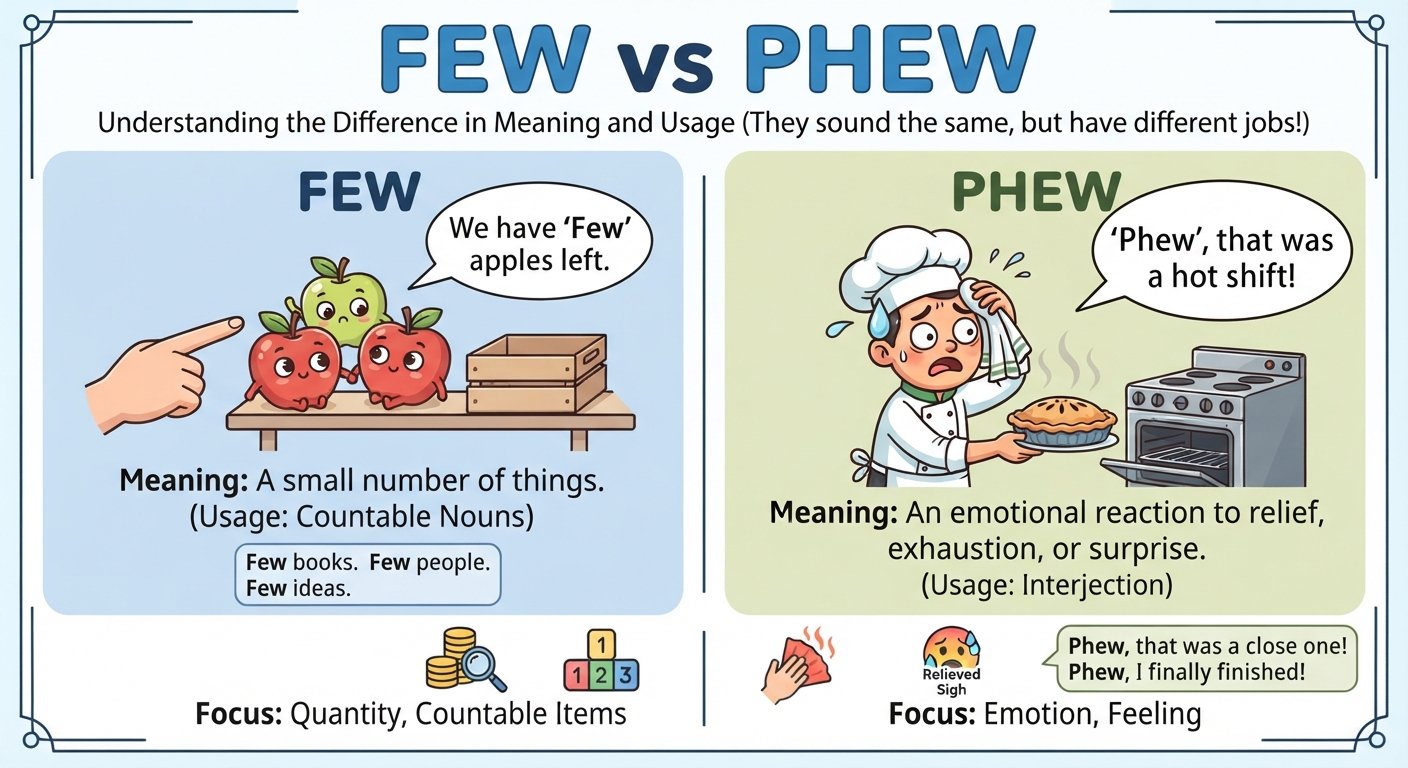
However, their meanings, grammatical roles, and uses are completely different. Few refers to a small number or limited quantity, while phew is an emotional reaction, usually showing relief, exhaustion, surprise, or stress release.
The difference becomes easy once you connect each word with its purpose. If you’re talking about people, books, minutes, ideas, or other countable things, few is normally the word you need. If you’re reacting to a difficult, stressful, or surprising situation, phew is the natural choice.
This guide explains the difference between few and phew, their pronunciation, grammar, origins, common mistakes, and practical examples so you can use both confidently.
Few vs Phew: Why Does the Confusion Exist?
The main reason people confuse these words is pronunciation. Few and phew are homophones, which means they have the same pronunciation but different spellings and meanings.
Both are pronounced /fjuː/ and contain one syllable. Because they sound identical when spoken, you cannot always identify the correct spelling from sound alone.
English has many words that sound the same but have different meanings. Examples include sale/sail, there/their/they’re, and pair/pear. Few and phew belong to the same group.
Spelling creates another problem. The unusual spelling of phew makes it easy to connect the word incorrectly with few. Yet the two words perform entirely different jobs in a sentence.
See Also: Work Like a Charm: Meaning, Origin, Usage, Examples, and Grammar
Why It Matters in Professional Settings
Knowing the difference matters especially in professional communication and formal writing.
Imagine a report saying, “Phew employees completed the training.” The intended meaning is probably that a small number of employees completed it. In that case, “phew” is incorrect.
The correct sentence is, “Few employees completed the training.”
A single letter combination can therefore change the meaning of a sentence. Good spelling accuracy, writing clarity, and correct usage help maintain credibility in emails, reports, applications, and academic work.
Few vs Phew: Which One Is Correct?
Both few and phew are correct English words. The important question is not which spelling is universally correct, but which word fits the meaning and context.
Use few when you mean a small number of countable things.
Few students attended the meeting.
Here, “few” describes the number of students.
Use phew when expressing an emotional reaction.
Phew, that exam was difficult!
Here, “phew” does not describe a number. It communicates relief, exhaustion, or emotional release.
Understanding this basic grammar difference makes the choice much easier.
If the sentence answers “How many?”, think of few. If it expresses a reaction similar to a sigh, think of phew.
What Does “Few” Mean? Origins, Definition, and Usage
The word few is one of the most common words used to describe quantity in English. It generally means a small number or not many.
Unlike words such as “little,” few is normally used with countable nouns.
For example:
- Few people agreed with the proposal.
- Few books remained on the shelf.
- Few employees arrived early.
- Few opportunities were available.
The word can appear in everyday speech, academic writing, business documents, and formal communication.
Definition of Few
The basic few meaning is “a small number.”
It can also communicate “not many” or a limited quantity of something.
For example:
Few customers complained about the service.
The sentence tells us that only a small number of customers complained.
In grammar, few can work as a determiner, adjective-like modifier, or pronoun depending on how it appears in a sentence. Its central job is to communicate quantity.
When you see few people, few ideas, or few options, the word is connected to a plural countable noun.
Origins of the Word “Few”
The origin of few can be traced to Old English. It is related to words found in other Germanic languages and has retained its central meaning of a small number over many centuries.
The word has appeared throughout English literature, historical documents, academic texts, and everyday communication.
Its long history explains why it feels completely natural in modern English. Although grammar and vocabulary have changed over time, the core idea behind few has remained remarkably stable.
Why Few Is a Common Misspelling
The biggest reason people confuse few with phew is that both words have the same pronunciation.
This is a classic example of homophone words creating spelling confusion.
Someone may hear “few” and remember the sound without remembering the spelling. When writing, they may then choose “phew,” especially if they’ve mostly encountered the word in speech.
The solution is to connect few with quantity. Think:
Few = number.
Whenever you’re discussing people, objects, choices, minutes, problems, or other countable things, check whether you are describing a small number.
See Also: Would vs Will: Understanding the Difference in English Grammar
Exploring the Significance of “Phew” in Everyday Language
Unlike few, phew does not describe quantity. The phew definition is an expression used to communicate an emotional or physical reaction.
It is commonly associated with relief, but it can also express surprise, exhaustion, disbelief, or the feeling of releasing tension.
For example:
Phew, we finally finished the project!
The speaker is not counting anything. Instead, they are expressing relief after completing something difficult.
Because of this function, phew is classified as an interjection.
Role of “Phew” in a Professional Kitchen
In a professional kitchen, communication is usually fast, direct, and highly situational. A chef or kitchen worker might say “Phew!” after completing a demanding service, handling a difficult order, or surviving a particularly busy period.
For example:
Phew, that was a busy dinner service!
Here, phew communicates exhaustion and relief.
The word can appear in many workplaces, not just kitchens. A teacher might say it after a difficult class, while an office worker might use it after completing a demanding presentation.
Therefore, its significance comes from emotional expression, not from the particular profession or setting.
Common Reasons for the “Few” and “Phew” Misspelling
Several factors make these words easy to mix up.
First, they are perfect homophones. Their identical pronunciation means spoken language does not provide a spelling clue.
Second, English spelling often fails to match pronunciation perfectly. The “ph” combination in phew represents the /f/ sound, just as it does in words such as phone, photo, and phrase.
Third, learners may remember the sound before they understand the grammatical role of each word.
Finally, both words are short. Short words can sometimes create more confusion because there are fewer visual clues to distinguish them.
A useful method is to focus on word function. Ask yourself what the word is doing.
If it describes a quantity, use few.
If it expresses an emotion, use phew.
Side-by-Side Comparison: “Few” vs “Phew”
| Feature | Few | Phew |
|---|---|---|
| Meaning | Small number | Emotional reaction |
| Part of speech | Determiner, adjective-like modifier, or pronoun | Interjection |
| Main purpose | Shows quantity | Expresses emotion |
| Used with nouns | Yes | No |
| Countable nouns | Yes | No |
| Common emotion | Usually none by itself | Relief, surprise, exhaustion |
| Context | Formal and informal | Mostly informal |
| Pronunciation | /fjuː/ | /fjuː/ |
| Spelling | Few | Phew |
| Example | Few people arrived. | Phew, we’re finished! |
This comparison makes the semantic difference clear. The words sound alike, but their semantic meaning, grammar, and purpose are completely different.
Everyday Examples of “Few” and “Phew” in Language
Real examples are often the easiest way to understand textual usage and expression usage.
Examples with Few
- Few students passed the difficult test.
- Few seats were available.
- Few customers complained.
- Few people knew the answer.
- Few options remained.
- Only a few minutes were left.
- Few mistakes appeared in the report.
These examples all communicate quantity.
Examples with Phew
- Phew, that was close!
- Phew, I finally finished the assignment.
- Phew, it’s much hotter than I expected.
- Phew, we made it on time.
- Phew, that was a difficult presentation.
These sentences demonstrate an emotional reaction.
Notice how few works inside the grammatical structure of a sentence, while phew can stand independently as an exclamation.
Few vs A Few: An Important Meaning Difference
Learners should also understand the difference between few and a few.
Although the difference is small in spelling, it can change the tone.
“Few” often suggests an insufficient or disappointing number:
Few students completed the assignment.
This can suggest that the number was lower than expected.
“A few” usually sounds more positive or neutral:
A few students completed the assignment.
This simply tells us that some students completed it.
Therefore, few vs a few is not only a grammar issue. It can also affect the emotional tone of a sentence.
“How to Spell Few vs Phew”: Remember the Correct Spelling
If you’re searching for how to spell “Few vs Phew”, the easiest solution is to associate each spelling with its meaning.
Remember:
Few = quantity.
Phew = emotion.
You can also connect “phew” with the sound of releasing your breath after stress.
Imagine finishing a difficult exam and saying:
Phew!
That mental connection can make the spelling easier to remember.
For few, think about counting:
Few books.
Few people.
Few choices.
This creates a simple mental separation between the two homophones.
Practice Sentences
Try reading these sentences and identifying the correct word:
I have few questions about the assignment.
Phew, that meeting lasted forever!
Few employees arrived before nine.
Phew, we solved the problem just in time!
Few opportunities were available.
The first, third, and fifth sentences discuss quantity. The others express emotion.
Regular practice improves word recognition, homophone recognition, and overall linguistic awareness.
Literature and Media Mentions: Correct Usage of “Few” and “Phew”
Both words appear in English communication, but they tend to appear in different situations.
Few is common in literature, journalism, academic texts, historical writing, and professional documents because writers often need to describe quantity.
For example, a writer might describe “few survivors,” “few opportunities,” or “few examples.”
Phew, meanwhile, is more common in dialogue, informal writing, comics, social media, scripts, and conversational scenes. Writers use it to make a character’s emotional reaction feel natural.
This difference reflects usage patterns rather than a strict rule that one word belongs only to one type of writing.
Understanding register can strengthen language comprehension and help readers recognize why a particular word appears in a particular situation.
Few vs Phew Pronunciation: Why Do They Sound the Same?
The pronunciation of both words is /fjuː/. Each word contains one syllable.
The unusual part is the spelling of “phew.” The letters “ph” commonly represent the /f/ sound in English.
Consider words such as phone, photo, and phrase.
That is why spelling cannot always be predicted simply by listening. Pronunciation awareness is useful, but you also need to understand meaning and grammar.
Common Mistakes When Using Few and Phew
One common error is using “phew” to describe quantity:
Incorrect: There are phew seats left.
Correct: There are few seats left.
Another mistake is using “few” as an exclamation:
Incorrect: Few, that was scary!
Correct: Phew, that was scary!
A third problem occurs when learners forget that few normally works with plural countable nouns.
You would say:
Few students attended.
But you would not normally say:
Few water remained.
For an uncountable noun such as water, “little” is generally more appropriate:
Little water remained.
Understanding these distinctions improves sentence meaning, grammar roles, and communication skill.
Quick Memory Tricks for Few vs Phew
The simplest memory trick is:
Few = number.
Phew = feeling.
Another useful technique is to imagine a counting scene for “few.” Picture a few books, a few students, or a few minutes.
For “phew,” imagine yourself completing something stressful and releasing a breath.
You can also ask two questions:
Am I talking about how many? Use few.
Am I reacting to something? Use phew.
This simple test works in most everyday situations.
Frequently Asked Questions About Few vs Phew
What’s the correct way to spell “few” and “phew”?
Both spellings are correct, but they have different meanings. Few describes a small number, while phew expresses relief or emotion.
Are “few” and “phew” homophones?
Yes. Few and phew are homophones because they share pronunciation while having different spellings, meanings, and grammatical functions.
Why is spelling “few” and “phew” correctly important?
Correct spelling prevents confusion and preserves meaning. Using the wrong homophone can make a sentence unclear, especially in professional and academic writing.
Is “phew” a French word?
No. Phew is an English interjection generally used to represent a breath, sigh, relief, exhaustion, or emotional reaction.
How can I remember the difference between few and phew?
Remember “few” as quantity and “phew” as emotion. If you’re counting something, choose few; if you’re reacting, choose phew.
Conclusion: Why It’s Important to Understand “Few vs Phew”
Understanding Few vs Phew becomes simple when you focus on meaning rather than sound. Few describes a small number of countable things, while phew expresses emotion such as relief, exhaustion, or surprise. Although both words are pronounced the same, their grammar and purpose are completely different. Remembering “few equals quantity” and “phew equals emotion” can prevent common spelling mistakes. With regular practice, attention to context, and exposure to real sentences, you can improve your spelling accuracy, vocabulary development, writing clarity, and overall English communication skills. Knowing this distinction also makes your formal writing and everyday conversations more precise.





One Comment