
Most Important vs Most Importantly: Master This Common Grammar Difference
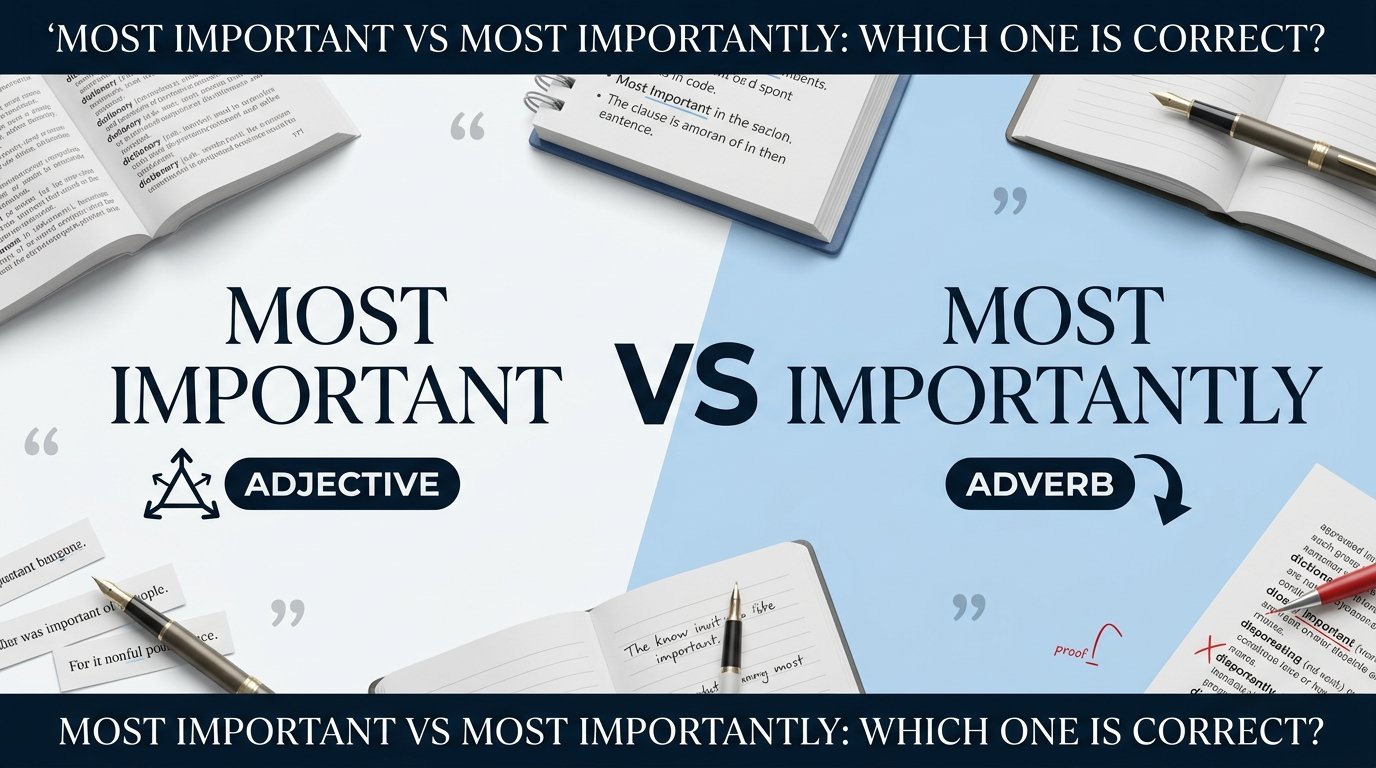
Have you ever stopped while writing and wondered whether you should say “most important” or “most importantly”? You’re not alone. This small grammar choice confuses English learners, students, bloggers, and even native speakers.
Both expressions are correct, but they do different jobs in a sentence. Most Important vs Most Importantly mainly comes down to how each phrase functions grammatically and what you want to emphasize.
“Most important” is generally connected with an adjective and can describe a noun. “Most importantly” works as an adverb and commonly introduces or emphasizes an entire statement.
The difference becomes much easier once you look at real examples. In this guide, we’ll explore their meanings, grammar roles, correct usage, formal and informal contexts, common mistakes, and practical examples.
Most Important vs Most Importantly: Why Does the Confusion Exist?
The confusion exists because both expressions come from the same root word: important.
The word “important” is an adjective, while “importantly” is an adverb. Their meanings are closely related, so they can sound interchangeable when they appear at the beginning of a sentence.
For example:
Most important, remember to bring your passport.
You may also see:
Most importantly, remember to bring your passport.
Both sentences communicate essentially the same idea. However, they have slightly different grammatical structures.
Most important can work as a shortened form of “most important of all” or “the most important thing is.” Meanwhile, most importantly directly functions as an adverbial expression.
That distinction explains why both forms appear in modern English.
Why It Matters in Professional Settings
Grammar choices can influence how polished your writing sounds.
In emails, reports, business documents, academic essays, and presentations, most importantly is often preferred because its adverbial structure is immediately clear.
For example:
Most importantly, the company must protect customer information.
Here, “most importantly” emphasizes the whole statement.
However, most important is not automatically wrong. It can sound concise and direct, especially when used as a sentence-opening expression.
For professional writing, focus on clarity rather than assuming that one expression is always correct.
Most Important vs Most Importantly: Which One Is Correct?
Both can be correct, depending on the sentence.
Use most important when the phrase describes a noun or works as an elliptical expression.
For example:
Safety is the most important concern.
Here, “most important” describes “concern.”
Another example is:
The most important lesson was to stay calm.
Again, “most important” modifies the noun “lesson.”
However, use most importantly when you want to emphasize an entire statement or idea.
Most importantly, everyone arrived safely.
The phrase does not describe “everyone.” Instead, it tells the reader that the entire point that follows has the greatest importance.
See Also: Advice vs Advise: Meaning, Examples and Usage
| Expression | Grammar role | Main use | Example |
|---|---|---|---|
| Most important | Adjective phrase | Describes a noun or emphasizes priority | The most important task is preparation. |
| Most importantly | Adverb phrase | Emphasizes an entire statement | Most importantly, stay calm. |
| More important | Comparative adjective | Compares importance | This issue is more important. |
| More importantly | Adverb | Adds a more significant point | More importantly, we need a solution. |
A useful test can help you choose.
If you can replace the phrase with “the most important thing is,” most important may fit.
Most important, remember your ID.
This can be expanded to:
The most important thing is to remember your ID.
If “above all” fits naturally, most importantly is usually a good choice.
Most importantly, remember your ID.
Above all, remember your ID.
The meaning remains natural.
What Does “Most Important vs Most Importantly” Mean? Origins, Definition, and Usage
The phrase Most Important vs Most Importantly describes a grammatical comparison between two related expressions.
The word “important” describes something that has great value, significance, or priority. “Importantly” developed from the same adjective and functions as an adverb.
Understanding their parts of speech makes their difference easier to recognize.
Definition of Most Important
“Most important” means having the greatest degree of importance among several things.
For example:
Trust is the most important part of a relationship.
Here, “most important” describes “part.”
You can also use it in a sentence-opening expression:
Most important, remember to check your work.
This construction is often understood as an abbreviated form of “most important of all.”
Origins of the Word “Important”
“Important” comes from French important, which developed from Latin roots connected with the idea of carrying weight or significance.
Over time, English adopted “important” as an adjective used to describe people, things, events, ideas, and situations that have considerable value or influence.
The adverb “importantly” developed from the same base word.
Modern English therefore has both forms, but their grammatical roles differ.
Why Most Important Is Sometimes Confused With Most Importantly
The two expressions share almost the same pronunciation and meaning.
People also commonly hear them at the beginning of sentences:
Most important, stay focused.
Most importantly, stay focused.
Because both sentences sound natural, writers may assume that one must be incorrect.
That assumption is too strict.
English allows certain sentence-opening expressions to function differently from ordinary adjective and adverb patterns. As a result, most important can be acceptable as a sentence modifier even though “important” itself is an adjective.
Common Reasons for the Most Important vs Most Importantly Confusion
Several factors make this grammar issue difficult.
First, both expressions communicate priority. A reader usually understands either one without difficulty.
Second, spoken English often reduces grammatical distinctions. During conversation, people tend to focus on meaning rather than analyzing parts of speech.
Third, sentence-opening modifiers can behave differently from ordinary adjectives.
Another reason is the influence of expressions such as “most important of all,” “above all,” and “more importantly.” These related expressions make the boundary between the forms seem less obvious.
Autocorrect and fast typing can also contribute to mistakes, especially when writers are unsure about the correct form.
Side-by-Side Comparison: Most Important vs Most Importantly
The easiest way to understand the distinction is to compare them directly.
| Feature | Most Important | Most Importantly |
|---|---|---|
| Word base | Important | Importantly |
| Part of speech | Adjective | Adverb |
| Main function | Describes a noun or emphasizes priority | Modifies/emphasizes a statement |
| Common meaning | Greatest in importance | Above all; in the most important way |
| Formal writing | Acceptable | Often preferred |
| Casual writing | Very natural | Also natural |
| Example | The most important reason is safety. | Most importantly, stay safe. |
Consider these two sentences:
The most important goal is customer satisfaction.
Here, “most important” describes “goal.”
Now compare:
Most importantly, customers need reliable service.
This time, “most importantly” emphasizes the whole statement.
That is the key distinction.
See Also: Elicit vs Illicit: Meaning, Usage, and Examples
Everyday Examples of Most Important vs Most Importantly in Language
Real-life examples make the difference easier to remember.
Examples With Most Important
Education is the most important investment you can make.
The most important question concerns safety.
Family is the most important thing in her life.
The most important skill is communication.
Most important, remember to stay calm.
Notice that the first four examples clearly describe nouns.
The final example uses “most important” as a sentence-opening expression.
Examples With Most Importantly
Most importantly, follow the instructions carefully.
Most importantly, keep your customers informed.
Most importantly, everyone remained safe.
Most importantly, listen before making a decision.
Most importantly, check your work before submitting it.
These examples emphasize complete ideas rather than individual nouns.
Formal and Informal Usage
In professional and academic contexts, most importantly may sound more polished.
For example:
Most importantly, the research must follow ethical standards.
In casual conversation, most important can sound shorter and more conversational:
Most important, just stay safe.
Neither choice automatically makes the sentence correct or incorrect. Context, sentence structure, and style all matter.
How to Spell “Most Important or Most Importantly” and Remember the Correct Spelling
If you’re searching for how to spell “Most Important or Most Importantly”, the good news is that both expressions are spelled correctly.
The real question is not spelling. It is correct usage.
Remember this simple connection:
Important = adjective
Importantly = adverb
When “important” describes a noun, choose “most important.”
This is the most important decision.
When you emphasize a whole statement, “most importantly” is usually the clearer choice.
Most importantly, make the right decision.
You can also remember the ending -ly as a useful clue. Many English adverbs use an -ly ending, although this is not a universal rule.
Practice Sentences
Try choosing the correct form:
The ________ reason for the change was safety.
Answer: most important
________, we need to protect customer data.
Answer: most importantly
This is the ________ lesson I learned.
Answer: most important
________, remember to save your work.
Answer: most importantly
The ________ thing is to remain patient.
Answer: most important
Practice helps you recognize whether the phrase describes a noun or emphasizes an entire statement.
Literature and Media Mentions: Correct Usage of Most Important vs Most Importantly
Both forms appear frequently in books, articles, journalism, business communication, speeches, and online writing.
Writers often choose between them based on rhythm and tone.
Most important can create a concise and direct opening:
Most important, never lose sight of your purpose.
The shorter form can work particularly well in persuasive or creative writing.
See Also: People Do vs People Does: Which Is Correct?
Most importantly has a more explicitly adverbial structure:
Most importantly, the decision should protect the people involved.
It often appears in formal explanations, essays, reports, and professional communication.
Modern English does not always follow rigid textbook patterns. Usage develops through repeated communication, and accepted writing styles can differ between contexts.
That is why it is better to understand the grammatical function instead of memorizing a rule that says one form is always right.
Frequently Asked Questions About Most Important vs Most Importantly
What’s the correct way to spell “Most Important or Most Importantly”?
Both are spelled correctly. Choose most important for adjective use and most importantly when emphasizing an entire statement.
Is “Most Importantly” a word?
Yes. “Importantly” is a correctly spelled English adverb. “Most importantly” is a common adverbial phrase used to emphasize significance.
Why is spelling “Most Important” correctly important?
Correct spelling supports clear communication and professional writing. It also helps readers understand your intended meaning without unnecessary confusion.
Is “Most Important” grammatically correct?
Yes. Most important is grammatically correct when it describes a noun or works as an accepted sentence-opening expression.
Which sounds more formal: Most Important or Most Importantly?
Most importantly generally sounds more formal and polished, especially in academic, professional, and business writing.
Conclusion: Why It’s Important to Use “Most Important” Correctly
Understanding Most Important vs Most Importantly becomes simple when you focus on grammar and sentence structure. “Most important” usually functions as an adjective phrase that describes a noun, while “most importantly” functions as an adverbial phrase that emphasizes an entire statement.
Both forms can appear naturally at the beginning of sentences. The choice depends on context, style, and the role the phrase plays.
For formal writing, “most importantly” is often the safer choice when emphasizing a complete idea. When describing a noun, use “most important.”
The goal is not to memorize complicated rules. Instead, look at what the phrase is doing in the sentence. Once you recognize that difference, choosing between the two becomes much easier.




One Comment