What Is a Subordinate Clause? Meaning, Examples, and Uses?
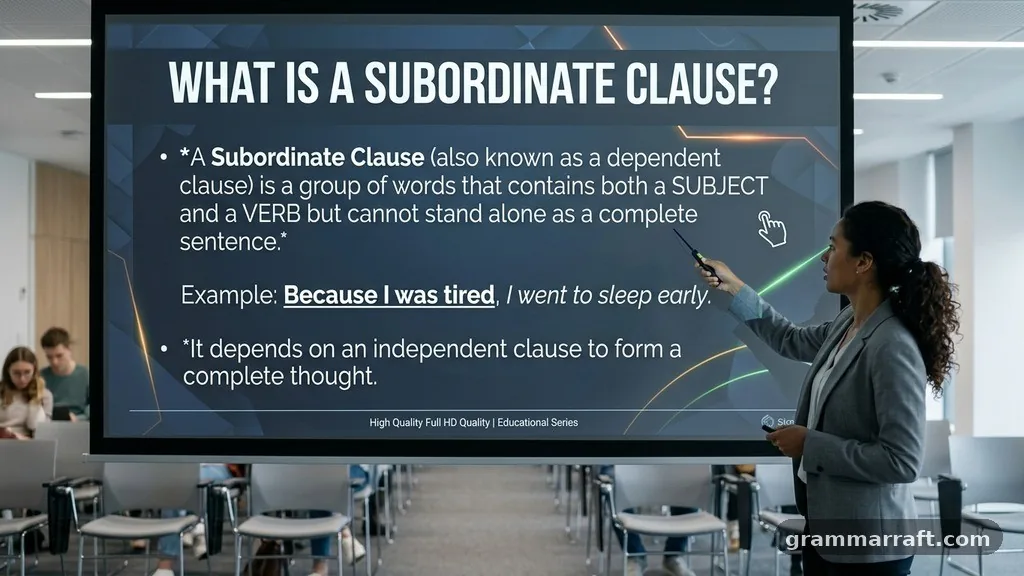
A subordinate clause is a group of words containing a subject and a verb that cannot stand alone as a complete sentence. It adds information to a main clause, often showing time, reason, condition, contrast, or description. Recognising one helps you understand how English sentences are built.
Once you can identify the dependent clause, the independent clause, and the word connecting them, complex sentences become much easier to read and write. The examples below show how subordinate clauses work, where punctuation belongs, and how to avoid common errors such as sentence fragments and comma splices.
What Is a Subordinate Clause?
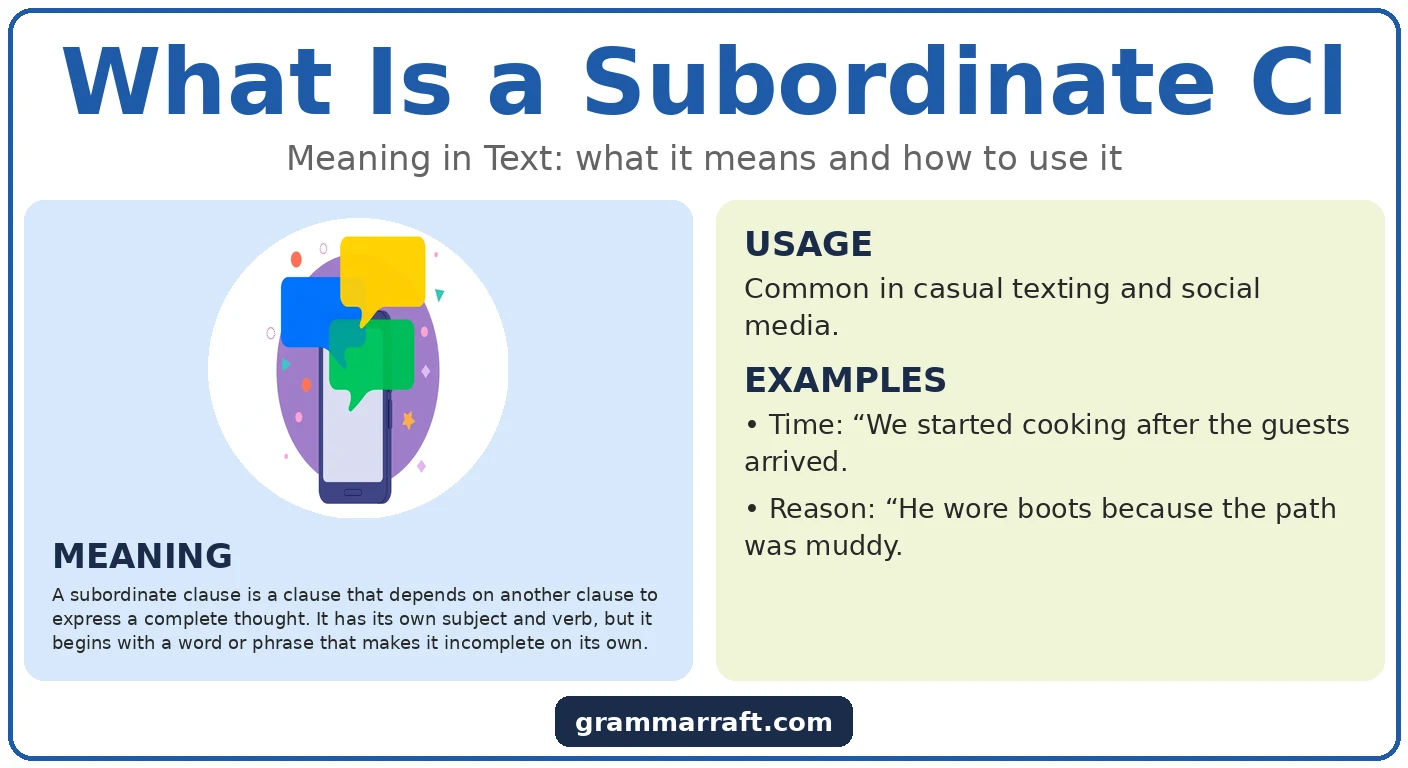
A subordinate clause is a clause that depends on another clause to express a complete thought. It has its own subject and verb, but it begins with a word or phrase that makes it incomplete on its own.
For example, because the road was icy contains a subject, “the road,” and a verb, “was.” However, the phrase leaves the reader waiting for more information. Because the road was icy—what happened?
Attach that clause to an independent clause and the meaning becomes complete: “Because the road was icy, the bus arrived late.” The subordinate clause explains the reason, while “the bus arrived late” can stand alone as a sentence.
Subordinate clauses are also called dependent clauses. The two terms mean the same thing in most grammar explanations, so you may see either one in a textbook, classroom, dictionary, or writing resource.
The word “subordinate” describes the clause’s grammatical relationship. It does not mean that the information is unimportant; it means the clause depends on the main clause for grammatical completeness.
The basic definition in simple terms
A useful test is to ask whether the group of words can stand alone with a complete meaning. If it cannot, but it contains both a subject and a verb, it may be a subordinate clause.
- Independent clause: “Maya finished her homework.”
- Subordinate clause: “Although Maya was tired.”
- Complete sentence: “Although Maya was tired, she finished her homework.”
The subordinate clause usually begins with a subordinating conjunction or a relative word. Some clauses instead begin with a phrase such as “to whom” or “whose,” depending on their role in the sentence.
Subordinate Clause vs. Independent Clause
The clearest way to understand a subordinate clause is to compare it with an independent clause. An independent clause contains a subject and a verb and expresses a complete thought, so it can function as a sentence by itself.
Consider the sentence “The children played outside while their parents prepared dinner.” “The children played outside” is an independent clause. “While their parents prepared dinner” is a subordinate clause because “while” introduces a time relationship and leaves the idea dependent on the first clause.
| Feature | Independent clause | Subordinate clause |
|---|---|---|
| Contains a subject and verb | Yes | Usually yes |
| Expresses a complete thought | Yes | No, in its dependent form |
| Can stand alone | Yes | No |
| Common opening words | And, but, or no connector | Because, although, if, when, who, that |
| Example | “The lights went out.” | “Because the storm arrived.” |
There is an important distinction between a clause being grammatically dependent and its information being secondary in meaning. A subordinate clause may contain the most interesting detail in the sentence, such as the cause of an event or the condition for an action.
For instance, “If the laboratory confirms the result, the team will publish the report” gives the condition in the subordinate clause. The condition is central to the meaning, even though the clause cannot stand alone.
A quick identification test
First, locate the verbs and their subjects. Next, look for a word that signals dependence, such as “because,” “although,” “unless,” “when,” “which,” or “that.” Finally, read the clause by itself and ask whether it sounds complete.
This test is helpful, but it is not perfect. Words such as “that” can introduce a subordinate clause, but they can also serve other grammatical purposes, so the clause’s full role in the sentence matters.
How Subordinating Conjunctions Work
A subordinating conjunction connects a dependent clause to an independent clause and shows the relationship between their ideas. It tells the reader whether the relationship involves time, cause, contrast, condition, purpose, or another meaning.
In “We stayed indoors because the air quality was poor,” the conjunction “because” introduces a reason. In “Although the forecast looked clear, the hikers packed rain jackets,” “although” introduces a contrast.
The conjunction does more than join words. It changes how the reader interprets the information, which is why choosing the right subordinating word improves precision in academic, professional, and creative writing.
| Relationship | Common subordinating words | Example |
|---|---|---|
| Time | when, while, before, after, until, since | “Call me when you arrive.” |
| Cause | because, since, as | “She left because she felt ill.” |
| Condition | if, unless, provided that | “We’ll go if the weather improves.” |
| Contrast | although, though, even though, whereas | “Although it was late, he kept working.” |
| Purpose | so that, in order that | “She spoke quietly so that the baby would sleep.” |
Some subordinating conjunctions can appear at the beginning or in the middle of a sentence. The meaning stays the same, but punctuation may change depending on the clause’s position.
Compare “Before the show began, the audience found their seats” with “The audience found their seats before the show began.” The first sentence normally uses a comma after the introductory subordinate clause, while the second usually does not need a comma.
Types of Subordinate Clauses
See Also: When to Use a Semicolon: Rules, Examples & Easy Guide
Subordinate clauses perform different jobs in a sentence. The three broad categories commonly taught in English grammar are adverb clauses, adjective clauses, and noun clauses.
The category depends on the clause’s function rather than simply the word that introduces it. An adverb clause modifies a verb or the whole main clause, an adjective clause describes a noun, and a noun clause acts like a noun within a larger clause.
Adverb clauses
An adverb clause explains circumstances such as time, place, reason, condition, purpose, or contrast. It often answers questions such as when, why, how, or under what condition an action happens.
Examples include “When the meeting ended, the employees left” and “The employees left when the meeting ended.” In both versions, “when the meeting ended” modifies the action of leaving by identifying its timing.
Other examples are “We cancelled the picnic because rain was falling,” “Unless you save the file, your changes may disappear,” and “Although the shop was crowded, service was quick.”
Adjective clauses
An adjective clause, often called a relative clause, modifies a noun or pronoun. It usually begins with a relative pronoun such as “who,” “whom,” “whose,” “which,” or “that,” or with a relative adverb such as “where” or “when.”
In “The scientist who led the study answered questions,” the clause “who led the study” describes “the scientist.” The clause cannot stand alone, but it gives the reader information that identifies or further explains the person.
Some adjective clauses are essential to the meaning and do not take commas: “The books that are on the top shelf belong to Lina.” Others add extra information and are separated with commas: “Lina’s books, which are on the top shelf, belong to her grandmother.”
Noun clauses
A noun clause functions as a subject, object, or complement. It may begin with “what,” “why,” “how,” “whether,” “who,” or “that.”
In “What the committee decides will affect the budget,” the noun clause “what the committee decides” serves as the subject. In “The manager explained why the schedule changed,” the clause acts as the object of “explained.”
Noun clauses can be difficult to spot because they do not always describe a visible noun. Try replacing the clause with a single noun or pronoun: “The manager explained the reason.” That substitution shows the clause’s noun-like function.
Subordinate Clause Examples in Sentences
Examples are especially useful because the same sentence can contain more than one type of subordinate clause. Seeing the clause in context makes its function easier to identify than memorising a list of opening words.
In “After the concert ended, the fans who had travelled from abroad waited outside,” “After the concert ended” is an adverb clause describing time. “Who had travelled from abroad” is a relative clause modifying “fans.”
Another example is “I believe that the new plan will work because the evidence is strong.” The clause “that the new plan will work” is a noun clause functioning as the object of “believe.” The clause “because the evidence is strong” is an adverb clause explaining the reason for that belief.
- Time: “We started cooking after the guests arrived.”
- Reason: “He wore boots because the path was muddy.”
- Condition: “You can borrow the car if you fill the tank.”
- Contrast: “Even though the task was difficult, the class completed it.”
- Relative description: “The artist who painted the mural lives nearby.”
- Noun function: “She remembers what the instructor said.”
Notice that each subordinate clause contains a subject and a verb. “After the guests arrived” contains “guests” and “arrived,” while “if you fill the tank” contains “you” and “fill.” A phrase such as “after the concert” does not contain a full subject-verb combination, so it is a prepositional phrase rather than a subordinate clause.
Here is another useful comparison: “Because the store closed” is a subordinate clause, while “Because of the store’s closure” is a prepositional phrase. Both can express a reason, but their grammatical structures are different.
Sentence Position and Comma Rules
A subordinate clause can come before or after the independent clause. The position affects emphasis and often affects comma placement, though the exact punctuation can depend on the clause’s function and whether its information is essential.
When an introductory adverb clause comes first, a comma commonly separates it from the main clause: “If the temperature drops, the pipes may freeze.” This comma helps the reader recognise where the introductory condition ends.
When the same clause follows the main clause, the comma is usually omitted: “The pipes may freeze if the temperature drops.” The sentence remains clear because the main clause appears first.
Essential and nonessential relative clauses
Relative clauses require closer attention. An essential relative clause identifies which person or thing the sentence means, so it normally has no commas: “Students who submit late work must contact the office.” The clause identifies the students being discussed.
A nonessential relative clause adds information that the reader could remove without losing the main identification: “Mr. Patel, who teaches chemistry, organised the visit.” The name already identifies the person, so the extra clause is set off with commas.
Using commas incorrectly can change the meaning. “The employees who completed the training received certificates” refers to a particular group, while “The employees, who completed the training, received certificates” presents the training as information about all the employees.
Do not place a comma between subject and verb
An introductory clause can make a sentence feel long, but the comma should not separate the subject from its verb. Write “Although the experiment was difficult, the researchers continued”, not “Although the experiment was difficult, the researchers, continued.”
Reading aloud can help, but punctuation should follow grammatical structure rather than every pause in speech. A pause in conversation is not automatically a comma in formal writing.
Common Errors with Subordinate Clauses
The most common error is a sentence fragment. A dependent clause may look substantial because it contains several words, but it is still incomplete if it begins with a subordinating conjunction and has no independent clause attached.
“Although the train was delayed.” is a fragment. Correct it by adding a main clause: “Although the train was delayed, we reached the station on time.”
A second error occurs when writers attach a subordinate clause to the wrong part of a sentence. The result may be confusing or may suggest that the clause modifies a noun or verb that it was not intended to describe.
For example, “Walking through the museum, the paintings seemed enormous” makes it sound as if the paintings were walking. A clearer version is “Walking through the museum, I thought the paintings seemed enormous.” The person performing the opening action must be the grammatical subject of the main clause.
Sentence fragments
Fragments often begin with words such as “because,” “when,” “although,” “if,” or “while.” To repair one, either connect it to a nearby independent clause or remove the subordinating word if the intended meaning allows a complete sentence.
For example, “Because the printer ran out of ink” can become “The report was incomplete because the printer ran out of ink.” Alternatively, if the reason is not needed, “The printer ran out of ink” is already complete.
Comma splices and run-on sentences
A comma splice joins two independent clauses with only a comma. Subordinate clauses are not the cause of every comma splice, but writers sometimes misread a long sentence and connect its clauses incorrectly.
The sentence “The deadline was close, we worked through lunch” contains two independent clauses. Fix it with a period, semicolon, or coordinating conjunction: “The deadline was close, so we worked through lunch.”
A subordinate clause can help create a smoother relationship: “Because the deadline was close, we worked through lunch.” Here, the first clause gives the reason and the second supplies the complete action.
How to Find a Subordinate Clause Step by Step
Identifying subordinate clauses becomes easier if you use the same process each time. This approach works for short classroom examples and longer sentences in books, reports, or workplace documents.
- Find the verbs. Look for action verbs, linking verbs, and auxiliary verbs such as “has,” “will,” or “can.”
- Find each subject. Ask who or what performs the action or exists in the state described by the verb.
- Group the subject with its verb. Each subject-verb combination may form a clause.
- Look for a subordinating word. Check for “because,” “although,” “if,” “when,” “who,” “which,” “that,” and similar words.
- Test the clause alone. If it cannot express a complete thought by itself, it is probably dependent.
- Identify its job. Decide whether it gives adverb information, describes a noun, or acts like a noun.
Take the sentence “While the technician checked the wiring, the supervisor explained what had happened.” The first clause is “While the technician checked the wiring,” which gives a time relationship. The second part contains the independent clause “the supervisor explained” and the noun clause “what had happened,” which functions as the object of “explained.”
This method prevents a common mistake: treating every group of words separated by a comma as a clause. A clause requires a subject and a verb, while a phrase may contain neither or may contain only a nonfinite verb form.
Why Subordinate Clauses Matter in Writing
Subordinate clauses allow writers to show relationships between ideas instead of presenting every thought as a short, separate sentence. They help explain causes, conditions, timing, exceptions, and qualifications.
Compare “The company changed its policy. Customers complained. The old policy was confusing.” with “Because customers complained about the confusing old policy, the company changed its rules.” The second version makes the cause-and-effect relationship explicit.
Subordination also helps writers control emphasis. In “Although the design was attractive, the engineers rejected it,” the main emphasis falls on the rejection, while the attractive design appears as a concession.
Subordination and coordination
Coordination joins ideas of equal grammatical status, usually with words such as “and,” “but,” or “or.” Subordination makes one idea grammatically dependent on another, which can signal that one fact is a reason, condition, time marker, or qualification.
“The road was closed, so we took a different route” uses coordination. “Because the road was closed, we took a different route” uses subordination and presents the road closure as the reason for the decision.
Neither structure is automatically better. Coordination can create a direct, balanced rhythm, while subordination can show logical relationships more precisely. Strong writing uses both rather than making every sentence follow one pattern.
Subordination and sentence variety
Using subordinate clauses can vary sentence openings and rhythms. Writers can begin with the main idea, place background information first, or embed a relative clause inside a noun phrase.
For example, “The researchers published the results after the review ended” is direct. “After the review ended, the researchers published the results” gives the timing more prominence, while “The researchers, who had repeated the trial, published the results” adds background detail.
Too many subordinate clauses can make writing dense, especially if several clauses are nested inside one another. If a sentence requires repeated rereading, divide it into two sentences and preserve only the relationships that readers need.
Subordinate Clauses for English Learners
See Also: How to Avoid Passive Voice in Writing (With Examples)
English learners often recognise the vocabulary in a sentence before they understand its clause structure. A useful exercise is to mark the independent clause with “M” for main and the subordinate clause with “D” for dependent.
In “When the lesson ended, the students asked questions,” “When the lesson ended” is D and “the students asked questions” is M. In “The students asked questions because the final topic was difficult,” the order is M followed by D.
Word order can change slightly in questions and embedded clauses. Compare “Where does the train stop?” with “I know where the train stops.” In the embedded noun clause, the subject comes before the verb, so “where the train stops” is correct rather than “where does the train stop.”
Another challenge is distinguishing “because” from “because of.” “Because” introduces a clause with a subject and verb: “We stayed home because it rained.” “Because of” introduces a noun or noun phrase: “We stayed home because of the rain.”
Relative words also require practice. “Who” generally refers to people, “which” commonly refers to things, and “that” can introduce restrictive relative clauses in many contexts. Usage choices can vary by style, but the clause must still connect clearly to the noun it describes.
For additional definitions of grammatical terms, learners can consult the Merriam-Webster dictionary entry for “clause”. A dictionary can confirm terminology, while sentence analysis shows how that terminology works in real writing.
Subordinate Clause Practice and Answers
Practice is most useful when you identify both the clause and its function. Do not stop after circling the opening word; explain what the clause contributes to the complete sentence.
- “If the package arrives today, we will install the equipment.” The opening clause is an adverb clause showing condition.
- “The musician who won the award thanked her teacher.” The clause beginning with “who” is a relative clause describing “musician.”
- “I understand why the schedule changed.” The clause beginning with “why” is a noun clause serving as the object of “understand.”
- “Although the recipe looked simple, preparation took an hour.” The opening clause is an adverb clause showing contrast.
- “We will wait until the manager returns.” The clause beginning with “until” is an adverb clause showing time.
Now compare these fragments: “Unless the temperature rises”, “who lives next door”, and “because the instructions were unclear.” Each has dependent meaning and must be attached to an independent clause to become a complete sentence.
Possible repairs include “Unless the temperature rises, the ice will remain,” “The neighbour who lives next door brought us the package,” and “We asked for help because the instructions were unclear.” The precise wording may change, but each corrected sentence contains a complete main clause.
For a final editing check, underline every subordinate clause in your own paragraph. Ask whether each one connects logically to the main clause, whether its punctuation is appropriate, and whether the sentence remains easy to follow when read aloud.
Frequently Asked Questions
What is the simplest definition of a subordinate clause?
A subordinate clause is a group of words with a subject and a verb that cannot stand alone as a complete sentence. It depends on an independent clause and often begins with a subordinating conjunction or relative word.
What is an example of a subordinate clause?
“Because the store was closed” is a subordinate clause. It becomes part of a complete sentence when joined to an independent clause: “Because the store was closed, we ordered online.”
Is a subordinate clause the same as a dependent clause?
Yes. “Subordinate clause” and “dependent clause” are two common names for the same grammatical structure. Both describe a clause that cannot function as a complete sentence by itself.
Does a subordinate clause always need a comma?
No. An introductory subordinate clause is commonly followed by a comma, as in “When the bell rang, the students left.” A subordinate clause at the end often does not need one: “The students left when the bell rang.” Relative clauses may or may not use commas depending on whether their information is essential.
Can a sentence have more than one subordinate clause?
Yes. A sentence can contain several dependent clauses with different functions. For example, “When the teacher arrived, the students who had finished their work explained what they had learned” contains a time clause, a relative clause, and a noun clause.
Conclusion
Knowing what a subordinate clause is gives you a practical way to analyse sentences and improve your writing. Look for the subject, verb, and subordinating word, then decide whether the clause shows time, reason, condition, contrast, description, or another relationship.
The key habit is to connect every dependent clause to a clear independent clause and check punctuation according to its position and purpose. Once subordinate clause patterns become familiar, you can write more precise complex sentences without creating fragments or confusing connections.
Explore more helpful guides on GrammarRaft.