Could or Can: Meaning, Difference, and Correct Use?
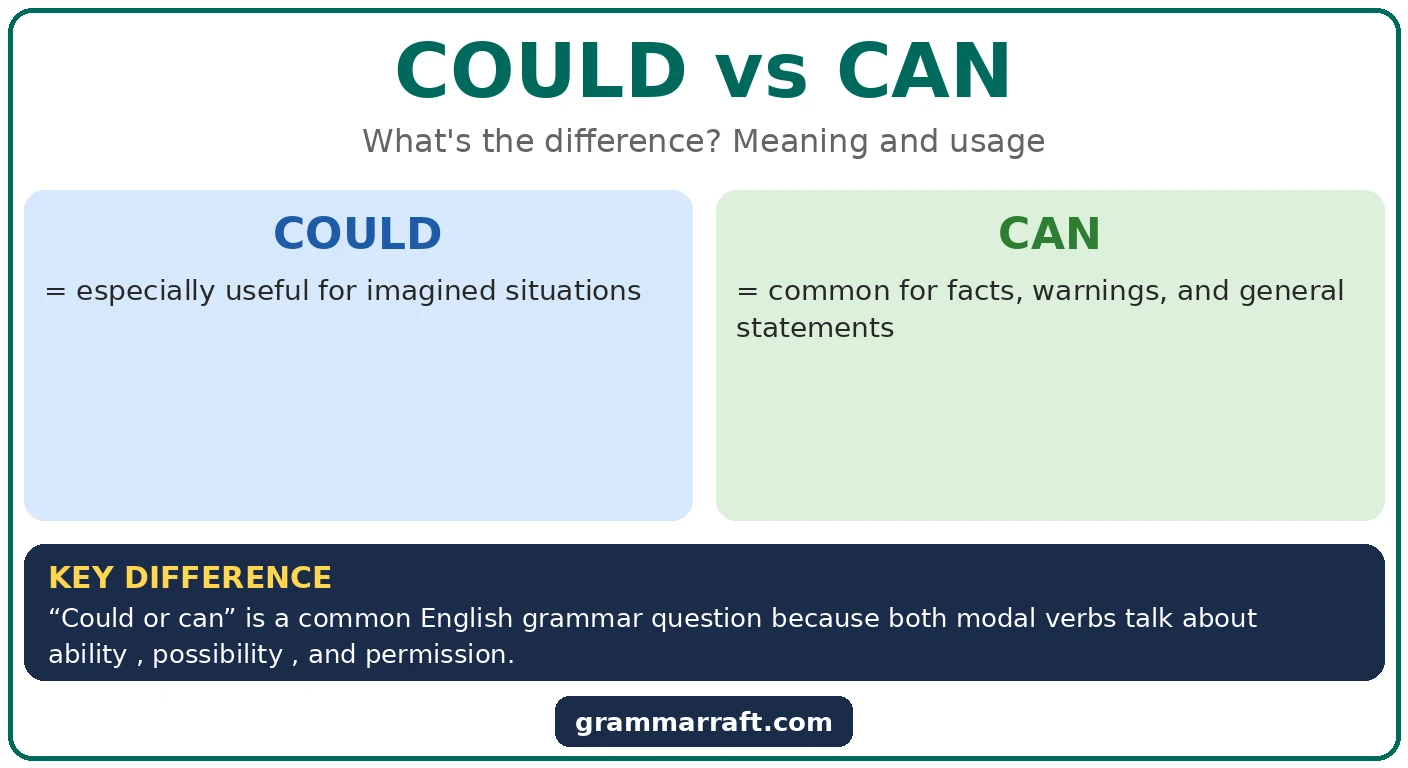
“Could or can” is a common English grammar question because both modal verbs talk about ability, possibility, and permission. They often appear in similar sentences, but they do not always create the same meaning or level of politeness.
The choice depends on time, certainty, tone, and the kind of action being described. “Can” usually sounds more direct or immediate, while “could” often points to the past, a less certain possibility, or a more careful request.
Learning the difference between could and can will help you ask permission naturally, describe what someone is able to do, and avoid tense mistakes. The examples below show how each word works in everyday English.
Could or Can: The Basic Difference
The simplest distinction is that can commonly expresses present ability, present possibility, or informal permission, while could commonly expresses past ability, a weaker possibility, or a more polite request. Neither word changes for the subject: we say “I can,” “she can,” and “they can,” not “she cans.”
Compare these two sentences: “I can swim” describes an ability that exists now, while “I could swim when I was five” describes an ability that existed in the past. The first sentence focuses on the present; the second shifts the ability into an earlier period.
The difference is not always about tense. “Could you help me?” refers to a present request, but “could” makes the request sound more polite and less forceful than “Can you help me?” In this use, “could” is not necessarily past tense.
| Word | Common meaning | Example | Typical effect |
|---|---|---|---|
| Can | Present ability | She can drive. | Direct and certain |
| Could | Past general ability | She could drive at seventeen. | Connected with the past |
| Can | Present possibility | That can happen. | General or realistic |
| Could | Possible situation | That could happen. | Less certain or hypothetical |
| Can | Informal permission | Can I leave early? | Natural and conversational |
| Could | Polite permission or request | Could I leave early? | More careful and respectful |
These patterns are useful, but they are not rigid rules for every sentence. Context decides whether the speaker is talking about ability, permission, possibility, or a hypothetical result.
Can for Present Ability and Skills
Use can to say that someone has the ability to do something now. “Marcus can speak Spanish” means Marcus currently has that skill, while “This phone can record video” describes a current function or capability.
Can also describes a temporary ability in a particular situation. For example, “I can meet you after work” may not describe a permanent skill; it means the speaker is available or able to meet at that time.
Positive statements with can

The structure is straightforward: subject + can + base verb. The verb after “can” does not take “to,” so we say “I can go,” not “I can to go,” and “She can help,” not “She can helps.”
- I can finish the report tonight.
- He can repair the bicycle.
- We can hear music from the next room.
- They can answer the question in English.
Can may describe physical ability, learned skill, access, or an available option. “You can use my laptop” can mean permission, while “You can lift that box” may describe physical ability or a judgment about what is possible.
Negative ability with cannot and can’t
The negative form is cannot or the contraction can’t. “I can’t attend the meeting” usually means I am unable to attend, although the reason might be lack of time, permission, health, transport, or another practical problem.
In formal writing, “cannot” is often preferred, especially when the writer wants to avoid an informal tone. In speech and casual messages, “can’t” is completely natural.
Do not add “to” after can in a negative sentence. The correct form is “She can’t drive,” not “She can’t to drive.” This rule applies because can is a modal verb, and modal verbs are followed by the base form of another verb.
Could for Past Ability
Use could to describe a general ability that existed in the past. “When I was younger, I could run five miles” tells us that the speaker had that capacity at an earlier time, even if it is no longer true.
Other examples include “My grandfather could read three languages” and “Before the injury, she could play tennis for hours.” These statements describe broad past abilities rather than one isolated successful event.
Could for general past ability
“Could” works well when the ability was available repeatedly or over a period. It can cover skills, senses, mental abilities, and physical actions.
- At six, Lena could already read.
- We could see the mountains from our old house.
- He could remember every street in the neighborhood.
- They could communicate without a translator.
For a single successful action in the past, English often uses was able to or managed to instead of could. “After three attempts, I was able to open the door” suggests one specific success, while “As a child, I could open difficult jars” describes a general ability.
When could is not the best choice
“Could” can sound unnatural if the sentence concerns one particular event that required effort and ended successfully. “The firefighters could rescue the child yesterday” is possible in some contexts, but “The firefighters were able to rescue the child yesterday” more clearly presents the rescue as a completed result.
That distinction matters because “could” sometimes describes opportunity rather than achievement. “We could visit the museum” means a visit was possible, not that the visit actually happened.
For a negative past ability, “couldn’t” is often suitable for both general and specific situations. “I couldn’t swim as a child” describes general inability, while “I couldn’t open the window this morning” describes one unsuccessful attempt.
Can and Could for Possibility
Both modal verbs can express possibility, but they usually communicate different degrees or types of possibility. Can often describes something that is generally possible, while could presents a particular possibility that is less certain, conditional, or hypothetical.
“Mistakes can happen” means mistakes are a normal possibility in that kind of situation. “A mistake could happen” points to a possible outcome in this specific situation, but the speaker does not present it as certain.
General possibility with can
Can is common for facts, warnings, and general statements. “Heavy rain can cause flooding” does not predict flooding at one exact moment; it describes a known relationship between heavy rain and flooding.
Can also express a characteristic or recurring result. “This medication can cause drowsiness” means drowsiness is a possible effect for some users, not that every person will experience it.
- Cold weather can damage exposed pipes.
- Long meetings can reduce concentration.
- A loose cable can create a safety problem.
- Small changes can improve the final result.
Specific or hypothetical possibility with could
Could often sounds more tentative. “The train could be late” means lateness is one possible explanation or outcome, but the speaker lacks complete information.
It also appears in conditional sentences: “If we leave now, we could arrive before dark.” The sentence describes a possible result that depends on a condition.
Could does not always mean that something is unlikely. “The new policy could reduce waiting times” may describe a realistic expectation, especially when the speaker is being cautious rather than making a firm prediction.
Asking for Permission: Can I or Could I?
Both “Can I?” and “Could I?” are used to ask permission. “Can I borrow your charger?” is common in everyday speech, while “Could I borrow your charger?” sounds more polite, formal, or considerate.
Some traditional grammar advice says that “can” should express ability and “may” should express permission. In modern English, however, native speakers regularly use “can” for informal permission, especially with friends, family, classmates, and coworkers.
| Request | Meaning | Natural context |
|---|---|---|
| Can I use your phone? | Permission requested directly | Conversation with someone familiar |
| Could I use your phone? | Permission requested politely | Workplace, service setting, or careful request |
| May I use your phone? | Permission requested formally | Formal speech or institutional setting |
| Am I allowed to use your phone? | Permission or rule clarified | Policy, instructions, or uncertainty about rules |
“Could I?” is not always more respectful because of the listener’s status. It often sounds softer because it gives the other person more room to refuse without pressure.
A useful response is “Yes, you can,” even when the question was “Could I?” The question uses “could” to make the request polite, but the answer uses “can” to grant present permission.
Requests for another person to act
“Can you send the file?” is a direct request about ability or willingness. “Could you send the file?” is usually more polite, particularly in professional email or when asking someone who is busy.
Adding “please” does not automatically make “can” rude. “Can you please close the door?” is perfectly normal, but “Could you please close the door?” has a gentler tone.
For a formal written request, phrases such as “Could you please confirm receipt?” and “Could you provide the updated schedule?” are conventional. They sound professional without becoming excessively formal.
Could Have and Can Have: Past Possibility
The forms could have + past participle and can have + past participle need careful attention. “Could have missed” refers to a possible past event, while “can have missed” is generally not used in the same way in standard modern English.
For example, “She could have taken the earlier train” may mean it was possible for her to take it, or it is possible that she did take it. The surrounding context determines which meaning is intended.
Could have for missed opportunities
“Could have” can describe an opportunity that was available but not used. “We could have saved money by booking earlier” means saving money was possible, but the speakers did not do it.
It can also express criticism or regret. “You could have called me” often means the person had the opportunity to call and should have done so.
- I could have finished sooner with better instructions.
- They could have avoided the delay.
- He could have asked for help.
Could have for uncertain past events
“Could have” can also show that the speaker is unsure about what happened. “The noise could have come from the kitchen” presents one possible explanation, not a confirmed fact.
Other modal forms may be more natural depending on the meaning. “She may have forgotten” and “She might have forgotten” both suggest uncertainty, while “She couldn’t have forgotten” means the speaker believes forgetting was impossible or very unlikely.
“Can have” appears in some structures, but it is not normally the ordinary replacement for “could have.” For example, “It can have serious effects” describes a general present possibility, while “It could have had serious effects” refers to a possible past result.
Could in Conditional and Hypothetical Sentences
Could is especially useful for imagined situations. It often appears in the result clause of a conditional sentence: “If we had more time, we could visit the gallery.” The sentence does not say that the visit will happen; it describes what would be possible under a different condition.
In first conditional sentences, “could” can describe a possible result: “If you leave now, you could catch the bus.” The condition is realistic, but the result is not guaranteed.
| Pattern | Example | Purpose |
|---|---|---|
| If + present, could + base verb | If we hurry, we could catch the bus. | Realistic possible result |
| If + past, could + base verb | If I had time, I could help. | Unreal or unlikely present situation |
| If + past perfect, could have + participle | If they had left earlier, they could have arrived on time. | Alternative past result |
Could compared with would
Could describes possibility or ability, while would describes a likely result, preference, or imagined action. “If I had enough money, I could buy the car” means buying it would be possible; “If I had enough money, I would buy the car” states the speaker’s intended choice.
The two words can appear together. “If the weather improved, we could go outside, and the children would enjoy it” means the improved weather would make the outing possible, while enjoyment is presented as the expected reaction.
Could is also useful for suggesting solutions without sounding overly forceful. “You could contact the supplier” offers one option, whereas “You should contact the supplier” gives stronger advice.
Could or Can in Polite English
English uses modal verbs to manage social tone as well as literal meaning. Can is often shorter and more direct, while could creates distance that may sound more respectful, less demanding, or more tentative.
That does not mean “can” is impolite. A friend asking “Can you pick me up?” is not necessarily being rude. The relationship, urgency, wording, and situation all affect how the request is heard.
Choosing the right level of directness
Use “can” when the situation is familiar and a direct request is appropriate. Use “could” when you want to sound more careful, when the request is an inconvenience, or when you are speaking to someone you do not know well.
- Can you pass the salt? — casual and direct.
- Could you pass the salt? — polite and slightly softer.
- Would you mind passing the salt? — indirect and considerate.
- Could you possibly pass the salt? — very cautious, sometimes overly formal.
In customer service, “Could you confirm your address?” is usually more comfortable than “Can you confirm your address?” Both are grammatically correct, but “could” reduces the sense of command.
Politeness is not only grammar
Word choice matters, but tone of voice and context matter just as much. “Could you do that now?” can sound impatient if spoken sharply, while “Can you help me for a moment?” can sound warm and reasonable.
Adding a brief explanation can also make a request more cooperative. “Could you send the invoice today? We need it for the afternoon payment run” gives the listener useful context without making the sentence unnecessarily formal.
For a deeper reference on how modal verbs function in English grammar, the Cambridge Dictionary grammar reference provides explanations and examples from an established language authority.
Common Errors with Could and Can
Many mistakes happen because learners translate directly from another language or treat could as a simple past form in every situation. Understanding the meaning of the whole sentence is more reliable than changing can to could mechanically.
Using “to” after a modal verb
Do not use “to” after can or could. The correct forms are “I can understand,” “She could arrive,” and “They can help.” The forms “I can to understand” and “She could to arrive” are incorrect.
There are exceptions with expressions such as “be able to,” but that is a different structure. “I will be able to attend” is correct because “able” is an adjective that takes “to,” not a modal verb.
Adding -s to the main verb
Modal verbs are followed by the base form, even when the subject is he, she, or it. Write “He can speak French,” not “He can speaks French,” and “She could understand,” not “She could understands.”
Confusing possibility with certainty
“It can rain tomorrow” is possible in some varieties of English, but “It could rain tomorrow” is usually the more natural prediction for one future event. “It can rain heavily in this region” works better as a general statement about climate or recurring conditions.
Using could for every past event
Could is not a universal past form of can. “I could see the stage” describes past ability, but “I was able to see the stage after moving seats” emphasizes a successful action in one particular situation.
When editing, ask three questions: Is the sentence about a current ability, a past general ability, or a possible result? Is the request casual or polite? Is the possibility general or tied to one situation?
How to Choose Between Could and Can
A quick decision process can make the choice easier. First identify the meaning, then consider time and tone. Do not choose only because one word looks like the past form of the other.
- Check ability now: use “can” for a current skill or capacity, as in “I can solve this problem.”
- Check general ability in the past: use “could,” as in “I could solve similar problems at school.”
- Check general possibility: use “can” for recurring or typical outcomes, such as “Errors can occur.”
- Check a particular possibility: use “could” for a possible event, such as “Errors could occur during the transfer.”
- Check permission: use “can” in casual situations and “could” for a softer request.
- Check a hypothetical result: use “could” when an action would be possible under a condition.
Consider the sentence “I can meet you tomorrow.” This usually means the speaker is available and has made a fairly clear statement. “I could meet you tomorrow” sounds less definite and may imply that the speaker needs to check another commitment.
Now compare “The plan can fail” with “The plan could fail.” The first sounds like a general warning about the plan’s weaknesses; the second focuses on a possible outcome in the current situation.
When two forms both seem possible, ask what the listener needs to understand. If the key idea is certainty or current ability, can may be best. If the key idea is politeness, uncertainty, past ability, or a conditional option, could will often communicate it more accurately.
FAQ: Could or Can
Is “could” just the past tense of “can”?
Sometimes, but not always. Could is the past form of can when it describes general ability in the past, as in “I could read before I started school.” It also expresses present politeness, possibility, and hypothetical situations, so its meaning must be judged from context.
Is “Can I?” grammatically correct for asking permission?
Yes. “Can I?” is standard in informal modern English and is widely used to ask for permission. “Could I?” is also correct and usually sounds more polite or less direct, while “May I?” has a more formal tone.
Which is more polite: “Can you” or “Could you”?
“Could you” is generally perceived as more polite because it softens the request. “Can you” is still acceptable and natural, especially in casual conversation, but the best choice depends on the relationship and situation.
Can “could” describe a future possibility?
Yes. “Could” often describes a future event that is possible but not certain, as in “The package could arrive tomorrow.” It can also appear in conditional sentences, such as “If we leave early, we could reach the coast before noon.”
Should I use “could” or “was able to” for one past success?
Use “was able to” or “managed to” when you want to emphasize one completed success. “I was able to fix the printer after checking the manual” is clearer than “I could fix the printer” if the sentence refers to one specific occasion.
Conclusion
The choice between could or can depends on the meaning you need: present ability usually takes “can,” general past ability takes “could,” and specific possibility or polite requests often favor “could.” Can is also natural for informal permission, while could gives requests a softer tone.
When you are unsure, identify the time, certainty, and social setting before choosing. A few careful comparisons—such as “I can help,” “I could help,” and “I could have helped”—make the difference clear, and regular practice will make the choice feel natural.
Related Articles
- Whos vs Whose: Meaning, Difference and Correct Use
- Whose vs Whos: Meaning, Difference and Correct Use?
- Sneaked vs Snuck: Meaning, Grammar, and Correct Use
Explore more helpful guides on GrammarRaft.