Good Communication: Meaning, Skills, and Practical Examples
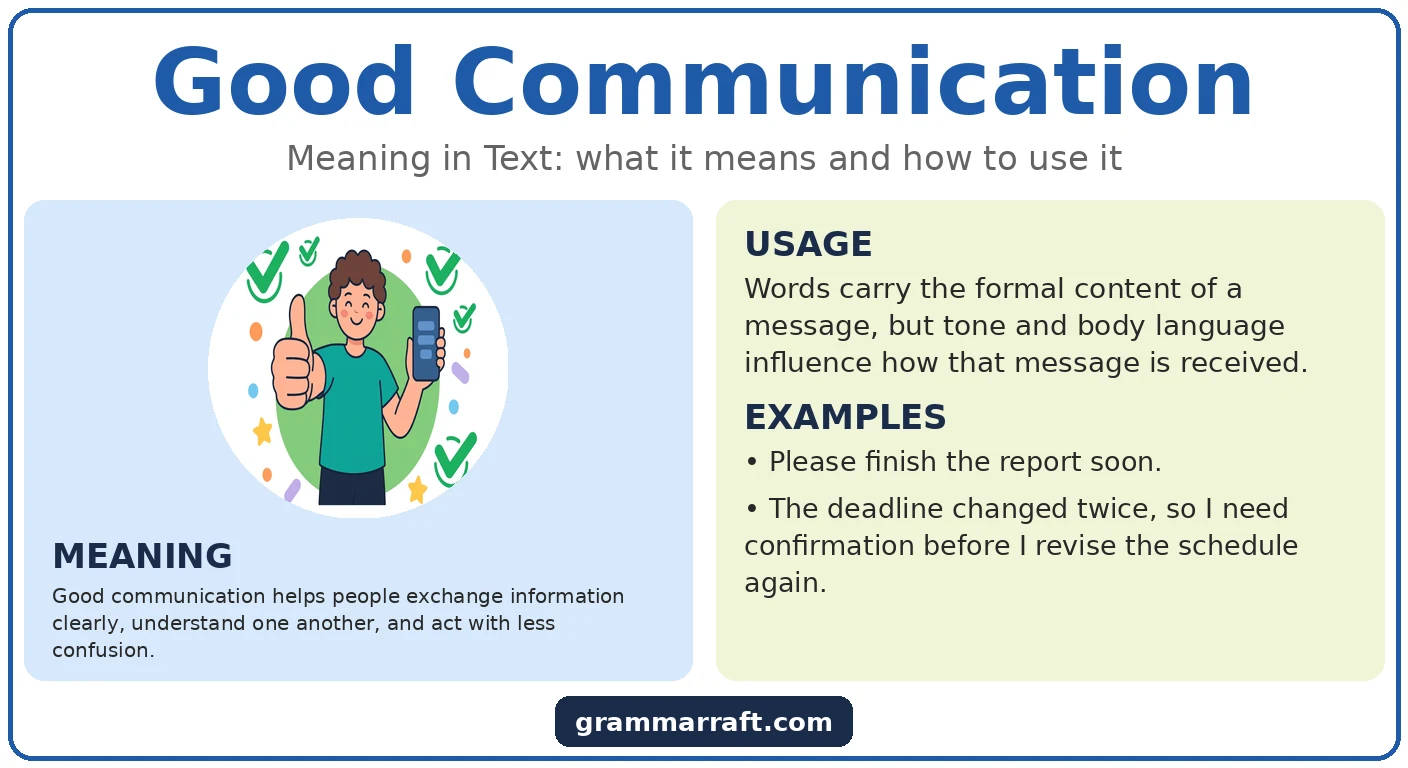
Good communication helps people exchange information clearly, understand one another, and act with less confusion. It matters in ordinary conversations, close relationships, classrooms, customer service, and every workplace where people need to make decisions together.
Effective communication is more than choosing the right words. It also involves listening, tone, timing, body language, emotional awareness, and the ability to adapt a message to the person receiving it.
This article explains what good communication looks like in practice, why misunderstandings happen, and how to improve communication skills without sounding scripted. You’ll find examples for teams, clients, relationships, email, difficult conversations, and everyday situations.
What Good Communication Really Means
Good communication is the successful exchange of meaning between people. One person sends a message, another person interprets it, and both have enough shared understanding to respond appropriately. The exchange may happen through speech, writing, gestures, facial expressions, or a combination of all four.
Being clear is important, but clarity alone isn’t enough. A person can deliver a perfectly understandable message in a hostile tone, at the wrong time, or without listening to the response. Good communication combines clarity, respect, attention, accuracy, and two-way participation.
Consider a manager who says, “Please finish the report soon.” The words are simple, but “soon” could mean today, tomorrow, or before the end of the week. A stronger message would identify the task, the deadline, the expected format, and the reason the work matters.
Communication also succeeds when the receiver can ask questions without feeling punished for doing so. That does not mean every conversation must be long. Sometimes the most effective exchange is brief because both people understand the goal and the next step.
| Communication element | Weak approach | Stronger approach |
|---|---|---|
| Purpose | Starting without a clear goal | Stating what needs to be decided or understood |
| Clarity | Using vague words such as “later” or “better” | Giving specific details, dates, or examples |
| Listening | Waiting silently to speak | Checking that the other person’s meaning is understood |
| Tone | Sounding dismissive or defensive | Remaining direct, calm, and respectful |
| Follow-up | Assuming everyone remembers the agreement | Confirming responsibilities and next actions |
The central test is practical: after the exchange, do the people involved know what was meant and what happens next? If not, the communication needs more precision or a better opportunity for clarification.
The Core Skills Behind Effective Communication
Strong communication skills work together rather than operating as isolated tricks. Speaking clearly without listening creates one-sided communication, while listening carefully without expressing a clear position can leave a problem unresolved.
The most useful foundation includes these abilities:
- Active listening: paying attention to words, tone, pauses, and the speaker’s main concern.
- Clear expression: presenting an idea in a logical order with language the other person can understand.
- Empathy: recognising how the situation may feel from another person’s perspective.
- Assertiveness: expressing a need, limit, or disagreement without attacking someone.
- Nonverbal awareness: noticing facial expression, posture, eye contact, gestures, and physical distance.
- Adaptability: adjusting detail, channel, tone, and timing to suit the person and situation.
- Feedback: explaining what worked, what needs to change, and how improvement can happen.
These skills matter because the same message may be received differently by different people. A technical explanation may help an experienced colleague but confuse a new client. A joke that works among friends may sound careless in a serious workplace discussion.
Good communicators pay attention to the receiver’s signals. If someone looks confused, stops responding, or asks a question that reveals a different interpretation, repeating the same sentence louder won’t solve the problem. A better response is to reframe the idea, offer an example, or ask what part needs clarification.
Assertiveness deserves special attention. Passive communication hides concerns until resentment builds, while aggressive communication tries to win through pressure. Assertive language describes the situation, explains its effect, and makes a reasonable request: “The deadline changed twice, so I need confirmation before I revise the schedule again.”
Communication skill is therefore not the ability to sound impressive. It is the ability to make meaning easier to share while protecting dignity on both sides.
Listening Is the First Half of Good Communication
Many people think listening means staying quiet while another person speaks. Genuine listening requires more attention than silence. It means trying to understand the speaker’s facts, feelings, priorities, and intended meaning before preparing a reply.
Active listening begins with reducing avoidable distractions. Put down the phone, close unrelated tabs, and give the person enough time to finish a thought. If the conversation is important, face the speaker and use brief signals such as “I see,” “right,” or a nod to show that you’re present.
Questions can reveal whether you’re listening to understand or listening to argue. Open questions such as “What part is causing the biggest problem?” invite useful detail. Clarifying questions such as “Do you mean the deadline or the quality of the work is the main concern?” narrow the issue without assuming an answer.
Reflecting back is another practical method. You might say, “So the client approved the design, but the delivery date is still uncertain.” This gives the other person a chance to correct your interpretation before the conversation moves forward.
Listening does not require agreement. You can understand a person’s position and still disagree with the conclusion. The point is to make sure the disagreement concerns the real issue rather than a distorted version created by guesswork.
Avoid common listening failures such as interrupting, finishing someone’s sentences, checking messages, or immediately telling a similar story about yourself. Advice can also arrive too early. Sometimes a person needs to explain the problem fully before deciding whether they want a solution, reassurance, or simply a witness.
Good listeners also notice what remains unsaid. A normally talkative team member who becomes unusually brief may be uncertain, frustrated, or excluded from the discussion. That signal should prompt a respectful question, not a confident assumption.
Clarity, Tone, and Nonverbal Communication
Words carry the formal content of a message, but tone and body language influence how that message is received. The sentence “That’s fine” can sound reassuring, irritated, or dismissive depending on volume, facial expression, timing, and context.
Clear speech starts with a clear purpose. Before speaking, decide whether you want to inform, request, persuade, solve a problem, or repair a relationship. A conversation becomes easier to follow when the speaker does not switch between several purposes without warning.
A useful structure is simple: state the main point, give the necessary context, explain the effect or reason, and identify the next action. For example: “The launch date needs to move to Friday because testing found two serious errors. I’ll send the revised schedule by noon, and I need approval from the product team before we notify clients.”
Short sentences can help, especially during stressful discussions. Avoid jargon when the other person may not know it, and don’t use vague intensifiers such as “really,” “obviously,” or “basically” instead of concrete information.
Nonverbal communication should be interpreted carefully. Eye contact can show attention, but people differ in comfort, culture, personality, and ability. Crossed arms may indicate coldness, concentration, discomfort, or habit; one gesture rarely proves what someone feels.
The strongest approach is to observe patterns and check your interpretation. If a colleague becomes quiet and looks away after a proposal, ask, “What concerns do you have about this plan?” That is more reliable than deciding that the person is uninterested.
Digital communication removes many nonverbal cues, which increases the risk of misreading intent. A brief email may feel cold, a delayed reply may seem hostile, and a message written in capital letters may look angry even when the sender intended urgency. When emotion or complexity is high, a call or face-to-face conversation may be more suitable than text.
Good Communication in the Workplace
Workplace communication affects coordination, trust, customer experience, and the quality of decisions. A team can have skilled people and useful resources yet still perform poorly if responsibilities are unclear or important information stays in private conversations.
Every work message should answer the questions the receiver is likely to have. What needs to happen? Who owns it?
When is it due? What standard applies?
What should happen if a problem appears? Including these details reduces repeated questions and prevents different people from working from different assumptions.
Meetings benefit from the same discipline. A useful meeting has a stated purpose, the right participants, enough background information, and a clear record of decisions. Not every discussion requires a meeting; a short written update may be better when no debate or shared decision is needed.
Managers should create room for disagreement. If employees believe that raising a concern will damage their reputation, they may remain silent until a small issue becomes expensive. Asking, “What are we missing?” or “What could make this plan fail?” invites specific analysis rather than polite agreement.
Feedback is most helpful when it concerns observable behaviour and its effect. “You’re careless” attacks identity and offers no route forward. “The figures in the final section were not checked against the source file, so the client received two incorrect totals” identifies a problem that can be corrected.
Good feedback also includes a conversation, not just a verdict. Ask whether there was missing information, an unrealistic deadline, or a process problem. Accountability matters, but an organisation learns more when it examines the conditions that produced an error.
For client communication, accuracy and expectation management are central. Don’t promise a delivery date before checking capacity, and don’t hide a delay until the client discovers it. A prompt message that explains the new timing, the reason, and the available options usually preserves more trust than silence.
Communication in Relationships and Difficult Conversations
Close relationships need communication that is honest without being cruel. People often focus on winning an argument, proving intent, or forcing an immediate apology, but lasting improvement usually begins with understanding the impact of an event and agreeing on what should change.
Use specific language instead of broad accusations. “You never listen” invites a defence because it treats one person’s behaviour as a permanent character flaw. “I felt dismissed when you checked your phone while I was explaining the problem” identifies a moment that can be discussed.
The familiar “I” statement can help when it is used accurately. It should not become a way to avoid responsibility or disguise an accusation. A useful pattern is: “When this happened, I felt this way, and I need this next time.”
Timing matters. A difficult issue raised during exhaustion, public embarrassment, or an immediate crisis may produce a reaction rather than a thoughtful exchange. Postponing a conversation can be responsible if you name a specific time to return to it.
Emotional regulation does not mean pretending not to feel angry or hurt. It means creating enough space to choose words instead of releasing every impulse. A short pause, slower breathing, or a walk can prevent a sentence that later becomes the focus of the entire argument.
Repair is an important but overlooked communication skill. A sincere apology names the action, acknowledges the effect, avoids excuses, and explains what will be done differently. “I’m sorry you felt that way” shifts attention back to the other person’s reaction; “I’m sorry I cancelled without telling you, and I’ll give you earlier notice next time” accepts responsibility more clearly.
Some conversations involve boundaries rather than compromise. A boundary explains what you will do to protect your time, safety, or wellbeing. It is not a demand that another person feel differently, and good communication cannot guarantee that someone else will respond respectfully.
For broader guidance on relationships and communication, the American Psychological Association’s communication resources provide a useful starting point. Personal safety should take priority if a conversation involves threats, intimidation, or abuse.
Written, Email, and Digital Communication
Written communication creates a record, which makes it useful for instructions, decisions, schedules, and agreements. It also removes immediate opportunities to correct a misunderstanding, so the writer must provide enough context without burying the main point.
Begin an email with the purpose. “I’m writing to confirm Friday’s delivery schedule” is more useful than a long opening that makes the reader search for the reason. Put the requested action, deadline, or decision where it can be found quickly.
Use one subject for each message whenever possible. If an email about a budget suddenly includes a staffing dispute, the recipient may respond to one issue and overlook the other. Separate topics make replies easier to track.
Before sending, check the tone from the receiver’s perspective. Words such as “obviously,” “as I already said,” and “you failed to” can turn a practical correction into a personal confrontation. Directness is compatible with courtesy.
Messages sent through chat tools need the same care. A fast channel encourages incomplete sentences, fragmented decisions, and constant interruption. If a discussion produces an agreement, record the decision in a place the whole team can access rather than leaving it buried in a private exchange.
Not every message deserves an instant response. Set expectations if you’ll be unavailable, and distinguish urgent matters from ordinary work. People cannot make good choices about priority when every notification appears equally important.
Use accessibility as part of effective communication. Plain language, descriptive headings, readable formatting, captions, transcripts, and text alternatives can help people receive information in different ways. Accessibility is not only a technical concern; it changes who can participate in the conversation.
When emotion is rising in a text exchange, move to a richer channel if appropriate. A phone or video conversation allows questions and tone to be clarified quickly, followed by a short written summary of the decision.
How to Improve Communication Skills
Communication improves through deliberate practice rather than personality change. You don’t need to become highly extroverted, entertaining, or endlessly talkative. The goal is to become more accurate, attentive, adaptable, and comfortable with useful feedback.
Start with one observable habit

Choose a behaviour that can be measured in ordinary interactions. You might pause for two seconds before answering, ask one clarifying question in each important meeting, or summarise agreements before ending a conversation.
Small habits are easier to repeat than vague goals such as “be a better communicator.” After a week, review where the habit helped and where it felt unnatural. Then adjust it rather than abandoning the whole effort.
Practise concise explanations
Take a complicated idea and explain it in three layers: one sentence for the main point, a short explanation for context, and extra detail only if the listener needs it. This prevents both oversimplification and information overload.
Before giving instructions, imagine what the other person does not yet know. A new employee, a client, and a technical specialist may need different examples even if the underlying information is the same.
Ask for useful feedback
General feedback often produces general answers. Ask a trusted colleague, friend, or manager, “Was my main point clear?” “Did I interrupt?” or “What would have made that email easier to act on?”
Listen to the answer without explaining immediately why you behaved that way. Context can matter, but defending every example teaches people that giving honest feedback is not worthwhile.
Review difficult conversations
After a tense exchange, write down what you wanted, what the other person appeared to need, what you said, and where the conversation changed direction. This is not an exercise in blaming yourself; it helps you identify a repeatable pattern.
Perhaps you give too much background before making a request. Maybe you avoid disagreement until your frustration shows through your tone. Once the pattern is visible, you can practise a different response in the next conversation.
Common Communication Mistakes to Avoid
One common mistake is assuming that a message was understood because it was sent. Sending an email, giving an instruction, or explaining a concern completes only the delivery side of communication. Understanding must be checked, especially when the task affects safety, money, deadlines, or other people.
Another mistake is confusing confidence with certainty. A confident statement can still be wrong, incomplete, or poorly timed. Strong communicators leave room for new information and can say, “I don’t know yet,” without turning uncertainty into avoidance.
People also often over-explain when they feel nervous. Extra detail may seem helpful, but it can hide the decision or request. State the main point first, then offer supporting information in a logical order.
Under-explaining creates the opposite problem. “Handle the customer issue” does not tell a team member what authority they have, what outcome is acceptable, or when the matter must be escalated. Specificity is especially important when different people interpret standards differently.
Another failure is using the wrong channel. A sensitive performance discussion should not be reduced to a cold one-line message, while a simple schedule change may not justify a long meeting. Match the channel to the emotional weight, complexity, urgency, and need for a permanent record.
- Don’t interrupt simply because you think you know the ending.
- Don’t use silence as proof that everyone agrees.
- Don’t criticise a person when you can describe the behaviour and its effect.
- Don’t send an angry email before reading it once more.
- Don’t promise confidentiality if you cannot keep it.
- Don’t treat a different communication style as evidence of low ability.
Finally, avoid treating communication as a one-time performance. Trust is shaped by repeated behaviour: whether you keep agreements, correct errors, answer reasonable questions, and speak to people with the same basic respect when pressure rises.
Measuring Whether Communication Is Working
Communication quality can be assessed through outcomes, not just impressions. Ask whether people can explain the decision, complete the task, find the information, and raise concerns before the problem grows.
In a workplace, useful signs include fewer repeated questions, clearer ownership, faster resolution of misunderstandings, and more accurate handoffs between teams. These signals do not prove that every conversation is effective, but they can reveal where a process is creating avoidable confusion.
Customer communication can be reviewed by examining recurring complaints, missed expectations, escalation patterns, and the questions clients ask repeatedly. If many customers ask for the same missing detail, the original message probably needs revision.
Personal communication has different measures. A relationship may improve when difficult topics can be raised earlier, apologies become more specific, and both people can disagree without threats or contempt. The aim is not constant harmony; healthy communication must also make room for honest difference.
Ask the receiver what would make the message more useful. This question shifts attention away from the speaker’s intention and toward the actual experience of receiving the information. Intent matters, but impact supplies important evidence.
Reviewing communication should not become surveillance or a demand that everyone use the same style. Quiet reflection, direct feedback, and occasional process checks are usually more helpful than scoring every interaction. People communicate differently, and effectiveness depends on context.
The most valuable measure is whether communication helps people make better decisions together. If a message creates clarity, appropriate action, and a respectful opportunity to respond, it has done its job.
FAQ About Good Communication
How do you describe good communication?
Good communication is a clear, respectful, two-way exchange in which people understand the meaning, purpose, and expected next step of a message. It includes speaking, listening, nonverbal signals, emotional awareness, feedback, and appropriate use of the communication channel.
What are the five most important communication skills?
The five commonly useful skills are active listening, clear speaking or writing, empathy, assertiveness, and nonverbal awareness. Adaptability and feedback are also important because a message may need to change depending on the audience and the result.
What are examples of effective communication?
Examples include confirming a deadline in writing, asking a clarifying question before starting a task, summarising another person’s concern, giving behaviour-based feedback, and telling a client about a delay before it becomes a surprise. Each example reduces uncertainty and supports a specific next action.
How can I improve my communication at work?
Start by making requests specific, listening without interrupting, and recording decisions after meetings. Ask for feedback on whether your messages are clear, and choose a communication channel that matches the issue’s urgency, complexity, and sensitivity.
Why does communication fail even when people use simple words?
Communication can fail because people have different assumptions, priorities, experiences, emotional states, or expectations. Tone, timing, body language, missing context, and vague terms can also change how simple words are interpreted.
Conclusion
Good communication is built from ordinary choices: listen before responding, state the purpose, use specific language, check understanding, and treat the other person with respect. The same principles support a workplace instruction, a client update, a difficult relationship conversation, and a short email.
Choose one communication habit to practise this week, such as asking a clarifying question or confirming the next step aloud. As those small behaviours become consistent, good communication becomes less about saying the perfect thing and more about creating shared understanding people can rely on.
Related Articles
- Make a Difference: Meaning, Examples, and Practical Ways to Help
- What Does FYTB Mean? Meaning, Slang, Examples & How to Use It
- Walk It Off Meaning: Definition, Origin, Uses, and Examples
Explore more helpful guides on GrammarRaft.