
Walk It Off Meaning: Definition, Origin, Uses, and Examples
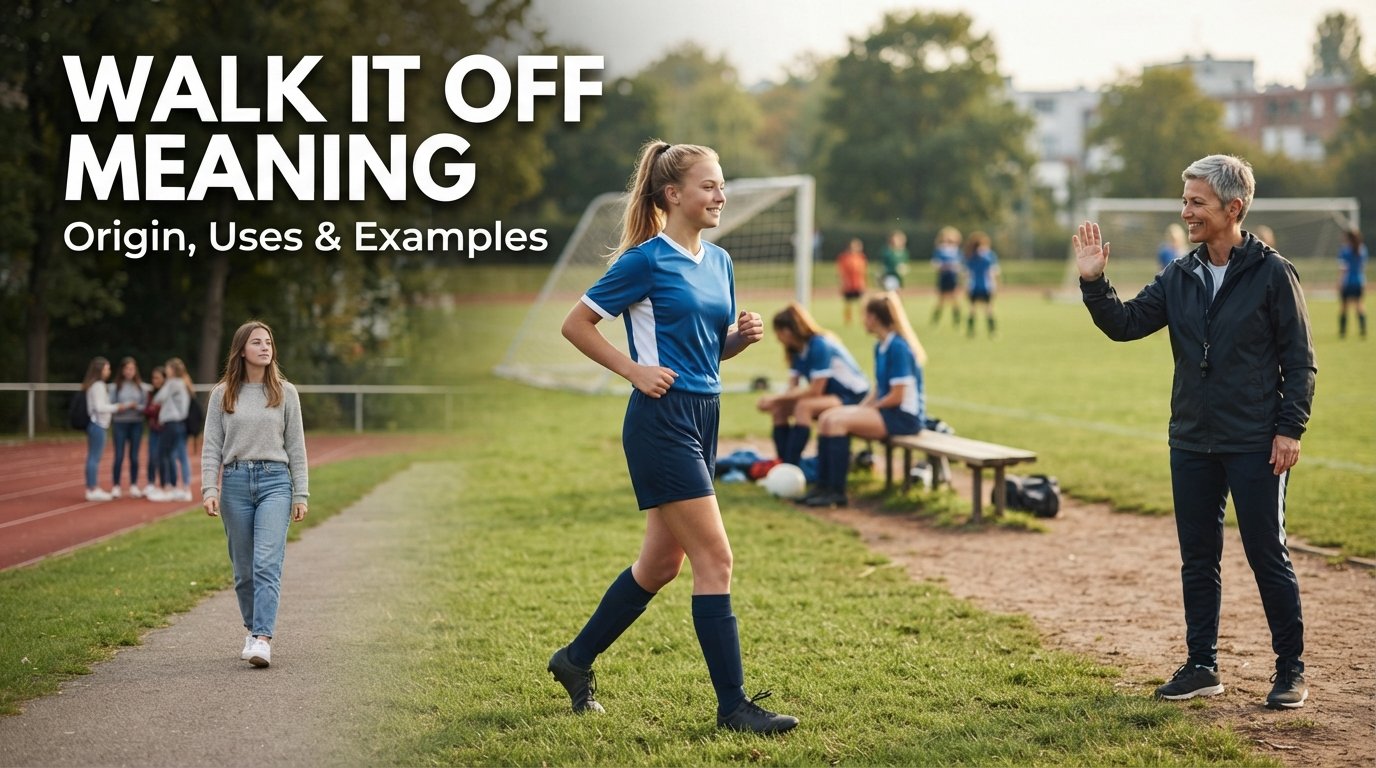
If someone tells you to “walk it off,” they may not literally be talking about walking. The phrase can describe physical recovery after a minor injury, but it can also mean getting over a small emotional setback, embarrassment, or frustrating moment.
You may hear it on a sports field, in a gym, at home, or during an ordinary conversation. A coach might tell an athlete to walk off a minor cramp. A friend might use the same phrase after you make an awkward mistake.
The meaning depends heavily on the context, tone, and situation.
Although “walk it off” is often associated with toughness and resilience, it isn’t appropriate for every injury or emotional struggle. Understanding how the expression works can help you use it naturally without sounding careless or dismissive.
What Does “Walk It Off” Mean?
The walk it off meaning can be understood in two main ways: a literal physical meaning and a figurative emotional meaning.
Literally, “walk it off” means to keep moving gently after experiencing minor discomfort, stiffness, or a small physical problem.
Figuratively, it means to stop focusing on a minor problem, recover from an unpleasant experience, and move forward.
For example:
“You bumped your leg, but it doesn’t look serious. Walk it off.”
Here, the speaker is referring to physical discomfort.
Now consider:
“That presentation didn’t go well, but don’t worry. Walk it off and try again tomorrow.”
In this case, nobody expects the person to physically walk away from the presentation. The phrase means to recover emotionally and avoid dwelling on the mistake.
So, depending on the situation, “walk it off” can suggest movement, recovery, resilience, or simply moving past something.
Literal Meaning of “Walk It Off”
The literal use of “walk it off” is especially common in sports and physical activities.
Imagine a soccer player receives a light knock on the leg. There is no serious pain, swelling, or obvious injury. The player stands up and slowly walks around before returning to practice.
Someone might say:
“Give it a minute and walk it off.”
The basic idea is that gentle movement may help the person avoid feeling stiff after a minor problem.
The expression can refer to situations involving:
- Mild muscle cramps
- Minor stiffness
- Light bruising
- Temporary discomfort
- Mild post-exercise soreness
- Small bumps during sports
However, “walk it off” should never be treated as a universal solution for injuries.
A serious injury requires proper assessment rather than simply continuing to move.
Figurative Meaning of “Walk It Off”
The figurative meaning is broader and often relates to emotional recovery.
When someone says “walk it off” after a minor disappointment, they may be telling you not to overthink the situation.
It can mean:
- Don’t dwell on it.
- Move past it.
- Calm down.
- Recover quickly.
- Keep going.
- Don’t let one mistake ruin your day.
For instance:
“You made one mistake during the meeting. Walk it off. You’ll do better next time.”
The phrase communicates resilience. It suggests that the problem is temporary and shouldn’t control the person’s mood.
Still, this use depends on the seriousness of the situation. Telling someone to “walk it off” after a traumatic experience could sound insensitive rather than encouraging.
Walk It Off Meaning in Different Contexts
The expression changes slightly depending on where and how it is used.
Walk It Off in Sports
Sports are probably the setting most closely associated with the phrase.
Coaches, teammates, and commentators may use it after a player experiences minor discomfort. The expression became closely connected with sports culture, particularly the idea that athletes should remain composed and continue after small setbacks.
You might hear:
“He took a hard-looking bump, but he’s walking it off.”
Here, the commentator means that the player appears to be recovering and moving normally.
The phrase can occur in:
- Football
- Baseball
- Basketball
- Soccer
- Running
- Youth sports
- Gym workouts
In these settings, “walk it off” often carries a practical meaning. However, modern sports medicine has made it increasingly important to distinguish minor discomfort from genuine injury.
Walk It Off in Everyday Conversation
Outside sports, the expression often becomes figurative.
Someone might say:
“You forgot your friend’s birthday. Apologize and walk it off.”
Or:
“The interview didn’t go perfectly. Walk it off and keep applying.”
Here, the phrase means to avoid becoming trapped in a small setback.
It can communicate optimism and forward movement.
Walk It Off When Someone Is Emotionally Upset
This is where tone becomes particularly important.
If your friend is mildly frustrated because their plans changed, saying “walk it off” may be intended as light encouragement.
But if someone is experiencing serious emotional distress, the same words may feel dismissive.
Instead of immediately saying “walk it off,” consider whether the person needs:
- A listening ear
- Emotional support
- Reassurance
- Time to process the situation
- Professional help
The phrase works best when the problem is genuinely minor and the person understands the supportive intention behind it.
Where Did the Phrase “Walk It Off” Come From?
The exact history of everyday expressions can be difficult to reduce to one specific moment. “Walk it off” developed naturally from the connection between movement and recovering from minor physical discomfort.
Its association with American sports culture helped make it especially recognizable.
Sports have long used short, direct expressions to encourage athletes to stay focused. Phrases such as “shake it off” and “tough it out” communicate a similar attitude.
The Origin of “Walk It Off”
The literal concept is straightforward: after a minor bump, cramp, or period of stiffness, a person walks around instead of remaining completely still.
Over time, this physical idea developed a metaphorical meaning.
Walking became associated with moving forward, while standing still became associated with remaining stuck.
That made the phrase useful for emotional situations too.
A person could “walk it off” after a bad day just as an athlete could “walk it off” after a minor knock.
Walk It Off and American Sports Culture
The expression fits several traditional values associated with American athletics:
- Grit
- Independence
- Self-reliance
- Toughness
- Personal responsibility
- Persistence
- Stoicism
The underlying message is often:
You can handle this. Don’t let a small setback stop you.
This attitude can be positive when it encourages healthy resilience. But it can become problematic when toughness is valued above safety.
That distinction is especially important in modern sports.
Why Do People Say “Walk It Off”?
There are both practical and cultural reasons behind the expression.
From a physical perspective, gentle movement can sometimes help with minor stiffness and support normal mobility.
From a psychological perspective, taking a short walk can create distance from a stressful environment. Changing your surroundings can give you time to breathe, think, and regain composure.
There is also a cultural element.
People often use short expressions to encourage someone without having a long conversation. “Walk it off” quickly communicates the idea of recovering and moving forward.
“Walk It Off” and the Idea of Toughness
The expression has traditionally been connected with toughness.
In sports, athletes may be expected to tolerate ordinary discomfort without immediately stopping. This can build confidence and resilience when applied appropriately.
But healthy toughness doesn’t mean ignoring every warning sign.
Real resilience includes knowing when to continue and when to stop.
A strong athlete isn’t necessarily the person who ignores pain. Sometimes the strongest decision is asking for help or accepting a medical evaluation.
“Walk It Off” as Encouragement
The phrase can also be warm and supportive.
For example:
“Don’t let one awkward moment ruin your whole evening. Walk it off.”
The speaker is not necessarily minimizing the person’s feelings. They may simply be encouraging them to regain confidence.
The difference often comes down to tone and empathy.
Does Walking Actually Help Minor Injuries?
Sometimes, gentle walking can be useful for minor physical discomfort. But it isn’t appropriate for every injury.
Light movement can support circulation and mobility. It may also prevent a person from becoming unnecessarily stiff after certain forms of exercise.
This concept is sometimes described as active recovery.
The key word is active. The movement should be appropriate for the person’s condition and shouldn’t increase pain or cause additional damage.
How Walking May Improve Circulation
Walking activates muscles and encourages blood circulation throughout the body.
Good circulation helps deliver oxygen and nutrients to working tissues. It also supports the body’s normal recovery processes.
For minor muscle tightness, gentle movement may therefore feel more comfortable than remaining completely still.
However, circulation alone doesn’t mean walking can heal every injury.
A fracture, significant ligament injury, or serious tissue damage requires appropriate medical care.
Walking and Muscle Stiffness
One reason light movement can feel helpful is that prolonged inactivity can make some muscles and joints feel stiff.
Gentle walking can support:
- Flexibility
- Joint mobility
- Range of motion
- Comfortable movement
- General physical activity
This is different from forcing yourself to walk through significant pain.
If movement makes symptoms substantially worse, continuing isn’t a sensible interpretation of “walk it off.”
When Light Walking May Be Helpful
Walking may be reasonable for some minor situations, depending on the circumstances.
Examples include:
- Mild stiffness
- Minor post-exercise soreness
- A small muscle cramp that is resolving
- Light discomfort without warning signs
Even in these cases, listen to your body.
The purpose of gentle movement should be recovery and comfort, not proving toughness.
When Should You Not “Walk It Off”?
This is one of the most important parts of understanding the expression.
“Walk it off” is not a substitute for medical assessment.
If an injury appears serious, continuing to walk could potentially make the situation worse or delay appropriate treatment.
Be especially cautious with:
- Severe pain
- Sharp bone pain
- Significant swelling
- Inability to put weight on a limb
- Obvious deformity
- Loss of normal movement
- Severe weakness
- Numbness
- Symptoms following a significant impact
In these situations, encouraging someone to continue moving simply because “it’s probably nothing” is poor judgment.
Concussion Symptoms
Head injuries deserve particular attention.
Someone who experiences symptoms such as:
- Headache
- Dizziness
- Nausea
- Confusion
- Blurred vision
- Difficulty concentrating
- Unusual behavior
- Problems with balance
should not simply be told to “walk it off.”
A possible concussion requires appropriate evaluation and careful management.
This is one area where traditional sports culture has changed significantly. Modern awareness emphasizes athlete safety rather than automatically encouraging players to continue after a head impact.
When Medical Evaluation Is Necessary
If you’re unsure whether an injury is minor or serious, it’s better to seek appropriate medical guidance than rely on an idiom.
The phrase “walk it off” describes a cultural expression, not a medical treatment.
That distinction matters.
Can “Walk It Off” Help With Stress and Emotions?
Interestingly, walking can be useful for emotional wellbeing even when there is no physical injury.
A short walk can provide an opportunity to step away from a stressful environment.
For example, imagine receiving harsh criticism at work.
Your first reaction might be anger or defensiveness. Instead of immediately responding, you take a 15-minute walk.
During that time, you may:
- Slow your breathing
- Organize your thoughts
- Reduce emotional intensity
- Think about what happened
- Decide how to respond calmly
In that sense, you’re figuratively “walking it off.”
Walking and Stress Reduction
Physical activity can influence mood and stress.
Walking gives your body something simple to focus on while providing a temporary break from a stressful environment.
Even a short walk can feel mentally refreshing, especially when you combine it with slower breathing and a change of scenery.
It isn’t a cure for serious mental health problems, but it can be a useful everyday coping strategy for ordinary stress.
Walking and Emotional Processing
Walking can also create space for reflection.
After an argument, for example, immediately responding may lead to words you later regret.
Taking a walk can help create a pause between the emotional reaction and the eventual response.
That pause can make communication more thoughtful.
Walking as a Cognitive Reset
Changing your physical environment can help create a psychological sense of separation from a stressful event.
You leave your desk, walk outside, change your posture, and spend several minutes away from the original situation.
When you return, the problem may still exist, but your reaction to it may be calmer.
That’s one of the healthiest interpretations of the phrase.
Is “Walk It Off” Supportive or Dismissive?
It can be either.
The phrase itself isn’t automatically kind or rude.
Context and tone determine the message.
When “Walk It Off” Sounds Supportive
It can work well when:
- The problem is clearly minor.
- The person isn’t seriously hurt.
- The person wants encouragement.
- The situation is temporary.
- The speaker uses a friendly tone.
For example:
“That little mistake isn’t the end of the world. Walk it off and give it another try.”
This sounds encouraging because the speaker recognizes that the problem is small.
When “Walk It Off” Sounds Dismissive
The expression becomes insensitive when it ignores someone’s genuine needs.
For example, telling someone with severe pain to “walk it off” could make them feel that their suffering isn’t being taken seriously.
The same applies to serious emotional experiences.
If someone is dealing with grief, trauma, severe anxiety, or another major emotional struggle, a casual “walk it off” can sound invalidating.
Why Tone and Context Matter
Words don’t operate independently from the situation.
A teammate saying “walk it off” after a harmless bump may sound normal.
A stranger saying the same thing to someone experiencing severe pain may sound cruel.
Understanding this difference is an important part of effective interpersonal communication.
When Is It Appropriate to Say “Walk It Off”?
The phrase is generally more appropriate when the situation is genuinely minor and the speaker has good reason to believe the person is safe.
Situations Where It May Be Appropriate
You might use it for:
- A minor sports bump
- Temporary muscle stiffness
- A small social mistake
- Mild frustration
- A harmless embarrassment
- A disappointing but manageable setback
For example:
“You missed one shot. Walk it off and focus on the next play.”
The phrase encourages the person to regain focus without suggesting that serious pain should be ignored.
Situations Where You Should Avoid Saying It
Avoid using it when someone may have:
- A serious physical injury
- A possible concussion
- Severe or worsening pain
- Major swelling
- A fracture
- Significant emotional distress
- Trauma
- A situation requiring immediate assistance
In these cases, empathy and appropriate support are much better choices.
“Walk It Off” Examples in Real Conversations
Seeing the phrase in context makes its meaning easier to understand.
Sports Example
Coach: “That looked like a small knock. Take a moment and walk it off.”
Here, the phrase refers to physical recovery from minor discomfort.
Emotional Example
Friend: “I can’t believe I made that mistake in front of everyone.”
You: “It happens. Walk it off. You’ll feel better tomorrow.”
Here, “walk it off” means to recover emotionally and stop dwelling on the embarrassment.
Work Example
Coworker: “My presentation was terrible.”
Friend: “It wasn’t that bad. Walk it off and prepare for the next one.”
This expresses encouragement and resilience.
Inappropriate Example
Player: “I’m dizzy and can’t focus after that hit.”
Coach: “Just walk it off.”
This would be inappropriate because dizziness and difficulty focusing after a head impact can indicate a potentially serious problem.
Walk It Off vs. Similar Expressions
Several English expressions communicate a similar idea, but their meanings aren’t identical.
Walk It Off vs. Shake It Off
“Shake it off” is often more strongly associated with emotional or psychological setbacks.
“Shake it off. Don’t worry about what they said.”
“Walk it off” can have both physical and figurative meanings.
Walk It Off vs. Tough It Out
“Tough it out” usually emphasizes enduring something difficult.
“The workout is hard, but tough it out.”
“Walk it off” generally suggests recovering through movement or moving beyond a minor problem.
Walk It Off vs. Rub Some Dirt on It
“Rub some dirt on it” is strongly associated with traditional sports attitudes toward minor injuries.
Both expressions can suggest toughness, but “rub some dirt on it” often has a more humorous or old-fashioned tone.
What Does “Walk It Off” Say About American Culture?
The expression offers an interesting glimpse into cultural ideas about resilience.
It reflects the belief that people should sometimes remain composed during uncomfortable situations rather than immediately giving up.
Walking itself also provides a useful metaphor.
When you walk, you move forward.
That makes walking a natural symbol for:
- Progress
- Healing
- Recovery
- Momentum
- Resilience
- Optimism
The phrase essentially turns physical movement into a metaphor for life.
However, modern attitudes increasingly recognize that resilience doesn’t mean ignoring legitimate problems.
Knowing when to push forward and when to seek help is also a form of strength.
Common Misunderstandings About “Walk It Off”
It Doesn’t Mean Ignore Serious Pain
The phrase is generally associated with minor problems. It shouldn’t be interpreted as permission to ignore severe symptoms.
It Isn’t Medical Advice
“Walk it off” is an idiomatic expression, not a treatment plan.
It Doesn’t Always Mean Literally Walking
In everyday conversation, the phrase often means moving past an emotional setback rather than physically walking.
It Doesn’t Always Mean Emotional Dismissal
When used carefully, it can be a genuine expression of encouragement.
Context Determines the Meaning
The same words can be supportive in one situation and insensitive in another.
Frequently Asked Questions About “Walk It Off”
What does “walk it off” mean?
“Walk it off” usually means using gentle movement to deal with minor physical discomfort. Figuratively, it can mean recovering from a small emotional setback, embarrassment, or disappointment and moving forward.
Is “walk it off” only used in sports?
No. Although the expression is strongly associated with sports, it is also common in everyday conversations. People may use it when discussing embarrassment, frustration, mistakes, or other minor setbacks.
What does “walk it off” mean emotionally?
Emotionally, “walk it off” means not allowing a temporary disappointment or frustrating experience to consume your attention. It suggests calming down, recovering, and moving forward.
Does walking help with minor injuries?
Gentle walking may sometimes help with minor stiffness, mild muscle discomfort, and recovery after certain physical activities. However, serious injuries should not be treated by simply walking through the pain.
Is “walk it off” rude?
Not necessarily. It depends on the situation and tone. It can sound encouraging when used for a minor problem, but it may sound dismissive when someone is experiencing serious physical pain or emotional distress.
When should you not say “walk it off”?
Avoid the phrase when someone may have a serious injury, concussion symptoms, severe pain, major emotional distress, or another situation requiring appropriate support or medical attention.
What is another way to say “walk it off”?
Depending on the context, alternatives include “shake it off,” “move past it,” “keep going,” “don’t dwell on it,” “take a breather,” and “tough it out.”
Final Thoughts on the Meaning of “Walk It Off”
The phrase “walk it off” is much more than simple advice to keep walking.
Its literal meaning connects gentle movement with minor physical discomfort, while its figurative meaning relates to emotional recovery, resilience, and moving beyond a small setback.
Its strong connection with sports culture has helped shape its modern meaning. At the same time, everyday speakers now use it for embarrassment, frustration, mistakes, and other temporary problems.
But context matters.
For a minor bump or ordinary frustration, “walk it off” can be a friendly way to encourage someone to recover and keep going. For serious pain, possible concussion symptoms, major injury, or genuine emotional distress, the same phrase can be inappropriate and dismissive.
The healthiest interpretation is simple: keep moving forward when the situation is minor, but recognize when a problem deserves attention, support, or proper care.
Related Articles
- Latter Meaning: Definition, Examples, and Common Uses
- Silver Lining Meaning: Definition, Origin and Examples
- Uphill Battle Meaning: Definition, Examples & Origin