Finaly or Finally: Meaning, Spelling, and Correct Usage
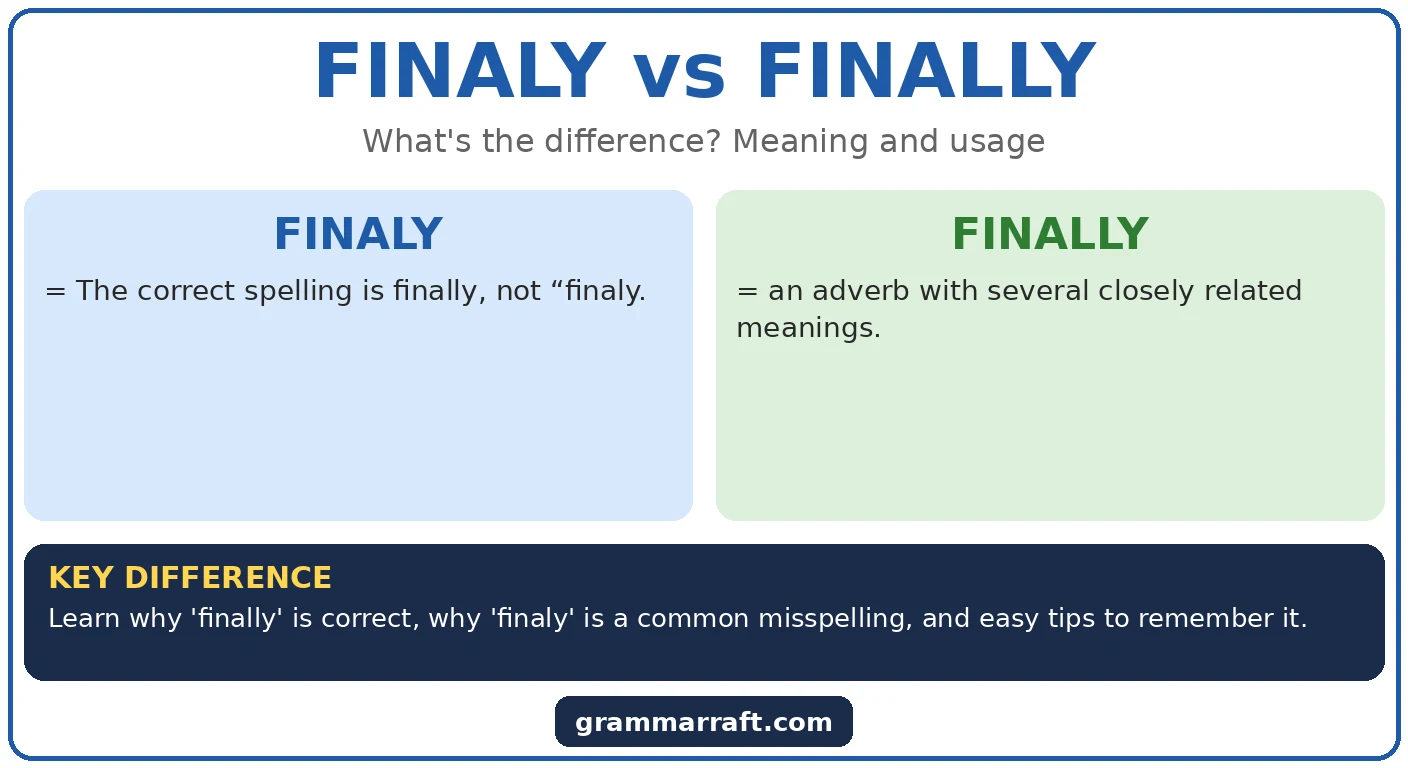
The correct spelling is finally, not “finaly.” The word means “at last,” “after a long delay,” or “as the last point in a sequence,” so it appears often in everyday speech and writing.
The spelling mistake is easy to make because “final” has one l at the end, while “finally” needs two l’s before the “y.” This article explains the rule, pronunciation, meaning, grammar, and simple ways to remember which form is finally correct.
You’ll also see practical examples showing how to use the word in a sentence, how it differs from related terms such as “lastly” and “eventually,” and why spell-check tools may not always catch every problem.
The Correct Answer: Finally
If you’re choosing between “finaly” or “finally,” the correct word is “finally.” The form “finaly” is a spelling error and does not belong in standard English writing.
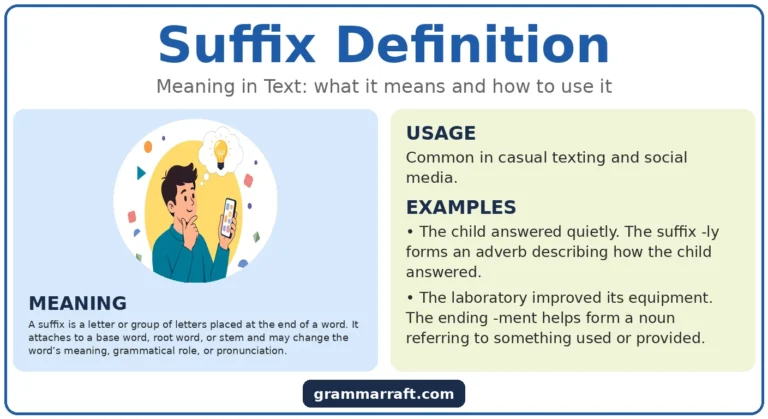
“Finally” contains two l’s: f-i-n-a-l-l-y. It is formed from the adjective “final” and the suffix “-ly,” but the spelling changes slightly because the final l is doubled before the suffix is added.
Here is the difference at a glance:
| Form | Correct? | Typical meaning or use | Example |
|---|---|---|---|
| finally | Yes | At last; in the end; as a final point | She finally arrived. |
| finaly | No | Misspelled form | Do not use this spelling. |
| final | Yes | Last or conclusive | This is the final answer. |
| lastly | Yes | Introducing the last item | Lastly, check your punctuation. |
The error usually happens because writers remember the spelling of “final” and add “y” without doubling the l. That produces “finaly,” but English spelling requires the second l in the adverb.
For formal emails, school assignments, applications, reports, and published content, always write finally. A reader may understand “finaly,” but understanding does not make the spelling acceptable.
What Does Finally Mean?
Finally is an adverb with several closely related meanings. Most often, it describes something that happens after a long wait, delay, or series of events.
For example, “The train finally arrived” means the train arrived after people had been waiting for it. The sentence often carries a feeling of relief, impatience, satisfaction, or emphasis.
Finally can also introduce the last item in a list or the final point in an explanation. In that use, it helps readers follow the order of ideas.
- After a delay: “The package finally arrived.”
- After effort: “He finally solved the problem.”
- At the end of a process: “The committee finally approved the plan.”
- As the last point: “Finally, remember to save your work.”
- As a concluding judgment: “The evidence finally proves that the method works.”
The meaning depends partly on context. “Finally, we need to discuss the budget” usually signals the last topic in a conversation, while “We finally discussed the budget” suggests that the discussion happened later than expected.
In many sentences, finally has an emotional undertone. Saying “I finally finished the report” suggests that finishing took time or required persistence, whereas “I finished the report” simply states the fact.
Finally as “At Last”
The most familiar meaning of finally is “at last.” It often follows a period of waiting, difficulty, uncertainty, or repeated attempts.
Examples include:
- “After three attempts, the machine finally started.”
- “She finally found the correct address.”
- “The children finally fell asleep.”
- “We finally reached an agreement.”
These sentences would still be grammatical without finally, but the meaning would be flatter. The adverb tells us that the result came later than expected or followed some struggle.
Finally as the Last Point
Finally can also organise a speech, essay, presentation, or set of instructions. In this role, it is similar to “lastly” or “to finish.”
For example, a presentation might say, “First, we’ll review the problem. Next, we’ll examine the options. Finally, we’ll choose a solution.” Here, finally does not necessarily suggest a delay; it identifies the last stage.
Why Does Finally Have Two L’s?
The spelling of finally becomes easier to understand if you separate the base word from the suffix. The base is final, and the suffix is -ly. When the suffix is added, the result is finally, with two l’s written next to each other.
This is not a matter of pronunciation. Both l’s are part of the spelling even though English speakers do not normally pronounce them as two separate sounds.
The same pattern appears in related words formed from adjectives that end in “l.” For example:
- final + ly = finally
- usual + ly = usually
- equal + ly = equally
- actual + ly = actually
- real + ly = really
Not every word ending in l behaves in exactly the same way across English spelling patterns, so memorising a useful group is often more practical than trying to apply one broad rule to every word.
The Difference Between Final and Finally
Final is usually an adjective or noun. It describes something last, decisive, or conclusive, as in “the final exam,” “the final chapter,” or “the final decision.”
Finally is an adverb. It modifies a verb, an adjective, another adverb, or an entire sentence.
| Word | Part of speech | Example |
|---|---|---|
| final | Adjective | We made the final choice. |
| final | Noun | The team reached the final. |
| finally | Adverb | We finally made a choice. |
This distinction matters because replacing one word with the other can change the grammar of a sentence. “The final arrived” and “The team finally arrived” do not express the same idea.
How to Use Finally in a Sentence
Finally can appear in several positions, although its position affects emphasis and rhythm. It commonly appears at the beginning of a sentence, before the main verb, or at the end of a sentence.
Finally at the Beginning
At the beginning, finally often introduces a result or the last item in a sequence. A comma usually follows it when it functions as an introductory adverb.
- “Finally, the doors opened.”
- “Finally, we need to review the conclusion.”
- “Finally, she understood what the message meant.”
This position gives the word strong emphasis. It can make the reader expect a resolution, a conclusion, or an important final step.
Finally Before the Main Verb
Finally can come before the main verb, especially when the sentence describes something that happened after waiting or repeated effort.
- “The students finally completed the assignment.”
- “He finally admitted the mistake.”
- “The company finally released the update.”
In these examples, finally highlights the timing of the action. The action occurred, but not immediately.
Finally at the End
At the end of a sentence, finally can sound more conversational or can place extra weight on the result.
- “They reached the station finally.”
- “We found the missing document finally.”
This position is grammatical, but it is often less natural than placing finally before the main verb or at the beginning. In polished writing, “They finally reached the station” will usually sound smoother.
Placement also depends on the intended meaning. Compare “Finally, she agreed” with “She finally agreed.” The first may introduce the last event in a story, while the second strongly suggests that she took a long time to agree.
Finally, Eventually, Lastly, and At Last
Several English words overlap with finally, but they are not interchangeable in every sentence. Understanding their differences helps you choose a more precise word and avoid repetitive writing.
Finally and Eventually
Eventually means that something happened at some later point, often after an uncertain period. Finally can carry the same time meaning, but it more often suggests a noticeable wait, effort, or sense of relief.
- “Eventually, the weather improved.”
- “Finally, the weather improved.”
The first sentence sounds neutral about the delay. The second may imply that people had been hoping for better weather and were relieved when it came.
Finally and Lastly
Lastly is mainly used to introduce the last item in a sequence. Finally can do that too, but it has additional meanings connected with delay and completion.
“Lastly, add the signature” means the signature is the final instruction. “She finally added the signature” suggests that she took a long time to do it.
Finally and At Last
At last is usually more expressive than finally. It can communicate strong relief, excitement, frustration, or impatience.
“The results are finally available” is fairly neutral. “The results are available at last” gives the sentence a stronger emotional tone and may suggest that the wait was especially frustrating.
Finally and In the End
In the end often refers to the eventual outcome of a situation, especially after alternatives or complications have been considered. Finally can refer to the same outcome, but it more directly marks sequence or timing.
| Expression | Main idea | Example |
|---|---|---|
| finally | At last or as the last point | She finally answered. |
| eventually | At some later time | He eventually found work. |
| lastly | Introducing the last item | Lastly, review the figures. |
| at last | At last, often with emotion | At last, the search was over. |
| in the end | The final outcome | In the end, they chose another plan. |
Pronunciation and Common Spelling Mistakes
Finally is commonly pronounced “FY-nuh-lee”, with the main stress on the first syllable. In phonetic notation, it is often represented approximately as /ˈfaɪnəli/, although pronunciation can vary slightly by accent.
The second l is not usually given a separate sound. That may be one reason writers omit it, particularly when spelling from memory or typing quickly.
The incorrect form “finaly” is a classic example of a silent-letter or doubled-letter spelling problem. Because it looks visually plausible, the mistake can survive a quick rereading.
Common Errors to Watch For
- Finaly: Missing one l; always incorrect in standard English.
- Finalley: Adds an unnecessary e; also incorrect.
- Finalyly: Mixes the base word and suffix incorrectly.
- Finially: Places the i in the wrong position.
- Final: Correct as a separate word, but not a replacement for finally.
Typing tools can help, but they are not a substitute for understanding the spelling. Many programs will correct “finaly,” while others may simply underline it and leave the decision to you.
For a reliable reference, you can check the entry for finally in the Cambridge Dictionary. A dictionary confirms the spelling, pronunciation, definitions, and example usage in one place.
Memory Tricks for Spelling Finally Correctly
A useful memory trick is to keep the word “final” visible inside “finally.” Start with final, then add ly: final + ly gives finally. The two l’s meet in the middle.
Another method is to connect the spelling with the phrase “the final last.” That phrase is not normally used as a polished expression, but it can remind you that “finally” contains the base word “final” followed by “-ly,” resulting in two l’s.
You can also remember the word in a complete sentence rather than as isolated letters. For example, repeat: “I finally remembered the spelling.” The sentence links the word with the act of remembering it.
A Quick Editing Routine
When proofreading, search specifically for “finaly.” This is faster than relying only on a general spell-check because you know the exact mistake you are trying to catch.
- Find every instance of “finaly” in the document.
- Replace it with “finally.”
- Check whether the word means “at last” or introduces a final point.
- Confirm that its position and punctuation fit the sentence.
- Read the surrounding sentence aloud once.
The final step matters because spelling and grammar are separate issues. A sentence can contain the correctly spelled word finally but still use it awkwardly or place a comma where it is not needed.
For example, “Finally the meeting ended” may be acceptable in some styles, but “Finally, the meeting ended” is clearer when finally introduces the sentence. In contrast, “The meeting finally ended” usually does not need a comma because finally sits inside the sentence.
Examples of Finally in Real Sentences
Examples show how the word changes meaning according to context. In each sentence below, finally is spelled with two l’s and functions as an adverb.
- “After a long delay, the flight finally departed.”
- “The researcher finally identified the source of the error.”
- “We finally arrived at the hotel just before midnight.”
- “Finally, place the form in the envelope.”
- “She finally understood why the instructions mattered.”
- “The final decision was announced on Friday.”
- “He eventually accepted the offer, but not immediately.”
- “Lastly, remove the temporary files.”
The first three examples describe an event after waiting or effort. The fourth introduces the last step in a process, while the fifth describes a change in understanding that took time.
Examples in Formal Writing
In academic or professional writing, finally can structure an argument without sounding informal. It often appears after “first” and “second,” though those introductory words do not always need to appear.
For example: “First, the proposal identifies the problem. Second, it compares two possible responses. Finally, it recommends a course of action.” The sequence is clear, and finally tells the reader that the recommendation is the final stage.
In a report, you might write, “The tests produced inconsistent results. After the equipment was recalibrated, the readings finally became stable.” This use communicates both sequence and delay.
Examples in Conversation
In everyday speech, finally often expresses emotion. “You’re finally here” may sound welcoming, but depending on tone, it can also suggest impatience about someone’s late arrival.
Similarly, “I finally got the app to work” tells the listener that the speaker experienced difficulty. The word adds useful context that would be missing from “I got the app to work.”
How to Avoid Repeating Finally
Although finally is useful, repeating it in every paragraph can make writing sound mechanical. Choose a related expression when the meaning changes or when another word provides a better emphasis.
- Use eventually for a later result without strong emotional emphasis.
- Use lastly to introduce the last item in a list.
- Use at last when relief or impatience is important.
- Use in the end to focus on the eventual outcome.
- Use ultimately for a final conclusion, decision, or consequence.
These alternatives are not automatic replacements. “Ultimately” often refers to a judgment or consequence, while “finally” may simply describe an action that happened after a wait.
Compare these examples:
- “Ultimately, the board rejected the proposal.”
- “The board finally rejected the proposal.”
The first focuses on the final decision after considering the issue. The second suggests that the rejection took time or came after delay.
Good writing depends on selecting the word that matches the intended meaning. Correct spelling is the first requirement, but precise word choice gives the sentence its full effect.
Frequently Asked Questions
Is “finaly” ever a correct spelling?
No. “Finaly” is a misspelling of finally. The correct form contains two l’s: f-i-n-a-l-l-y.
What does finally mean?
Finally usually means “at last,” especially after a delay, effort, or period of waiting. It can also introduce the last point in a list, explanation, or set of instructions.
How do you remember the spelling of finally?
Start with the word “final” and add “-ly.” The result is “finally,” with the two l’s from the end of “final” and the beginning of the suffix sequence appearing together in the spelling.
What is the difference between finally and eventually?
Both can describe something happening later, but “eventually” is usually more neutral about timing. “Finally” often suggests a long wait, difficulty, relief, or the last stage of a process.
Should finally have a comma after it?
Use a comma when finally begins a sentence as an introductory word, as in “Finally, the work was complete.” A comma is usually unnecessary when it appears before the main verb, as in “The work finally ended.”
Conclusion
The correct spelling is finally, never “finaly.” It means “at last,” can describe something that happens after a long delay, and can introduce the last point in a sequence. Remember the two l’s, and check whether the word is expressing timing, completion, or order.
Once the spelling is secure, pay attention to meaning and placement. Choosing finally, eventually, lastly, or at last with care will make your writing clearer and more natural. If you still pause over “finaly or finally,” use “final” plus “-ly” as your quick reminder: finally is the correct word.
Related Articles
- Heros or Heroes: Meaning, Spelling and Correct Usage
- Cacoon or Cocoon: Meaning, Correct Spelling & Usage
- Peices or Pieces: Correct Spelling, Meaning and Usage
Explore more helpful guides on GrammarRaft.