Confirm Receipt: Meaning, Usage and Examples
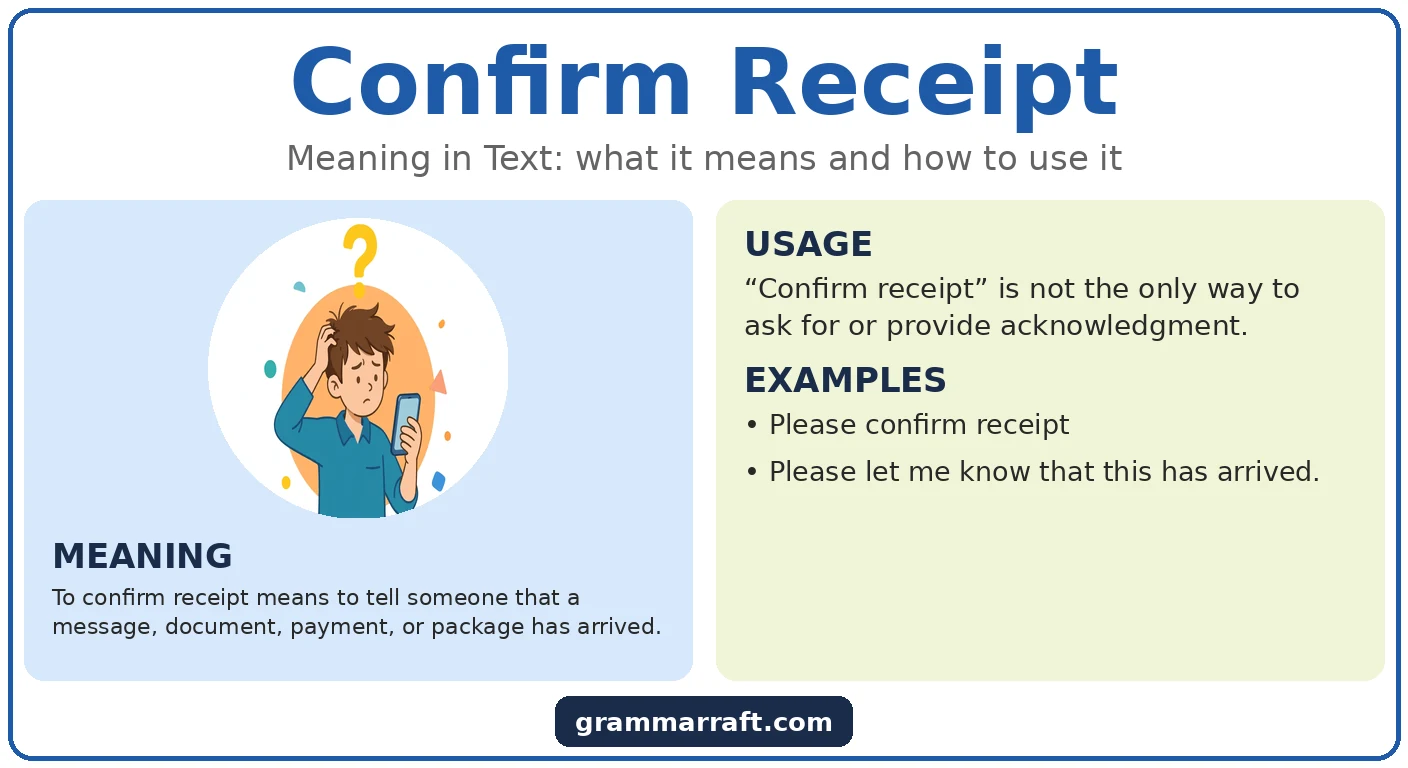
To confirm receipt means to tell someone that a message, document, payment, or package has arrived. The phrase appears often in business email because it creates a clear record without necessarily saying that the contents have been reviewed or approved.
That distinction matters. A short reply can acknowledge delivery, prevent unnecessary follow-ups, and show that a request or invoice reached the right person.
This article explains the meaning of confirming receipt, when the wording is appropriate, how to write a professional reply, and which alternatives work better in casual, formal, payment, and customer-service situations.
What “Confirm Receipt” Means
“Confirm receipt” is a request for someone to acknowledge that they received something. The item could be an email, contract, invoice, application, shipment, payment, or another business document.
In plain English, “Please confirm receipt” means, “Please let me know that this has arrived.” It does not automatically mean, “Please agree with it,” “Please approve it,” or “Please confirm that you have completed the next step.”
The word receipt refers to the act of receiving, not only to a printed sales slip. That is why the phrase can apply to an email or digital file even though no physical receipt exists.
Receipt versus review
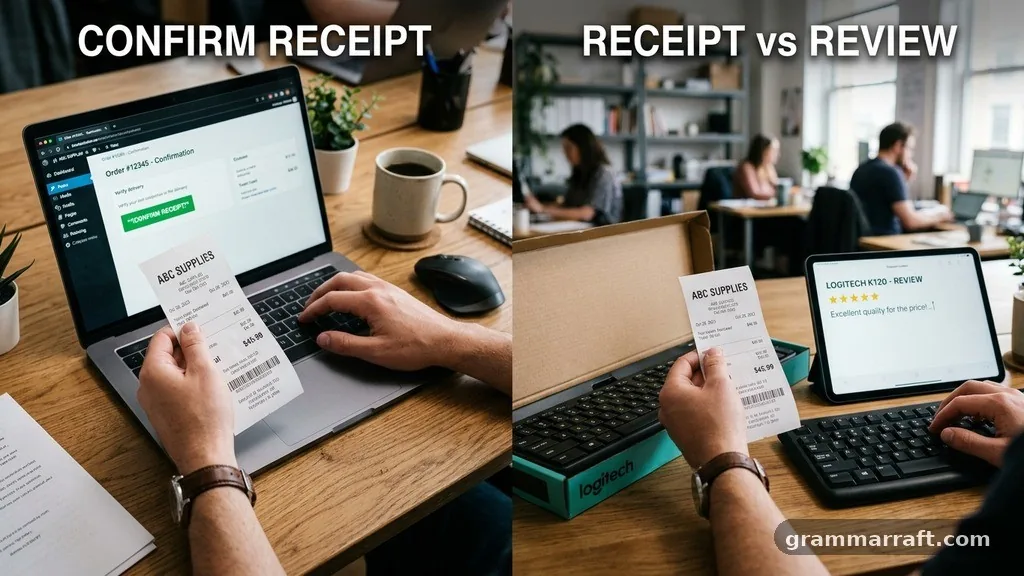
Receipt and review are separate actions. Someone may confirm receipt of a contract immediately but need several days to read the terms before responding to its substance.
This difference is useful in professional communication. If a sender needs only delivery confirmation, asking someone to “confirm receipt” is precise; if the sender needs a decision, the request should say so directly.
- Confirm receipt: The item arrived.
- Acknowledge the contents: The recipient has seen or understood what was sent.
- Approve the document: The recipient accepts its terms or authorizes an action.
- Respond to the request: The recipient provides the requested information or decision.
For example, a manager might write, “Please confirm receipt of the attached policy. A separate response regarding your approval is requested by Friday.” That sentence separates delivery from approval and reduces the risk of misunderstanding.
The phrase can also appear as “confirming receipt,” “confirmation of receipt,” or “I confirm receipt of your email.” These forms express the same basic idea, although their tone differs slightly.
Is “Confirm Receipt” Correct English?
Yes. “Confirm receipt” is grammatically correct and widely used in formal and business communication. It is an example of an imperative request in which the subject “you” is understood: “Please confirm receipt” means “Please confirm that you received it.”
The wording is concise, but it can sound somewhat formal or administrative. That is not a problem in a contract, invoice email, legal notice, procurement message, or workplace exchange where a clear record is important.
Some readers wonder whether “confirm receipt” is redundant because receiving and confirming seem closely related. They are not identical: receiving is the event, while confirming is the communication that tells the sender the event occurred.
“Confirm receipt” and “confirm the receipt”
Both forms can be correct, but “confirm receipt” is usually the more natural business phrase. The version without “the” treats receipt as the general act of receiving an item.
“Confirm the receipt” is more specific and may be useful when the receipt itself is a particular document. For example, “Please confirm the receipt of the returned equipment” identifies a specific delivery or event.
In ordinary email, the following forms are all acceptable:
- “Please confirm receipt of this email.”
- “Please confirm receipt of the attached document.”
- “I confirm receipt of your invoice.”
- “This message confirms receipt of your application.”
For a plain-language alternative, write “Please let me know that you received this.” It is less formal, but often sounds warmer and more direct, especially when writing to a customer, colleague, or individual who may not use business terminology regularly.
A useful grammar reference for related wording is the Cambridge Dictionary entry for “acknowledge”. In many contexts, “acknowledge” and “confirm receipt” overlap, although acknowledge can sometimes suggest recognition or acceptance as well as delivery.
How to Confirm Receipt in an Email
A good confirmation email is usually short. It should identify what was received, state the date or timing when useful, and explain what happens next if a response or review is still pending.
Start with a direct sentence such as “I confirm receipt of your email and the attached proposal.” This tells the sender exactly what arrived and avoids the ambiguity of a reply that says only “Thanks.”
If you have not reviewed the material, say so. “I confirm receipt and will review the documents before responding” acknowledges delivery without suggesting that you agree with the contents.
A simple structure
Most receipt confirmations can follow four parts. Not every message needs all four, but the structure helps when the exchange concerns a deadline, payment, legal document, or important request.
- Greeting: Address the sender naturally.
- Confirmation: Identify the email, document, payment, or package received.
- Next step: State whether you will review, process, or answer it.
- Closing: End politely with your name or signature.
For example: “Hello Priya, I confirm receipt of your revised quotation and the product specifications. I’ll review both documents and send any questions by Wednesday. Best, Marcus.”
That message does more than acknowledge an arrival. It names the materials, sets an expectation, and gives the sender a useful timeframe without making an unnecessary promise about approval.
When a one-line reply is enough
A one-line answer is suitable when the request is simple and no further action is needed immediately. “Received, thank you” may be enough for a routine internal message.
Use more detail if the sender needs a reliable record. A stronger version is, “I confirm receipt of your email sent on 8 March, including the signed form.” Specific wording helps distinguish one document from several similar messages.
Be careful with “Noted.” It may indicate that you saw the message, but it does not always reassure the sender that an attachment, payment, or complete set of documents arrived.
Professional Confirm Receipt Templates
A template should provide a starting point, not replace judgment. The right reply depends on what was received, whether it has been checked, and what the sender expects next.
Confirming receipt of an email
“Hello Daniel, I confirm receipt of your email. Thank you for the information; I’ll review it and reply with any questions. Kind regards, Elena.”
This version works when the sender needs acknowledgment but not an immediate substantive answer. It avoids implying that the recipient has already examined every detail.
Confirming receipt of an attachment
“Thank you for sending the proposal and supporting documents. I confirm that the attachments were received and can be opened. I’ll follow up after reviewing them.”
Mentioning whether the attachments can be opened is helpful because a file can be listed in an email but still be missing, corrupted, or inaccessible.
Confirming receipt of an application
“We confirm receipt of your application and supporting materials. Your submission has been forwarded for review, and we’ll contact you if additional information is required.”
This wording confirms arrival without promising acceptance, selection, or a particular decision date. That distinction matters for recruitment, grants, admissions, and other processes with multiple stages.
Confirming receipt of payment
“Thank you for your payment. We confirm receipt of the amount shown in your remittance advice, subject to final processing by our payment provider.”
If the money has not actually cleared, do not say “payment received” as though settlement is complete. Use wording such as “payment instruction received” or “payment is being processed” when that is more accurate.
Confirming receipt of a physical item
“This message confirms receipt of the equipment delivered on 12 March. The package has been logged, and we’ll report any visible damage after inspection.”
That final clause is important. Receiving a parcel is not the same as confirming that its contents are complete, undamaged, or compliant with the order.
Confirm Receipt of Payment, an Invoice, or a Receipt
Financial messages require extra care because “receipt” can refer to either the act of receiving something or a document proving a transaction. The surrounding words should make the intended meaning clear.
“We confirm receipt of your invoice” means the invoice arrived. It does not necessarily mean the invoice has been approved, entered into the accounting system, or scheduled for payment.
“We confirm receipt of your payment” means the sender believes the funds arrived. Depending on the payment method, the business may still need to verify settlement, match the amount to an account, or remove a payment hold.
| Message | What it confirms | What it does not necessarily confirm |
|---|---|---|
| Receipt of your invoice | The invoice was received | Approval or payment date |
| Receipt of your payment | Funds appear to have arrived | Final settlement or account reconciliation |
| Receipt of your payment details | Payment information was sent | That payment was made |
| Receipt of the attached receipt | A transaction document was received | That the transaction is valid or accepted |
| Receipt of the goods | The goods were delivered | That they were inspected or accepted |
Use precise accounting language
Suppose a customer sends proof of a bank transfer. A safe reply could say, “We confirm receipt of the transfer confirmation and will match the payment to your invoice once the funds are credited.” That acknowledges the document without claiming that the bank has completed settlement.
Likewise, a supplier can write, “We confirm receipt of invoice 1048 and have sent it for internal review.” This is clearer than saying, “Your invoice has been accepted,” unless the business has actually approved it.
Payment platforms may show statuses such as pending, authorized, completed, reversed, or refunded. Those labels vary by provider, so a business should use the platform’s actual status rather than treating every notification as final payment confirmation.
Keep a copy of important confirmation emails, payment references, invoice numbers, and dates. A short written record can help resolve questions about duplicate invoices, missing funds, delivery timing, or disputed transactions.
Formal and Informal Alternatives
“Confirm receipt” is not the only way to ask for or provide acknowledgment. The best alternative depends on the relationship, the urgency, and whether the message needs to distinguish arrival from review.
| Situation | Formal wording | Plain or informal wording |
|---|---|---|
| Asking someone to acknowledge an email | Please confirm receipt of this message. | Please let me know you received this. |
| Stating that an email arrived | I confirm receipt of your email. | I received your email, thanks. |
| Confirming an attachment | We acknowledge receipt of the attached document. | I received the file and can open it. |
| Confirming delivery | We confirm receipt of the shipment. | The package arrived safely. |
| Requesting a response | Please acknowledge receipt and advise on next steps. | Please let me know you got this and tell me what happens next. |
“Acknowledge receipt”
“Acknowledge receipt” is a close alternative and often sounds more formal. It is common in procurement, legal correspondence, public administration, and official notices.
However, acknowledge can carry a broader meaning than confirm. Someone who acknowledges a complaint may be recognizing the complaint and its seriousness, not merely stating that the message arrived.
“I confirm I received…”
“I confirm I received your email” is natural and clear. It uses a complete clause, so it may sound less like a fixed administrative phrase than “I confirm receipt of your email.”
This version is useful when writing to a person who prefers straightforward language. It also makes the recipient explicit: “I confirm I received the signed agreement” clearly identifies who performed the receiving action.
“Please confirm you received…”
“Please confirm you received the document” is direct and conversational. It can be better than “Please confirm receipt” when the audience may find formal business wording stiff or unclear.
The choice is rarely about right versus wrong. It is about precision, tone, and the level of formality appropriate to the situation.
When Confirmation Creates a Useful Record
A receipt confirmation can be valuable evidence that a message or item reached a recipient, but it should not be treated as proof of every fact surrounding that exchange. An email saying “I received the contract” does not necessarily show that the recipient signed it or agreed to its clauses.
For important transactions, preserve the original message, attachments, transmission date, delivery status, and reply. A confirmation that omits the document name or date may be difficult to match later, particularly when several versions were exchanged.
Businesses often use automated acknowledgments for support tickets, applications, orders, and online forms. These messages can confirm that a system captured a submission, but they do not always mean a staff member has reviewed it.
Do not overstate legal effect
The legal significance of a confirmation varies by location, contract, industry, and the exact wording used. A receipt acknowledgment may help establish communication, but it does not automatically create a contract, waive a right, prove delivery under a particular law, or establish acceptance of terms.
If a document involves a deadline, regulated notice, court process, employment matter, property transaction, or substantial payment, follow the required delivery method and retain the relevant records. A routine email reply may not replace a signature, certified delivery, portal submission, or other formal requirement.
Also consider privacy and security. Avoid putting full card numbers, banking credentials, passwords, or unnecessary personal information in a receipt confirmation email.
Automated versus personal confirmation
An automated message often says, “Your request has been received.” That wording confirms that a system recorded the request, not necessarily that a person has accepted responsibility for it.
A personal reply can add useful context: “I confirm receipt of your complaint and have forwarded it to the billing team.” The recipient now knows both that the message arrived and what action followed.
If a system generates duplicate confirmations, keep the most complete record rather than replying repeatedly. Repeated messages can create confusion, especially when they contain different reference numbers or conflicting status language.
Common Mistakes to Avoid
The biggest mistake is treating acknowledgment as approval. A person may confirm receipt because a process requires it while still disagreeing with the proposal, disputing the invoice, or needing more information.
Another problem is failing to identify what was received. “Received” can refer to an entire email, one attachment, a payment screenshot, or a physical shipment, so name the item whenever confusion is possible.
- Do not say “approved” when you only know that the item arrived.
- Do not say “payment received” if you have seen only a payment instruction or screenshot.
- Do not promise a deadline that you cannot meet.
- Do not rely on “thanks” alone for a sensitive or high-value exchange.
- Do not ignore missing attachments when the sender believes they were included.
- Do not use vague status terms if a transaction is pending, under review, or subject to verification.
Weak and stronger examples
Weak: “Got it.” This is friendly, but it does not identify what arrived or indicate whether a file can be opened.
Stronger: “I confirm receipt of your email and the revised invoice attached to it. I’ll check the invoice details and contact you if anything needs clarification.”
Weak: “Your payment has been accepted,” when the sender has only provided a transfer confirmation. Stronger: “We received your transfer reference and will confirm the payment once it appears in our account.”
Do not make the reply longer than necessary. Precision is more valuable than ceremony, and a concise confirmation can still be complete.
How to Improve a Confirm Receipt Message
Before sending a confirmation, ask what the sender actually needs to know. If the only question is whether an email arrived, a single sentence is enough; if the sender needs assurance about an invoice, shipment, or deadline, add the relevant status.
Use concrete nouns instead of vague references. “I confirm receipt of the signed service agreement dated 14 March” is more useful than “I confirm receipt of the document,” especially if several documents are in circulation.
Separate facts from future intentions. “I received the proposal and will review it tomorrow” contains one confirmed fact and one planned action, while “I received and approved the proposal” makes a much stronger statement.
A practical editing checklist
- Have you named the email, document, payment, or item?
- Have you distinguished receipt from review, approval, or acceptance?
- Have you stated the next step if one is expected?
- Have you avoided claiming that funds cleared when they are still pending?
- Have you included a useful date, reference number, or invoice number?
- Does the tone fit the recipient and the seriousness of the exchange?
Read the message as if you were the sender. If you still would not know whether the attachment arrived, whether the payment cleared, or when to expect a response, revise the wording.
For recurring business processes, create separate templates for email receipt, document receipt, payment receipt, delivery receipt, and application receipt. Small differences between those templates prevent staff from using an inaccurate confirmation in the wrong situation.
Frequently Asked Questions About Confirm Receipt
Is it correct to say “please confirm receipt”?
Yes. “Please confirm receipt” is correct, professional English and means “Please tell me that you received this.” It is especially common in formal email, business correspondence, invoice communication, and document exchange.
If you want a warmer or plainer tone, write “Please let me know that you received this.” Both versions are correct; the better choice depends on the audience and context.
How do I confirm receipt of an email?
You can write, “I confirm receipt of your email. Thank you; I’ll review the information and respond shortly.” If an attachment matters, identify it directly: “I confirm receipt of your email and the attached report.”
Do not imply that you have reviewed the email merely because you received it. Add a separate statement if review or approval is still pending.
What is another way to say “confirm receipt”?
Common alternatives include “acknowledge receipt,” “confirm you received it,” “let me know that this arrived,” “I received your message,” and “this confirms delivery.” The most formal options are usually “acknowledge receipt” and “confirm receipt.”
“Received, thank you” is shorter and more conversational, but it may be too vague for a payment, contract, or document that needs a clear record.
Does confirming receipt mean that I agree with the contents?
No. Confirming receipt normally means only that the item arrived or was received. It does not automatically mean that you accept, approve, sign, understand, or agree with the contents.
If agreement is required, the sender should request it separately and state the required action clearly. A recipient can also write, “I confirm receipt but have not yet reviewed or approved the terms.”
How should I confirm receipt of a payment?
Use wording that matches the actual payment status. If the money has cleared, “We confirm receipt of your payment for invoice 1048” may be appropriate; if only payment details or a transfer notice arrived, say that instead.
When the status is pending, write, “We confirm receipt of your payment reference and will update you once the funds are credited.” That avoids promising that the transaction is complete before it has been verified.
Conclusion
Confirm receipt is a simple phrase with an important boundary: it acknowledges arrival, not necessarily review, approval, acceptance, or completed payment. The strongest messages identify exactly what was received, use accurate status language, and explain the next step only when one is known.
For everyday email, a brief reply may be enough; for invoices, contracts, applications, and deliveries, include a date or reference number and keep the record. Using confirm receipt carefully makes business communication clearer and gives both sides a dependable written trail.
Related Articles
- 45+ Other Ways to Say Thank You So Much: Professional and Polite Alternatives
- How to Avoid Passive Voice in Writing (With Examples)
- When to Use a Semicolon: Rules, Examples and Easy Guide
Explore more helpful guides on GrammarRaft.