Looking Forward to Seeing: Meaning, Grammar and Examples
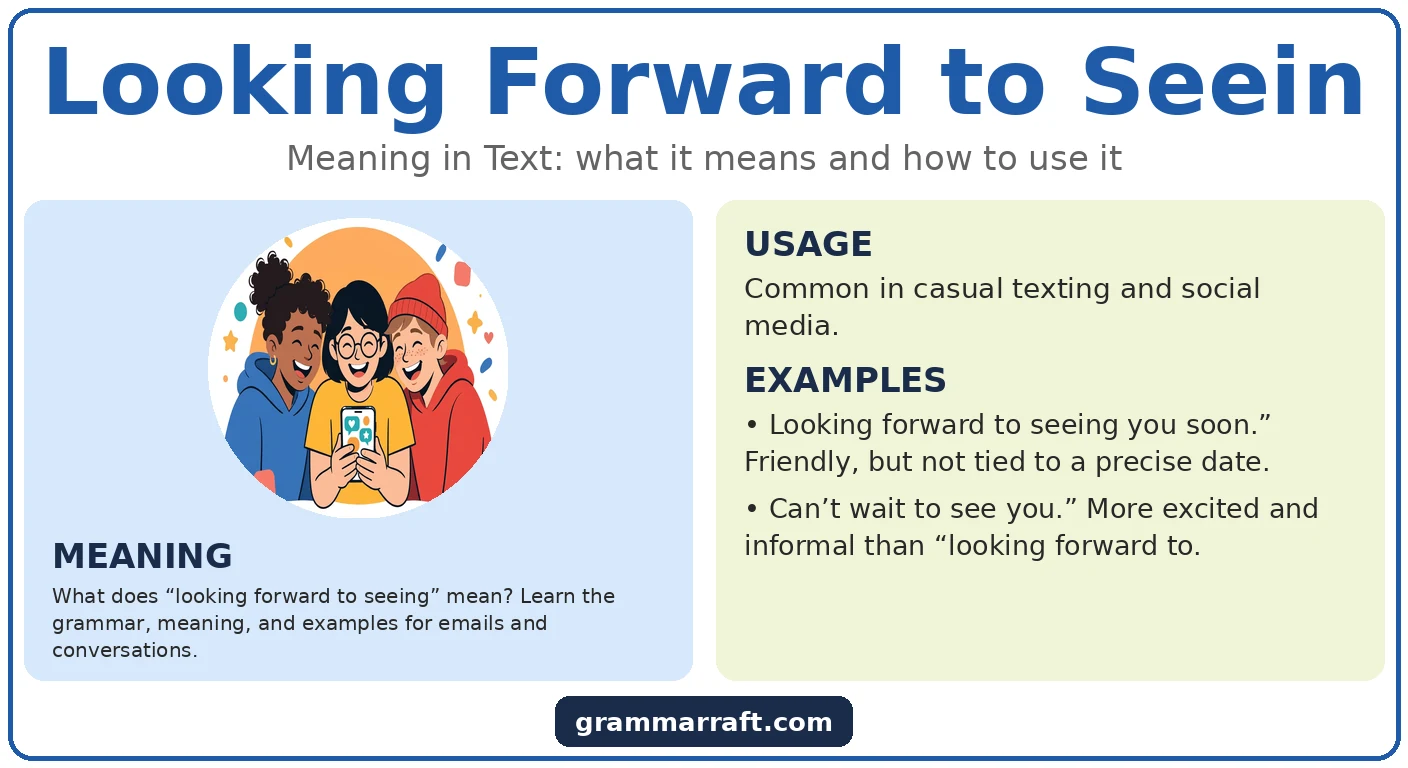
“Looking forward to seeing” is a common English phrase used to express pleasant anticipation about meeting someone or experiencing something. It sounds warm, positive and natural in personal messages, workplace emails and invitations, but the grammar can be confusing because many people expect “to see” after “look forward.”
The correct form is usually “looking forward to seeing you,” because “to” functions as a preposition here and must be followed by a noun or a gerund. This article explains the meaning, grammar, punctuation, tone and best alternatives, with examples for professional, casual and written communication.
You’ll also learn how to choose between “I look forward to seeing you,” “I’m looking forward to seeing you soon” and more formal expressions. By the end, you’ll be able to use the phrase confidently without sounding stiff, overly familiar or grammatically uncertain.
What “Looking Forward to Seeing” Means
“Looking forward to seeing” means feeling happy or hopeful about meeting someone in the future. The speaker expects the meeting to happen and views it as something positive, whether that meeting is tomorrow, next month or at an uncertain point later on.
For example, “I’m looking forward to seeing you at the conference” tells the other person that the speaker is pleased about the planned meeting. It is more personal than simply saying “I will see you at the conference,” because it adds an emotional response.
The expression can also refer to an experience rather than a person. You might write, “We’re looking forward to seeing the new exhibition,” or “She’s looking forward to seeing how the project develops.” In each case, the phrase communicates anticipation.
The word “seeing” does not always mean literally using your eyes. In “I’m looking forward to seeing you,” it usually means meeting or spending time with you. In “I’m looking forward to seeing the results,” it means receiving, reviewing or discovering the results.
Common meanings include:
- Anticipating a meeting: “I’m looking forward to seeing you on Friday.”
- Expecting an experience: “They’re looking forward to seeing the final performance.”
- Expressing warmth: “We’re looking forward to seeing everyone again.”
- Showing polite enthusiasm: “I look forward to seeing your presentation.”
The phrase is generally positive, but its tone depends on the surrounding words. “I’m really looking forward to seeing you” sounds enthusiastic and personal, while “I look forward to seeing you” is restrained and suitable for professional correspondence.
Is “Looking Forward to Seeing” Grammatically Correct?
Yes. “Looking forward to seeing” is grammatically correct when the sentence refers to an anticipated meeting or experience. The complete phrase often appears as “I’m looking forward to seeing you,” “We look forward to seeing you” or “She was looking forward to seeing her family.”
The main grammar point is the word “to.” In this expression, “to” is a preposition, not the infinitive marker used in a phrase such as “to see.” A preposition is followed by a noun, pronoun or gerund, and “seeing” is the gerund form of the verb “see.”
That is why the standard form is “I look forward to seeing you,” rather than “I look forward to see you.” The second version treats “to” as an infinitive marker, but that does not fit the established structure of “look forward to.”
| Sentence | Correct? | Reason |
|---|---|---|
| I look forward to seeing you. | Yes | “Seeing” follows the preposition “to.” |
| I look forward to see you. | No in standard English | The verb form after “to” is incorrect in this expression. |
| I’m looking forward to our meeting. | Yes | “Our meeting” is a noun phrase after “to.” |
| We look forward to hearing from you. | Yes | “Hearing” is a gerund, just like “seeing.” |
The same pattern applies to related expressions. English speakers say “I look forward to speaking with you,” “She looks forward to visiting her parents” and “They’re looking forward to receiving your reply.” The verb after “to” takes the -ing form.
Why “To Seeing” Is the Right Form
The confusion comes from the fact that “to” has two important grammatical roles. It can introduce an infinitive, as in “I want to see you,” or it can act as a preposition, as in “I’m committed to seeing the task through.” The spelling is identical, but the grammar that follows is different.
In “I want to see you,” the structure is “want + to-infinitive.” In “I look forward to seeing you,” the structure is “look forward to + noun or gerund.” Recognising the whole expression is more useful than trying to apply one rule to every appearance of “to.”
A simple substitution test can help. Replace “seeing you” with a noun phrase: “I look forward to our meeting.” That sentence is clearly correct, so the phrase requires something that behaves like a noun after the preposition “to.” A gerund such as “seeing,” “hearing” or “working” performs that role.
The same principle appears in many everyday expressions:
See Also: Confirm Receipt: Meaning, Usage and Examples
- Be accustomed to: “She is accustomed to working late.”
- Be committed to: “They are committed to improving access.”
- Object to: “He objects to paying an additional fee.”
- Contribute to: “This contributes to reducing waste.”
- Look forward to: “We look forward to meeting you.”
English learners sometimes describe “to seeing” as an exception, but it is not an exception in the grammatical sense. The phrase follows the normal rule for a preposition followed by a gerund; the challenge is identifying the role of “to” correctly.
For a concise reference on how dictionary entries distinguish meanings and grammatical patterns, the Merriam-Webster dictionary entry for “look forward to” is useful. It confirms the phrase’s meaning and shows how it functions in standard American English.
“Looking Forward to Seeing You” in Different Tenses
The phrase changes slightly depending on the time and the subject of the sentence. The core structure remains stable, but the auxiliary verb or main verb may shift from present to past or future context.
Present continuous

“I’m looking forward to seeing you” is very common in personal messages and informal professional communication. It describes a current feeling about a future meeting and often sounds warmer than the simple present.
Examples include “We’re looking forward to seeing you at the reception” and “She’s looking forward to seeing her children during the holiday.” The contracted forms “I’m,” “we’re” and “she’s” make the sentence sound conversational.
Simple present
“I look forward to seeing you” is especially common in business emails, formal letters and closing statements. It is polite, clear and slightly more reserved than “I’m looking forward to seeing you.”
A job applicant might write, “I look forward to seeing you at the interview,” although “I look forward to meeting you at the interview” may sound more natural if the people have not met before. A business might write, “We look forward to seeing you at our annual event.”
Past tense
“I was looking forward to seeing you” describes an expectation that existed in the past. It may still have been fulfilled, or the sentence may introduce disappointment: “I was looking forward to seeing you, but I became ill.”
Past perfect forms can describe an earlier expectation: “She had been looking forward to seeing the concert for months.” This version places the anticipation before another past event.
Future context
“I’ll be looking forward to seeing you” is grammatically possible, but it can sound less direct than “I look forward to seeing you.” It may fit a sentence about a later point: “After the move, I’ll be looking forward to seeing familiar faces again.”
Choose the tense that matches the feeling being described, rather than treating one version as universally correct. The grammar is flexible, but the emotional emphasis changes slightly with each form.
Professional Ways to Say It
“I look forward to seeing you” works well in most professional situations, especially after a meeting has been arranged. It is courteous without being excessively formal, and it avoids the overly personal tone that some workplaces may not suit.
Use “I’m looking forward to seeing you” when the relationship is familiar or the message has a friendly tone. A consultant writing to a long-term client might use it naturally, while a first contact with a senior official may call for the more restrained “I look forward to meeting you.”
Professional wording should match the actual situation. If the person will attend a scheduled event, “We look forward to seeing you at the workshop” is appropriate. If the recipient has not agreed to meet, “I look forward to hearing from you” may be better than suggesting a meeting that has not been arranged.
Useful alternatives include:
- “I look forward to meeting you.” Use this when you have not met the person before.
- “We look forward to welcoming you.” Use this for an event, appointment or visit.
- “I look forward to our discussion.” Use this when the focus is a conversation or business meeting.
- “I’m pleased that we’ll have the opportunity to meet.” Use this for a more formal, polished tone.
- “I look forward to speaking with you.” Use this when the contact may be by phone or video rather than in person.
Avoid piling on intensifiers in a formal email. “I am extremely, incredibly and very much looking forward to seeing you” can sound exaggerated, particularly when the meeting is routine. One clear expression of anticipation is usually enough.
The closing of an email also affects the tone. “Best regards” creates a conventional business finish, while “Warm regards” feels more personal. The phrase itself does not need to carry the entire emotional message.
Casual and Personal Examples
In personal communication, “looking forward to seeing you” can sound affectionate, excited or simply friendly. The context determines the strength of the feeling, so a message to a close friend may use more enthusiasm than a note to a distant acquaintance.
“I’m looking forward to seeing you this weekend” is a natural text message before a planned visit. “Really looking forward to seeing you!” sounds more enthusiastic and works well as a standalone message, particularly when the relationship is already clear.
Other examples show how small changes affect meaning:
- “Looking forward to seeing you soon.” Friendly, but not tied to a precise date.
- “Can’t wait to see you.” More excited and informal than “looking forward to.”
- “It’ll be great to see you again.” Warm and natural after a period apart.
- “I’m excited about seeing you tomorrow.” Direct and enthusiastic.
- “I hope to see you at the party.” Less certain because attendance or contact may not be guaranteed.
“Looking forward to seeing you soon” is common, but “soon” is deliberately vague. It may mean within days, weeks or simply the next realistic opportunity. If timing matters, include a definite day: “I’m looking forward to seeing you on Saturday.”
When the message is romantic, the phrase can be sincere without sounding dramatic. “I’m really looking forward to seeing you tonight” communicates anticipation while leaving the emotional intensity to the surrounding relationship.
For friends, natural language is often better than a formal sign-off. “See you Friday—I’m looking forward to it” may sound more relaxed than repeating “I’m looking forward to seeing you” after every arrangement.
Common Mistakes and How to Fix Them
The most common mistake is writing “I look forward to see you.” Although the sentence may be understood, it is not the standard grammatical form because “seeing” is required after the preposition “to.”
Another error is using “looking forward” without a clear object when the sentence needs one. “I’m looking forward” can be complete in a conversation where the context is obvious, but in a formal email, “I’m looking forward to seeing you at the meeting” is clearer.
Writers also sometimes add “for” incorrectly. The standard expression is “I’m looking forward to seeing you,” not “I’m looking forward for seeing you.” The verb phrase is “look forward to,” and the preposition cannot be replaced with “for.”
See Also: Please Be Advised: Meaning, Tone, and Better Alternatives
Watch for these frequent problems:
| Common version | Better version | What to remember |
|---|---|---|
| I look forward to see you. | I look forward to seeing you. | Use the gerund after “to.” |
| I’m looking forward for seeing you. | I’m looking forward to seeing you. | The fixed preposition is “to.” |
| I look forward seeing you. | I look forward to seeing you. | Do not omit “to.” |
| I’m looking forwards to seeing you. | I’m looking forward to seeing you. | In this expression, “forward” is normally singular. |
Capitalisation and punctuation matter less than the verb form, but they still shape presentation. In a sentence, write “I’m looking forward to seeing you.” In a subject line or informal note, “Looking forward to seeing you!” may work as a sentence fragment because the context supplies the subject.
Do not confuse “seeing you” with “seeing to you.” The phrase “see to” means deal with or take responsibility for something, as in “I’ll see to the arrangements.” It has a completely different meaning from “look forward to seeing you.”
Choosing the Best Alternative
No single synonym fits every situation. “Looking forward to seeing” is useful because it combines anticipation with a future meeting, but another expression may be more accurate if the meeting is uncertain, the tone is highly formal or the contact will happen remotely.
| Expression | Tone | Best use |
|---|---|---|
| I look forward to seeing you. | Polite and professional | A confirmed meeting or event |
| I’m looking forward to seeing you. | Warm and conversational | Friends, colleagues or familiar clients |
| I can’t wait to see you. | Very enthusiastic and informal | Close friends, family or exciting plans |
| I hope to see you there. | Friendly but uncertain | When attendance or contact is not guaranteed |
| I look forward to speaking with you. | Professional and neutral | Telephone or video conversations |
| It will be a pleasure to meet you. | Formal and courteous | First meetings or official settings |
“Can’t wait to see you” is not a perfect replacement in a formal business email. It is energetic and natural in American English, but some professional contexts call for a calmer expression. “I look forward to meeting you” is safer when the recipient is new to you.
“I hope to see you soon” also differs in meaning. It expresses a wish rather than a firm expectation, so it is useful after an invitation, a farewell or a conversation where no date has been set.
If the event is online, “I look forward to seeing you on the call” is understandable, but “I look forward to speaking with you during the video meeting” may sound more precise. The best wording reflects what will actually happen.
How to Use the Phrase in Emails and Messages
Placement affects how natural the phrase sounds. In a professional email, it commonly appears near the end after the main information: “Thank you for confirming the appointment. I look forward to seeing you on Tuesday.”
In a personal message, it can appear at the beginning or end. “I’m looking forward to seeing you this weekend. I’ve missed our long conversations” sounds warmer because the second sentence adds a specific reason for the anticipation.
A strong message usually includes three details: the meeting or event, the timing and the appropriate degree of enthusiasm. For example, “We’re looking forward to seeing you at the launch next Thursday” is clearer than “Looking forward to seeing you,” especially if the recipient receives many messages.
These templates can be adapted without copying them word for word:
- Confirmed appointment: “Thank you for confirming the appointment. I look forward to seeing you on Monday.”
- Professional event: “We’re looking forward to seeing you at the seminar and discussing the next stage of the project.”
- First meeting: “I look forward to meeting you and learning more about your work.”
- Friendly reunion: “I’m really looking forward to seeing you again after so long.”
- Uncertain plans: “I hope to see you at the festival if you’re able to attend.”
Keep the wording proportionate to the relationship. A short confirmation does not need several sentences explaining how excited you feel, and a close friend may find an overly formal sign-off distant.
Digital communication also changes punctuation and formatting. In plain text, a final exclamation mark can make the phrase sound cheerful; in HTML email, bold type or multiple exclamation marks may feel excessive, so simple wording usually works best.
Meaning Across American and British English
“Look forward to” is standard in both American and British English. The grammar does not change: both varieties use “I look forward to seeing you,” not “I look forward to see you.”
Differences may appear in vocabulary, formality and preferred conversational alternatives. “Can’t wait to see you” is common in American English and is also widely understood in Britain, while “It’ll be lovely to see you” may sound especially natural in some British contexts.
Pronunciation does not alter the written grammar. In fast speech, “looking forward to” may be reduced, and “to” may sound weak or almost disappear. That does not mean it should be omitted in writing.
The phrase can also carry different degrees of warmth depending on cultural and workplace expectations. A direct “I’m looking forward to seeing you” may sound enthusiastic in one setting and routine in another. The surrounding message provides the strongest clue.
American dictionary entries often label “look forward to” as a phrase meaning to anticipate something with pleasure. That definition supports the practical distinction between anticipation and certainty: the speaker expects or hopes for a future event, but the phrase itself does not guarantee that the event will happen.
For international communication, clear wording is usually preferable to idioms. “I look forward to meeting you at 10 a.m. on 12 June” gives the recipient more useful information than an enthusiastic phrase alone, particularly when date formats may differ by country.
Examples for Real Situations
Context determines whether “looking forward to seeing” feels natural. A family message, a customer reminder and a job interview email may all use similar grammar, but the surrounding vocabulary should change.
Before a family visit
“We’re looking forward to seeing you next month. The guest room is ready, and we’ll plan a quiet dinner for your first evening.” This version is warm because it combines the phrase with concrete details rather than relying on enthusiasm alone.
After arranging a business meeting
“Thank you for sending the agenda. I look forward to seeing you at the office on Wednesday and discussing the revised proposal.” The simple present creates a polished, professional tone while the second clause explains the purpose of the meeting.
See Also: Mark Your Calendars: Meaning, Use, and Examples
Before a public event
“The organisers are looking forward to seeing everyone at the community concert.” This wording addresses a group and works well in an announcement, invitation or event reminder.
After a long separation
“I’m really looking forward to seeing you again. It has been far too long since we had a proper conversation.” The word “again” matters because it tells the reader that the people have met before.
For an uncertain invitation
“I hope to see you at the reception, but please don’t worry if your schedule doesn’t allow it.” Here, “hope to see” is better than “look forward to seeing” because attendance has not been confirmed.
For an online meeting
“I look forward to seeing you on the video call at 2 p.m.” This is acceptable when the participants will appear on camera. If the meeting is audio-only, “I look forward to speaking with you” is more accurate.
These examples show why meaning cannot be separated from context. The phrase is flexible, but precision comes from naming the time, place, event or type of contact whenever that information matters.
FAQ: Looking Forward to Seeing
Is it “looking forward to see” or “looking forward to seeing”?
The standard form is “looking forward to seeing.” In this phrase, “to” is a preposition, so it is followed by the gerund “seeing,” as in “I’m looking forward to seeing you tomorrow.”
Is “I look forward to seeing you” professional?
Yes. “I look forward to seeing you” is a polite and widely accepted professional expression for a confirmed meeting or event. It is slightly more formal and restrained than “I’m looking forward to seeing you.”
What is another way to say “looking forward to seeing you”?
Possible alternatives include “I look forward to meeting you,” “I’m excited to see you,” “It will be great to see you,” “I hope to see you soon” and “I look forward to speaking with you.” Choose according to whether the meeting is confirmed, personal, formal or remote.
Can I say “looking forward to seeing you soon”?
Yes. “Looking forward to seeing you soon” is natural in both personal and professional messages, although “soon” is not a precise time. Use a specific day or date if the recipient needs clear scheduling information.
Is “looking forward” positive or negative?
“Looking forward” is normally positive because it expresses pleasant anticipation. The meaning can change through context, however: “I was looking forward to seeing you, but the meeting was cancelled” shows that the expectation was disappointed.
Conclusion
“Looking forward to seeing” is the correct form for expressing positive anticipation about a future meeting or experience. The key grammar rule is simple: “look forward to” takes a noun or gerund, so write “I look forward to seeing you,” not “I look forward to see you.”
Choose the tone that fits the relationship, add a time or place when useful, and use “hope to see” if plans are uncertain. With those choices in mind, looking forward to seeing someone can sound warm, professional and completely natural in any message.
Explore more helpful guides on GrammarRaft.