Mark Your Calendars: Meaning, Use, and Examples
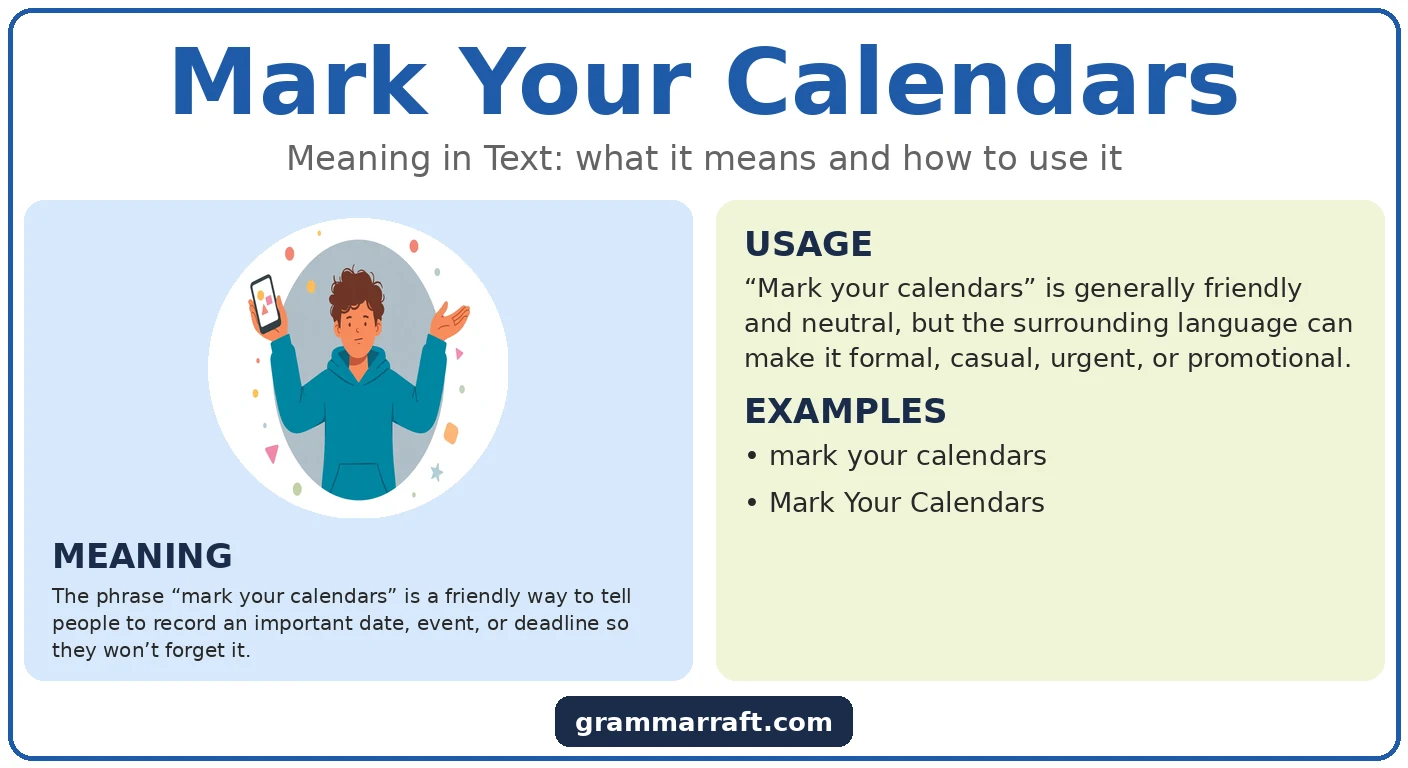
The phrase “mark your calendars” is a friendly way to tell people to record an important date, event, or deadline so they won’t forget it. You’ll see it in invitations, announcements, newsletters, social posts, workplace messages, and event promotions.
Although the expression sounds simple, its tone and meaning can change slightly depending on the situation. It may signal a firm appointment, a save-the-date notice, or an exciting event that has not yet opened for registration.
This article explains how to use “mark your calendars” naturally, how to add the date and time clearly, which alternatives fit different audiences, and how to place the reminder in a digital calendar without creating confusion.
What “Mark Your Calendars” Means
“Mark your calendars” means write down or save a particular date so you remember an upcoming event. The calendar may be a paper planner, a wall calendar, a phone app, a work scheduling system, or any other tool used to track time.
The phrase usually carries more energy than a plain instruction such as “record the date.” It suggests that the date matters and that readers should take action now, even if the event is still weeks or months away.
For example, a school might announce, “Mark your calendars for the spring concert on May 18.” A company could write, “Mark your calendars: the annual meeting begins at 9 a.m. on October 4.”
The expression does not always mean that tickets, registration, or full event details are available. Often, the speaker is giving people an early warning so they can protect the date before making other plans.
| Expression | Basic meaning | Typical tone | Best use |
|---|---|---|---|
| Mark your calendars | Record the date now | Friendly and encouraging | Announcements and event promotions |
| Save the date | Keep the date available | Polite and anticipatory | Weddings, conferences, and major events |
| Please note the date | Pay attention to the date | Formal and direct | Official notices and instructions |
| Add it to your calendar | Enter it into a calendar tool | Practical and conversational | Digital scheduling and team communication |
The phrase is often plural because it speaks to a group. If you are addressing one person, “mark your calendar” is grammatically appropriate. Both forms communicate the same basic idea.
Is “Mark Your Calendars” a Saying?
Yes. “Mark your calendars” is a common English expression, especially in American business, education, media, and event communication. It functions as an idiomatic reminder rather than a literal instruction to draw on a particular calendar.
Like many familiar phrases, it works because the intended meaning is immediately understood. A reader does not need to know whether the sender expects a pen-and-paper note, a phone notification, or a shared work schedule.
The saying is also flexible. It can introduce a serious deadline, an informal party, a public holiday, a product release, or a broadcast date. The surrounding information determines how important or formal the event feels.
Why the phrase is effective

The words create a small sense of urgency without sounding aggressive. “Remember this date” is clear, but “mark your calendars” feels more engaging because it encourages the reader to participate.
It also gives the audience a simple next step. They do not need to register immediately, make a payment, or read a long explanation; they only need to note the date and wait for additional information.
That makes the expression useful in announcements where plans are confirmed but details are still developing. A nonprofit may announce the day of its annual fundraiser before publishing the venue, ticket price, or volunteer schedule.
Singular and plural forms
Use “mark your calendar” when speaking to one person or when writing a general instruction directed at each individual reader. Use “mark your calendars” when addressing several people as a group.
Examples include “Mark your calendar for your appointment on Tuesday” and “Mark your calendars for the company picnic.” Neither version is more correct in every situation.
In a public announcement, the plural form often sounds more natural because the message is aimed at a broad audience. In a personal email, the singular form may feel more direct.
Where the Expression Comes From
The expression is based on a literal habit: people once wrote important dates in paper calendars so they could find them later. Before digital reminders became common, marking a date might involve circling a day, underlining it, adding a note, or placing a colored sticker on the page.
“Mark” has long been used in English to mean identify, record, or draw attention to something. In this phrase, it does not necessarily mean making a visible ink mark; it means making the date noticeable and memorable.
The wording became especially common in announcements and promotional writing because it combines instruction with anticipation. A phrase such as “Mark your calendars for opening night” tells readers both what to do and why the date deserves attention.
Modern digital calendars have changed the physical action, but not the meaning. A person can now mark a calendar by tapping a date, creating an event, setting a reminder, or accepting an invitation from another organizer.
“Mark down your calendar” versus “mark your calendar”
“Mark your calendar” is the standard expression. “Mark down your calendar” is sometimes heard, but it is less conventional and may sound awkward to many speakers.
The word “down” is more naturally used in phrases such as “write down the date” or “note down the appointment.” Combining it with “mark your calendar” creates a mixed expression that people can still understand, but it is not the clearest choice.
For polished writing, use one of these forms: “mark your calendar,” “mark your calendars,” “write down the date,” or “note the date.” Each one is easy to understand and appropriate in a different setting.
Is it literal or figurative?
The phrase is both literal and figurative. Literally, it asks someone to place a visible entry in a calendar; figuratively, it means the date should receive special attention.
That dual meaning explains why the expression works in digital communication. A person may never physically draw a mark, yet creating a calendar event still satisfies the instruction.
How to Use “Mark Your Calendars” Correctly
See Also: How to Avoid Passive Voice in Writing (With Examples)
The most useful version of the phrase includes the event, date, time, and time zone when relevant. Without those details, readers may remember that something is happening but still need to search for the information later.
A basic announcement can follow this pattern: “Mark your calendars for [event] on [date] at [time].” For a larger event, add the location, registration date, or notice that more details will follow.
- State the event name clearly.
- Write the date in a format that your audience will understand.
- Include the start time and end time if they are known.
- Add the time zone for online or international events.
- Explain whether registration, tickets, or additional instructions are coming later.
- Use a reminder link or calendar file when readers need to save the event digitally.
For example, “Mark your calendars for the neighborhood cleanup on Saturday, April 12, from 9 a.m. to noon at Riverside Park” gives readers enough information to take action.
Examples for different situations
A workplace message might say, “Mark your calendars for the quarterly planning meeting on Thursday, June 6, at 2 p.m. Eastern Time.” The exact time zone matters because remote teams may be spread across several regions.
A school announcement could read, “Please mark your calendars for the sixth-grade presentation on May 21 at 6:30 p.m. in the auditorium.” This version uses a warmer phrase while retaining a specific instruction.
A marketing message may use more excitement: “Mark your calendars—the summer collection arrives online July 10.” If the launch time is important, it should be included rather than left to guesswork.
Using punctuation and capitalization
The phrase can appear at the beginning of a sentence, after a colon, or as a short standalone line. For example: “Mark your calendars for the community forum” and “Mark your calendars: registration opens Monday” are both correct.
In a headline or promotional graphic, capitalization may be used for design reasons. In ordinary sentence text, lowercase is usually appropriate unless the phrase begins the sentence.
An exclamation mark can make a celebration feel lively, but it is not required. A formal notice may be better with a period, while a festival announcement may suit a more enthusiastic tone.
Marking a Date on iPhone and Digital Calendars
On a phone, “mark your calendar” usually means creating a calendar event rather than simply viewing the date. A useful event entry should include a descriptive title, the correct date, the start and end time, the location or meeting link, and an alert.
On an iPhone, open the Calendar app, select the relevant day, create a new event, and enter the details. Apple’s official instructions for adding calendar events on iPhone explain the available fields and options.
The same principle applies to Android calendar apps, desktop programs, and web-based services. The labels may differ, but the important task is to turn a vague reminder into a complete schedule entry.
Choosing the right reminder
A reminder should match the importance of the event. A casual online discussion may need an alert ten minutes before it begins, while a flight, examination, or appointment may require a reminder several days in advance as well as one shortly before the start time.
For an event that requires preparation, create more than one alert. A conference could have an early reminder to arrange travel and a second reminder on the morning of the first session.
Do not assume that every calendar invite contains the information attendees need. Check the time zone, meeting link, location, access instructions, and any changes to the original announcement.
Shared calendars and invitations
A shared calendar is useful when several people must coordinate the same event. Teams can see the scheduled time, identify conflicts, and update details without sending a separate message to every participant.
However, a shared calendar entry does not always equal confirmed attendance. Some systems distinguish between invitations that were sent, invitations that were accepted, and events that were merely added by an individual.
If attendance matters, include a clear response request. “Please accept or decline the invitation by Friday” is more precise than assuming that everyone who sees the event will attend.
Choosing the Right Tone
“Mark your calendars” is generally friendly and neutral, but the surrounding language can make it formal, casual, urgent, or promotional. The phrase itself is rarely inappropriate; the main question is whether the details and tone match the audience.
A government office might write, “Please mark your calendars for the public hearing on September 14.” A group of friends could say, “Mark your calendars for game night.” Both uses are natural because the phrase adapts to the situation.
Formal communication
Formal writing benefits from precision. Include the official event name, complete date, time zone, venue, and any action required from the recipient.
For example: “Please mark your calendars for the board meeting scheduled for Tuesday, November 19, at 10 a.m. Central Time. The agenda will be distributed one week before the meeting.”
This wording avoids excessive excitement and gives recipients information they can use immediately. It also separates the date reminder from later instructions.
Casual communication
Casual writing can be shorter and more expressive. “Mark your calendars for our beach day on August 3” may be enough if everyone already knows the location and schedule.
Emojis, exclamation marks, and colorful images may suit a private group or social media post, but they should not replace essential details. A visually attractive design still needs a readable date and time.
Promotional communication
Promotional announcements often use “mark your calendars” to create anticipation before an event, release, sale, or broadcast. The message should explain what makes the date important rather than relying on the phrase alone.
“Mark your calendars for the grand opening on June 1, with live music beginning at noon” gives the audience a reason to pay attention. If the event is not yet fully confirmed, use careful wording such as “planned for” or “scheduled to take place,” depending on the certainty of the date.
Alternatives and Similar Expressions
See Also: Work Like a Charm: Meaning, Origin, Usage, Examples, and Grammar
Several expressions can replace “mark your calendars,” but they do not all carry exactly the same tone. Choosing the best alternative depends on whether you want to emphasize memory, availability, urgency, or formal notice.
“Save the date”
“Save the date” asks people to keep a date available, usually before a formal invitation or full schedule is sent. It is especially common for weddings, conferences, reunions, fundraisers, and other events that require advance planning.
The phrase often suggests that more information will follow. “Mark your calendars” is slightly broader because it focuses on recording the date, while “save the date” stresses protecting that time from competing plans.
“Note the date”
“Note the date” is concise and somewhat more formal. It works well in reports, official messages, meeting notices, and professional correspondence.
It can sound less enthusiastic than “mark your calendars,” so it may not be the strongest option for a festival, product launch, or social celebration.
“Add it to your calendar”
“Add it to your calendar” is a practical digital instruction. It tells the reader exactly what action to take, making it suitable for online meetings, project deadlines, medical appointments, and team schedules.
This phrase is less useful when the date is tentative. If the event might change, asking people to “save the date” may be safer than encouraging them to create a fixed calendar entry.
Other useful alternatives
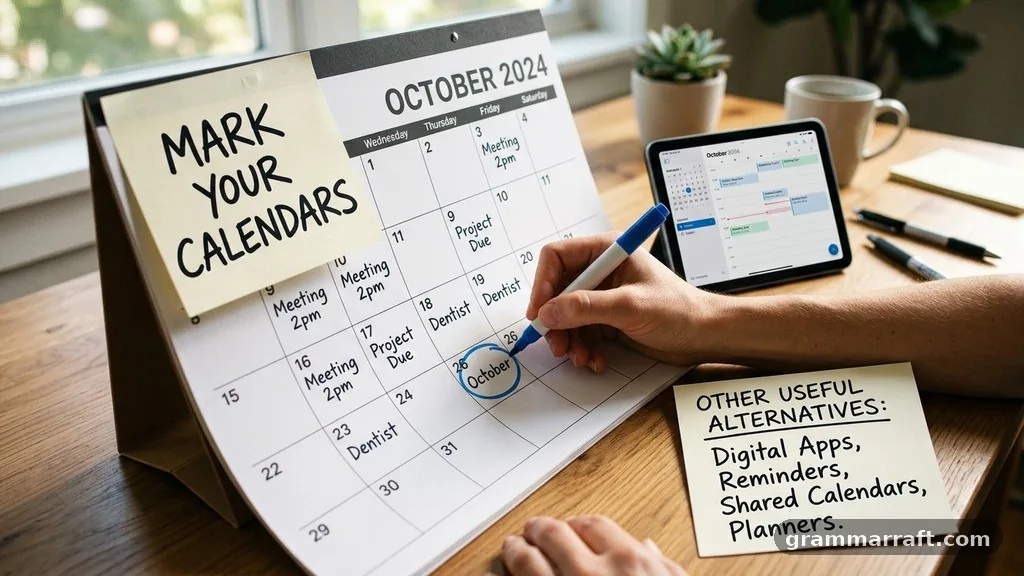
- Keep the date open: emphasizes avoiding other commitments.
- Remember this date: direct and easy to understand.
- Please take note: formal and suitable for official communication.
- Join us on: inviting and event-focused.
- Set a reminder for: practical and especially suited to digital tools.
The best choice is the one that tells readers what they need to do. A clever phrase is not helpful if the audience cannot tell whether the date is final, tentative, optional, or mandatory.
Common Mistakes to Avoid
The biggest mistake is announcing a date without enough context. “Mark your calendars for the big day” may sound exciting, but it forces readers to search for the event name, location, time, and purpose.
Another common problem is using a date format that can be misunderstood. In some countries, “04/05” means April 5, while in others it means May 4. Writing the month as a word removes that uncertainty.
Leaving out the time zone
Online events require special care. A message that says “Join us at 7 p.m.” is incomplete if the audience includes people in different regions.
Write “7 p.m. Eastern Time,” “19:00 UTC,” or provide an automatic calendar invitation that displays the local time. If daylight-saving changes could affect the event, rely on a recognized time-zone label rather than an unexplained abbreviation.
Confusing a reminder with confirmation
“Mark your calendars” does not prove that the event is fully confirmed. Dates can change because of venue problems, weather, staffing, technical issues, or approval delays.
If a date is provisional, say so clearly. “The event is currently planned for September 8; final details will be confirmed in August” gives readers useful information without presenting an uncertain schedule as permanent.
Overloading the announcement
A reminder should be easy to scan. Long paragraphs, decorative images with tiny text, and several competing calls to action can bury the date that readers need to notice.
Put the event, date, and time near the beginning. Add secondary information afterward, and use a separate link or message for detailed policies, directions, ticketing, or registration instructions.
Forgetting to update changes
If the date changes, update every place where it appears. That includes the original post, website, email campaign, calendar invitation, printed material, social graphics, and automated reminder.
People often keep the first calendar entry they receive. A correction should therefore state the old date and new date plainly, such as “The workshop has moved from June 11 to June 18.”
Making Calendar Reminders More Useful
A good reminder does more than identify a day. It helps the reader understand what is happening, decide whether it matters to them, and take the next practical step.
Start with the essential facts, then add information based on the event’s complexity. A short birthday reminder may need only a date and time, while a professional conference may require travel instructions, registration deadlines, access details, and preparation notes.
A reliable announcement formula
Use this structure for most situations: “Mark your calendars for [event] on [date] at [time] in [location or platform]. [Next step or additional detail].”
For example: “Mark your calendars for the parent information night on Thursday, September 12, at 6 p.m. in the library. Registration is not required, and a recording will be shared afterward.”
This formula works because it presents the most important information in a predictable order. Readers can find the event, day, time, place, and action without reading every word.
Designing an image or social post
If the reminder appears in an image, make sure the date and time remain readable on a small phone screen. Use strong contrast, a simple layout, and enough space around the key information.
Do not place essential details only in the image. Include them in the text accompanying the post so screen-reader users and people who cannot load the image can still understand the announcement.
A useful event graphic might show the event title at the top, the date in the largest text, and the time and location underneath. Decorative design should support the message rather than compete with it.
Following up at the right time
One reminder may not be enough for a major event, but repeated messages can frustrate people if they contain no new information. Use an early announcement, a practical follow-up, and a final reminder close to the event day.
The first message can encourage readers to reserve the date. The second can provide registration or preparation details, while the final message can confirm the schedule and explain what attendees should bring or expect.
Timing depends on the audience and event. A recurring team meeting may need only an automated calendar entry, while a wedding, examination, or travel-related event deserves earlier notice.
Examples You Can Adapt
See Also: Die on the Vine: Meaning, Origin, Examples & Correct Usage
Examples help show how the phrase changes across contexts. Each one should be adjusted to include the actual information your audience needs rather than copied as a complete announcement.
For a workplace
“Mark your calendars for the annual staff meeting on Wednesday, October 9, from 1 to 3 p.m. The meeting will take place in Conference Room B, with a video option available for remote employees.”
This version gives employees a date, duration, location, and access option. It is more useful than a short message that simply announces “the annual meeting is coming.”
For a school or community group
“Please mark your calendars for Family Day on Saturday, May 17, from 11 a.m. to 2 p.m. at the community center. Activities are free, and the full program will be shared next month.”
The wording is welcoming while remaining specific. It also distinguishes confirmed information from details that have not yet been released.
For a wedding or private celebration
“Save the date and mark your calendars for June 21, when we’ll celebrate together in Portland. A formal invitation with the venue and RSVP details will follow.”
Using both expressions can work here because “save the date” emphasizes keeping the day available, while “mark your calendars” provides a familiar reminder.
For an online event
“Mark your calendars for our live product demonstration on March 4 at 3 p.m. Pacific Time. The access link and recording information will be sent to registered attendees.”
This example identifies the time zone and explains what attendees should expect next. If the event is limited to registered participants, that requirement should appear prominently.
For a deadline
“Mark your calendar: applications close at 5 p.m. on August 30. Late submissions will not be reviewed.”
For deadlines, direct language is often better than a celebratory tone. The reader needs to understand not only the date but also the consequence of missing it.
FAQ About “Mark Your Calendars”
What is another way to say “mark your calendars”?
Common alternatives include “save the date,” “note the date,” “add it to your calendar,” “keep the date open,” and “set a reminder.” Choose “save the date” for advance event notices, “add it to your calendar” for a practical digital instruction, and “note the date” for more formal writing.
How do I mark my calendar?
Write the event name, date, time, and location in a paper planner or create a digital calendar event with those details. Add an alert that gives you enough time to prepare, travel, register, or gather any materials you need.
Is “mark your calendar” grammatically correct?
Yes. Use the singular form when addressing one person or giving an instruction to each individual reader, and use “mark your calendars” when addressing a group. Both forms are standard and widely understood.
Does “mark your calendars” mean the date is confirmed?
Not necessarily. The phrase can introduce a confirmed event or a preliminary date, so the announcement should say whether the schedule is final. Words such as “tentatively scheduled,” “planned for,” or “subject to change” make uncertainty clear.
Should I use “mark down your calendar”?
It is understandable, but “mark your calendar,” “mark your calendars,” or “write down the date” sounds more natural. “Mark down your calendar” blends two familiar expressions and is best avoided in polished professional writing.
Conclusion
“Mark your calendars” is a clear, friendly way to draw attention to an upcoming date. Use it with the event name, complete date, time, location, and time zone whenever those details are known, and explain whether the schedule is confirmed or still tentative.
For digital communication, create a complete calendar entry and choose reminders that match the event’s importance. Whether you’re writing a workplace notice, a social invitation, or a public announcement, a well-timed “mark your calendars” message helps people plan instead of simply hoping they remember.
Explore more helpful guides on GrammarRaft.