What Does <锟紷锟� Mean in Text? Explained
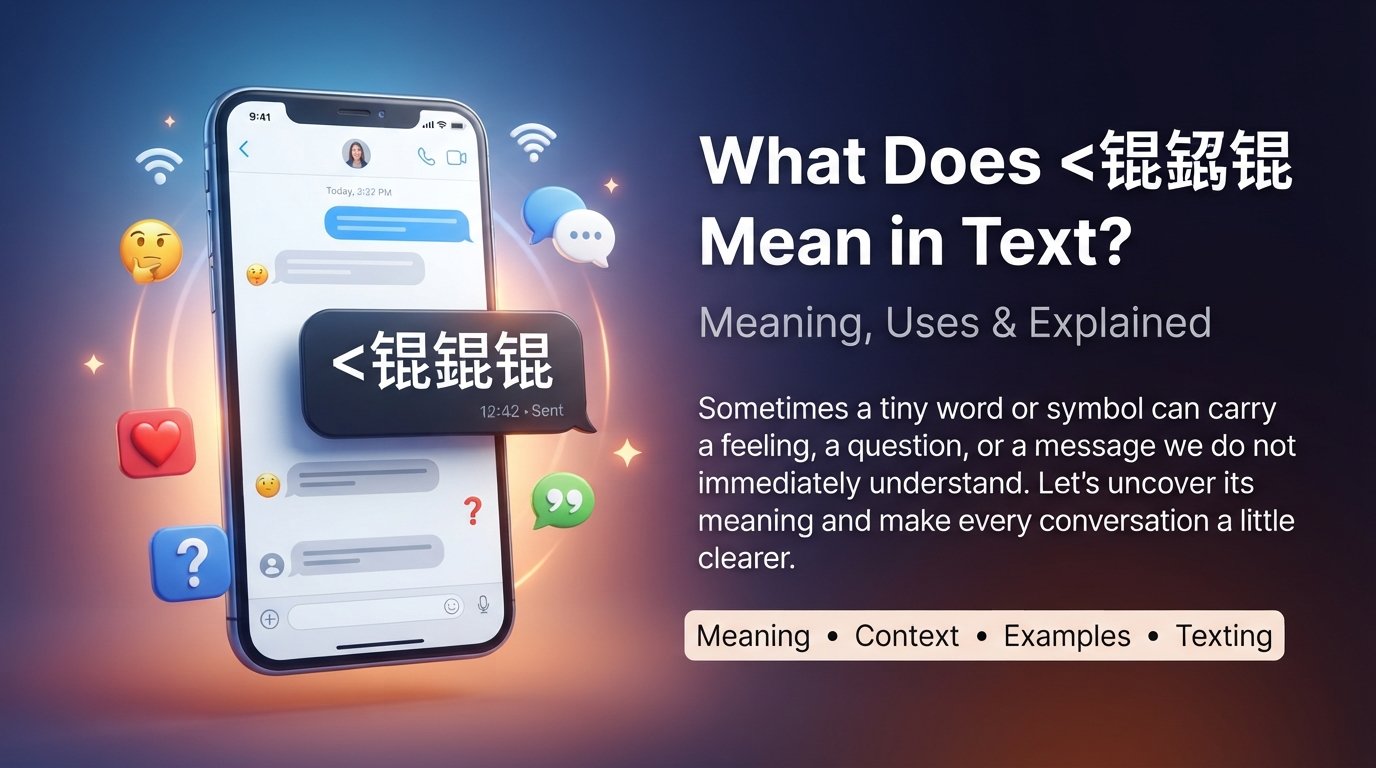
If you have received “<锟紷锟�” in a text message, comment, or social media post, you may be wondering whether it is slang, an abbreviation, or some kind of hidden expression. The good news is that the confusion is understandable because this exact string does not appear to be a standard English texting abbreviation or widely recognized piece of internet slang.
In most cases, “<锟紷锟�” looks like corrupted or incorrectly decoded text, rather than a phrase with a specific emotional or conversational meaning. The unusual Chinese-looking characters are an important clue. They can appear when text encoded in one character system is incorrectly interpreted using another.
Understanding this distinction matters. Instead of assuming that the sender intended a secret meaning, it is usually better to consider where the text appeared, what came before it, and whether the original message may have been damaged during copying, conversion, or display.
<锟紷锟�> Meaning: Quick Meaning
The exact string “<锟紷锟�” has no established, universal meaning in ordinary English texting.
It is most likely related to character encoding corruption, sometimes called mojibake. This happens when a computer or application reads characters using the wrong encoding.
In simple terms:
- <锟紷锟�> is not recognized as common English texting slang.
- It may be a garbled version of another character or symbol.
- The original text may have been damaged during copying, importing, exporting, or displaying.
- Its intended meaning can only be identified reliably from the original source or surrounding conversation.
For example, a person might see:
“I was going to say <锟紷锟�> but never mind.”
Here, the strange characters may represent missing or corrupted text rather than something the sender intentionally typed.
Another example could be:
“Thanks <锟紷锟�>”
The characters themselves do not provide enough reliable information to determine whether the sender meant an emoji, punctuation, another language, or something else.
Origin & Background
The unusual appearance of “锟紷锟�” provides a strong clue that the issue may be technical rather than linguistic.
Computers store written characters as numerical data. Different character encoding systems tell software how those numbers should be interpreted. Modern applications commonly rely on Unicode, which was designed to support writing systems from around the world.
Problems occur when text created under one encoding is opened or processed under another.
This can produce strange sequences of characters that look completely different from the original message. Such corrupted text is commonly known as mojibake, a Japanese term used to describe garbled characters caused by encoding problems.
The phenomenon became especially noticeable as the internet expanded across languages and writing systems. Older software, databases, websites, and messaging systems sometimes handled non-English characters inconsistently.
Social media has made the problem even more visible. Text can pass through several systems before reaching a reader. A message might be written on one device, copied into an application, stored in a database, processed by a website, and then displayed on another device.
If something goes wrong during that process, a normal character can become a confusing sequence such as “锟紷锟�.”
That does not automatically mean the sender intended those characters.
Real-Life Conversations
Person A:
“Hey, what did you mean by <锟紷锟�>?”
Person B:
“Wait, what? I didn’t type that. I think WhatsApp messed up the message when I copied it.”
Person A:
“Ah, okay. I thought it was some new abbreviation.”
This is a realistic situation because unusual characters can easily be mistaken for internet slang.
Instagram DMs
Person A:
“Your last message showed up as <锟紷锟�>. Is that a word?”
Person B:
“No 😂. I copied it from an old note and apparently something went wrong.”
Person A:
“That makes much more sense.”
Here, context immediately suggests that the unusual text is probably a formatting or encoding issue.
TikTok Comments
Person A:
“What does <锟紷锟�> mean?”
Person B:
“I think it’s corrupted text. The original comment probably had a symbol or another character.”
Person A:
“Got it. I thought I was missing some new slang.”
Short-form social platforms can make these misunderstandings more common because users frequently copy captions, comments, symbols, and multilingual text.
Text Messages
Person A:
“Did you send me <锟紷锟�>?”
Person B:
“Yeah, but that isn’t what I typed. My keyboard changed something when I pasted it.”
Person A:
“Okay, send it again.”
This is usually the simplest solution. When the original sender is available, asking them to resend the message is much more reliable than trying to decode an isolated corrupted string.
Emotional & Psychological Meaning
Unlike expressions such as “LOL,” “OMG,” or “IDK,” <锟紷锟�> does not have a recognized emotional meaning on its own.
It does not automatically communicate happiness, sadness, anger, flirting, sarcasm, embarrassment, or affection.
The psychological response often comes from the reader rather than the expression itself. When people encounter unfamiliar symbols, they naturally try to find a pattern. In a fast-moving digital conversation, that can lead someone to wonder whether a strange sequence has hidden slang meaning.
For example, imagine receiving an unfamiliar string from someone you care about. You might spend several minutes wondering whether it was a joke, an inside reference, or a coded response.
In everyday communication, I have found that the safest approach with unexplained text is to check the context before assigning emotion to it. A strange character sequence is not automatically a hidden message.
Usage in Different Contexts
Social Media
On Instagram, TikTok, Facebook, and similar platforms, unusual characters may appear because content has been copied between applications or because a platform does not interpret certain characters correctly.
If you see <锟紷锟�> in a public comment, do not automatically assume it is current slang.
Friends & Relationships
With friends or romantic partners, context becomes particularly important. A strange sequence could simply be a typo, corrupted emoji, or copied character.
If the message seems emotionally important, ask what the person intended rather than interpreting the symbols yourself.
Work and Professional Settings
Avoid using <锟紷锟�> intentionally in professional communication because it is not a recognized business abbreviation.
If it appears in an email, document, or workplace message, it is better to verify the original wording.
Casual vs. Serious Tone
There is no reliable casual or serious interpretation of the string itself.
Its meaning depends on what it replaced and where it came from.
When NOT to Use It
You generally should not intentionally use <锟紷锟�> as slang unless you and your audience have specifically agreed on a private meaning.
There are several reasons.
First, most readers will not recognize it.
Second, some people may assume their device or browser has malfunctioned.
Third, the sequence may look like corrupted foreign-language text.
Finally, in professional, educational, or formal communication, unexplained characters can make a message appear incomplete or technically damaged.
Cultural sensitivity also matters. Because the sequence contains characters that visually resemble Chinese writing, readers may mistakenly believe it is a meaningful Chinese expression. It is better not to present it as a Chinese word or phrase without evidence.
Common Misunderstandings
“It must be new slang.”
Not necessarily. Internet users constantly create new abbreviations, but unusual characters are not automatically slang.
“It is a Chinese expression.”
The appearance of Chinese characters does not prove that the sequence is a genuine Chinese phrase.
“It has a secret emotional meaning.”
There is no established evidence that <锟紷锟�> universally expresses a particular emotion.
“Everyone online knows what it means.”
There is no broadly recognized English texting definition for this exact sequence.
“The sender definitely typed it deliberately.”
That is another common mistake. Encoding problems can transform ordinary text into strange characters without the sender realizing it.
Comparison Table
| Expression or issue | Meaning | Typical use |
|---|---|---|
| <锟紷锟�> | No established texting meaning; likely corrupted text | Accidental or technical appearance |
| LOL | Laughing or finding something funny | Casual texting |
| IDK | I don’t know | Casual conversations |
| SMH | Disappointment, disbelief, or frustration | Social media and texting |
| ??? | Confusion or asking for clarification | Informal messages |
| [missing character] | A character failed to display | Digital communication |
| Mojibake | Garbled text caused by encoding problems | Technical and online contexts |
| Typo | Accidental typing mistake | Any written communication |
| Emoji replacement | An emoji or symbol fails to display properly | Messaging and social media |
| Clear wording | Directly understandable communication | Formal and casual settings |
Key Insight
The biggest distinction is between slang and corrupted text. Slang carries a socially understood meaning, while corrupted text is often the result of a technical problem. Treating the two as identical can create unnecessary confusion.
Variations / Types
Because <锟紷锟�> is not an established slang expression, its apparent variations are better understood as possible forms of text corruption.
1. Encoding Corruption
Meaning: Characters are displayed incorrectly because the wrong encoding was used.
The visible text may have little resemblance to the original.
2. Replacement Character
Meaning: A system cannot interpret a character and substitutes another symbol.
This can happen when software encounters unsupported or invalid character data.
3. Garbled Emoji
Meaning: An emoji or symbol fails to render correctly.
Instead of seeing the intended icon, users may see strange characters or an empty box.
4. Copy-and-Paste Corruption
Meaning: Text changes when copied between different applications.
This can happen when formatting or character information is not preserved correctly.
5. Database Encoding Error
Meaning: Stored text is interpreted using an incompatible character set.
This is particularly relevant to websites, archives, and older databases.
6. Browser Display Error
Meaning: A webpage displays characters incorrectly.
The problem may be caused by how the page declares or handles its character encoding.
7. Font Rendering Problem
Meaning: The correct character exists, but the device cannot display it properly.
Users may see boxes, symbols, or unusual substitutes.
8. Language Conversion Error
Meaning: Text passes incorrectly between systems that handle different languages.
Multilingual content is particularly vulnerable to this type of problem.
9. Damaged Imported Text
Meaning: Text becomes corrupted while being transferred from another document or platform.
Old files and copied content can sometimes produce unexpected characters.
10. Accidental Typing
Meaning: The sender may simply have entered unusual characters by mistake.
In this situation, there may be no hidden meaning at all.
How to Respond When Someone Uses It
Casual Replies
- “What does that mean?”
- “I think your message got scrambled.”
- “Can you send that again?”
Funny Replies
- “Did your keyboard just invent a new language? 😂”
- “Okay, now I need the translation.”
- “My phone clearly missed that lesson.”
Mature Replies
- “I’m not sure what that text means. Could you clarify?”
- “That part appears corrupted on my end. Could you resend it?”
- “I don’t want to misunderstand you. What did you intend to say?”
Respectful Replies
- “Could you please explain that part?”
- “I think some characters may not have displayed correctly.”
- “Would you mind sending the original wording again?”
The best response depends on the relationship. With a close friend, humor can work. In a serious conversation, simple clarification is usually better.
Regional & Cultural Usage
Western Culture
In Western online communication, people are familiar with abbreviations, emojis, memes, and slang. However, <锟紷锟�> is not a standard English abbreviation.
A Western reader is more likely to interpret it as a technical glitch or corrupted message.
Asian Culture
Asian digital communication is highly multilingual, and people often move between English, local languages, emojis, and different writing systems.
That makes encoding and display issues particularly noticeable when text moves between platforms.
Still, the sequence should not automatically be treated as a meaningful Asian slang expression.
Middle Eastern Culture
Digital conversations across the Middle East can also involve Arabic, English, transliterated Arabic, emojis, and other writing systems.
When multilingual text is transferred between applications, unusual characters may occasionally appear.
The safest interpretation remains contextual rather than assuming that the sequence represents a particular regional expression.
Global Internet Usage
The internet has created a communication environment where text can cross languages and platforms within seconds.
As a result, strange characters can appear anywhere. <锟紷锟�> should therefore be understood as an unexplained character sequence rather than global internet slang.
Generational Differences
Gen Z and Millennials are both comfortable with abbreviations and digital shorthand, but neither generation has a universal texting definition for this exact sequence.
A younger user might initially assume it is a meme or newly invented slang, while an older user might immediately recognize it as a display error. Either interpretation can be wrong without context.
Is It Safe for Kids?
The string <锟紷锟�> is not inherently inappropriate or dangerous.
Because it does not have a recognized slang definition, parents and educators should focus on the surrounding conversation rather than the characters themselves.
If a child receives the sequence in a message, a simple question such as “What did the person mean?” can help clarify the situation.
Parents should be especially careful about assuming that unfamiliar digital language is automatically harmful. Context is more informative than a strange-looking sequence by itself.
FAQs
What does <锟紷锟�> mean in text?
<锟紷锟�> has no established English texting meaning. It most likely represents corrupted, incorrectly decoded, or improperly displayed text.
Is <锟紷锟�> slang?
No recognized slang definition exists for the exact sequence <锟紷锟�>. It should not automatically be treated as internet slang.
Is <锟紷锟�> a Chinese word?
Not necessarily. Although the characters visually resemble Chinese characters, their appearance alone does not establish that they form a meaningful Chinese expression.
Why do strange characters appear in text messages?
They can appear because of encoding problems, unsupported characters, copying errors, software incompatibility, or failed emoji rendering.
Should I reply to <锟紷锟�>?
If someone sends it to you, the safest response is to ask what they intended to say or request that they resend the message.
Can <锟紷锟�> have a private meaning?
Yes, technically a person or group could assign any private meaning to unusual characters. However, there is no widely recognized meaning that readers should assume.
How can I find the original meaning?
Check the original message, ask the sender to resend it, or look at the source where the text was copied from. An isolated corrupted sequence may not contain enough information to reconstruct the original wording.
Conclusion
Seeing “<锟紷锟�” in a message can be surprisingly confusing, especially when you are used to seeing hundreds of abbreviations and slang terms online. However, not every unfamiliar sequence is a secret expression waiting to be decoded.
The exact string has no established, universal texting meaning. Its unusual characters strongly suggest that it may be the result of encoding corruption, incorrect character interpretation, copying problems, or another display issue.
The most confident way to handle it is also the simplest: look at the surrounding conversation and ask the sender for clarification when necessary. Good digital communication is not about pretending to understand every unfamiliar symbol. It is about making sure the intended message and emotional meaning actually reach the other person.
When text looks strange, context is often more valuable than the characters themselves.