
IMU Meaning in Text: Definition, Examples and Usage
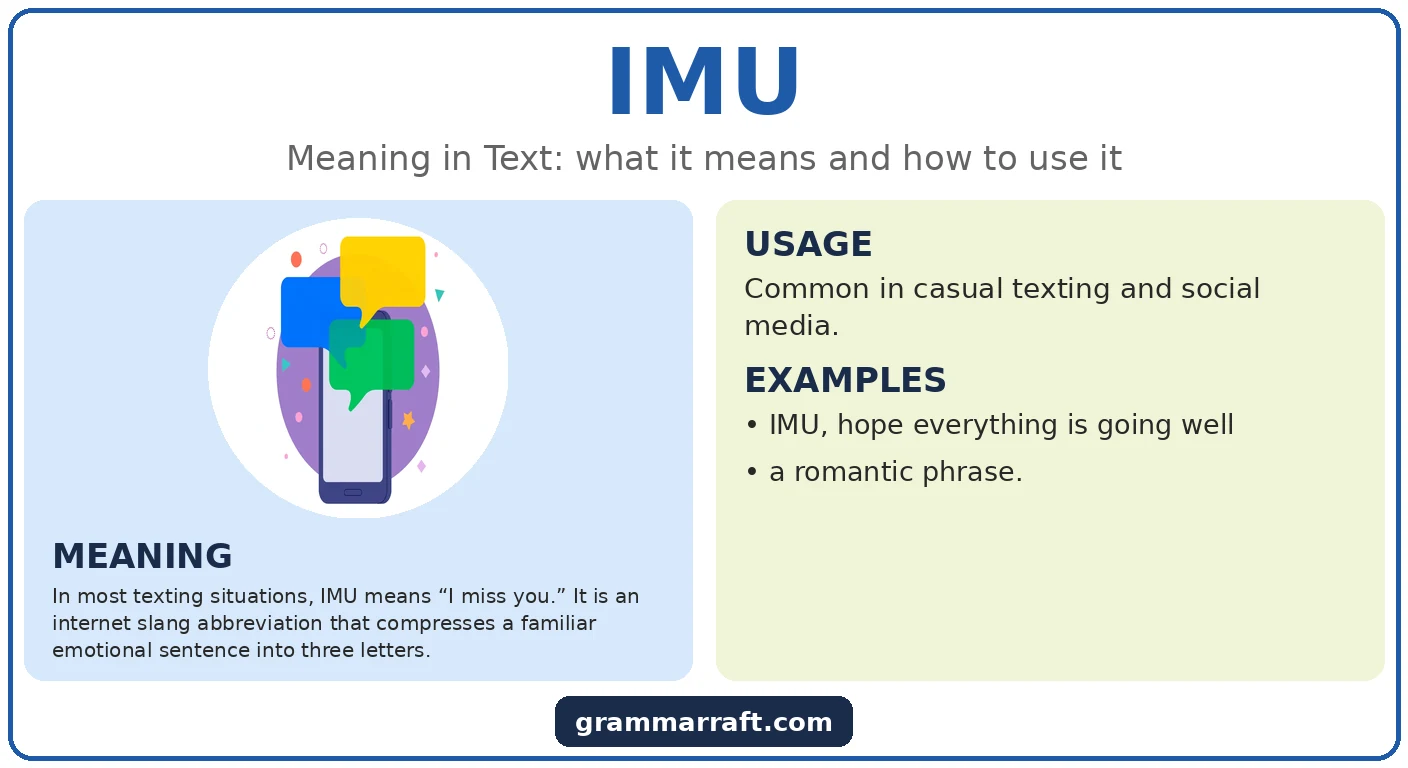
The IMU meaning in text is usually “I miss you,” especially in a personal message or casual chat. It’s a short expression of longing, but the tone can range from affectionate to friendly depending on who sends it and what surrounds it.
IMU is less common than “I miss you,” “I miss u,” or the similar abbreviation IMY, so confusion is understandable. The same three letters can also refer to an inertial measurement unit in technology, which makes context especially important.
This guide explains the IMU definition, how people use the abbreviation in texting and social media, how it compares with IMY, and how to reply without reading too much into a brief message.
What Does IMU Mean in Text?
In most texting situations, IMU means “I miss you.” It is an internet slang abbreviation that compresses a familiar emotional sentence into three letters. Someone might send “IMU” after moving away, ending a visit, or remembering a person they have not seen recently.
The phrase is generally warm, but it does not automatically signal romance. A friend, family member, former classmate, or romantic partner could all use it. The relationship, recent conversation, and punctuation usually reveal more than the abbreviation itself.
For example, “IMU already” often sounds affectionate and immediate. “IMU, hope everything is going well” may come from a friend or relative, while “IMU ❤️” is more likely to carry romantic or emotionally intimate meaning.
Here are common interpretations of the IMU text message meaning:
- “I miss you” in a romantic or emotionally close conversation.
- “I miss you” between friends or relatives who are apart.
- A quick emotional response to a photo, memory, or reunion discussion.
- A playful or informal version of a longer message.
- A potentially different abbreviation if the conversation concerns engineering, robotics, or navigation.
Because IMU is brief, it leaves room for interpretation. A message from a partner after several days apart probably has a different emotional weight from the same message sent by a friend after a weekend trip.
That is why the safest IMU definition is not simply “a romantic phrase.” It is a compact way to say that someone is missed, with the exact feeling supplied by context.
IMU Meaning in Texting and Chat
The IMU meaning in texting is shaped by the speed and informality of digital conversation. Text messages, direct messages, and instant messaging often remove full sentences, capitalization, and punctuation. Abbreviations make emotional communication faster without necessarily making it less sincere.
In a chat, IMU might appear as a standalone message: “IMU.” It can also be placed inside a longer sentence, such as “Had a great time today, IMU already,” or “IMU too, come visit soon.” The surrounding words help identify whether the sender is being serious, playful, or affectionate.
Texting abbreviations also vary by age, platform, country, and personal habit. Some people use “u” for “you” and write “IMU,” while others consider the abbreviation dated or prefer the clearer “I miss you.” Neither style is universally correct.
Common settings for IMU in chat include:
- Private conversations between romantic partners.
- Messages between friends living in different cities or countries.
- Family group chats after someone leaves a visit.
- Replies to old photographs or shared memories.
- Social media direct messages after an account becomes inactive.
The abbreviation may also be used ironically. A person might comment “IMU guys” beneath a group photo after missing a gathering, even though the tone is light rather than deeply emotional. Emojis, exclamation marks, and phrases such as “so much” can make the message feel more intense.
For readers searching “IMU meaning in texting,” the practical answer is simple: read it as “I miss you” first, then check the conversation before deciding what emotional meaning the sender intended.
IMU vs IMY: What Is the Difference?
IMU and IMY are close abbreviations, but they are not equally common. IMY usually means “I miss you,” while IMU can also mean the same thing in informal SMS language. The difference comes from the final letter: “Y” represents “you,” whereas “U” represents the single-letter texting form of “you.”
In other words, IMY uses the initial of “you,” and IMU uses the texting abbreviation “u.” Both can communicate the same sentence, and many readers will understand either one immediately.
| Abbreviation | Usual meaning | Typical tone | Potential issue |
|---|---|---|---|
| IMU | I miss you | Informal, personal | Can have technical meanings |
| IMY | I miss you | Informal, affectionate | May be unfamiliar to some readers |
| IMYSM | I miss you so much | More emotionally intense | Can feel overly strong in casual chat |
| MISS U | I miss you | Direct and easy to understand | Less compact than an acronym |
| I MISS YOU | I miss you | Clear, sincere, or emphatic | May sound more serious depending on context |
There is no universal rule that makes IMU more romantic than IMY. A person who regularly uses “u” in messages may choose IMU simply because it matches their normal writing style.
If clarity matters, “I miss you” remains the best choice. It avoids confusion, works across age groups, and makes the emotional message unmistakable. IMY may be a safer short form than IMU when discussing technology, because IMU has a well-established technical meaning.
When comparing IMU vs IMY, focus less on the final letter and more on the full exchange. The sender’s usual texting habits are often the strongest clue.
How People Use IMU on Social Media
IMU on social media generally appears in comments, captions, replies, and private messages. Its meaning stays close to “I miss you,” but the public nature of a post can change the tone. A comment under a friend’s travel photo may express genuine affection, while a comment under a celebrity’s post could be playful or enthusiastic rather than personal.
For example, a person might write “IMU!” beneath a former coworker’s farewell post. Another user may comment “IMU all” under a group picture from a family event. In both cases, the abbreviation communicates absence and connection without requiring a long message.
Social media also encourages compressed emotional language. Short chat acronyms, emojis, tags, and abbreviations let users respond quickly to posts that might otherwise invite a full sentence. IMU can therefore function as both a direct statement and a public signal of familiarity.
The following details can affect how IMU is understood:
- Audience: A private message usually feels more personal than a public comment.
- Emoji choice: A heart may add affection, while a laughing emoji can make the phrase playful.
- Post type: A reunion photo invites a different reading from a professional announcement.
- Relationship: Close friends may use IMU casually without romantic intent.
- Message history: Previous conversations can clarify whether the phrase is serious or joking.
Public comments also tend to be less precise than private communication. Someone may write IMU to a whole group, even though they do not literally feel the same level of absence toward every person pictured. It can be a friendly collective expression.
That context-dependent meaning is normal in internet slang. Short phrases often carry social information that is not contained in the letters alone.
Is IMU Romantic or Friendly?
IMU is not automatically romantic. It expresses missing someone, but people miss friends, siblings, parents, colleagues, classmates, and familiar communities as well as romantic partners.
A romantic reading becomes more likely when IMU appears with intimate language, affectionate emojis, or discussion of a relationship. “IMU, babe,” “IMU every night,” and “IMU more than I can say” have a stronger romantic flavor than “IMU guys” in a group chat.
The timing can matter too. If someone sends IMU shortly after a breakup, the message may signal lingering feelings. If a friend sends it after a holiday visit, it may simply reflect the normal sadness of parting.
Consider these examples:
- “IMU ❤️” — affectionate and possibly romantic, depending on the relationship.
- “IMU, bestie!” — clearly friendly in many conversations.
- “IMU guys after that trip.” — a group-oriented, casual message.
- “IMU. Can we talk?” — emotionally significant and potentially serious.
- “IMU lol, this place isn’t the same without you.” — warm but probably lighthearted.
It is risky to infer a confession from three letters alone. Some people use abbreviations freely, while others choose them carefully. Their normal communication style may tell you more than the abbreviation itself.
If you receive IMU from someone and are unsure how to read it, answer the literal message before interpreting the hidden meaning. “I miss you too” is appropriate if you feel the same, while “That’s sweet—hope we can catch up soon” keeps the response warm but less intimate.
IMU as an Ambiguous Abbreviation
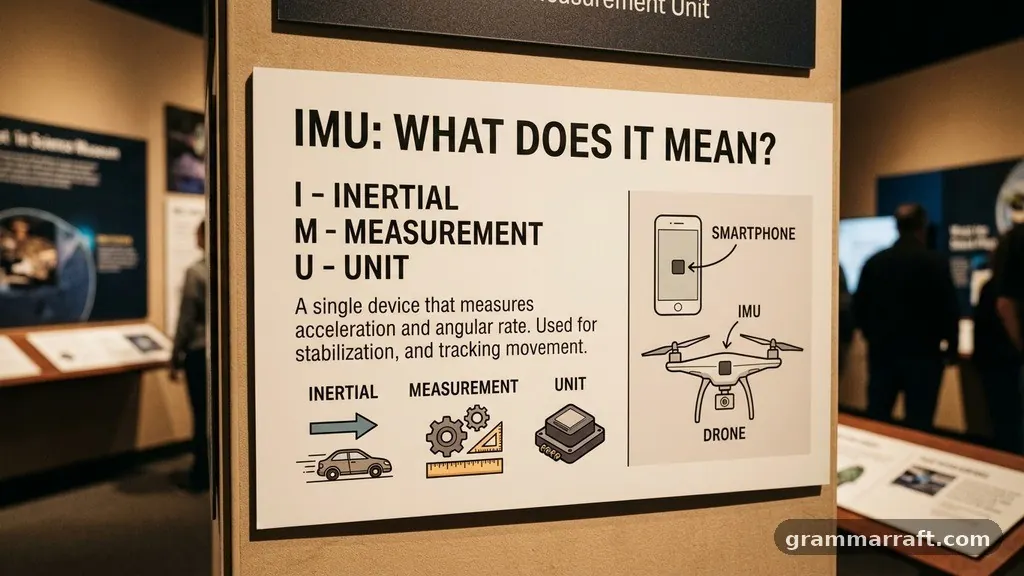
Although the slang meaning is usually “I miss you,” IMU is not limited to texting. In engineering and technology, an IMU is an inertial measurement unit, a device that measures motion-related data such as acceleration and angular velocity. It may be discussed in robotics, drones, aviation, mobile devices, vehicles, and navigation systems.
This technical meaning is completely different from IMU slang. A sentence such as “The drone’s IMU needs calibration” clearly refers to hardware or sensors, not an emotional message. Likewise, “The IMU data is noisy” belongs to a technical discussion.
The abbreviation can also appear in names of institutions or organizations, although those uses depend on the specific setting. A search result, workplace message, or academic document may therefore use IMU in a way unrelated to internet slang.
| Context | Likely meaning of IMU | Example |
|---|---|---|
| Personal texting | I miss you | “IMU already.” |
| Social media comment | I miss you | “IMU, everyone!” |
| Robotics | Inertial measurement unit | “Check the IMU calibration.” |
| Drone engineering | Inertial measurement unit | “The IMU detects orientation changes.” |
| Formal document | Could be an organization or technical term | Defined by the document’s glossary |
Capitalization does not solve every ambiguity. Technical writing commonly uses uppercase IMU, but people also type texting abbreviations in capitals, lowercase, or mixed case. The surrounding vocabulary is the reliable clue.
When a message includes words such as “sensor,” “gyro,” “accelerometer,” “flight controller,” or “calibration,” use the technical definition. When it includes hearts, memories, visits, or personal names, “I miss you” is the stronger interpretation.
How to Reply When Someone Says IMU
Your reply should match both your feelings and the relationship. If you genuinely miss the person, a direct answer works well: “IMU too,” “I miss you too,” or “Same here.” The full sentence is clearer, while the abbreviation mirrors the sender’s informal tone.
If you want to continue the conversation, add a concrete invitation. “IMU too—are you free for a call tonight?” gives the message somewhere to go. “I miss you too; let’s plan a visit soon” acknowledges the emotion and suggests a practical next step.
Not every IMU message requires an equally intense response. A friendly answer can remain friendly, especially if the sender is an acquaintance or group-chat member.
- Warm: “I miss you too! We need to catch up soon.”
- Romantic: “I miss you too, sweetheart. I’m thinking about you.”
- Friendly: “IMU too! That trip feels like ages ago.”
- Neutral: “That’s kind of you to say. Hope you’re doing well.”
- Boundary-setting: “I appreciate that, but I’d rather keep some space right now.”
Someone who does not share the same feeling does not need to pretend. A polite response can recognize the message without returning the sentiment. “I’m glad you reached out” is gentler than ignoring the person, but it does not say “I miss you too.”
If IMU appears after a difficult event or a long silence, consider the broader situation before replying quickly. A short message may be an attempt to reconnect, apologize, or restart a relationship, and those possibilities call for different responses.
IMU, I Miss U and Other Texting Abbreviations
IMU belongs to a larger group of texting abbreviations built from initials or shortened spellings. “I miss u” is not an acronym, but it is often more immediately understandable because it preserves the full phrase. “I miss you” is the clearest option, while IMU is the most compressed.
Other related forms include IMY, IMYSM, and “miss u.” These expressions are not perfectly interchangeable in tone. “IMYSM” adds “so much,” which makes the feeling sound stronger. “Miss u” can be affectionate but may also feel casual or routine.
| Expression | Plain meaning | Typical impression |
|---|---|---|
| IMU | I miss you | Very brief and informal |
| IMY | I miss you | Short and recognizable to many users |
| I miss u | I miss you | Casual but easy to understand |
| Miss u | I miss you | Relaxed and conversational |
| IMYSM | I miss you so much | More emotionally emphatic |
| I miss you | I miss you | Direct, clear, and sincere |
SMS language developed partly because early mobile messaging rewarded shorter communication, but modern users also choose abbreviations for style. Instant messaging has fewer technical limits than older text systems, yet compressed forms remain popular because they feel quick and familiar.
For professional communication, avoid IMU unless the context is unmistakably personal and informal. A phrase such as “I miss working with the team” is clearer in a workplace email than a three-letter abbreviation that some readers may interpret as a technical term.
Language changes quickly online. The most useful rule is simple: use the version your recipient will understand without stopping to decode it.
How to Tell Which IMU Meaning Applies
Identifying the correct IMU meaning is usually a process of reading the message as a whole. Start with the channel. A text from a partner, a comment beneath a reunion photo, and a robotics report all provide different expectations before you even examine the abbreviation.
Next, look at the words around IMU. Emotional clues include “miss,” “wish,” “visit,” “love,” “memory,” “tonight,” and personal nicknames. Technical clues include “sensor,” “motion,” “orientation,” “calibration,” “data,” “drone,” and “navigation.”
These questions can help:
- Who sent the message?
- What were you discussing immediately beforehand?
- Is the conversation personal, public, academic, or technical?
- Are emojis or affectionate terms present?
- Does the sender normally use abbreviations?
- Could the sender be referring to a device or system?
Do not rely on capitalization alone. “IMU” and “imu” may both refer to “I miss you” in casual typing, while technical documents may use the same uppercase form consistently. Capital letters are not a dependable meaning marker.
When uncertainty remains, asking is reasonable. “Do you mean you miss me?” may feel direct, but it prevents a mistaken assumption in an emotionally sensitive conversation. In a technical setting, ask what the acronym means before acting on it.
The central lesson is that IMU has a context-dependent meaning. Dictionaries and abbreviation lists can suggest a definition, but the actual conversation determines which definition fits.
FAQ About IMU Meaning in Text
What does IMU stand for in a text message?
IMU most commonly stands for “I miss you” in a personal text message. It is an informal abbreviation used in texting, instant messaging, and social media conversations.
Is IMU a romantic abbreviation?
It can be romantic, but it is not automatically romantic. Friends and relatives also use IMU, so the relationship, wording, emojis, and conversation history matter.
What is the difference between IMU and IMY?
Both IMU and IMY can mean “I miss you.” IMU uses “U,” the texting form of “you,” while IMY uses the first letter of “you”; neither one is inherently more romantic.
Can IMU mean something other than “I miss you”?
Yes. In engineering and technology, IMU commonly means “inertial measurement unit,” a sensor system used to measure motion and orientation. Technical words around the abbreviation usually make that meaning clear.
How should I respond to “IMU”?
If you feel the same, reply “I miss you too” or “IMU too,” and add a plan to talk or meet if appropriate. If you do not share the feeling, respond kindly without claiming that you do.
Conclusion: IMU Meaning in Text
The most common IMU meaning in text is “I miss you,” but the abbreviation is not limited to romance or personal messages. IMU can also describe an inertial measurement unit, so the subject of the conversation matters. IMY, “I miss u,” and “I miss you” express a similar idea with slightly different levels of clarity and informality.
Use the surrounding words, relationship, platform, and tone to interpret the message accurately. If someone sends IMU, answer in a way that reflects your real feelings rather than guessing at hidden intent. That simple approach keeps the IMU meaning in text clear and the conversation honest.
Related Articles
- NT Meaning in Text: Nice Try or No Thanks?
- GFY Meaning in Text: Definition, Tone and Usage
- Ft Meaning in Text: Definitions, Examples, and Uses
Explore more helpful guides on GrammarRaft.
One Comment