Did vs Done: Meaning, Grammar, and Correct Usage?
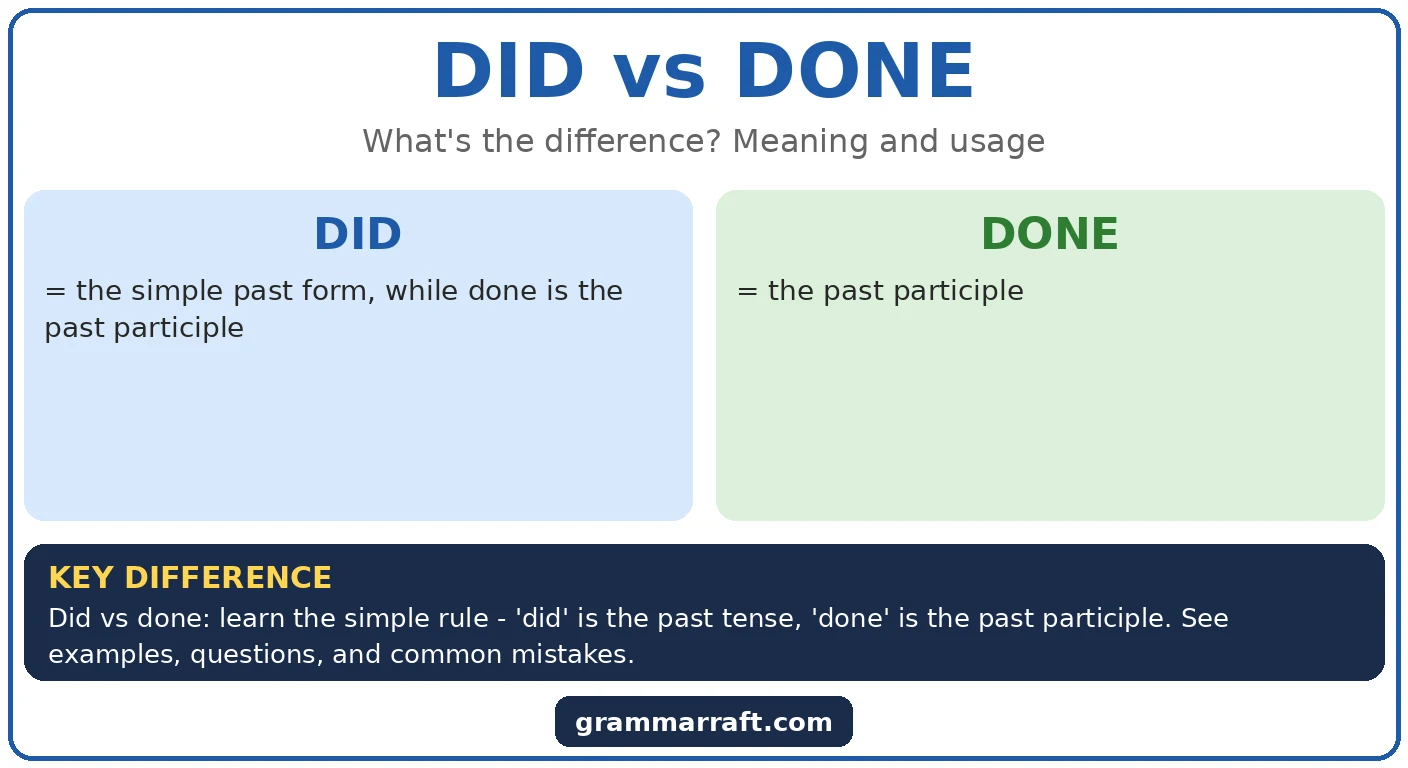
“Did vs done” is a common English grammar question because both words come from the verb “do,” but they do different jobs in a sentence. The key distinction is simple: did is the simple past form, while done is the past participle.
You say “I did my homework yesterday,” but “I have done my homework already.” The first sentence uses a finished past action without another auxiliary verb; the second uses “have” to form the present perfect.
Once you can identify the auxiliary verb and the tense, the choice becomes much easier. The examples below explain the difference, show common mistakes, and give you practical ways to decide whether “did” or “done” belongs in a sentence.
Did vs Done: The Basic Difference
“Did” and “done” are two forms of the irregular verb “do.” “Do” can work as a main verb, as in “I do my work,” or as an auxiliary verb that helps form questions, negatives, and emphasis.
Did is the simple past form of “do.” It can stand alone as the main verb in a past-tense statement, question, or short answer. For example, “She did the dishes,” “Did they call?” and “Yes, they did” are all correct.
Done is the past participle of “do.” It normally needs an auxiliary verb such as “have,” “has,” “had,” or sometimes “be.” You can say “He has done the work,” but standard English does not normally say “He done the work” when “done” is being used as the only past-tense verb.
| Word | Grammatical form | Typical use | Example |
|---|---|---|---|
| do | Base form | Present tense, infinitives, and commands | “I do my work.” |
| does | Present third-person singular | He, she, or it in the present | “She does her homework.” |
| did | Simple past | Finished actions in the past | “They did the task yesterday.” |
| done | Past participle | Perfect tenses and passive structures | “They have done the task.” |
A quick test helps: if there is no auxiliary verb before the word, “did” is usually the correct past form. If “have,” “has,” or “had” appears before it, “done” is usually required.
- Simple past: “I did the assignment.”
- Present perfect: “I have done the assignment.”
- Past perfect: “I had done the assignment before dinner.”
- Passive structure: “The assignment was done before dinner.”
How “Did” Works in the Simple Past
“Did” describes an action that happened or was completed at a definite time in the past. The time may be stated directly, as in “She did the work yesterday,” or understood from the surrounding conversation.
In an affirmative sentence, “did” can be the main verb. The structure is usually subject + did + object: “Marco did the shopping,” “We did the exercise,” or “The students did their homework.”
The object can be a physical task, an activity, a duty, or something more abstract. English speakers use “do” for actions such as “do the laundry,” “do business,” “do research,” “do someone a favor,” and “do well on a test.”
Affirmative sentences with did
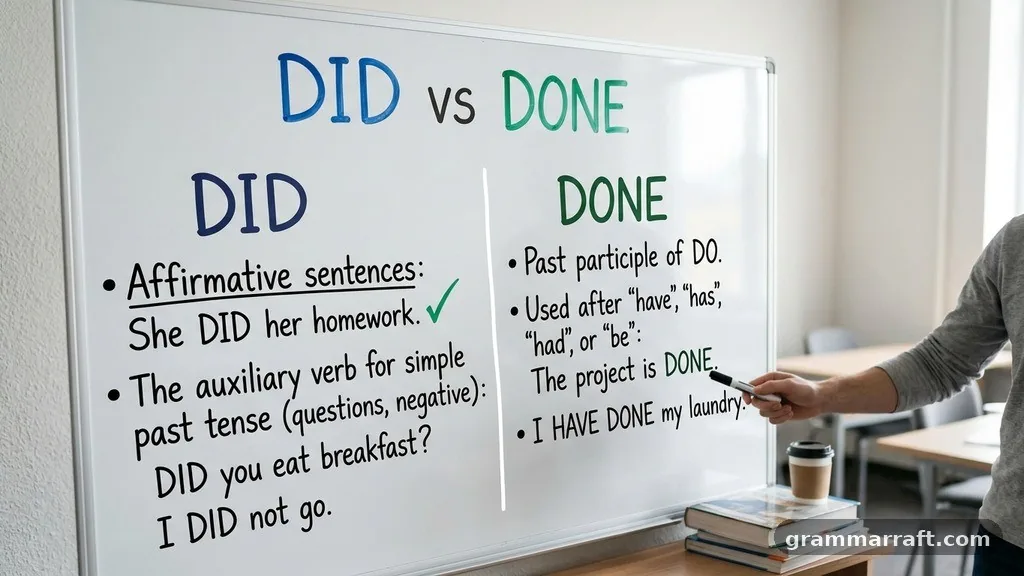
Here are several examples of “did” as the main verb:
- “I did my homework after dinner.”
- “She did a careful job on the report.”
- “They did the cleaning before the guests arrived.”
- “We did everything we could.”
- “He did well in the interview.”
“Did” can also add emphasis. In “I did call you,” the speaker is strongly insisting that the call happened. This emphatic use is different from the ordinary past-tense use, but the form remains the same.
The word “did” can also appear as an auxiliary verb in a past question or negative statement. In that role, the main verb returns to its base form: “Did you see the message?” and “I did not see the message.”
Did in questions and negatives
For most past-tense questions, put “did” before the subject and use the base form of the main verb afterward. The correct sentence is “Did you finish the project?” rather than “Did you finished the project?”
The same rule applies to negatives. Say “She did not go,” not “She did not went,” and “They didn’t understand,” not “They didn’t understood.” The past tense is already carried by “did,” so the following verb does not take another past-tense form.
| Sentence type | Correct pattern | Example |
|---|---|---|
| Statement | Subject + did + object | “He did the work.” |
| Question | Did + subject + base verb? | “Did he do the work?” |
| Negative | Subject + did not + base verb | “He did not do the work.” |
| Emphasis | Subject + did + base verb | “He did do the work.” |
How “Done” Works as a Past Participle
“Done” cannot normally express the simple past by itself in standard English. It is a past participle, so it usually works with an auxiliary verb to create a perfect tense or a passive construction.
The present perfect uses “has” or “have” plus the past participle. “I have done the work” means the action happened before now and has relevance to the present. “She has done her homework” may suggest that the homework is now complete or ready to be checked.
The past perfect uses “had” plus “done.” In “They had done the shopping before the storm began,” the shopping happened first, and the storm began afterward.
Perfect tenses with done
Perfect grammar is about the relationship between an earlier action and another point in time. The auxiliary identifies the tense, while “done” supplies the past participle.
- Present perfect: “I have done enough for today.”
- Present perfect with he or she: “She has done the right thing.”
- Past perfect: “We had done the preparation before the meeting.”
- Future perfect: “By Friday, they will have done the repairs.”
- Modal perfect: “You should have done it earlier.”
“Done” also appears after modal verbs when the modal is followed by “have.” For example, “could have done,” “might have done,” and “should have done” are all correct patterns.
A common error is “I have did.” This is incorrect in standard English because “have” requires the past participle, and the past participle of “do” is “done.” The correct sentence is “I have done my work.”
Done in passive sentences
“Done” can also be used in a passive construction with “be.” The sentence “The work was done by noon” focuses on the completed work rather than the person who completed it.
Other examples include “The dishes were done before the visitors arrived” and “The job will be done tomorrow.” In these sentences, “done” follows a form of “be,” not “have.”
English speakers also use “done” as an adjective in phrases such as “The work is done” or “The food is done.” Here, the word describes a completed condition, although the exact grammatical analysis can depend on the sentence and context.
Did vs Done in Questions
Questions create much of the confusion because “did” can appear with “do,” while “done” generally cannot appear after “did.” The correct choice depends on whether the question uses simple past or a perfect tense.
Use “did” for a simple past question: “Did you do your homework?” The first “did” is the auxiliary, and “do” is the base-form main verb.
Use “done” when the question contains “have,” “has,” or “had.” For example, “Have you done your homework?” asks whether the work has been completed by now, while “Did you do your homework?” asks about the past action more directly.
| Question | Meaning or focus | Answer pattern |
|---|---|---|
| “Did you do it?” | Asks about a past action | “Yes, I did.” |
| “Have you done it?” | Asks whether it is complete now | “Yes, I have.” |
| “Had you done it before lunch?” | Asks about completion before a past time | “Yes, I had.” |
| “Who did it?” | Asks who performed the action | “Maria did.” |
| “Who has done it?” | Asks who has completed the action | “Maria has.” |
Did you do or did you done?
The correct phrase is “Did you do?” because “did” already marks the past tense. The verb after a past-tense auxiliary must be in its base form.
For example, say “Did you do the dishes?” and “Did he do the assignment?” Do not say “Did you done the dishes?” or “Did he done the assignment?” in standard written English.
The same principle applies to other verbs. Say “Did you see it?” rather than “Did you saw it,” and “Did she take the bus?” rather than “Did she took the bus.” This is a general rule for the simple past, not a special exception limited to “do.”
Have you done or did you do?
Both “Have you done it?” and “Did you do it?” can be correct, but they do not always communicate exactly the same idea. “Have you done it?” usually connects the action with the present, especially its current result or completion status.
“Did you do it?” presents the action as a past event and often appears with a finished time such as “yesterday,” “last night,” or “after class.” In American English, simple past is widely used in situations where British English may prefer the present perfect, so regional usage can affect the choice.
Did vs Done in Everyday Sentences
Real conversations often use short forms and implied information. A speaker may ask, “Who did this?” and receive the answer, “I did.” In that reply, “did” replaces a longer phrase such as “I did this” or “I did the task.”
“Done” can also appear in short answers, but it normally follows an auxiliary or functions as a description. “Have you finished?” can be answered with “Yes, I have,” while “Is the report complete?” can be answered with “Yes, it’s done.”
Examples with homework and routine tasks
Consider the difference between these sentences:
- “I did my homework last night.” This reports a completed action at a finished past time.
- “I have done my homework.” This emphasizes the present result: the homework is complete now.
- “I had done my homework before the lesson began.” This places the completion before another past action.
- “My homework was done before breakfast.” This uses the passive voice and does not identify who completed it.
The time expression can help you choose. “Yesterday,” “last week,” and “in 2022” usually fit the simple past, while “already,” “yet,” and “so far” often fit the present perfect, although context still matters.
For example, “She did the shopping yesterday” is natural because “yesterday” is a finished time. “She has done the shopping already” is natural because “already” highlights a result that matters now.
Examples with work and personal actions
“Did” and “done” are not limited to schoolwork. You can say “He did a great job,” “We have done enough,” “They did business together,” or “She has done me a favor.”
Some expressions have fixed or strongly preferred forms. English speakers say “do your best,” “do the right thing,” “do harm,” and “do someone a favor,” while other expressions use “make,” such as “make a decision” and “make a mistake.”
Here are more natural examples:
- “Did you do anything interesting at the weekend?”
- “I’ve done all the preparation.”
- “She did what she promised.”
- “They should have done more research.”
- “The repairs are done.”
Common Mistakes with Did and Done
Most errors come from treating “did” and “done” as interchangeable past-tense words. They are related, but their grammatical roles are different.
Mistake 1: Using done as a simple past verb
“I done my work yesterday” is common in some dialects and informal speech, but it is not the standard form expected in formal writing or most educational settings. Use “I did my work yesterday” for the simple past.
The phrase “I done told you” may occur in regional varieties of English, including some varieties influenced by Southern American speech or African American English. That usage has its own linguistic patterns, but learners writing standard academic or professional English should use “I told you” or “I have told you,” depending on the meaning.
Mistake 2: Using did after have
“I have did the work” is incorrect in standard English. The auxiliary “have” must be followed by the past participle, so the correct sentence is “I have done the work.”
This error occurs with other irregular verbs too. English learners may write “I have went” instead of “I have gone” or “I have saw” instead of “I have seen.” Memorizing the three principal forms of irregular verbs helps prevent the pattern.
Mistake 3: Using done after did
“Did” already marks the past, so the following verb should be in the base form. Write “Did you do the work?” rather than “Did you done the work?”
The same rule applies in negative sentences: “She didn’t do it” is correct, while “She didn’t done it” is not standard grammar. The contraction “didn’t” still functions as the past-tense auxiliary.
Mistake 4: Confusing done with finished
“Done” and “finished” can have similar meanings, but they are not always interchangeable in grammar. “The job is done” and “The job is finished” are both natural, while “I have done the job” and “I have finished the job” use different verbs with their own forms.
When “done” means completed, it often describes a task or result. When “done” means cooked, as in “The chicken is done,” it refers to preparation rather than simply the completion of an activity.
Regional and Informal Use of Done
Standard written English distinguishes clearly between “did” and “done,” but spoken English varies across regions and communities. Some speakers use “done” in places where formal grammar traditionally expects “did,” especially in expressions such as “I done told you.”
That does not mean the speakers are careless or that the variety has no rules. Dialects can develop their own tense and aspect systems, and a form that is nonstandard in a classroom may be normal within a particular speech community.
Context matters. In a personal conversation, reproducing someone’s dialect may be appropriate; in a job application, school assignment, examination, or formal report, standard forms are generally safer.
Why “done” may sound natural in speech
“Done” can carry a strong sense of completed action. Phrases such as “I’m done,” “It’s done,” and “We’re done here” are extremely common in everyday English.
In “I’m done,” the word often functions as an adjective or subject complement meaning finished. In “It’s done,” “done” can describe a completed task, a cooked food item, or the end of an activity.
The phrase “I’ve done it” is also reduced in speech to “I done it” in some dialects. Learners should listen for the difference between an informal or regional form and the standard form expected in edited writing.
Choosing the right form for formal writing
Formal writing benefits from clear tense choices. Use “did” with a finished past time, “have done” for a past action connected with the present, and “had done” when one past action occurred before another.
If you are unsure, identify the time relationship first. Ask whether the action happened at a finished time, whether its result matters now, or whether it happened before another past event.
The [British Council’s reference material on the past simple](https://learnenglish.britishcouncil.org/grammar/english-grammar-reference/past-simple) provides additional practice with simple past forms and auxiliary verbs.
A Practical Method for Choosing Did or Done
You do not need to memorize every possible sentence separately. A short decision process can solve most “did vs done” questions.
Step 1: Find the auxiliary verb
Look for words such as “have,” “has,” “had,” “was,” “were,” “is,” “are,” or a modal verb. If “have,” “has,” or “had” comes before the verb, choose “done”: “She has done it,” “They had done it,” or “You should have done it.”
If “did” is the auxiliary, use “do” afterward: “Did she do it?” The words “did do” may look repetitive, but they are perfectly grammatical because the first word marks tense and the second carries the main meaning.
Step 2: Identify the time
A finished past time usually calls for “did.” Common signals include “yesterday,” “last night,” “in 2020,” “two hours ago,” and “when I was a child.”
A connection with the present often calls for “has done” or “have done.” Signals include “already,” “just,” “yet,” “ever,” “never,” and “so far,” although these words do not force one tense in every variety of English.
Step 3: Check the verb after did
When “did” is an auxiliary, the next verb must be the base form. Check for sentences such as “Did you do it?” “Did she see the note?” and “Did they go home?”
Do not add a second past-tense marker. “Did you went?” and “Did he saw?” have two competing past forms, so they are incorrect in standard English.
Step 4: Read the complete sentence aloud
Reading aloud can reveal awkward combinations quickly. Compare “I have did the work” with “I have done the work,” then compare “Did you done it?” with “Did you do it?”
For extra practice, write pairs that express the same action from different time perspectives. For example, “I did the report yesterday” and “I have done the report” differ mainly in how they connect the action to the present.
Did vs Done Practice and Exercises
Practice is most useful when each answer requires a reason, not just a guess. Before checking an answer, identify whether the sentence is simple past, present perfect, past perfect, or passive.
Choose did or done
- “I ___ my homework last night.”
- “She has ___ the shopping.”
- “___ you ___ the assignment?”
- “They had ___ the work before noon.”
- “The repairs were ___ by Friday.”
- “He ___ what he promised.”
- “We should have ___ more preparation.”
- “Have you ___ your best?”
The answers are “did,” “done,” “Did” and “do,” “done,” “done,” “did,” “done,” and “done.” The important pattern is that “did” appears as a simple past verb or auxiliary, while “done” follows a perfect or passive auxiliary.
Correct the mistakes
- Incorrect: “I have did the work.” Correct: “I have done the work.”
- Incorrect: “Did you done your homework?” Correct: “Did you do your homework?”
- Incorrect: “She didn’t did the task.” Correct: “She didn’t do the task.”
- Incorrect: “They done it yesterday.” Correct: “They did it yesterday.”
- Incorrect: “He has did well.” Correct: “He has done well.”
Notice that the correction is not always just a matter of replacing one word. In “Did you done your homework?” the correct answer requires changing “done” to the base form “do,” because “did” is already functioning as the auxiliary.
For a useful self-check, underline every auxiliary verb in your sentence. Then ask what form should follow it: a base verb after “did,” a past participle after “have,” “has,” or “had,” and a past participle after a form of “be” in a passive construction.
When Did and Done Are Not Interchangeable
Some sentences may look similar but answer different questions. “Did you do the job?” asks about the action, while “Have you done the job?” often asks whether the task is complete by now.
Compare “I did the dishes after dinner” with “I have done the dishes.” The first includes a finished past time; the second may be a response to someone asking whether the kitchen has been cleaned.
“I had done the dishes before they arrived” adds a third time point. The dishwashing happened before the guests arrived, so the past perfect makes the order clear.
| Sentence | Tense or structure | Main idea |
|---|---|---|
| “I did the work.” | Simple past | The action happened in the past. |
| “I have done the work.” | Present perfect | The action is relevant or complete now. |
| “I had done the work.” | Past perfect | The action happened before another past point. |
| “The work was done.” | Passive or result description | The work was completed, without focusing on who did it. |
English varieties can differ in how often they use the present perfect. American English commonly uses “Did you eat yet?” where British English may prefer “Have you eaten yet?” Both are understood, but learners should follow the style expected in their school, workplace, or audience.
Related guides: Whichever vs Whatever: Meaning, Grammar and Usage · Parents vs Parents Apostrophe: Meaning and Usage · Could vs Would: Meaning, Differences, and Examples?
FAQ: Did vs Done
What is the difference between did and done?
“Did” is the simple past form of “do,” while “done” is the past participle. Use “did” in a sentence such as “I did the work yesterday,” and use “done” after an auxiliary in “I have done the work.”
Do you say “I did” or “I done”?
In standard English, say “I did” when you mean that you performed or completed an action in the simple past. “I done” appears in some regional and informal dialects, but “I did” is the appropriate form for formal writing and standard grammar.
Which is correct: “should have done” or “should have did”?
“Should have done” is correct because “have” must be followed by a past participle. The modal structure is modal + have + past participle, as in “could have done,” “might have done,” and “should have done.”
Which is correct: “I have did” or “I have done”?
“I have done” is correct. “Have” requires the past participle “done,” not the simple past form “did.” For example, write “I have done my homework,” not “I have did my homework.”
Is “Did you do it?” different from “Have you done it?”
Usually, yes. “Did you do it?” asks about a past action, while “Have you done it?” generally asks whether the action has been completed by the present time. The exact difference can depend on context and regional English preferences.
Conclusion
The central rule for did vs done is straightforward: use did for the simple past, and use done as a past participle after “have,” “has,” “had,” or a form of “be.” Remember that questions and negatives with “did” take the base verb: “Did you do it?” and “She didn’t do it.”
When choosing between them, check the auxiliary and the time relationship before you write. A few contrast pairs—“I did it yesterday,” “I have done it,” and “I had done it before lunch”—will make the pattern familiar quickly, so use them in your next grammar exercise or piece of writing.
Explore more helpful guides on GrammarRaft.