Percent vs Per Cent: Meaning, Origin and Usage
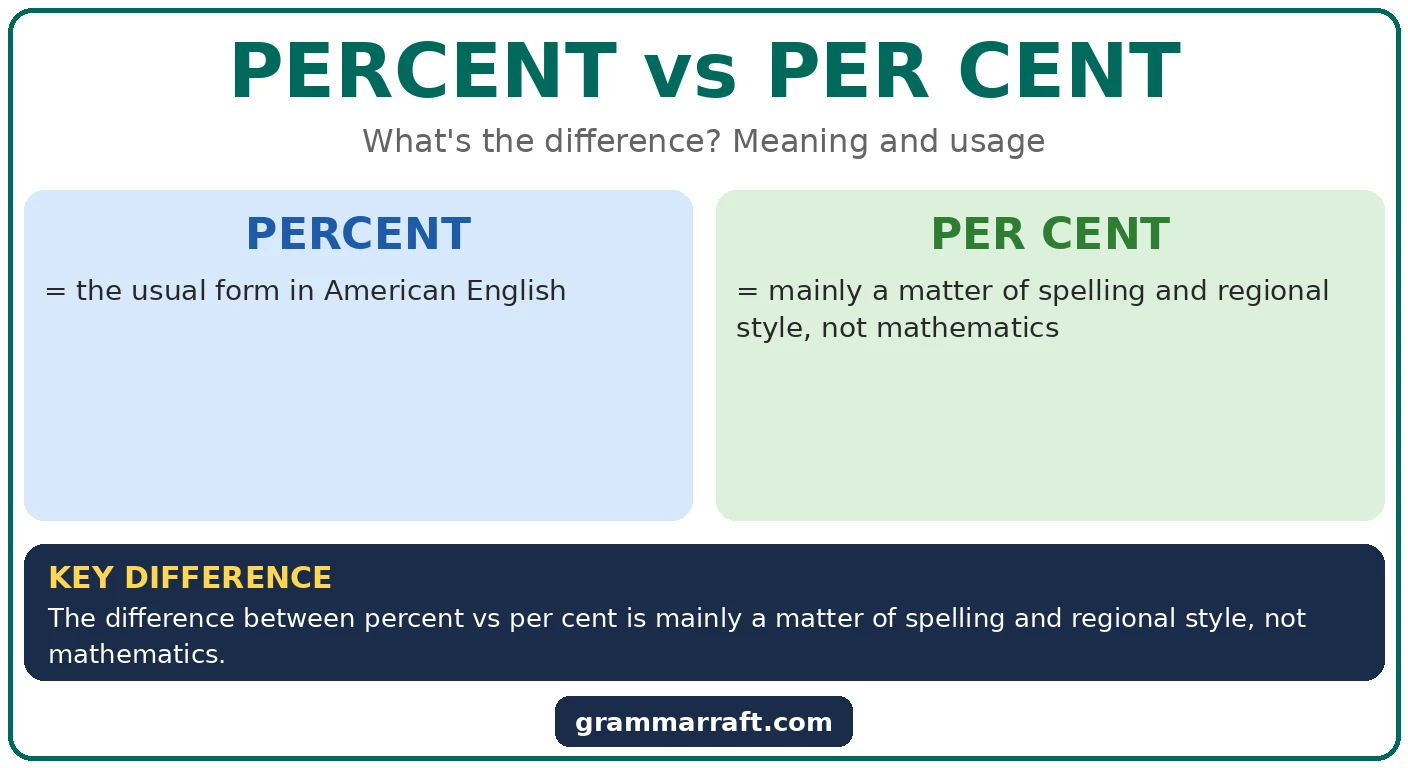
The difference between percent vs per cent is mainly a matter of spelling and regional style, not mathematics. Both forms mean “out of one hundred,” and both describe a proportion such as 25 percent or 25 per cent.
American English generally prefers percent as one word, while British, Irish, Australian, and some other varieties of English traditionally use per cent as two words. Usage is not completely uniform, though, so the publication, country, or style guide you are following can matter.
This article explains the origin of both forms, shows how to use the percent sign correctly, separates percent from percentage and percentage points, and answers common questions about spelling, grammar, and examples. By the end, choosing the right form should be straightforward.
Percent and per cent mean the same thing
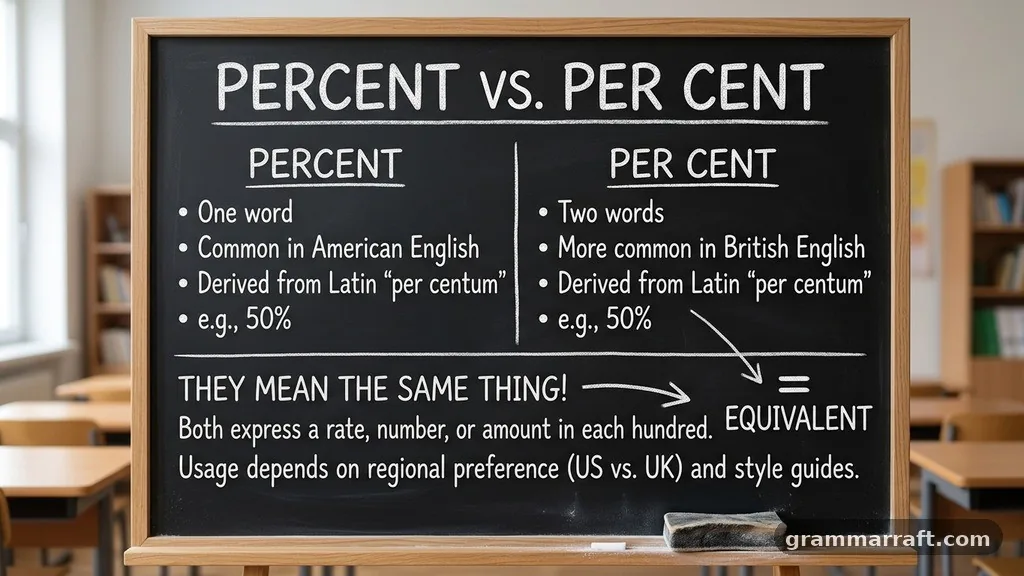
Percent and per cent have the same meaning: a specified number for every hundred. Therefore, 8 percent and 8 per cent represent the same value, which is 8 out of 100, or 0.08 as a decimal.
The difference is primarily orthographic. “Percent” is a closed compound written as one word, whereas “per cent” retains the original two-word form. Neither spelling changes the calculation, the fraction, or the size of the quantity being described.
For example, a statement that “40 percent of the class passed” communicates the same information as “40 per cent of the class passed.” In both sentences, the intended fraction is 40/100, and the remaining 60 percent or 60 per cent did not pass.
English-language conventions usually divide along regional lines:
- Percent is the usual form in American English.
- Per cent remains common in British, Irish, Australian, and New Zealand English.
- Canadian usage varies by publication, institution, and editorial style.
- The symbol % is widely understood across English-speaking regions.
- A writer should normally choose one word form and use it consistently.
These are useful tendencies rather than absolute laws. A British newspaper may use “percent” in a particular section, and an American publication may retain “per cent” in a quotation or in material prepared for an international audience.
If you’re checking a dictionary, the [Merriam-Webster entry for percent](https://www.merriam-webster.com/dictionary/percent) confirms the standard one-word form used in American English. A national dictionary or the style guide of your employer may give a different preferred spelling for your audience.
Why are there two spellings?
The expression comes from the Latin phrase per centum, meaning “by the hundred” or “for every hundred.” English writers first used versions of this phrase in financial and commercial contexts, where calculating interest, taxes, and rates required a compact way to describe parts of a hundred.
Over time, per cent developed as a shortened English form of per centum. In American English, the phrase gradually became more commonly written as the single word percent. The two spellings therefore share an origin rather than representing two different concepts.
The percent symbol also has a long historical connection with written shorthand. The mark % developed from abbreviated forms of “per cento” or related expressions used by scribes and merchants. Its exact visual development was gradual, but its function has remained stable: it signals a rate or proportion based on 100.
The Latin source explains why the phrase should not be interpreted as “per one cent.” Here, “cent” relates to the Latin idea of one hundred, as it also does in words such as century and centennial. A percent is therefore a hundred-based measure.
Modern English has shortened many expressions that began as phrases. “Already” developed from “all ready,” and “perhaps” came from “per haps,” although these examples followed their own histories. In the case of percent, regional publishing habits allowed both the closed and open forms to survive.
Knowing the origin is useful because it explains why both forms are legitimate. It also prevents a common misunderstanding: the spelling difference does not indicate a difference in precision, formality, or mathematical value.
Percent vs per cent by region and style
American English normally uses percent in ordinary prose. American readers will see forms such as “a 12 percent increase,” “percent change,” and “the percentage of voters who participated.” The one-word spelling is also common in American business, academic, government, and technical writing.
British English traditionally prefers per cent, especially in formal prose. A British publication might write, “The rate rose by 3 per cent,” while an American publication would usually write, “The rate rose by 3 percent.” Both sentences are grammatically sound.
Australian and New Zealand English often follow the two-word convention, although individual publishers may choose otherwise. Irish English also frequently uses “per cent.” These patterns can change as international media, software interfaces, and cross-border business make one-word usage more visible.
| Context | Common written form | Example |
|---|---|---|
| American English prose | percent | Sales rose by 15 percent. |
| British English prose | per cent | Sales rose by 15 per cent. |
| Australian English prose | often per cent | The survey recorded 15 per cent. |
| Charts and tables | % is common | Sales rose by 15%. |
| Quoted material | preserve the source form | The report says “15 per cent.” |
Style guides may also differ within the same country. A university, government department, newspaper, or scientific journal may specify whether writers should spell out percent, use the symbol, or follow a particular spacing rule.
The safest practical rule is simple: identify your audience, check the relevant house style, and remain consistent. If no style guide applies, use “percent” for American readers and “per cent” for readers accustomed to British or Commonwealth conventions.
How to use percent or per cent in a sentence
Both forms usually follow a number directly: “30 percent,” “30 per cent,” or “30%.” In prose, the word form is often easier to read, especially when the sentence contains several figures or when the subject is general rather than statistical.
Examples include “The battery was 75 percent charged,” “Only 6 per cent of respondents disagreed,” and “The company reduced its emissions by 20%.” The numerical meaning stays the same in each example, although the presentation changes.
Percent can function after a number as part of a measurement expression. It can also appear before a noun in a compound modifier, as in “a 10 percent discount” or “a 10 per cent discount.” In that position, the number and the percent expression work together to describe the noun.
Common sentence patterns include:
- Part of a group: “Twenty percent of employees work remotely.”
- Change: “The price increased by 7 percent.”
- Rate: “The account earns 3 percent interest.”
- Proportion: “The mixture contains 2 per cent salt.”
- Compound adjective: “Customers received a 15 percent refund.”
When a number begins a sentence, many formal styles recommend spelling it out, including the percentage expression: “Thirty percent of the sample responded.” In technical documents, charts, tables, and data-heavy writing, numerals are often preferred for quick comparison.
Do not add an apostrophe to the plural form. “Percentages” is the plural of “percentage,” while “percents” is sometimes used for multiple rates but is less common in polished prose. The phrase “ten percents” will usually look incorrect to readers.
Prepositions also affect the meaning. “A rise of 5 percent” describes the amount of the rise, while “a rise to 5 percent” identifies the final level. Confusing of and to can produce a numerical error even when the spelling is perfect.
Percent, percentage, and percentage points
Percent describes a value measured out of 100. Percentage is a noun that refers to the proportion itself or to an amount expressed in percent. A writer might say, “The percentage of households with access increased,” but “The percentage increased by 5 percent” needs careful interpretation.
For example, suppose a survey result rises from 40 percent to 45 percent. The result has increased by 5 percentage points, because 45 minus 40 equals 5. Relative to the original 40 percent, however, the increase is 12.5 percent: 5 divided by 40, multiplied by 100.
This distinction matters in news reports, research findings, elections, financial analysis, and business metrics. Saying that support rose by 5 percent could mean an increase from 40 percent to 42 percent, because 5 percent of 40 is 2 percentage points. Saying it rose by 5 percentage points clearly identifies a move from 40 to 45 percent.
| Starting value | Ending value | Change in percentage points | Relative percent change |
|---|---|---|---|
| 40% | 45% | 5 points | 12.5% |
| 50% | 55% | 5 points | 10% |
| 80% | 85% | 5 points | 6.25% |
The phrase “percent percentage” is usually unnecessary because percent and percentage overlap in meaning but serve different grammatical roles. Use “percent” after a number, as in “25 percent,” and use “percentage” as a noun, as in “a high percentage of students.”
There is one further complication: “percentage” does not always require a number. “A small percentage of the budget” is complete because the phrase describes an unspecified share. “A small percent of the budget” appears in some usage, but “percentage” is generally the more natural noun in that construction.
When to use the percent sign
The symbol % is a compact alternative to percent or per cent. It is especially useful in tables, charts, dashboards, labels, formulas, financial documents, and other places where readers compare multiple values quickly.
In ordinary sentences, many style guides prefer the word form, particularly when the number is written out: “The rate was five percent.” A report may use “5%” in a table and “five percent” in its explanatory prose without creating a contradiction.
Spacing conventions vary. In standard English typography, the symbol is commonly written directly after the number: 25%. Some international scientific and publishing systems place a space between the number and symbol, as in “25 %,” following conventions used in parts of Europe and by certain technical organizations.
The important point is consistency. Do not write “25 %” in one paragraph and “25%” in the next unless a specific layout or style rule requires the change. Check the document’s established convention before editing individual instances.
The percent sign should not be used as a substitute for the word in every context. A sentence such as “The result was % higher” is incomplete; it needs a number. Likewise, a headline, caption, or interface may favor the symbol because space is limited, while a legal explanation may spell out the term for clarity.
Readers should also distinguish the percent sign from related symbols. The symbol for per mille, or parts per thousand, is ‰, while basis points are often written as bp or bps. These measures are not interchangeable: 1 percent equals 10 basis points and 10 per mille.
Calculating percentages correctly
Understanding the wording is only half the task; the calculation must match the question. To find what percentage one number is of another, divide the part by the whole and multiply by 100. For example, 18 out of 60 is 18 ÷ 60 × 100, which equals 30 percent.
To find a percentage of a number, convert the percent to a decimal and multiply. Ten percent of 250 is 0.10 × 250, or 25. The word form and the symbol describe the same operation: 10 percent of 250 and 10% of 250 both equal 25.
Percentage increase uses a different denominator. Subtract the original value from the new value, divide by the original value, and multiply by 100. If a price rises from 80 to 100, the increase is 20; 20 divided by 80 equals 0.25, so the increase is 25 percent.
Percentage decrease follows the same structure. A reduction from 100 to 80 is a decrease of 20 percent because the difference, 20, is divided by the original value of 100. If the starting value were 80 and the ending value 60, the decrease would be 25 percent, not 20 percent.
- Part as a percentage of whole: part ÷ whole × 100.
- Percentage of a number: decimal form of the rate × number.
- Percentage increase: increase ÷ original value × 100.
- Percentage decrease: decrease ÷ original value × 100.
- Percentage-point change: ending percentage − starting percentage.
These formulas explain why “percent change” and “percentage-point change” cannot always be substituted for one another. A move from 20 percent to 30 percent is a 10-point increase but a 50 percent relative increase.
Rounding can create another source of confusion. If a calculation produces 33.333 percent, a report may display 33.3 percent or 33 percent, depending on the required precision. The rounded result should be labeled or presented consistently so readers do not mistake it for an exact value.
Common mistakes with percent and per cent
One frequent mistake is treating the two spellings as if they represent different levels of formality or accuracy. They do not. The choice between percent and per cent signals regional or editorial preference, while the number determines the mathematical value.
Another error is writing “percent of” when “percentage points” is needed. If an approval rating moves from 55 percent to 60 percent, the clearest statement is that it increased by 5 percentage points. Calling that a 5 percent increase gives a different calculation.
Writers also sometimes confuse percent with percentage. “The percentage is 25 percent” is natural because percentage is the noun and percent supplies the measured value. “The percent is 25 percentage” reverses their roles and sounds incorrect.
Watch for these additional problems:
- Using both “percent” and “per cent” randomly in one document.
- Writing “percentages” when a specific percentage value is required.
- Confusing a percentage increase with an increase in percentage points.
- Using a symbol without its number, such as “% of the sample.”
- Changing the denominator halfway through a comparison.
- Adding unnecessary punctuation, such as an apostrophe in “20%’s.”
Possessive constructions deserve special care. Instead of writing “the 20 percent’s effect,” rewrite the sentence as “the effect of the 20 percent increase” or “the effect of a 20 percent increase.” This is clearer and avoids treating the measurement as a person or object that owns something.
Consistency also applies to numbers. A document might choose “twenty percent” in running prose and “20%” in tables, but it should explain that convention through its design and apply it systematically. Readers should never have to guess whether different forms indicate different measurements.
Finally, preserve the original form in a direct quotation unless there is a compelling editorial reason to alter it. Outside the quotation, follow your own publication’s style. That approach respects the source while keeping the surrounding text coherent.
Choosing the right form for your writing
Start with the audience rather than with a universal rule. If you’re writing for a United States newspaper, school, company, or website, “percent” will usually be the expected choice. For a British or Australian audience, “per cent” may be more familiar and may match the organization’s established style.
Next, check any applicable style guide. A company handbook may specify the spelling, while an academic journal may set rules for numerals, symbols, and spaces. If the document will be edited by others, following the house style is more important than imposing a personal preference.
If no instructions exist, make a deliberate choice and apply it throughout. A short document needs only a quick search for inconsistent forms. In a long report, a find-and-replace check can help, but review each result manually because “percent” may occur in quotations, titles, names, or technical terms that should not be changed.
Use words when the prose benefits from a conversational flow. Use the symbol when readers need to scan data rapidly, compare rows in a table, read a chart label, or fit a measurement into a restricted space.
A practical editing checklist includes:
- Identify the intended regional variety of English.
- Confirm whether the preferred form is percent or per cent.
- Choose a consistent policy for the % symbol.
- Check spaces between numbers and symbols against the style guide.
- Separate percentage points from relative percent change.
- Verify every denominator in a calculation.
- Preserve direct quotations unless the publication says otherwise.
There is no need to “correct” a valid regional spelling simply because another form is more familiar to you. Editing should serve the intended readers. A consistent, accurate document is better than one that switches forms in pursuit of a supposedly universal standard.
FAQ about percent vs per cent
Is per cent the same as percent?
Yes. Both forms mean “out of one hundred,” and both represent the same mathematical value. The difference is spelling: “percent” is written as one word, while “per cent” is written as two words.
Should I use percent or per cent?
Use the form that matches your audience and style guide. American English generally uses “percent,” while British and several Commonwealth varieties commonly use “per cent.” If no rule applies, choose one and use it consistently.
Is the percent sign a word or a symbol?
The percent sign, %, is a symbol representing percent or per cent. It is especially common in tables, charts, formulas, and data displays, while the spelled-out form often reads more naturally in ordinary prose.
What is the difference between percent and percentage?
Percent usually follows a number, as in “30 percent.” Percentage is a noun referring to a proportion or share, as in “a high percentage of voters.” They are related but do not normally occupy the same grammatical position.
What is the difference between percent and percentage points?
Percent describes a relative rate of change, while percentage points describe the direct difference between two percentages. A change from 40 percent to 45 percent is an increase of 5 percentage points, but a relative increase of 12.5 percent.
Final takeaway on percent vs per cent
The choice between percent vs per cent rarely changes meaning. “Percent” is the dominant American spelling, “per cent” remains common in British and Commonwealth writing, and the symbol % is useful in compact data displays. The important habits are consistency, accurate calculations, and a clear distinction between percentages and percentage points.
Before publishing, check the audience’s regional convention and the relevant house style, then review every number for its correct denominator. Once those decisions are made, writing percent or per cent becomes a straightforward editorial choice rather than a source of uncertainty.
Related Articles
- Utmost vs Upmost: Meaning, Usage, and Examples
- Switch vs Swap: Meaning, Usage, and Key Differences
- Someday vs Some Day: Meaning, Usage, and Examples
Explore more helpful guides on GrammarRaft.